EduNinja
[Maximum number: 1]

The temperature of a sample of an inert gas is increased.
What effect does this have on the number of molecules with the most probable energy and on the number of molecules with high energy?

number of molecules with the most probable energy

number of molecules with high energy

decreases

decreases

decreases

increases

increases

decreases

increases

increases

[Maximum number: 1]

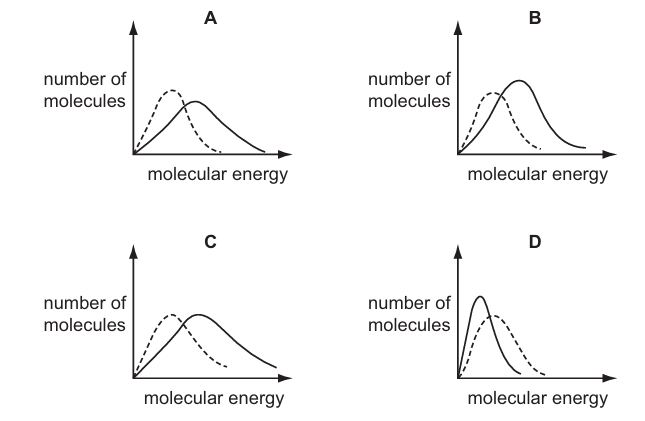
Which solid-line curve most accurately represents the distribution of molecular energies in a gas at 500 K if the dotted-line curve represents the corresponding distribution for the same gas at 300 K ?

Question image
[Maximum number: 1]

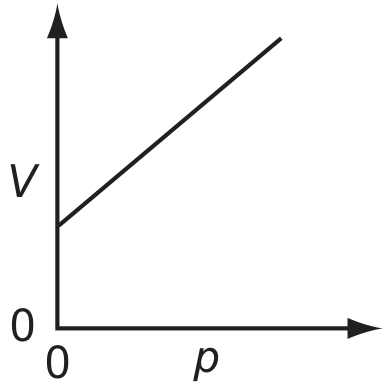
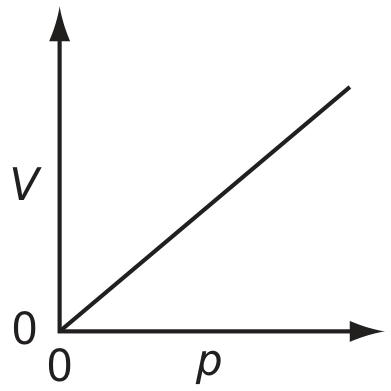
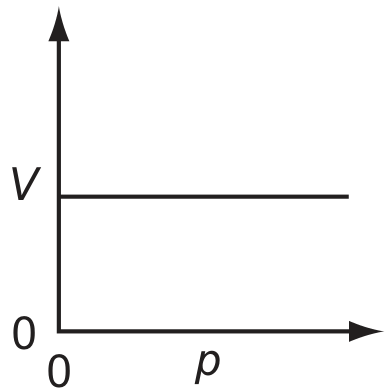
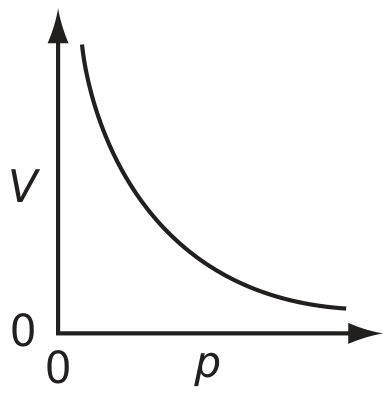
Which diagram shows the correct graph of V against p for a fixed mass of an ideal gas at constant temperature?

A
Question image
B
Question image
C
Question image
D
Question image
[Maximum number: 3]

The Pauling electronegativity values of elements can be used to predict the chemical properties of compounds.

Use the information in Table 1.1 to answer the following questions.

Table 1.1

Table 1.1

(a)
(i)

At 150C150^{\circ} \mathrm{C} and 103 kPa , all of the compounds listed in Table 1.2 are gases.

Under these conditions, 0.284 g of one of the compounds occupies a volume of 127 cm3127 \mathrm{~cm}^{3}.
Use this information to calculate the MrM_{\mathrm{r}} of the compound. Hence, identify the compound from those given in Table 1.2.

Show your working.
Mr=M_{\mathrm{r}}= identity of compound =

[ 3 ]
[Maximum number: 2]

Hydrogen iodide, HI, is a colourless gas at room temperature.

(a)

HI(g) can also be formed by the reaction of I2( g)\mathrm{I}_{2}(\mathrm{~g}) with hydrazine, N2H4( g)\mathrm{N}_{2} \mathrm{H}_{4}(\mathrm{~g}).

2I2( g)+N2H4( g)4HI( g)+N2( g)2 \mathrm{I}_{2}(\mathrm{~g})+\mathrm{N}_{2} \mathrm{H}_{4}(\mathrm{~g}) \rightarrow 4 \mathrm{HI}(\mathrm{~g})+\mathrm{N}_{2}(\mathrm{~g})

State the change in pressure that would occur when 2 molI2( g)2 \mathrm{~mol} \mathrm{I}_{2}(\mathrm{~g}) fully reacts with 1 mol N2H4( g)1 \mathrm{~mol} \mathrm{~N}_{2} \mathrm{H}_{4}(\mathrm{~g}) in a sealed container at constant temperature. Explain your answer.

[ 2 ]
[Maximum number: 6]

The rate of chemical reactions is affected by changes in temperature and pressure.

(a)

The Boltzmann distribution assumes that the particles behave as an ideal gas.

[ 6 ]
(i)

State two assumptions of the kinetic theory as applied to an ideal gas.

1

2

[ 2 ]
(ii)

2.00 g of krypton gas, Kr(g), is placed in a sealed 5.00dm35.00 \mathrm{dm}^{3} container at 120C120^{\circ} \mathrm{C}.

Calculate the pressure, in Pa , of Kr(g) in the container. Assume Kr(g) behaves as an ideal gas.

Show your working.
pressure =

[ 2 ]
(iii)

State and explain the conditions at which krypton behaves most like an ideal gas.

[ 2 ]
[Maximum number: 3]

Combustion data can be used to calculate the empirical formula, molecular formula and relative molecular mass of many organic compounds.

(a)

T is an alcohol, CxHyO\mathrm{C}_{x} \mathrm{H}_{y} \mathrm{O}. A gaseous sample of T occupied a volume of 20 cm320 \mathrm{~cm}^{3} at 120C120^{\circ} \mathrm{C} and 100 kPa .

The sample was completely burned in 200 cm3200 \mathrm{~cm}^{3} of oxygen (an excess). The final volume, measured under the same conditions as the gaseous sample, was 250 cm3250 \mathrm{~cm}^{3}.

Under these conditions, all water present is vaporised. Removal of the water vapour from the gaseous mixture decreased the volume to 170 cm3170 \mathrm{~cm}^{3}.

Treating the remaining gaseous mixture with concentrated alkali, to absorb carbon dioxide, decreased the volume to 110 cm3110 \mathrm{~cm}^{3}.

The equation for the complete combustion of T can be represented as shown.

CxHyO+zO2xCO2+y2H2O\mathrm{C}_{x} \mathrm{H}_{y} \mathrm{O}+z \mathrm{O}_{2} \rightarrow x \mathrm{CO}_{2}+\frac{y}{2} \mathrm{H}_{2} \mathrm{O}
[ 3 ]
(i)

Use the general gas equation to calculate the mass of T present in the original 20 cm320 \mathrm{~cm}^{3} gaseous sample, which was measured at 120C120^{\circ} \mathrm{C} and 100 kPa .

Give your answer to three significant figures. Show your working.

[ 3 ]
[Maximum number: 2]

Aluminium is a metal in Period 3 and Group III of the Periodic Table.

(a)

Aluminium reacts with chlorine to form a white, solid chloride that contains 79.7 % chlorine and sublimes (changes straight from a solid to a gas) at 180C180^{\circ} \mathrm{C}.

[ 2 ]
(i)

Calculate the relative molecular mass, MrM_{\mathrm{r}}, of the chloride. Give your answer to three significant figures.

Mr=M_{r}=
[ 2 ]
[Maximum number: 2]

Aluminium is a metal in Period 3 and Group III of the Periodic Table.

(a)

Aluminium reacts with chlorine to form a white, solid chloride that contains 79.7 % chlorine and sublimes (changes straight from a solid to a gas) at 180C180^{\circ} \mathrm{C}.

[ 2 ]
(i)

Calculate the relative molecular mass, MrM_{\mathrm{r}}, of the chloride. Give your answer to three significant figures.

Mr=M_{r}=
[ 2 ]
[Maximum number: 13]

Compound A is an organic compound which contains carbon, hydrogen and oxygen.
When 0.240 g of the vapour of A is slowly passed over a large quantity of heated copper(II) oxide, CuO , the organic compound A is completely oxidised to carbon dioxide and water. Copper is the only other product of the reaction.

The products are collected and it is found that 0.352 g of CO2\mathrm{CO}_{2} and 0.144 g of H2O\mathrm{H}_{2} \mathrm{O} are formed.

(a)

When a 0.148 g sample of A was vapourised at 60C60^{\circ} \mathrm{C}, the vapour occupied a volume of 67.7 cm367.7 \mathrm{~cm}^{3} at a pressure of 101 kPa .

[ 3 ]
(i)

Use the general gas equation p V=n R T to calculate MrM_{\mathrm{r}} of A.

Mr=.M_{\mathrm{r}}=.
0