EduNinja
[Maximum number: 3]

The elements in Group 17 are known as the halogens.

(a)

A solution of aqueous bromide ions, Br(aq)\mathrm{Br}^{-}(\mathrm{aq}), is added to separate samples of Cl2(aq)\mathrm{Cl}_{2}(\mathrm{aq}) and I2(aq)\mathrm{I}_{2}(\mathrm{aq}).

Describe what is observed in each reaction. Explain your answer in terms of the relative reactivity of these elements as oxidising agents.
observation on addition to Cl2(aq)\mathrm{Cl}_{2}(\mathrm{aq})
observation on addition to I2(aq)\mathrm{I}_{2}(\mathrm{aq})
explanation

[ 3 ]
(a)

Tennessine, Ts, is an unstable man-made element. It is found below astatine, At, in Group 17. The chemical properties of Ts and its compounds have only been predicted.

[ 2 ]
(i)

Suggest an equation for the reaction of NaTs and Br2\mathrm{Br}_{2}. Assume that Ts follows the same trends as the other elements in Group 17. Explain your answer. equation explanation

[ 2 ]
[Maximum number: 3]

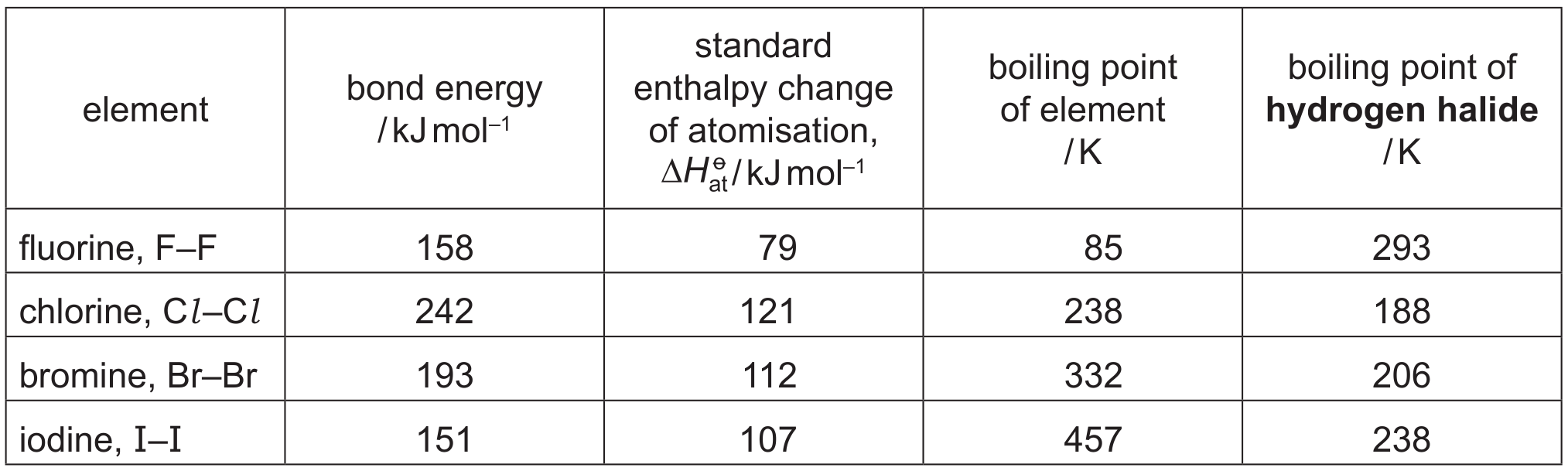
The elements in Group 17, the halogens, and their compounds, show many similarities and trends in their properties. Some data are given for the elements fluorine to iodine.

Table
(a)

In an experiment, two of the halogens are represented as P2\mathbf{P}_{2} and Q2\mathbf{Q}_{2}.
P2\mathbf{P}_{2} combines with hydrogen on heating to form HP, which can be easily broken down into its elements. A solution of HP in water reacts with aqueous silver ions to form a yellow precipitate that is insoluble in dilute aqueous ammonia.
Q2\mathbf{Q}_{2} combines explosively with hydrogen in sunlight to form HQ , which is stable to heat. A solution of HQ in water reacts with aqueous silver ions to form a white precipitate that is soluble in dilute aqueous ammonia.

[ 3 ]
(i)

HP readily decomposes into its elements when heated but HQ is stable to heat. Explain this with reference to bond energies.

[ 2 ]
(ii)

Write an equation for the thermal decomposition of HP.

[ 1 ]
[Maximum number: 3]

Each of the Group VII elements chlorine, bromine and iodine forms a hydride.

(a)
(i)

Outline how the relative thermal stabilities of these hydrides change from HCl to HI .

(ii)

Explain the variation you have outlined in (i).

Hydrogen iodide can be made by heating together hydrogen gas and iodine vapour. The reaction is incomplete.

H2( g)+I2( g)2HI( g)\mathrm{H}_{2}(\mathrm{~g})+\mathrm{I}_{2}(\mathrm{~g}) \rightleftharpoons 2 \mathrm{HI}(\mathrm{~g})
[ 3 ]
[Maximum number: 3]

Group 17 elements are commonly referred to as the halogens.

(a)
(i)

State the conditions required for chlorine to react with hydrogen at room temperature.

[ 1 ]
(ii)

On heating, iodine reacts with hydrogen in a reversible reaction.

Give the equation for this reaction. Include state symbols.

[ 2 ]
[Maximum number: 2]

Chlorine, Cl2\mathrm{Cl}_{2}, is a reactive yellow-green gas. It is a strong oxidising agent.

(a)

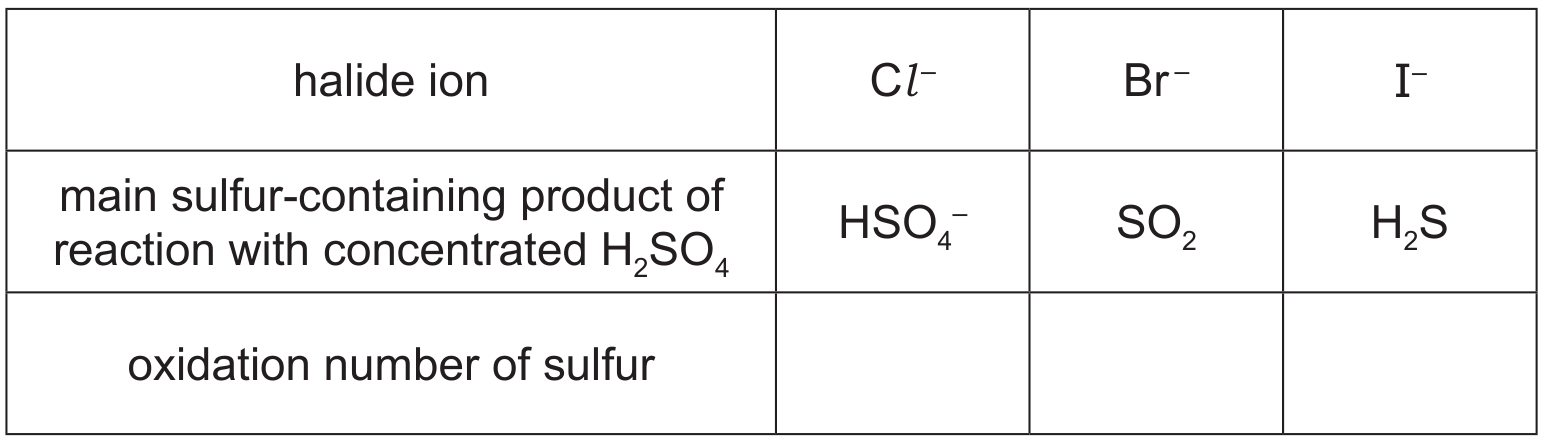
The halide ions, X\mathrm{X}^{-}(where X=C l, Br, I ), show clear trends in their physical and chemical properties.

[ 2 ]
(i)

State and explain the relative thermal stabilities of the hydrogen halides, HX .

The halide ions react easily with concentrated H2SO4\mathrm{H}_{2} \mathrm{SO}_{4}.
The main sulfur-containing product of each reaction is shown in the table.

Table
[ 2 ]
[Maximum number: 4]

Chlorine gas is manufactured by the electrolysis of brine using a diaphragm cell.

(a)

Chlorine is very reactive and will form compounds by direct combination with many elements.

Describe what you would see when chlorine is passed over separate heated samples of sodium and phosphorus.
In each case write an equation for the reaction.
sodium
phosphorus

[ 4 ]
(a)

Describe the trend in the reactivity of the halogens Cl2,Br2\mathrm{Cl}_{2}, \mathrm{Br}_{2} and I2\mathrm{I}_{2} as oxidising agents. Explain this trend using values of E(X2/X)E^{\ominus}\left(\mathrm{X}_{2} / \mathrm{X}^{-}\right)from the Data Booklet.

[ 2 ]
[Maximum number: 3]

Hydrogen halides are compounds formed when halogens (Group 17 elements) react with hydrogen. The bond polarity of the hydrogen halides decreases from HF to HI.

Some relevant data are shown in the table.

Table
(a)
(i)

Describe and explain the relative thermal stabilities of the hydrogen halides.

[ 3 ]
(a)
(i)

Use these results to describe and explain the trend in the thermal stabilities of the hydrides of Group VII.

[ 5 ]
0