EduNinja
[Maximum number: 1]

Propanoic acid is treated with reagent X at room temperature. The organic product of the reaction is sodium propanoate. No gas is produced during the reaction.

What could be reagent X ?

A

NaHCO3(aq)\mathrm{NaHCO}_{3}(\mathrm{aq})

B

NaOH(aq)

C

Na2CO3(aq)\mathrm{Na}_{2} \mathrm{CO}_{3}(\mathrm{aq})

D

Na2SO4(aq)\mathrm{Na}_{2} \mathrm{SO}_{4}(\mathrm{aq})

[Maximum number: 2]

Iron is a transition element in the fourth period. Iron forms compounds containing the ions Fe2+\mathrm{Fe}^{2+} and Fe3+\mathrm{Fe}^{3+}.

(a)

E is a complex ion, [Fe(C2O4)2Cl2]4\left[\mathrm{Fe}\left(\mathrm{C}_{2} \mathrm{O}_{4}\right)_{2} \mathrm{C} l_{2}\right]^{4-}, containing Fe2+\mathrm{Fe}^{2+} with a coordination number of 6 .

[ 2 ]
(i)

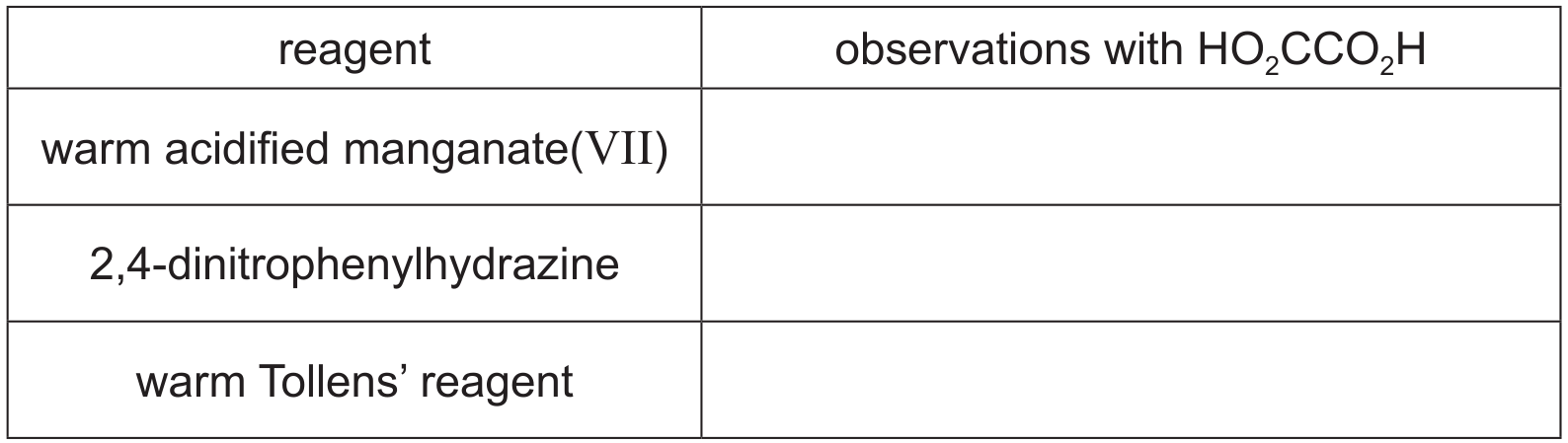
[Fe(C2O4)2Cl2]4\left[\mathrm{Fe}\left(\mathrm{C}_{2} \mathrm{O}_{4}\right)_{2} \mathrm{Cl}_{2}\right]^{4-} contains ligands which are anions of ethanedioic acid, HO2CCO2H\mathrm{HO}_{2} \mathrm{CCO}_{2} \mathrm{H}.

Complete the table to show any observations for the reactions of HO2CCO2H\mathrm{HO}_{2} \mathrm{CCO}_{2} \mathrm{H} with the named reagents.

Where no change is observed, write 'none'.
Table
[ 2 ]
[Maximum number: 3]

Barium hydroxide, Ba(OH)2\mathrm{Ba}(\mathrm{OH})_{2}, is a strong base used in inorganic and organic reactions.
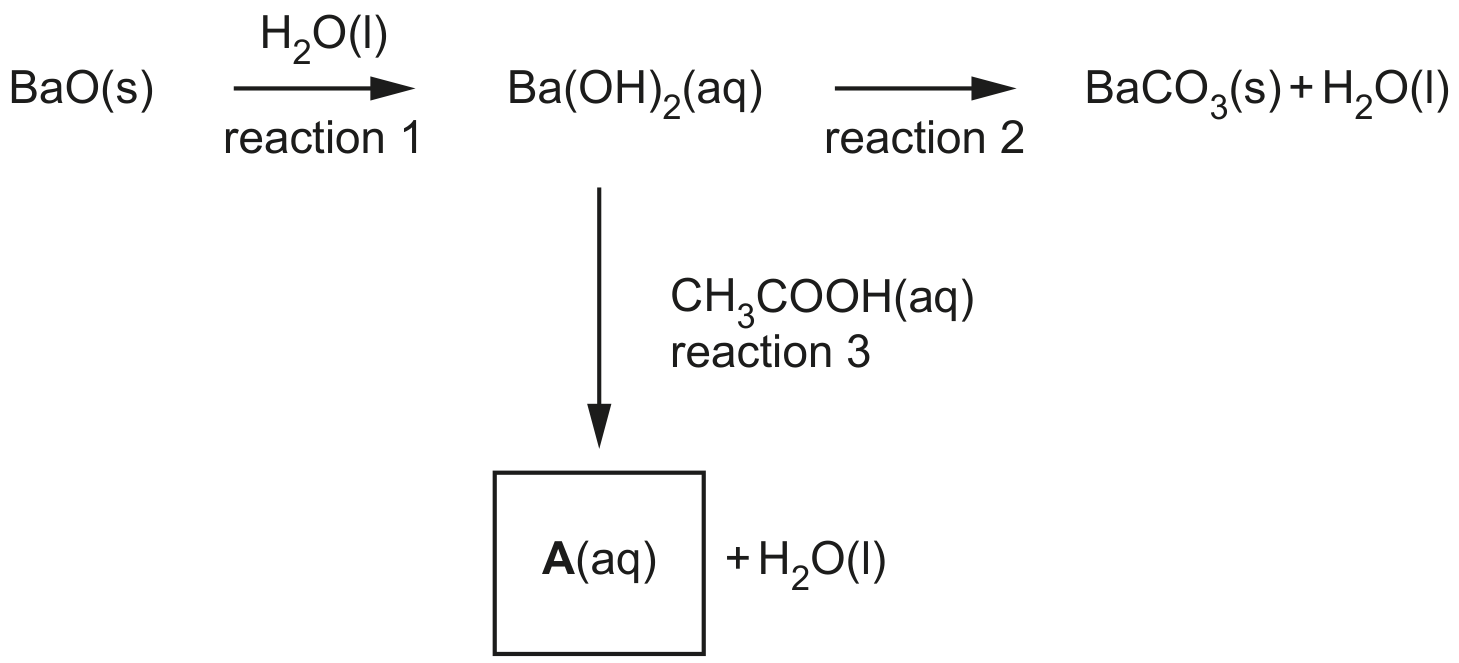
Fig. 2.1 shows a reaction scheme involving \(\mathrm{Ba

Fig. 2.1 shows a reaction scheme involving \(\mathrm{Ba

(a)

Ba(OH)2\mathrm{Ba}(\mathrm{OH})_{2} is used to hydrolyse organic compounds.

Fig. 2.2 shows the reaction of B with Ba(OH)2\mathrm{Ba}(\mathrm{OH})_{2}, followed by acidification.
Draw the structures of the organic products of the process shown in Fig. 2.2.
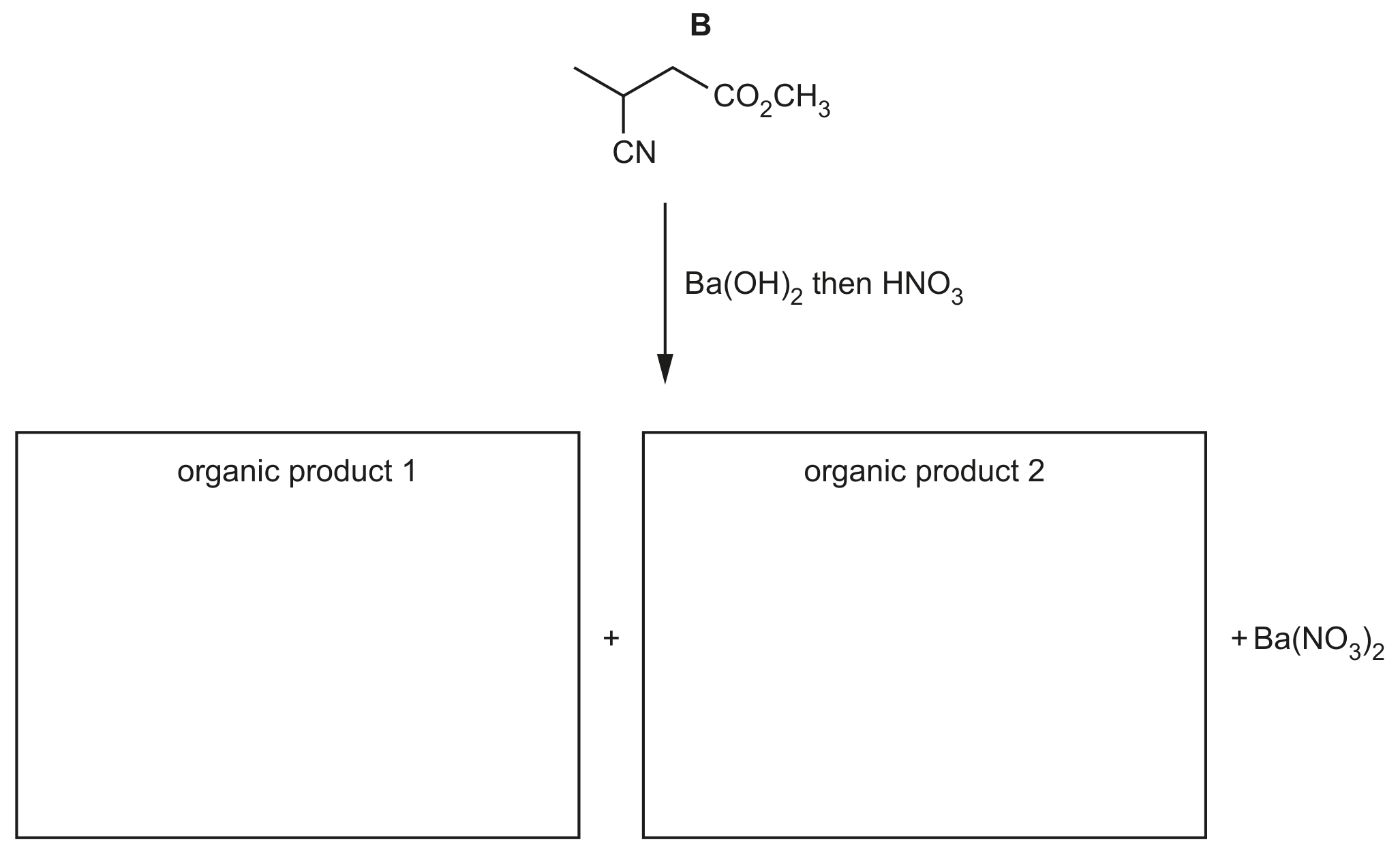
Fig. 2.2

Fig. 2.2

[ 3 ]
[Maximum number: 1]

Which substance, when warmed with aqueous ammonium chloride, would produce an alkaline gas?

A

CH3CO2H\mathrm{CH}_{3} \mathrm{CO}_{2} \mathrm{H}

B

CH3CH2OH\mathrm{CH}_{3} \mathrm{CH}_{2} \mathrm{OH}

C

CH3CO2CH3\mathrm{CH}_{3} \mathrm{CO}_{2} \mathrm{CH}_{3}

D

CH3CH2ONa\mathrm{CH}_{3} \mathrm{CH}_{2} \mathrm{ONa}

(a)

Propanoic acid, CH3CH2CO2H\mathrm{CH}_{3} \mathrm{CH}_{2} \mathrm{CO}_{2} \mathrm{H}, is a weak acid with Ka=1.34×10⁵ moldm3K_{\mathrm{a}}=1.34 \times 10^{-5} \mathrm{~mol} \mathrm{dm}^{-3}.

[ 6 ]
(i)

Write an equation for the reaction between sodium hydroxide and propanoic acid.

[ 6 ]
[Maximum number: 1]

A compound Y has all of the properties below.
- It is a liquid at 25C25^{\circ} \mathrm{C}.
- It mixes completely with water.
- It reacts with aqueous sodium hydroxide.

What could Y be?

A

ethanoic acid

B

ethanol

C

ethene

D

ethyl ethanoate

[Maximum number: 1]

An organic compound J reacts with sodium to produce an organic ion with a charge of -3 . J reacts with NaOH(aq) to produce an organic ion with a charge of -1 .

What could be the structural formula of J ?

A

HO2CCH(OH)CH2CO2H\mathrm{HO}_{2} \mathrm{CCH}(\mathrm{OH}) \mathrm{CH}_{2} \mathrm{CO}_{2} \mathrm{H}

B

HO2CCH(OH)CH2CHO\mathrm{HO}_{2} \mathrm{CCH}(\mathrm{OH}) \mathrm{CH}_{2} \mathrm{CHO}

C

HOCH2CH(OH)CH2CO2H\mathrm{HOCH}_{2} \mathrm{CH}(\mathrm{OH}) \mathrm{CH}_{2} \mathrm{CO}_{2} \mathrm{H}

D

HOCH2COCH2CHO\mathrm{HOCH}_{2} \mathrm{COCH}_{2} \mathrm{CHO}

[Maximum number: 1]

Butanoic acid can be produced from 1-bromopropane in two steps using reagents V and W as shown.

 1-bromopropane  reagent V compound Q reagent W butanoic acid \text { 1-bromopropane } \xrightarrow{\text { reagent } \mathrm{V}} \text { compound } \mathrm{Q} \xrightarrow{\text { reagent } \mathrm{W}} \text { butanoic acid }

What could be reagents V and W ?

V

W

KCN in ethanol

HCl(aq)

KCN in ethanol

NaOH(aq)

NH3\mathrm{NH}_{3} in ethanol

HCl(aq)

NaOH(aq)

H+/Cr2O72(aq)\mathrm{H}^{+} / \mathrm{Cr}_{2} \mathrm{O}_{7}{ }^{2-}(\mathrm{aq})

[Maximum number: 1]

Carboxylic acids may be prepared by several different methods.
In which reaction would propanoic acid be formed?

A

adding ammonium propanoate to dilute sulfuric acid

B

heating ethyl propanoate with aqueous sodium hydroxide

C

heating propan-2-ol with acidified potassium manganate(VII) under reflux

D

heating propyl ethanoate with dilute sulfuric acid

[Maximum number: 1]

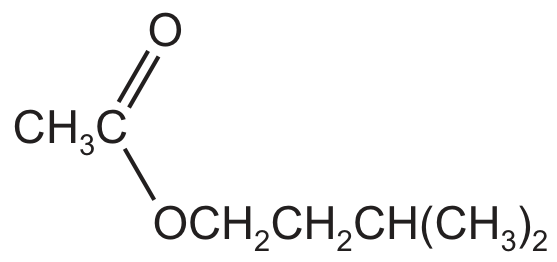
An ester P with a fruity odour has the following structural formula.
Question image

Which compounds are produced when P is hydrolysed using hydrochloric acid?

A

CH3COCl\mathrm{CH}_{3} \mathrm{COCl} and (CH3)2CHCH2CH2OH\left(\mathrm{CH}_{3}\right)_{2} \mathrm{CHCH}_{2} \mathrm{CH}_{2} \mathrm{OH}

B

CH3CHO\mathrm{CH}_{3} \mathrm{CHO} and (CH3)2CHCH2CH2OH\left(\mathrm{CH}_{3}\right)_{2} \mathrm{CHCH}_{2} \mathrm{CH}_{2} \mathrm{OH}

C

CH3CO2H\mathrm{CH}_{3} \mathrm{CO}_{2} \mathrm{H} and (CH3)2CHCH2CH2CHO\left(\mathrm{CH}_{3}\right)_{2} \mathrm{CHCH}_{2} \mathrm{CH}_{2} \mathrm{CHO}

D

CH3CO2H\mathrm{CH}_{3} \mathrm{CO}_{2} \mathrm{H} and (CH3)2CHCH2CH2OH\left(\mathrm{CH}_{3}\right)_{2} \mathrm{CHCH}_{2} \mathrm{CH}_{2} \mathrm{OH}

0
