
EduNinja
[Maximum number: 5]

Sulfuric acid is manufactured by the Contact process.
One stage in this process is the conversion of sulfur dioxide into sulfur trioxide in the presence of a heterogeneous catalyst of vanadium(V) oxide, V2O5\mathrm{V}_{2} \mathrm{O}_{5}.

Question image
(a)

The SO3\mathrm{SO}_{3} produced is converted to sulfuric acid in two stages. In the first stage the SO3\mathrm{SO}_{3} is reacted with concentrated sulfuric acid to produce oleum, H2 S2O7\mathrm{H}_{2} \mathrm{~S}_{2} \mathrm{O}_{7}.
The oleum is then reacted with water to form sulfuric acid.
Suggest an equation for the reaction of oleum, H2 S2O7\mathrm{H}_{2} \mathrm{~S}_{2} \mathrm{O}_{7}, with water to form sulfuric acid.

[ 1 ]
(b)

SO2\mathrm{SO}_{2} reacts with water to form sulfurous acid.

Sulfurous acid is a weak Brønsted-Lowry acid, while sulfuric acid is a strong Brønsted-Lowry acid.

[ 4 ]
(i)

State the meaning of the term strong Brønsted-Lowry acid.

[ 2 ]
(ii)

Write an equation to show the acid-base behaviour of sulfuric acid with water. Include state symbols.
[ 2 ]
[Maximum number: 3]

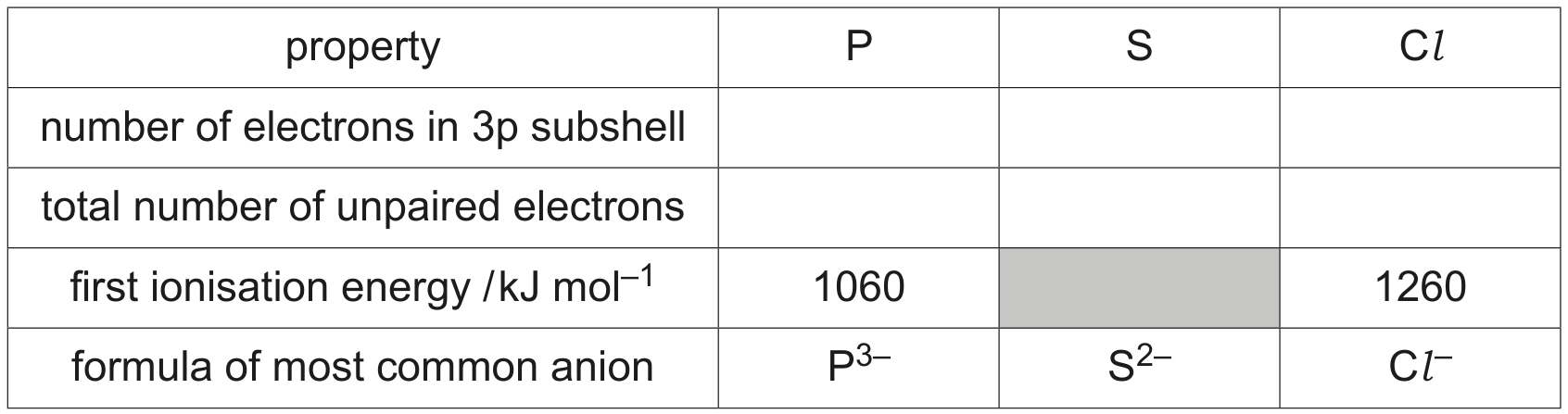
The elements phosphorus, sulfur and chlorine are in Period 3 of the Periodic Table.

Table 1.1 shows some properties of the elements P to Cl .
The first ionisation energy of S is not shown.

Table 1.1

Table 1.1

(a)

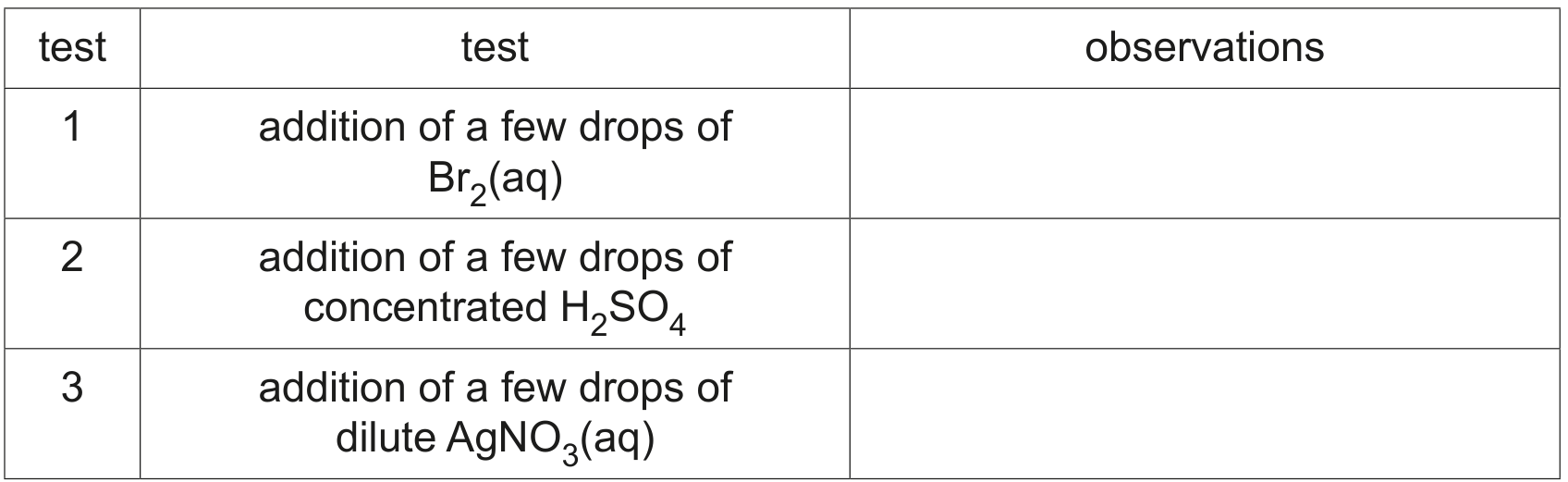
A student does three tests on separate samples of NaCl(aq).

Complete Table 1.2 with the observations the student makes in each test.

Table 1.2

Table 1.2

[ 3 ]
[Maximum number: 3]

Sulfides are compounds that contain sulfur but not oxygen.

(a)

Hydrogen sulfide gas, H2 S( g)\mathrm{H}_{2} \mathrm{~S}(\mathrm{~g}), is slightly soluble in water. It acts as a weak acid in aqueous solution.

[ 1 ]
(i)

State the meaning of weak acid.

[ 1 ]
(b)

The compound As2 S3\mathrm{As}_{2} \mathrm{~S}_{3} is a common mineral.

When As2 S3\mathrm{As}_{2} \mathrm{~S}_{3} is heated strongly in air, it forms a mixture of products, as shown.

2As2 S3( s)+9O2( g)As4O6( s)+6SO2( g)2 \mathrm{As}_{2} \mathrm{~S}_{3}(\mathrm{~s})+9 \mathrm{O}_{2}(\mathrm{~g}) \rightarrow \mathrm{As}_{4} \mathrm{O}_{6}(\mathrm{~s})+6 \mathrm{SO}_{2}(\mathrm{~g})
[ 2 ]
(i)

SO2( g)\quad \mathrm{SO}_{2}(\mathrm{~g}) can be removed from the air by reacting it with NaOH(aq).

Construct an equation for the reaction of SO2( g)\mathrm{SO}_{2}(\mathrm{~g}) with NaOH(aq). Include state symbols.

[ 2 ]
[Maximum number: 11]

In 1814, Sir Humphrey Davy and Michael Faraday collected samples of a flammable gas, A, from the ground near Florence in Italy.
They analysed A which they found to be a hydrocarbon. Further experiments were then carried out to determine the molecular formula of A.

(a)

When 10 cm310 \mathrm{~cm}^{3} of A was mixed at room temperature with 50 cm350 \mathrm{~cm}^{3} of oxygen (an excess) and exploded, 40 cm340 \mathrm{~cm}^{3} of gas remained after cooling the apparatus to room temperature and pressure.
When this 40 cm340 \mathrm{~cm}^{3} of gas was shaken with an excess of aqueous potassium hydroxide, KOH,30 cm3\mathrm{KOH}, 30 \mathrm{~cm}^{3} of gas still remained.

[ 4 ]
(i)

The combustion of A produced a gas that reacted with the KOH(aq).

What is the identity of this gas?

[Maximum number: 2]

Sodium oxide, Na2O\mathrm{Na}_{2} \mathrm{O}, is a white crystalline solid with a high melting point.

(a)

When sodium oxide reacts with water an alkaline solution is obtained.

[ 2 ]
(i)

Explain why the solution obtained is alkaline. You should use the Brønsted-Lowry theory of acids and bases in your answer.

[ 2 ]
[Maximum number: 3]

Silicon tetrachloride, SiCl4\mathrm{SiCl}_{4}, is formed when silicon reacts with chlorine under suitable conditions. It is a colourless liquid with a low boiling point.

(a)

SiCl4\mathrm{SiCl}_{4} reacts with water to produce an acidic solution.

[ 3 ]
(i)

A sample of 0.8505 g of SiCl4\mathrm{SiCl}_{4} is added to 800 cm3800 \mathrm{~cm}^{3} of water. All of the soluble acidic product is dissolved in the water.

Calculate the pH of the solution obtained.

pH=\mathrm{pH}=
[ 3 ]
[Maximum number: 2]

Species such as NH4+,CO32\mathrm{NH}_{4}{ }^{+}, \mathrm{CO}_{3}{ }^{2-} and PO43\mathrm{PO}_{4}{ }^{3-} are examples of molecular ions.

(a)

NH4+\mathrm{NH}_{4}{ }^{+}is a Brønsted-Lowry acid.

[ 2 ]
(i)

Define Brønsted-Lowry acid.

[ 1 ]
(ii)

When NH4+(aq)\mathrm{NH}_{4}{ }^{+}(\mathrm{aq}) is heated with NaOH(aq), a pungent gas is produced.

Write an ionic equation for this reaction.

[ 1 ]
[Maximum number: 2]

Hydrogen iodide, HI, is a colourless gas at room temperature.

(a)

In the laboratory, HI(aq) can be formed in a two-step process.

step 13I2( s)+2P(s)2PI3( s)13 \mathrm{I}_{2}(\mathrm{~s})+2 \mathrm{P}(\mathrm{s}) \rightarrow 2 \mathrm{PI}_{3}(\mathrm{~s})

step 2PI3( s)+3H2O(l)H3PO3(aq)+3HI(aq)2 \mathrm{PI}_{3}(\mathrm{~s})+3 \mathrm{H}_{2} \mathrm{O}(\mathrm{l}) \rightarrow \mathrm{H}_{3} \mathrm{PO}_{3}(\mathrm{aq})+3 \mathrm{HI}(\mathrm{aq})

[ 2 ]
(i)

H3PO3(aq)\quad \mathrm{H}_{3} \mathrm{PO}_{3}(\mathrm{aq}) and HI(aq) are both strong Brønsted-Lowry acids.

Give the meaning of the term strong Brønsted-Lowry acid.

[ 2 ]
[Maximum number: 3]

Copper is a transition element and has atomic number 29.

(a)

Ethane-1,2-diamine is a useful reagent in organic chemistry.

[ 3 ]
(i)

Explain how the amino groups in ethane-1,2-diamine allow the molecule to act as a Brønsted-Lowry base.

[ 2 ]
(ii)

Write an equation for the reaction of ethane-1,2-diamine with an excess of hydrochloric acid.

[ 1 ]
(a)

The iron(II) complex ferrous bisglycinate hydrochloride is sometimes prescribed, in capsule form, to treat iron deficiency or anaemia.
A capsule containing 500 mg of this iron(II) complex was dissolved in dilute H2SO4\mathrm{H}_{2} \mathrm{SO}_{4} and titrated with 0.0200 moldm3KMnO40.0200 \mathrm{~mol} \mathrm{dm}^{-3} \mathrm{KMnO}_{4}.
18.1 cm318.1 \mathrm{~cm}^{3} of KMnO4\mathrm{KMnO}_{4} solution were required to reach the end point.
The equation for the titration reaction is as follows.

5Fe2++MnO4+8H+5Fe3++Mn2++4H2O5 \mathrm{Fe}^{2+}+\mathrm{MnO}_{4}^{-}+8 \mathrm{H}^{+} \rightarrow 5 \mathrm{Fe}^{3+}+\mathrm{Mn}^{2+}+4 \mathrm{H}_{2} \mathrm{O}
(i)

Describe how you would recognise the end point of this titration.

0
