EduNinja
[Maximum number: 3]

Atoms contain the subatomic particles electrons, protons and neutrons. Protons and electrons were discovered by observations of their behaviours in electric fields.

(a)

Electrons in atoms up to 36Kr{ }_{36} \mathrm{Kr} are distributed in s, p and dorbitals.

[ 3 ]
(i)

The first ionisation energies of elements in the first row of the d block (21Sc\left({ }_{21} \mathrm{Sc}\right. to 29Cu)\left.{ }_{29} \mathrm{Cu}\right) are very similar. For all these elements, it is a 4s electron that is lost during the first ionisation.

Suggest why the first ionisation energies of these elements are very similar.

[ 3 ]

[Maximum number: 1]

The first four ionisation energies for element X are shown in the table.

Table

Which ion of X is produced by removing an electron from a filled shell?

A

X+\mathrm{X}^{+}

B

X2+\mathrm{X}^{2+}

C

X3+\mathrm{X}^{3+}

D

X4+\mathrm{X}^{4+}

(a)

Explain what is meant by the term ionisation energy.

[ 3 ]
(a)

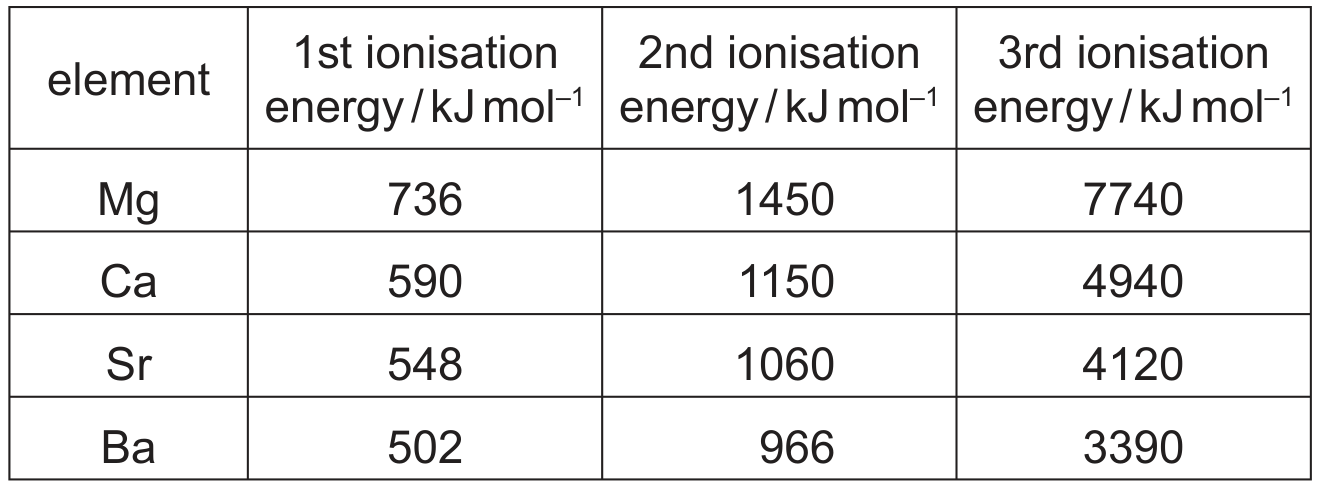
Successive ionisation energies for the elements magnesium to barium are given in the table.

Table
[ 5 ]
(i)

Explain why the first ionisation energies decrease down the group.

[ 3 ]
(ii)

Explain why, for each element, there is a large increase between the 2nd and 3rd ionisation energies.

[ 2 ]
[Maximum number: 1]

The table gives the successive ionisation energies for an element X.

Table

What could be the formula of a chloride of X ?

A

XCl

B

XCl2\mathrm{XCl}_{2}

C

XCl3\mathrm{XCl}_{3}

D

XCl4\mathrm{XCl}_{4}

(a)

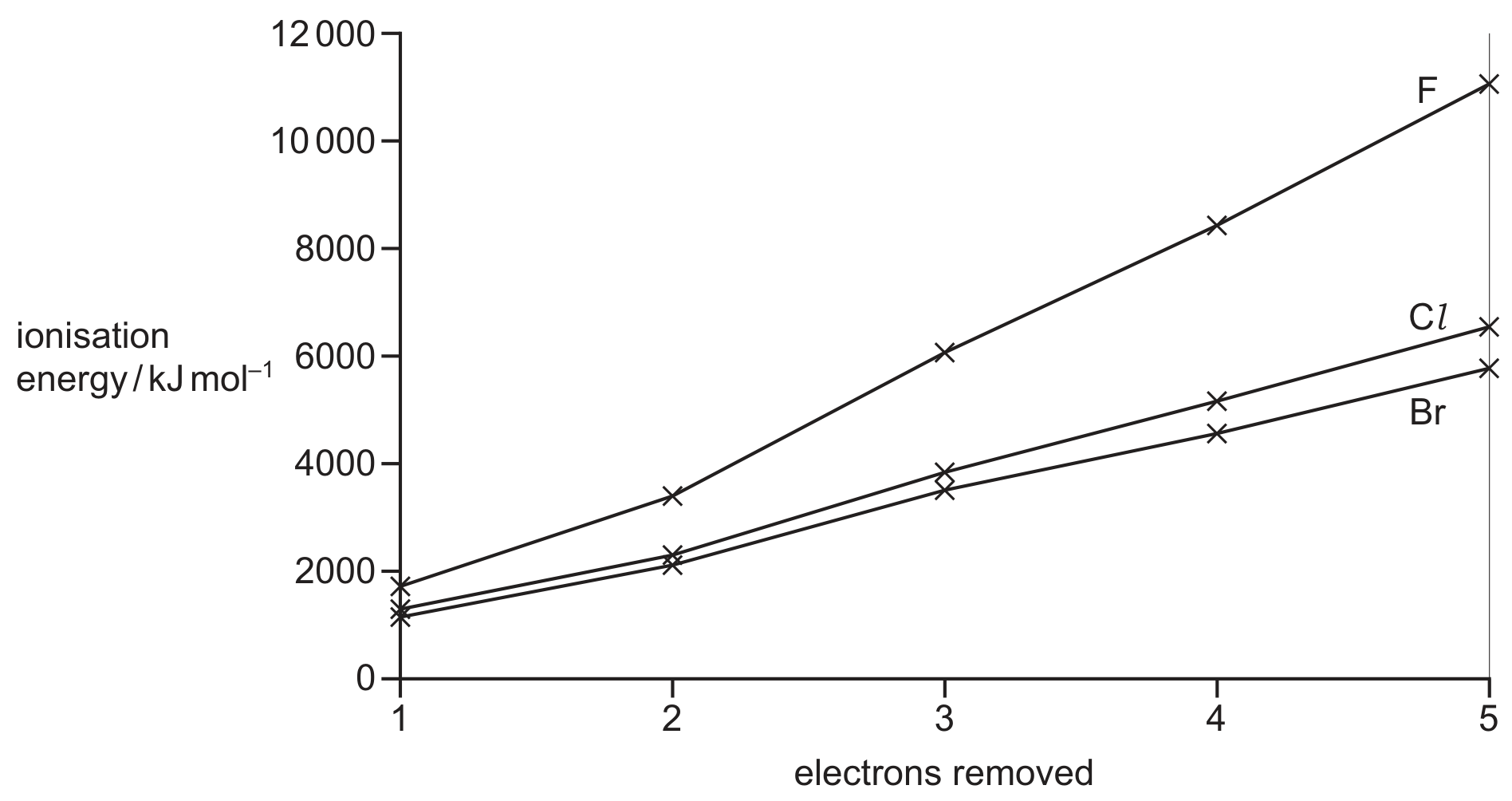
Successive ionisation energies for the elements fluorine, F , to bromine, Br , are shown on the graph.

Question image
[ 5 ]
(i)

Explain why the first ionisation energies decrease down the group.

[ 3 ]
(ii)

Explain why there is an increase in the successive ionisation energies of fluorine.

[ 2 ]
(a)

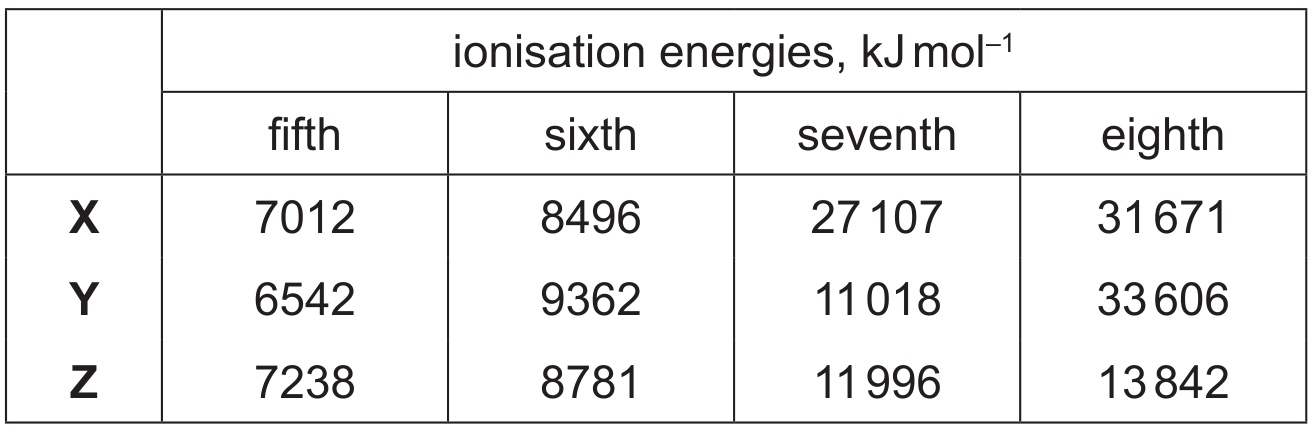
The fifth to eighth ionisation energies of three elements in the third period of the Periodic Table are given. The symbols used for reference are not the actual symbols of the elements.

Table
[ 3 ]
(i)

State and explain the group number of element Y.
group number
explanation

[ 1 ]
(ii)

State and explain the general trend in first ionisation energies across the third period.

[ 2 ]
(a)

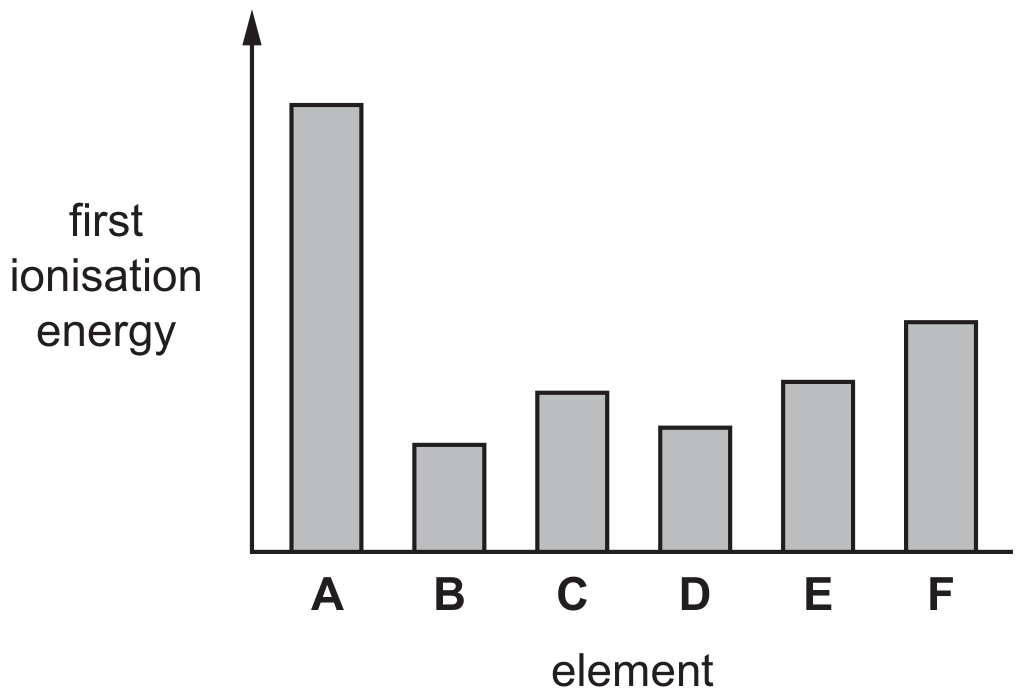
The graph shows a sketch of the first ionisation energies of six successive elements in the Periodic Table.

The letters are not the symbols of the elements.

Question image
[ 6 ]
(i)

Explain what is meant by the term first ionisation energy.

[ 3 ]
(ii)

Suggest why the first ionisation energy of B is much less than that of A.

[ 3 ]
(a)
(i)

Explain why the first ionisation energy of sulfur is less than that of phosphorus.

[ 2 ]
[Maximum number: 5]

In the Periodic Table, the p block contains elements whose outer electrons are found in the p subshell.

(a)

Elements in the p block show a general increase in first ionisation energy as the atomic number increases.

[ 5 ]
(i)

Write an equation to show the first ionisation energy of silicon.

[ 1 ]
(ii)

Explain why there is a general increase in first ionisation energies of the elements across Period 3.

[ 2 ]
(iii)

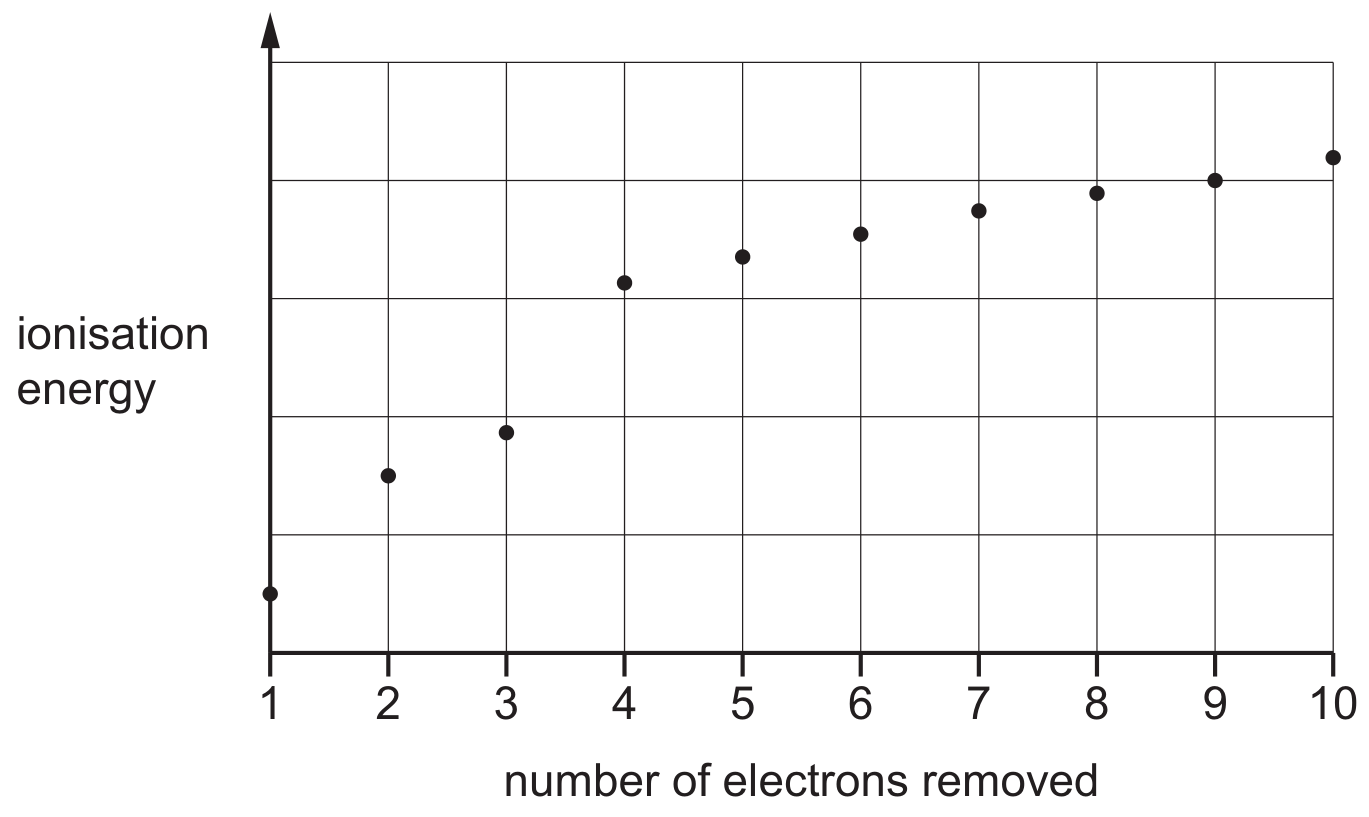
Element A is in the p block.

The graph shows the successive ionisation energies for the removal of the first ten electrons of A.

Question image

State and explain the group of the Periodic Table that element A belongs to. group number
explanation

[ 2 ]
0