EduNinja
[Maximum number: 2]

One reason for the wide variety of organic compounds is isomerism, either structural isomerism or stereoisomerism.

(a)

Pent-1-ene, CH2=CH(CH2)2CH3\mathrm{CH}_{2}=\mathrm{CH}\left(\mathrm{CH}_{2}\right)_{2} \mathrm{CH}_{3}, does not show stereoisomerism.

[ 2 ]
(i)

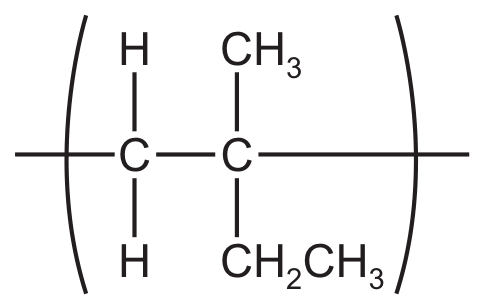
A structural isomer of pent-1-ene is used as the monomer to form a polymer. The repeat unit of this polymer is shown.
Question image

Draw the displayed formula of the monomer used to make this polymer.
Give the name of the monomer.

[ 2 ]
[Maximum number: 5]

Crude oil is a complex mixture of hydrocarbon molecules.
The hydrocarbon molecules in crude oil are separated by fractional distillation. Fractional distillation is used because the different hydrocarbon molecules in crude oil have different boiling points.

(a)

Cracking one mole of dodecane, C12H26\mathrm{C}_{12} \mathrm{H}_{26}, produces two moles of ethene and one mole of another hydrocarbon molecule.

[ 5 ]
(i)

Give the full name of the process used to produce poly(ethene) from ethene.

[ 1 ]
(ii)

Give two reasons why poly(ethene) should be reused or recycled rather than just thrown away.

[ 2 ]
(iii)

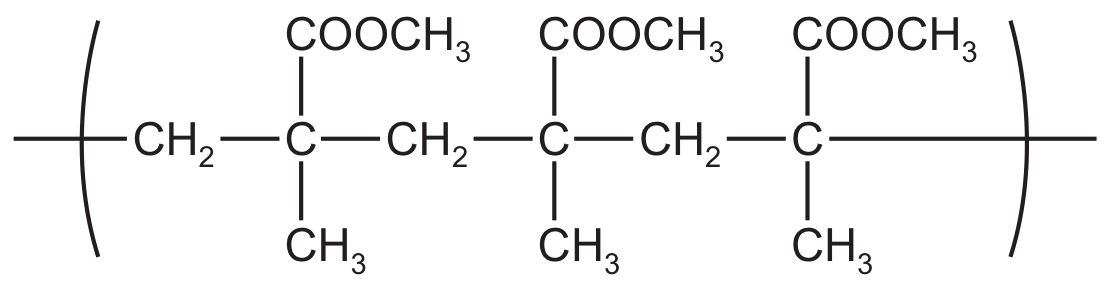
Part of a polymer chain, produced by the same type of process as poly(ethene), is shown.

Question image

Give the displayed formula of the monomer used to produce this polymer.

[ 2 ]
[Maximum number: 1]

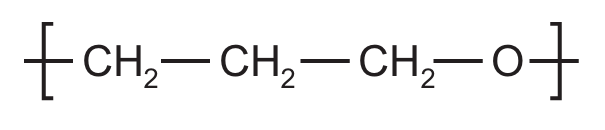
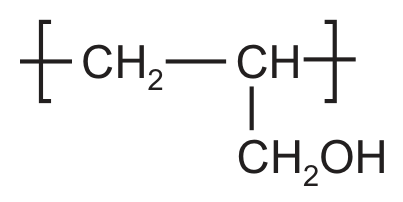
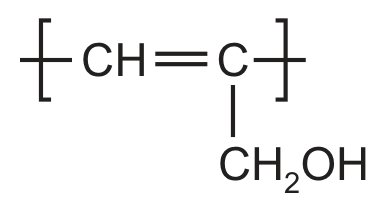
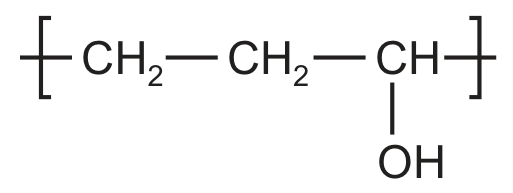
Synthetic resins can be made by polymerisation of a variety of monomers including prop-2-en-1-ol, CH2=CHCH2OH\mathrm{CH}_{2}=\mathrm{CHCH}_{2} \mathrm{OH}.

Which structure represents the repeat unit in poly(prop-2-en-1-ol)?

A
Question image
B
Question image
C
Question image
D
Question image
[Maximum number: 1]

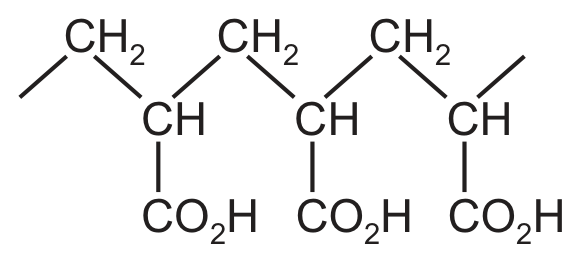
One of the characteristics of addition polymerisation is that the empirical formulae of the polymer and of its monomer are the same. The absorbent material in babies' disposable nappies is made from the addition polymer shown.

Question image

From which monomer could this addition polymer be obtained?

A

CH3CH(OH)CO2H\mathrm{CH}_{3} \mathrm{CH}(\mathrm{OH}) \mathrm{CO}_{2} \mathrm{H}

B

HOCH2CH2CO2H\mathrm{HOCH}_{2} \mathrm{CH}_{2} \mathrm{CO}_{2} \mathrm{H}

C

H2C=CHCO2H\mathrm{H}_{2} \mathrm{C}=\mathrm{CHCO}_{2} \mathrm{H}

D

HO2CCH=CHCO2H\mathrm{HO}_{2} \mathrm{CCH}=\mathrm{CHCO}_{2} \mathrm{H}

[Maximum number: 1]

Which statement is correct when referring to the complete combustion of PVC?

A

A gas is made which contributes to global warming.

B

Carbon dioxide and water are the only products.

C

If water is used to clean the exhaust gases, the water becomes alkaline.

D

There is no need to treat the exhaust gases as the products are non-hazardous.

[Maximum number: 1]

Which statement is not correct?

A

Combustion of PVC produces a highly acidic gas.

B

PVC molecules are saturated.

C

The empirical formula of PVC is the same as the empirical formula of its monomer.

D

The repeat unit of PVC is (CHClCHCl).

[Maximum number: 1]

Polyethene is made by the polymerisation of ethene.
Which statement is correct?

A

The monomer and the polymer have different empirical formulae.

B

The monomer can be oxidised without heat whereas the polymer cannot.

C

The monomer can be used as a fuel whereas the polymer cannot.

D

The monomer has greater van der Waals' forces than the polymer.

[Maximum number: 1]

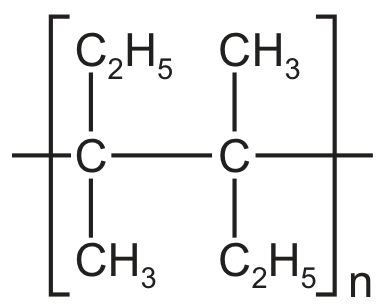
The diagram shows the repeat unit of an addition polymer.

Question image

What is the correct name for the monomer that would form this polymer?

A

cis-1,2-diethyl-1,2-dimethylethene

B

cis-2-ethyl-3-methylpent-2-ene

C

trans-2-ethyl-3-methylpent-2-ene

D

trans-3,4-dimethylhex-3-ene

[Maximum number: 1]

In polymer Z every carbon atom in the polymer chain is bonded to one hydrogen atom and one methyl group.

Which alkene could be polymerised to make polymer Z ?

A

but-1-ene

B

but-2-ene

C

methylpropene

D

propene

[Maximum number: 1]

PVC is difficult to dispose of. Two possible methods are burying it in landfill sites and disposal by combustion.

Which row of the table is correct?

rate of biodegradation of PVC in landfill sites

gases produced when PVC combusts

fast

CO2,H2O,HCl\mathrm{CO}_{2}, \mathrm{H}_{2} \mathrm{O}, \mathrm{HCl}

fast

CO2,H2O,Cl2\mathrm{CO}_{2}, \mathrm{H}_{2} \mathrm{O}, \mathrm{Cl}_{2}

slow

CO2,H2O,Cl2\mathrm{CO}_{2}, \mathrm{H}_{2} \mathrm{O}, \mathrm{Cl}_{2}

slow

CO2,H2O,HCl\mathrm{CO}_{2}, \mathrm{H}_{2} \mathrm{O}, \mathrm{HCl}

0