Silicon tetrachloride, , is formed when silicon reacts with chlorine under suitable conditions. It is a colourless liquid with a low boiling point.
reacts with water to produce an acidic solution.
Write an equation for this reaction.
EduNinjaSilicon tetrachloride, SiCl4, is formed when silicon reacts with chlorine under suitable conditions. It is a colourless liquid with a low boiling point.
SiCl4 reacts with water to produce an acidic solution.
Write an equation for this reaction.
Sulfuric acid is manufactured by the Contact process.
One stage in this process is the conversion of sulfur dioxide into sulfur trioxide in the presence of a heterogeneous catalyst of vanadium(V) oxide, V2O5.

SO2 reacts with water to form sulfurous acid.
Sulfurous acid is a weak Brønsted-Lowry acid, while sulfuric acid is a strong Brønsted-Lowry acid.
Complete the 'dot-and-cross' diagram to show the bonding in a molecule of SO2. Show outer electrons only.

The elements sodium to sulfur react with chlorine. The melting points of some of the chlorides formed are shown.

Draw the 'dot-and-cross' diagram of a molecule of SiCl4. Show outer electrons only.
Compounds containing different halogen atoms covalently bonded together are called interhalogen compounds.
Another interhalogen compound has the formula ICl.
Draw a 'dot-and-cross' diagram of a molecule of this compound, showing outer shell electrons only. Explain whether or not you would expect this molecule to be polar.
Valence Shell Electron Pair Repulsion theory (VSEPR) is a model of electron-pair repulsion (including lone pairs) that can be used to deduce the shapes of, and bond angles in, simple molecules.
Tellurium, Te, proton number 52, is used in photovoltaic cells.
When fluorine gas is passed over tellurium at 150∘C, the colourless gas TeF6 is formed.
Draw a 'dot-and-cross' diagram of the TeF6 molecule, showing outer electrons only.
Oxides are compounds which usually contain oxygen combined with one other element.
Oxides are classified as follows.
acidic alkaline amphoteric basic
Another sulfur compound which is present in the Earth's atmosphere is carbonyl sulfide, OCS. The sequence of atoms in the molecule is oxygen-carbon-sulfur and the molecule is not cyclic.
Draw a 'dot-and-cross' diagram of the OCS molecule.
Show outer electrons only.
Hydrazine, N2H4, can be used as a rocket fuel and is stored as a liquid. It reacts exothermically with oxygen to give only gaseous products.
The enthalpy change of a reaction such as that between hydrazine and oxygen may be calculated by using standard enthalpy changes of formation.
The bonding in hydrazine is similar to that in ammonia.
Showing outer-shell electrons only, draw a 'dot-and-cross' diagram of an ammonia molecule.
Elements and compounds which have small molecules usually exist as gases or liquids.
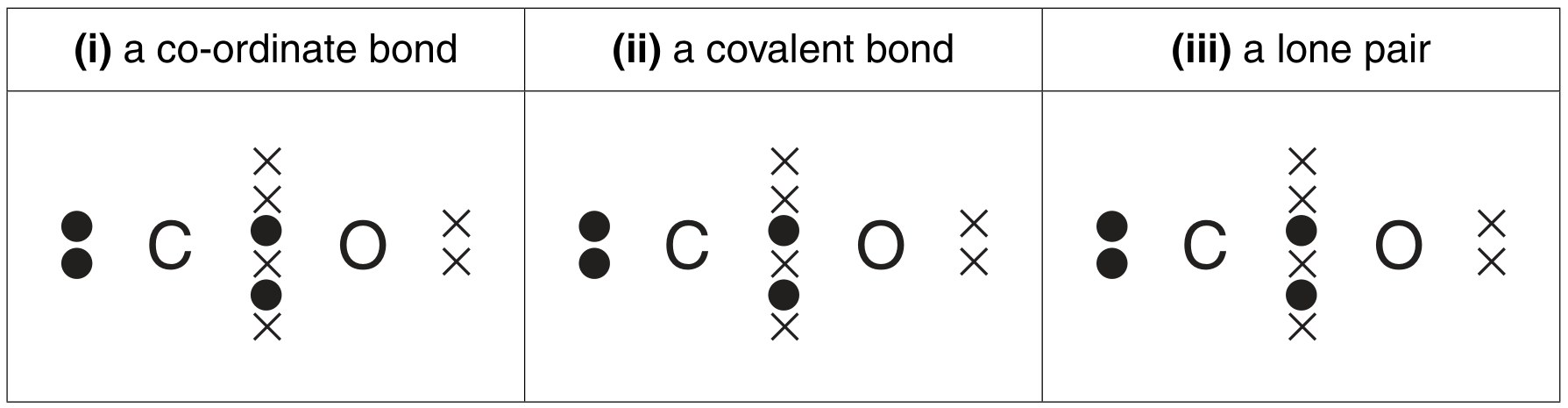
A 'dot-and-cross' diagram of a CO molecule is shown below. Only electrons from outer shells are represented.

In the table below, there are three copies of this structure.
On the structures, draw a circle round a pair of electrons that is associated with each of the following.

Sulfides are compounds that contain sulfur but not oxygen.
Carbon disulfide, CS2, is a volatile liquid at room temperature and pressure.
Draw a 'dot-and-cross' diagram of the CS2 molecule.
A Group 2 metal combines with bromine to form a crystalline solid, MBr2.
Excess aqueous AgNO3 is added to a solution of MBr2 and a precipitate forms. The mixture is filtered. The precipitate is dried and the mass of the precipitate is recorded.
State the formula and colour of the precipitate.