

EduNinja

CAIE IGCSE Chemistry Metal Reactivity from Displacement

CAIE IGCSE Chemistry Metal Reactivity from Displacement
Cambridge IGCSE Chemistry 0620 syllabus for exams in 2026, 2027 and 20282026–2028

Practise using displacement reactions and simple cells to rank metals by their tendency to form positive ions, supported by equations and observations.

How this is tested

  • predict that a more reactive metal displaces a less reactive metal from its aqueous ions
  • write the ionic equation with the more reactive metal forming positive ions
  • use solution colour, deposited metal, electron flow or voltage to deduce relative reactivity

Question 2

[Maximum number: 4]

A list of five metals is shown.

A list of five metals is shown.

\title{
copper \\ iron \\ magnesium \\ potassium \\ silver
}

Question 2(a)

(a)

All metals form positive ions.

[ 1 ]

Question 2(a)(ii)

(i)

State which of the five metals in the list has the greatest tendency to form positive ions.

[ 1 ]

Question 2(b)

(b)

A student adds a sample of a metal to an aqueous metal salt in a beaker to see if a displacement reaction takes place.

Complete Table 2.1 to show the colour of the solution in the beaker at the start and at the end of the experiment.
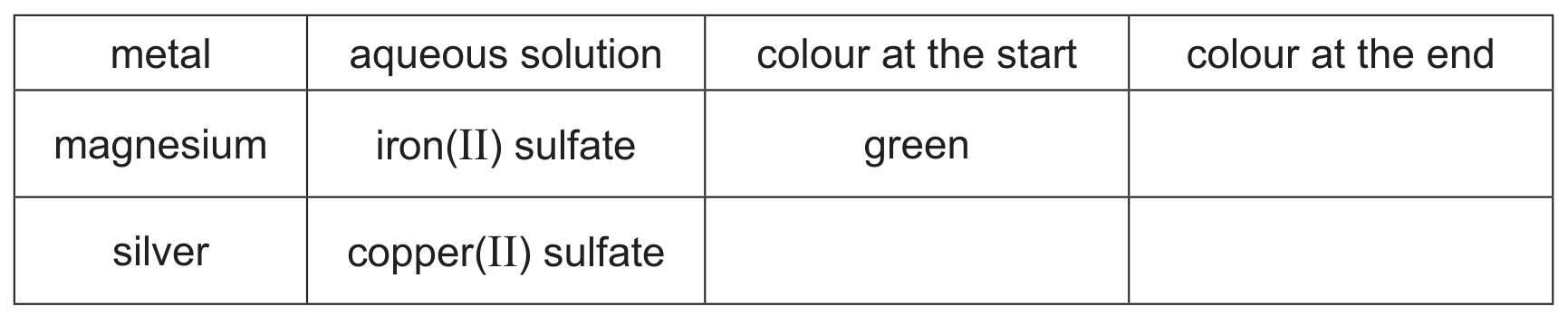
Table 2.1

Table 2.1

[ 3 ]