EduNinja

IGCSE Chemistry11.8 PolymersQuestion Bank

Question 1

[Maximum number: 1]

A list of gases is shown.
ammonia
carbon dioxide
carbon monoxide
ethene
fluorine
oxygen
sulfur dioxide
xenon

Answer the following questions using only the gases from the list. Each gas may be used once, more than once or not at all.

Give the name of the gas that:

Question 1(e)

(a)

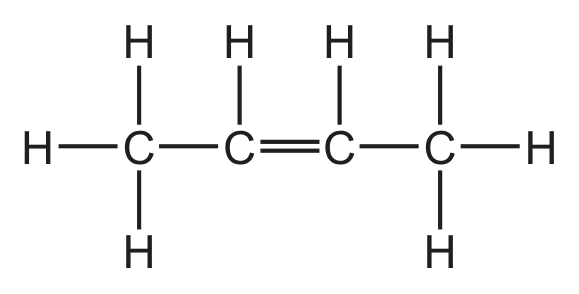
can form a polymer

[ 1 ]
Question 1

[Maximum number: 1]

Give the name of the process that is used:

Question 1(a)

(a)

to produce large molecules from monomers

[ 1 ]

Question 3

[Maximum number: 2]

Fluorine is a Group VII element. Fluorine forms compounds with metals and non-metals.

Question 3(f)

(a)

Tetrafluoroethene is an unsaturated compound with the formula C2 F4\mathrm{C}_{2} \mathrm{~F}_{4}. Tetrafluoroethene is the monomer used to make the polymer poly(tetrafluoroethene).

[ 2 ]

Question 3(f)(iv)

(i)

Tetrafluoroethene can be polymerised to form poly(tetrafluoroethene).

Draw one repeat unit of poly(tetrafluoroethene). Show all of the atoms and all of the bonds.

[ 2 ]

Question 2

[Maximum number: 2]

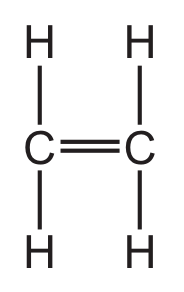
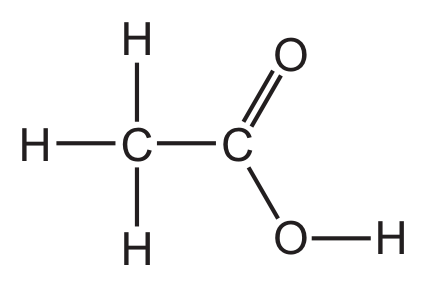
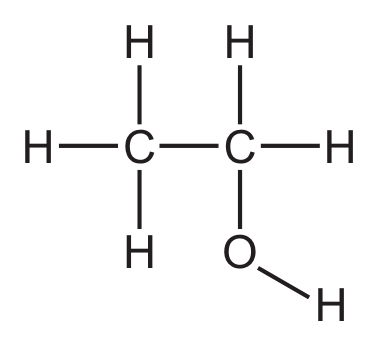
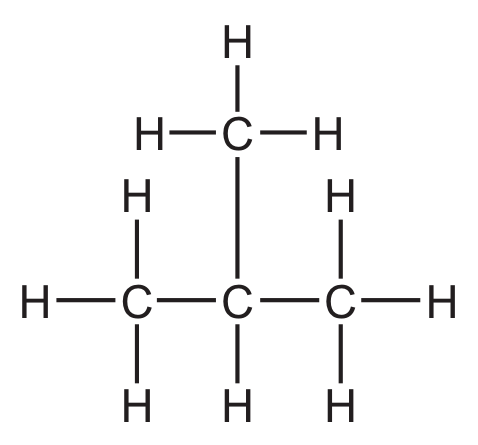
The structures of six organic compounds are shown.
A

Question image

B

Question image

C

Question image

D

Question image

E

Question image

F

Question image

Question 2(f)

(a)

Compound A forms an addition polymer.

Draw two repeat units of the addition polymer formed from A.

[ 2 ]

Question 2

[Maximum number: 4]

The gases Ar,CO2, N2\mathrm{Ar}, \mathrm{CO}_{2}, \mathrm{~N}_{2} and O2\mathrm{O}_{2} are in clean, dry air.
CO,NO,NO2\mathrm{CO}, \mathrm{NO}, \mathrm{NO}_{2} and SO2\mathrm{SO}_{2} are gases commonly found in polluted air.

Question 2(g)

(a)

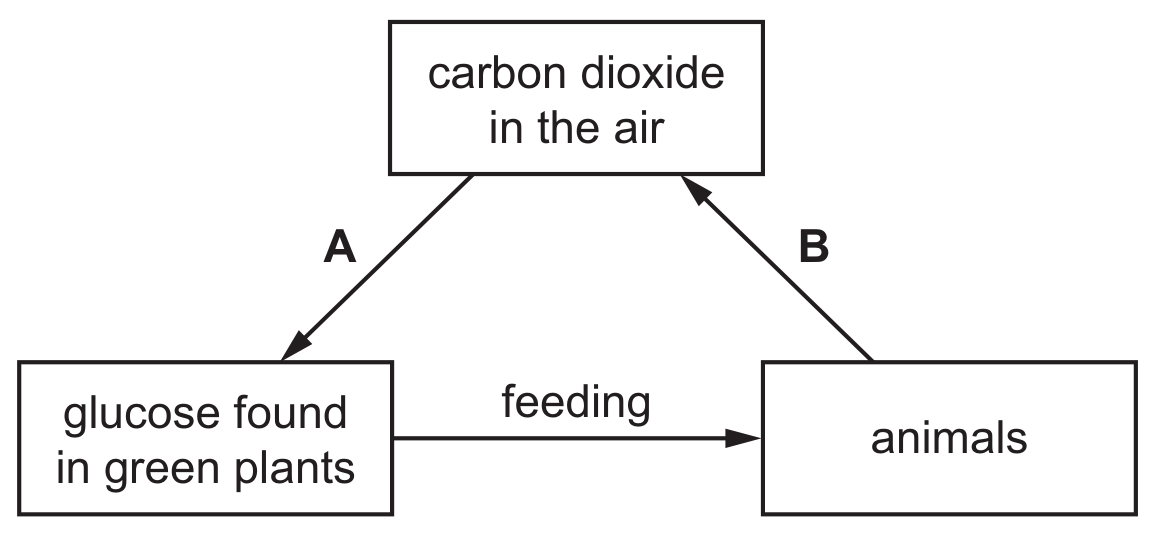
The CO2\mathrm{CO}_{2} in air is part of the carbon cycle.

The scheme shows a simple representation of part of the carbon cycle.

Question image
[ 4 ]

Question 2(g)(i)

(i)

State the scientific terms for each of process A and process B.

A
B

[ 2 ]

Question 2(g)(ii)

(ii)

Plants convert glucose into complex carbohydrates.

A unit of glucose can be represented as HOOH\mathrm{HO}-\square \mathrm{OH}.
Complete the diagram to show the complex carbohydrate formed from three units of glucose. Show all of the atoms and all of the bonds in the linkages.

Question image
Question image
Question image
[ 2 ]

Question 3

[Maximum number: 5]

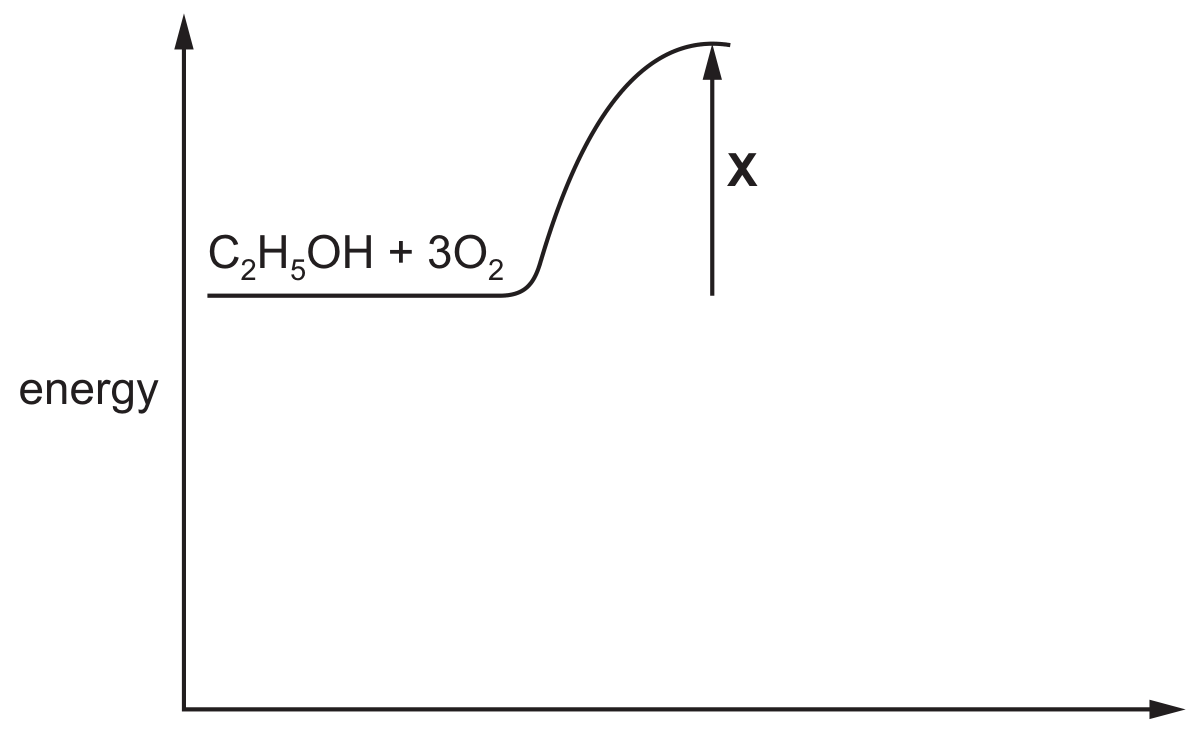
The chemical equation for the complete combustion of ethanol, C2H5OH\mathrm{C}_{2} \mathrm{H}_{5} \mathrm{OH}, is shown.

C2H5OH+3O22CO2+3H2O\mathrm{C}_{2} \mathrm{H}_{5} \mathrm{OH}+3 \mathrm{O}_{2} \rightarrow 2 \mathrm{CO}_{2}+3 \mathrm{H}_{2} \mathrm{O}

The energy released when one mole of ethanol undergoes complete combustion is 1280 kJ .
Part of the energy level diagram for this reaction is shown.

Question image

Question 3(f)

(a)

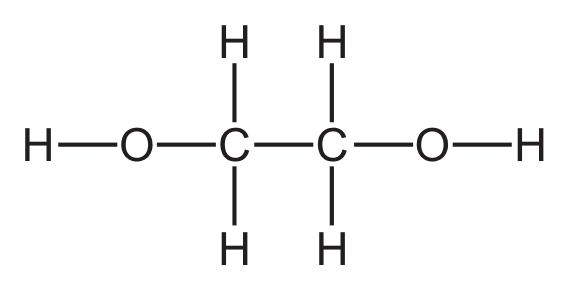
Ethane-1,2-diol has the following structure.

Question image
[ 5 ]

Question 3(f)(ii)

(i)

Ethane-1,2-diol can undergo condensation polymerisation but cannot undergo addition polymerisation.

Explain why ethane-1,2-diol cannot undergo addition polymerisation.
(iii) Ethane-1,2-diol undergoes condensation polymerisation with molecule Y.

The diagrams represent the structures of ethane-1,2-diol and molecule Y.

ethane-1,2-diol

ethane-1,2-diol

molecule Y

molecule Y

[ 1 ]

Question 3(f)(iii)

(ii)

Draw the condensation polymer formed between ethane-1,2-diol and molecule Y. Show one repeat unit. Show all of the atoms and all of the bonds in the linkage.

[ 3 ]

Question 3(f)(iv)

(iii)

Name the type of condensation polymer formed between ethane-1,2-diol and molecule Y.

[ 1 ]

Question 35

[Maximum number: 1]

What is the correct structure of PET?

Question 35

[Maximum number: 1]

The structure of a polymer is shown.

Question image

Which statement about this polymer is correct?

A

Alkenes are polymerised to make the polymer.

B

It is a polyester.

C

It is an addition polymer.

D

Water is produced when the polymer is made.

Question 35

[Maximum number: 1]

The diagram shows part of a polymer.

Question image

Which diagram shows the monomer from which this polymer is made?

Question 36

The structure of part of a polymer is shown.

Question image

Which monomers can be used to make this polymer?
1

Question image

2

Question image

3

Question image

4

Question image

A 1 and 2
B 1 and 4
C 2 and 3
D 3 and 4

0 selected