Question 1
[Maximum number: 1]
This question is about the first 30 elements in the Periodic Table.
Name the element which:
Question 1(j)
(a)
is used to galvanise iron.
[ 1 ]
 EduNinja
This question is about the first 30 elements in the Periodic Table.
Name the element which:
is used to galvanise iron.
Iron rusts when it is in contact with oxygen and water.
Explain how sacrificial protection prevents rusting.
State one other method of rust prevention.
Tin is a metallic element in Group IV. Its main ore is cassiterite which is an impure form of tin(IV) oxide, .
Tin also occurs in stannite, .
Iron does not rust when it is completely coated with zinc. When the zinc is scratched, the iron still does not rust.
Explain why the iron does not rust when it is completely coated with zinc.
Explain why the iron still does not rust when the zinc is scratched.
The metal iron and the alloy steel are commonly used materials. A problem with them is that they rust.
How does painting iron and steel prevent rusting?
Magnesium blocks can be attached to the bottom of steel boats.
Explain how the magnesium blocks prevent the whole of the bottom of the boat from rusting.
Replacing the magnesium blocks with copper blocks does not prevent rusting.
Explain why the copper blocks do not prevent rusting.
[Total: 10]
Iron is manufactured in a blast furnace.
Preventing the rusting of steel is important.
State the chemical name of rust.
Steel can be coated with zinc to prevent rusting. This provides both a barrier method and sacrificial protection.
State the term used for coating steel with zinc.
Describe another barrier method for preventing rusting.
Explain how zinc provides sacrificial protection.
Which statement explains why galvanising prevents iron from rusting?
Zinc is more reactive than iron and corrodes in preference to iron.
Zinc is more reactive than iron and loses electrons less easily than iron.
Zinc is less reactive than iron and corrodes in preference to iron.
Zinc is less reactive than iron and loses electrons more easily than iron.
Mild steel is galvanised to prevent corrosion of the iron.
Which statements about galvanising are correct?
1 Galvanising prevents corrosion because the zinc forms an alloy.
2 If the coating is damaged, water and oxygen do not corrode the iron.
3 Zinc is a sacrificial metal and corrodes in preference to iron.
1 and 2
1 and 3
2 only
2 and 3
This question is about metals and metal oxides.
Iron often rusts.
Name the two substances, other than iron, that must be present for iron to rust.
1
2
Metal X acts as a sacrificial metal to prevent iron from corroding.
Metal X does not act as a sacrificial metal to prevent aluminium from corroding.
What is X ?
copper
magnesium
silver
zinc
Three experiments, J, K and L, are set up to investigate rusting.
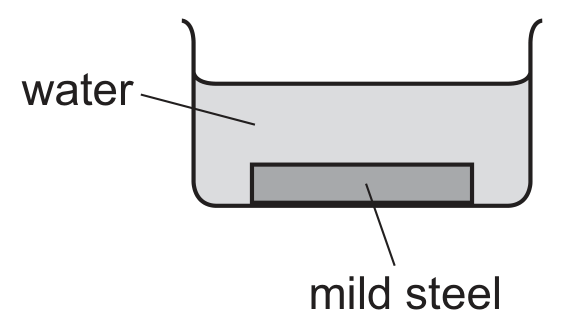
J
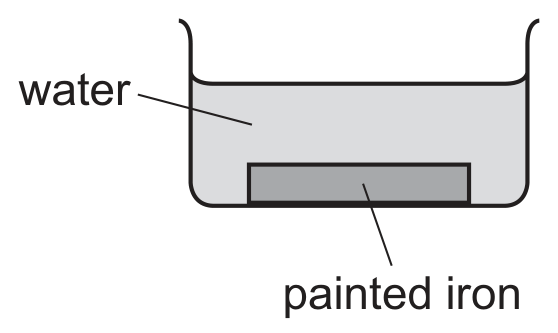
K
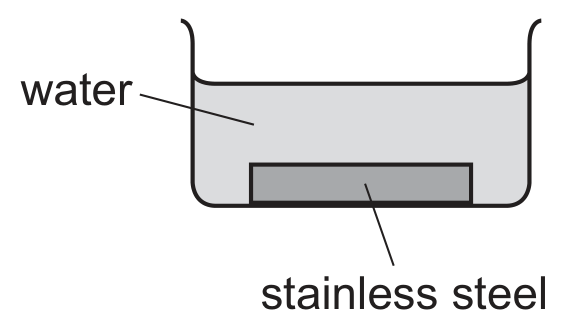
L
In which experiments does rusting occur?
J
K
L
key
x
x
x
yes
x
x
no
x