Question 1
Question 1(b)
(a)
Some acids are described as weak acids.
State the meaning of the term weak acid.
weak
acid
[2]
[Total: 10]
[ 2 ]
 EduNinja
Some acids are described as weak acids.
State the meaning of the term weak acid.
weak
acid
[2]
[Total: 10]
The following are the symbols and formulae of some elements and compounds.

Answer the following questions using only the elements or compounds in the list. Each element or compound may be used once, more than once or not at all.
State which element or compound is used:
to neutralise excess acidity in soil [1]
A list of gases is shown.
ammonia
carbon dioxide
carbon monoxide
ethene
fluorine
oxygen
sulfur dioxide
xenon
Answer the following questions using only the gases from the list. Each gas may be used once, more than once or not at all.
Give the name of the gas that:
forms an alkaline solution when dissolved in water
Some symbol equations and word equations, A to J, are shown.
A
B
C ethane + chlorine → chloroethane + hydrogen chloride
D
E ethene + steam → ethanol
F chlorine + aqueous potassium iodide → iodine + aqueous potassium chloride
G
H ethanoic acid + ethanol → ethyl ethanoate + water
I calcium carbonate → calcium oxide + carbon dioxide
J
Use the equations to answer the questions that follow.
Each equation may be used once, more than once, or not at all.
Give the letter, A to J, for the equation that represents:
a neutralisation reaction [1]
The symbols of the elements of Period 3 of the Periodic Table are shown.

Answer the following questions about these elements.
Each element may be used once, more than once or not at all.
Write the symbol of an element which:
forms a binary compound with hydrogen that is a strong acid.
The table shows the numbers of protons, neutrons and electrons in particles A to I.
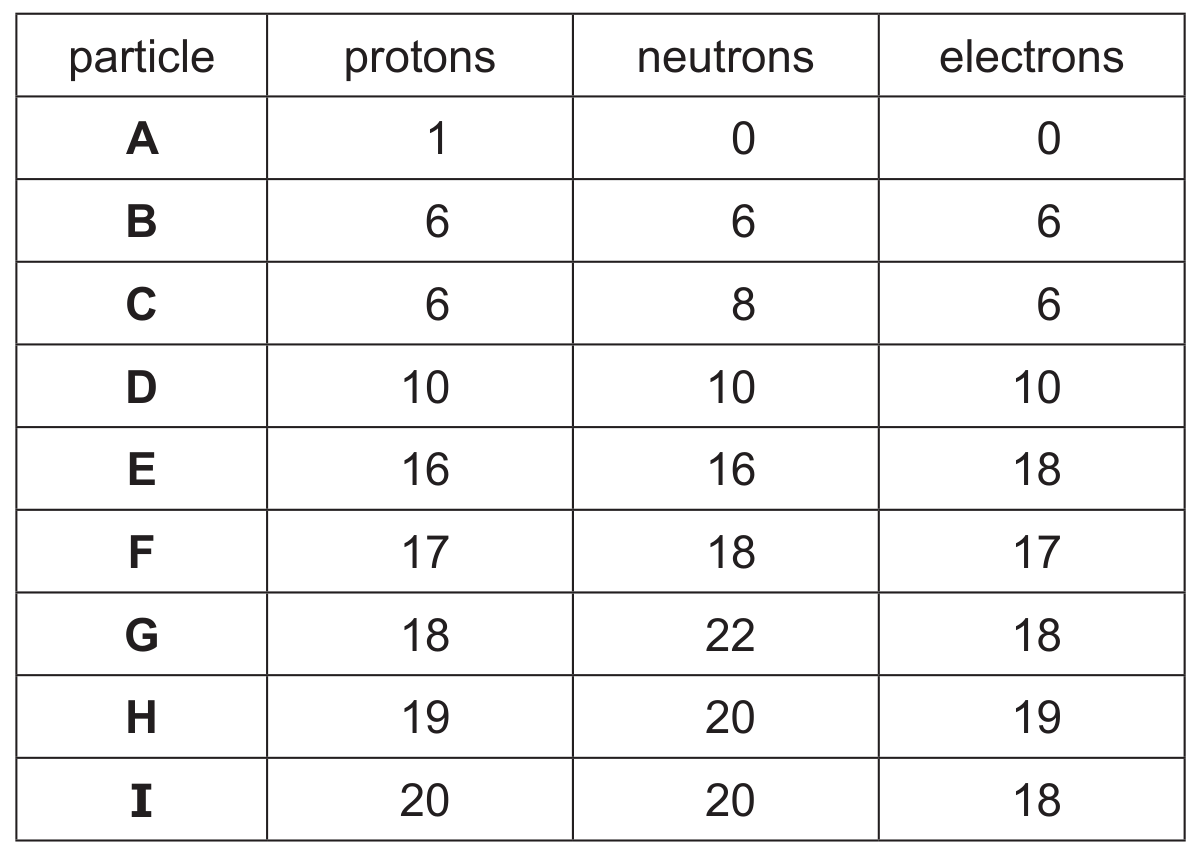
Answer the following questions about particles A to I. Each letter may be used once, more than once or not at all.
State which of the particles A to I:
causes acidity in aqueous solutions
Rubidium, Rb, is a Group I element. It has similar physical and chemical properties to the other elements in Group I.
When rubidium is added to cold water a reaction occurs.
What would be the colour of the solution if methyl orange was added to it after the reaction?
Period 3 contains the elements sodium to argon. This question asks about the chemistry of each of the Period 3 elements or their compounds.
Magnesium reacts slowly with warm water to form a base, magnesium hydroxide.
Explain what is meant by the term base.
Magnesium reacts with sulfuric acid.
What are the formulae of the products formed in this reaction?
A and
B and
C and
D and
Magnesium, calcium and strontium are Group II elements.
Calcium reacts with cold water to form two products:
- a colourless gas, P, which 'pops' with a lighted splint
- a weakly alkaline solution, Q, which turns milky when carbon dioxide is bubbled through it.
Identify the ion responsible for making solution Q alkaline.
Suggest the pH of solution Q.