EduNinja

IGCSE Chemistry2.6 Giant covalent structuresQuestion Bank

Question 1

[Maximum number: 1]

Period 3 of the Periodic Table is shown.

Table

Answer the following questions using only these elements.
Each element may be used once, more than once or not at all.
State which element:

Question 1(f)

(a)

forms an oxide which has a macromolecular structure

[ 1 ]
Question 1

[Maximum number: 1]

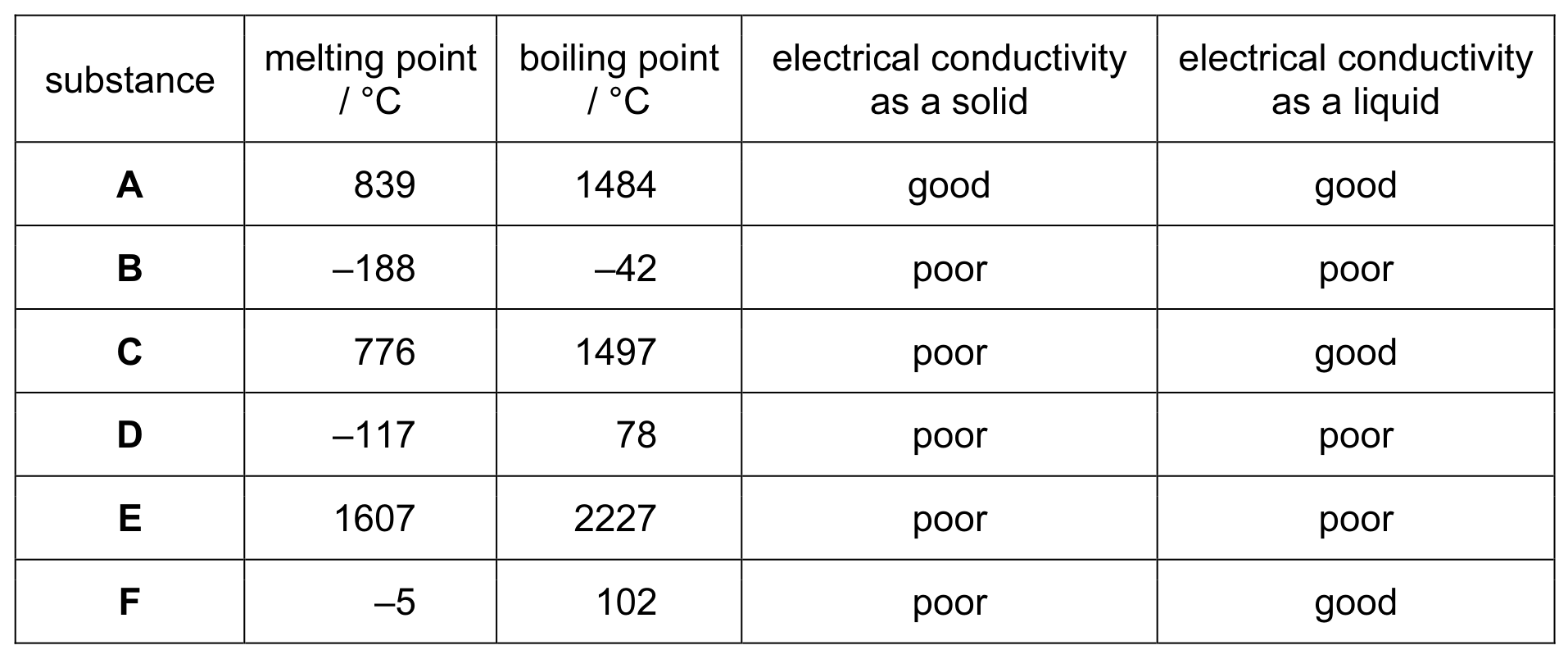
The following table gives information about six substances.

Table

Question 1(c)

(a)

Which substance could have a macromolecular structure similar to that of silicon(IV) oxide?

[ 1 ]

Question 1

Question 1(a)

(a)

This question is about elements.
> aluminium
> carbon iron hydrogen oxygen silicon sodium sulfur

Answer the following questions about these elements.
Each element may be used once, more than once or not at all.

[ 1 ]

Question 1(a)(ii)

(i)

Name the element that forms an oxide with a similar structure to diamond.

[ 1 ]

Question 1

[Maximum number: 1]

The symbols of the elements of Period 3 of the Periodic Table are shown.

Table

Answer the following questions about these elements.
Each element may be used once, more than once or not at all.
Write the symbol of an element which:

Question 1(g)

(a)

forms an oxide with a macromolecular structure

[ 1 ]

Question 1

[Maximum number: 1]

The names of eight substances are given.

Table

Answer the following questions about these substances.
Each substance may be used once, more than once or not at all.
State which substance is:

Question 1(f)

(a)

a macromolecular solid.

[ 1 ]

Question 1

[Maximum number: 1]

This question is about the first 30 elements in the Periodic Table.
Name the element which:

Question 1(d)

(a)

forms an oxide with a giant covalent structure

[ 1 ]

Question 1

[Maximum number: 6]

Diamond and graphite are different solid forms of carbon. The carbon atoms in diamond and graphite are arranged in different ways.

Question 1(a)

(a)

State the number of covalent bonds each carbon atom has in diamond.

[ 1 ]

Question 1(b)

(b)

State the term used to describe the structure of diamond.

[ 1 ]

Question 1(c)

(c)

Name an oxide that has a similar structure to diamond.

[ 1 ]

Question 1(d)

(d)

Describe the arrangement of atoms in graphite.

[ 2 ]

Question 1(e)

(e)

Explain how graphite conducts electricity.

[ 1 ]

Question 1

[Maximum number: 1]

A list of oxides, A to H, is shown.

A calcium oxide
B aluminium oxide
C silicon(IV) oxide
D sulfur dioxide
E carbon dioxide
F iron(III) oxide
G silver oxide
H carbon monoxide

Answer the following questions about the oxides, A to H. Each letter may be used once, more than once or not at all.

State which of the oxides, A to H:

Question 1(b)

(a)

has a giant covalent structure

[ 1 ]

Question 1

[Maximum number: 1]

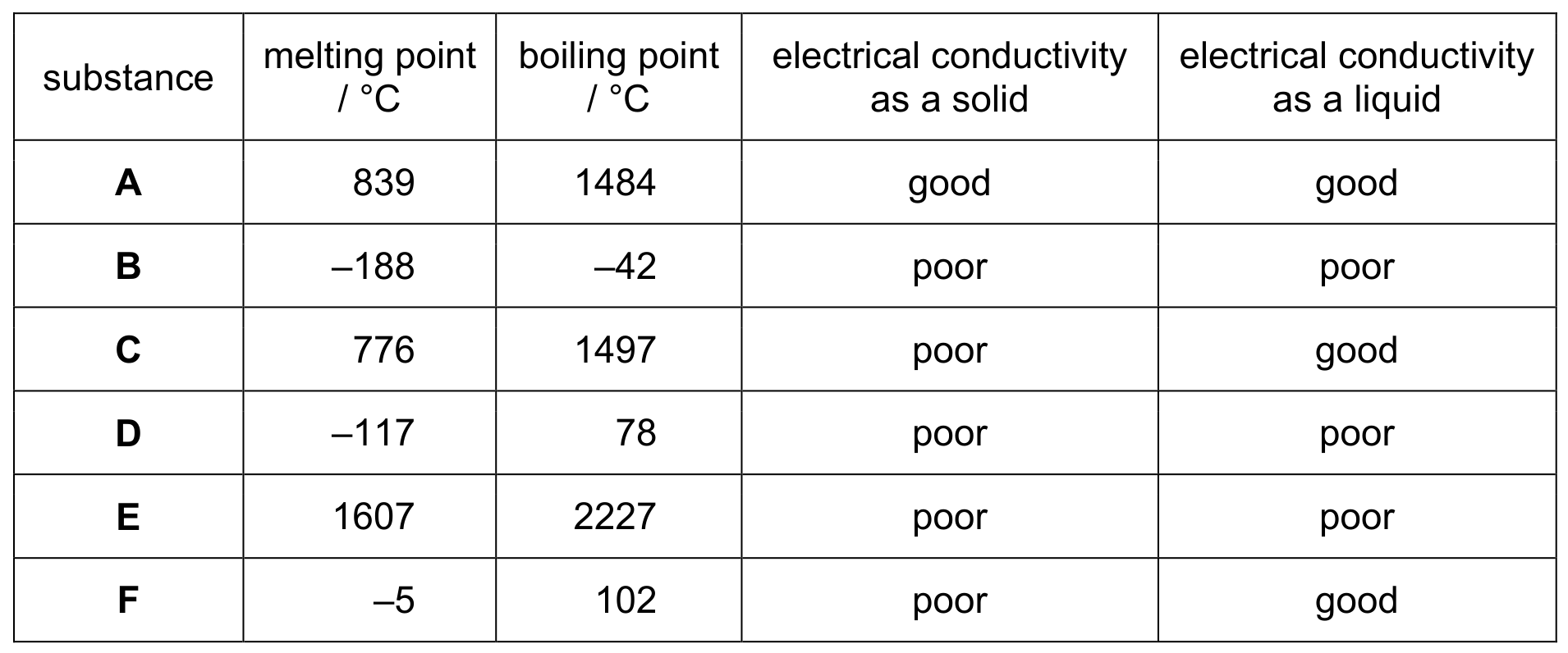
The following table gives information about six substances.

Table

Question 1(c)

(a)

Which substance could have a macromolecular structure similar to that of silicon(IV) oxide?

[ 1 ]

Question 1

Question 1(a)

(a)

For each of the following, give the name of an element from Period 2 (lithium to neon), which matches the description.
Elements may be used once, more than once or not at all.

[ 1 ]

Question 1(a)(vi)

(i)

an element which exists as both diamond and graphite

[ 1 ]
0 selected