EduNinja

IGCSE Chemistry1.2 DiffusionQuestion Bank

Question 1

[Maximum number: 1]

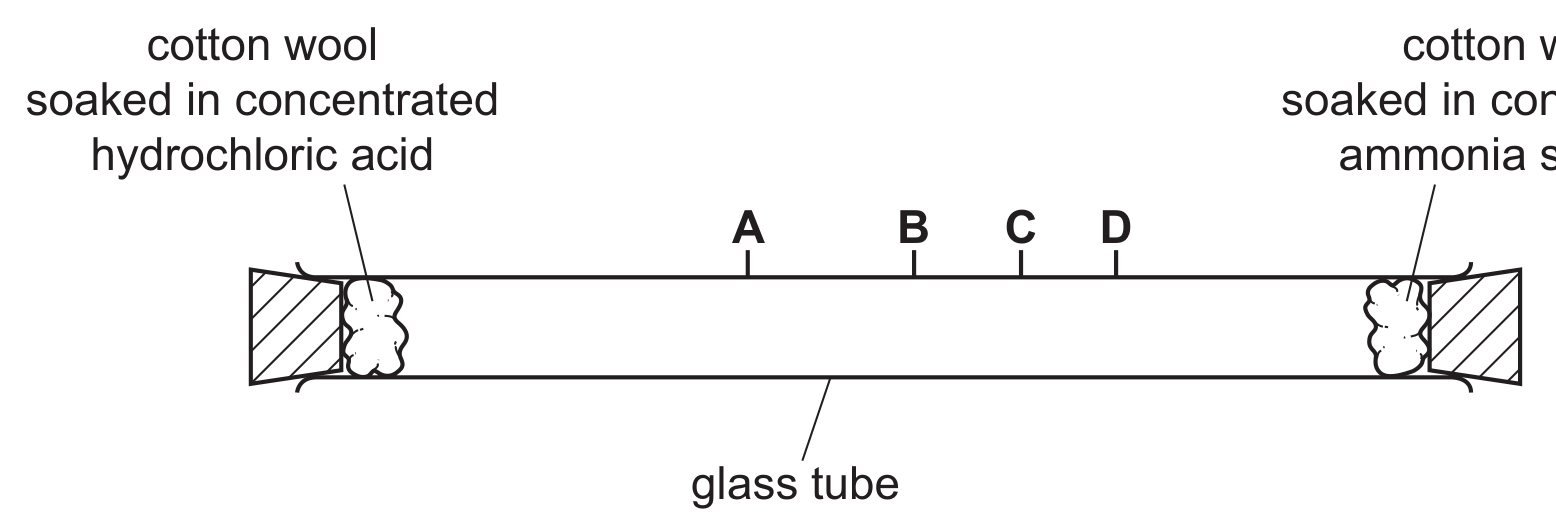
An experiment is set up as shown.

Question image

After several minutes, a white ring of ammonium chloride appears as shown.

Question image

Which statement explains the observation after several minutes?

A

Ammonia gas diffuses faster than hydrogen chloride gas because its molecules have a lower molecular mass.

B

Ammonia gas diffuses faster than hydrogen chloride gas because its molecules have a higher molecular mass.

C

Ammonia gas diffuses slower than hydrogen chloride gas because its molecules have a lower molecular mass.

D

Ammonia gas diffuses slower than hydrogen chloride gas because its molecules have a higher molecular mass.

Question 1

[Maximum number: 1]

A student investigated the diffusion of ammonia gas, NH3\mathrm{NH}_{3}, and hydrogen chloride gas, HC l.
Two sets of apparatus were set up as shown at room temperature and pressure.

apparatus 1

apparatus 1

apparatus 2

apparatus 2

The damp red litmus paper in apparatus 1 changed colour after 30 seconds.
How long does it take for the damp blue litmus paper to change colour in apparatus 2 ?

A

64 seconds

B

30 seconds

C

21 seconds

D

The blue litmus paper would not change colour.

Question 1

[Maximum number: 1]

Oxygen and fluorine are gaseous elements next to each other in the Periodic Table.
Under the same conditions of temperature and pressure, oxygen diffuses 1 than fluorine because its 2 is less than that of fluorine.

Which words correctly complete gaps 1 and 2?

1

2

faster

molecular mass

faster

reactivity

slower

molecular mass

slower

reactivity

Question 1

[Maximum number: 1]

Which statement explains why ammonia gas, NH3\mathrm{NH}_{3}, diffuses at a faster rate than hydrogen chloride gas, HCl ?

A

Ammonia expands to occupy all of the space available.

B

Ammonia has a smaller relative molecular mass than hydrogen chloride.

C

Ammonia is an alkali and hydrogen chloride is an acid.

D

Ammonia molecules diffuse in all directions at the same time. 22.00 g of powdered calcium carbonate is added to 50.0 cm350.0 \mathrm{~cm}^{3} of hydrochloric acid. Which apparatus is used to measure the calcium carbonate and the hydrochloric acid?

calcium carbonate

hydrochloric acid

balance

burette

balance

thermometer

pipette

burette

pipette

thermometer

Question 1

[Maximum number: 1]

Samples of four gases are released in a room at the same time.
The gases are carbon dioxide, CO2\mathrm{CO}_{2}, hydrogen chloride, HCl , hydrogen sulfide, H2 S\mathrm{H}_{2} \mathrm{~S}, and nitrogen dioxide, NO2\mathrm{NO}_{2}.

Which gas diffuses fastest?

A

carbon dioxide

B

hydrogen chloride

C

hydrogen sulfide

D

nitrogen dioxide

Question 1

[Maximum number: 1]

Which gas has the slowest rate of diffusion?

A

H2\mathrm{H}_{2}

B

NH3\mathrm{NH}_{3}

C

CH4\mathrm{CH}_{4}

D

CO2\mathrm{CO}_{2}

Question 1

[Maximum number: 1]

Which gas diffuses the most slowly?

A

CH4\mathrm{CH}_{4}

B

CO2\mathrm{CO}_{2}

C

H2\mathrm{H}_{2}

D

NH3\mathrm{NH}_{3}

Question 1

[Maximum number: 1]

'Particles moving very slowly from an area of higher concentration to an area of lower concentration.'

Which process is being described?

A

a liquid being frozen

B

a solid melting

C

a substance diffusing through a liquid

D

a substance diffusing through the air

Question 1

[Maximum number: 1]

The diagram shows the result of dropping a purple crystal into water.

Question image

Which processes take place in this experiment?

chemical

reaction

diffusing

dissolving

\checkmark

\checkmark

x

\checkmark

x

x

x

x

\checkmark

x

\checkmark

\checkmark

Question 1

[Maximum number: 1]

Small crystals of purple KMnO4(Mr=158)\mathrm{KMnO}_{4}\left(M_{\mathrm{r}}=158\right) and orange K2Cr2O7(Mr=294)\mathrm{K}_{2} \mathrm{Cr}_{2} \mathrm{O}_{7}\left(M_{\mathrm{r}}=294\right) were placed at the centres of separate petri dishes filled with agar jelly. They were left to stand under the same physical conditions.

After some time, the colour of each substance had spread out as shown.

Question image
Question image

The lengths of the arrows indicate the relative distances travelled by particles of each substance.
Which statement is correct?

A

Diffusion is faster in dish 1 because the mass of the particles is greater.

B

Diffusion is faster in dish 2 because the mass of the particles is greater.

C

Diffusion is slower in dish 1 because the mass of the particles is smaller.

D

Diffusion is slower in dish 2 because the mass of the particles is greater.

0 selected