Question 1
The particles of a substance gain energy and change from a regular ordered structure to a disordered structure with large distances between the particles.
Which change of state is described?
boiling
evaporation
melting
sublimation
EduNinjaThe particles of a substance gain energy and change from a regular ordered structure to a disordered structure with large distances between the particles.
Which change of state is described?
boiling
evaporation
melting
sublimation
A gas is placed in a sealed container. The gas has a pressure of one atmosphere and a temperature of 50∘C.
It is heated to 100∘C.
Which row describes the cause of the pressure of the gas and the effect of increasing the temperature of the gas?
cause of gas pressure
the effect of increased
temperature of the gas
collisions between
gas particles
collisions become
less frequent
collisions between
gas particles
the average speed of
the gas particles increases
collisions between gas
particles and the container
collisions become
less frequent
collisions between gas
particles and the container
the average speed of
the gas particles increases
A gaseous substance is slowly cooled and the temperature recorded every second.
The results are shown on the graph.

At which point is the substance a solid?
Substance M is a solid at 30∘C.
The substance is heated to 80∘C and its temperature measured as it cools down to room temperature.
The cooling curve is shown.

Between which times is substance M freezing?
P to Q
Q to R
R to S
S to T
A mixture of ice and water is left to stand and the ice melts.
Which row describes what happens as the ice is melting?
temperature of mixture
energy changes
increases
average kinetic energy of particles increases
increases
energy is used to overcome attractive forces
stays the same
average kinetic energy of particles increases
stays the same
energy is used to overcome attractive forces
A mixture of ice and water is left to stand and the ice melts.
Which row describes what happens as the ice is melting?
temperature of mixture
energy changes
increases
average kinetic energy of particles increases
increases
energy is used to overcome attractive forces
stays the same
average kinetic energy of particles increases
stays the same
energy is used to overcome attractive forces
Pure water boils at 100∘C.
What happens to the water particles when water boils?
They gain energy and move further apart.
They gain energy and stay close together.
They lose energy and move further apart.
They lose energy and stay close together.
When smoke particles are observed with a microscope they are seen to move around randomly. This is called Brownian motion.
What causes Brownian motion?
diffusion of the smoke particles
molecules in the air hitting the smoke particles
sublimation of the smoke particles
the smoke particles hitting the walls of the container
Which statement describes sublimation?
Particles moving slowly past each other speed up and move further apart.
Particles vibrating next to each other become mobile and move slowly past each other.
Particles vibrating next to each other start to move rapidly and move further apart.
Rapidly moving particles slow down and move closer together.
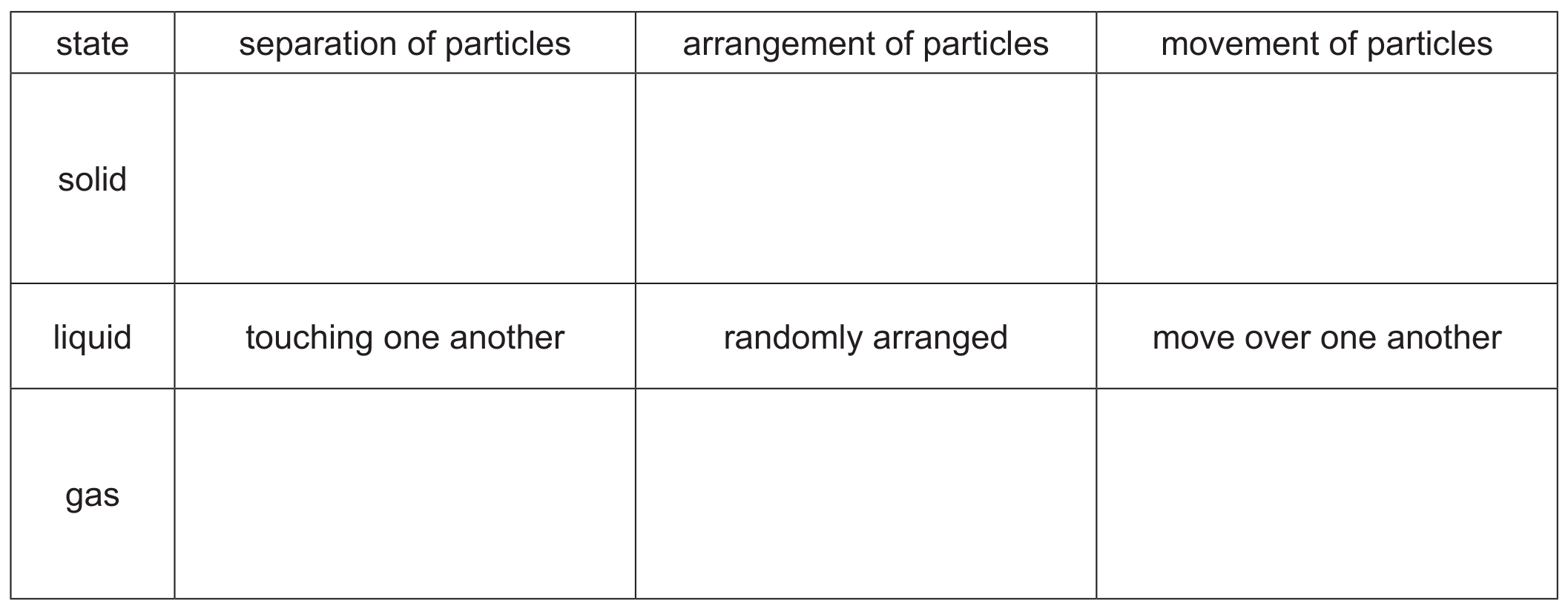
This question is about states of matter.
Complete the table, using ticks (✓) and crosses (X), to describe the properties of gases, liquids and solids.

Substances can change state.
Boiling and evaporation are two ways in which a liquid changes into a gas.
Describe two differences between boiling and evaporation.
1
2
Name the change of state when:
- a gas becomes a liquid
- a solid becomes a gas.
A substance boils at temperature X and melts at temperature Y.
Complete the graph to show the change in temperature over time as the substance cools from temperature A to temperature B.