EduNinja

IGCSE Chemistry9.4 Reactivity seriesQuestion Bank

Question 1

[Maximum number: 5]

Some elements are shown in the order they appear in the reactivity series. The most reactive element is at the top.
> sodium calcium magnesium aluminium zinc iron hydrogen copper

Question 1(b)

(a)

Name the main ores of:

[ 2 ]

Question 1(b)(i)

(i)

zinc [1]

[ 1 ]

Question 1(b)(ii)

(ii)

aluminium.

[ 1 ]

Question 1(c)

(b)

In an experiment, a sample of aluminium appeared less reactive than expected.

Explain why.

[ 1 ]

Question 1(e)

(c)

When zinc granules are added to aqueous copper(II) sulfate, a reaction occurs. During the reaction, a red-pink solid is formed and the solution becomes colourless.

[ 2 ]

Question 1(e)(i)

(i)

Name the red-pink solid.

[ 1 ]

Question 1(e)(ii)

(ii)

Name the colourless solution.

[ 1 ]
Question 1

[Maximum number: 1]

A list of oxides, A to H, is shown.

A calcium oxide
B aluminium oxide
C silicon(IV) oxide
D sulfur dioxide
E carbon dioxide
F iron(III) oxide
G silver oxide
H carbon monoxide

Answer the following questions about the oxides, A to H. Each letter may be used once, more than once or not at all.

State which of the oxides, A to H:

Question 1(f)

(a)

can be reduced by heating with copper.

[ 1 ]

Question 2

[Maximum number: 2]

Rubidium, Rb, is a Group I element. It has similar physical and chemical properties to the other elements in Group I.

Question 2(d)

(a)

When rubidium is added to cold water a reaction occurs.

[ 2 ]

Question 2(d)(i)

(i)

Suggest two observations that would be made when rubidium is added to cold water.

[ 2 ]

Question 2

[Maximum number: 2]

Period 3 contains the elements sodium to argon. This question asks about the chemistry of each of the Period 3 elements or their compounds.

Question 2(b)

(a)

Magnesium reacts slowly with warm water to form a base, magnesium hydroxide.

[ 2 ]

Question 2(b)(ii)

(i)

Write a chemical equation for the reaction between magnesium and warm water.

[ 2 ]

Question 2

[Maximum number: 2]

Boron and aluminium are Group III elements.

Question 2(e)

(a)

Explain the apparent unreactivity of aluminium.

[ 2 ]

Question 2

Question 2(c)

(a)

When a piece of zinc metal is added to copper(II) sulfate solution there is an immediate reaction.

Zn+CuSO4ZnSO4+Cu\mathrm{Zn}+\mathrm{CuSO}_{4} \rightarrow \mathrm{ZnSO}_{4}+\mathrm{Cu}

When a piece of aluminium metal is added to copper(II) sulfate solution the initial reaction is very slow.

[ 3 ]

Question 2(c)(i)

(i)

Explain why zinc metal reacts with copper(II) sulfate.

[ 1 ]

Question 2(c)(ii)

(ii)

What type of reaction is this?

[ 1 ]

Question 2(c)(iii)

(iii)

Explain why the initial reaction between aluminium metal and copper(II) sulfate is very slow.

[ 1 ]

Question 2

[Maximum number: 3]

Magnesium, calcium and strontium are Group II elements.

Question 2(c)

(a)

Calcium reacts with cold water to form two products:
- a colourless gas, P, which 'pops' with a lighted splint
- a weakly alkaline solution, Q, which turns milky when carbon dioxide is bubbled through it.

[ 3 ]

Question 2(c)(i)

(i)

Name gas P.

[ 1 ]

Question 2(c)(iv)

(ii)

Write a chemical equation for the reaction of calcium with cold water.

[ 2 ]

Question 2

[Maximum number: 4]

A list of five metals is shown.

A list of five metals is shown.

\title{
copper \\ iron \\ magnesium \\ potassium \\ silver
}

Question 2(a)

(a)

All metals form positive ions.

[ 1 ]

Question 2(a)(ii)

(i)

State which of the five metals in the list has the greatest tendency to form positive ions.

[ 1 ]

Question 2(b)

(b)

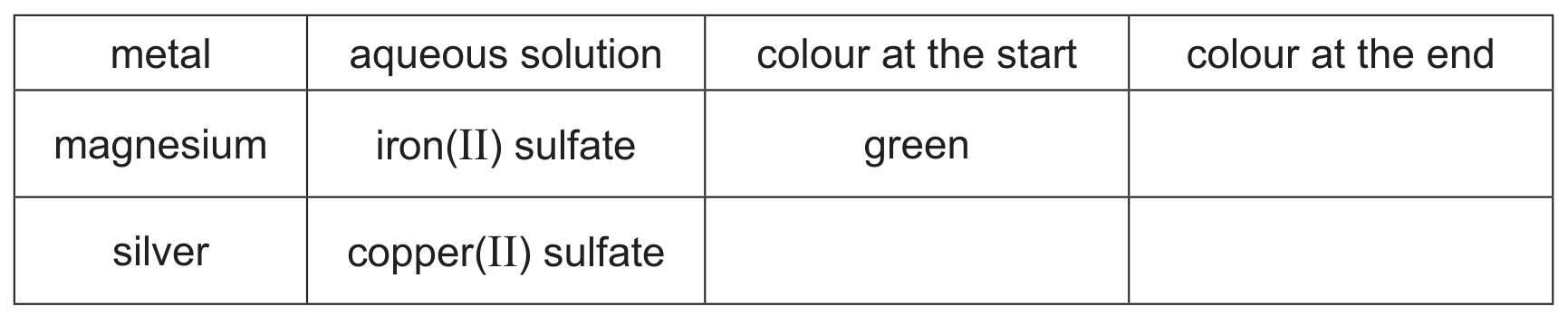
A student adds a sample of a metal to an aqueous metal salt in a beaker to see if a displacement reaction takes place.

Complete Table 2.1 to show the colour of the solution in the beaker at the start and at the end of the experiment.

Table 2.1

Table 2.1

[ 3 ]

Question 10

[Maximum number: 1]

The reactivity series for a number of different metals is shown.

Table

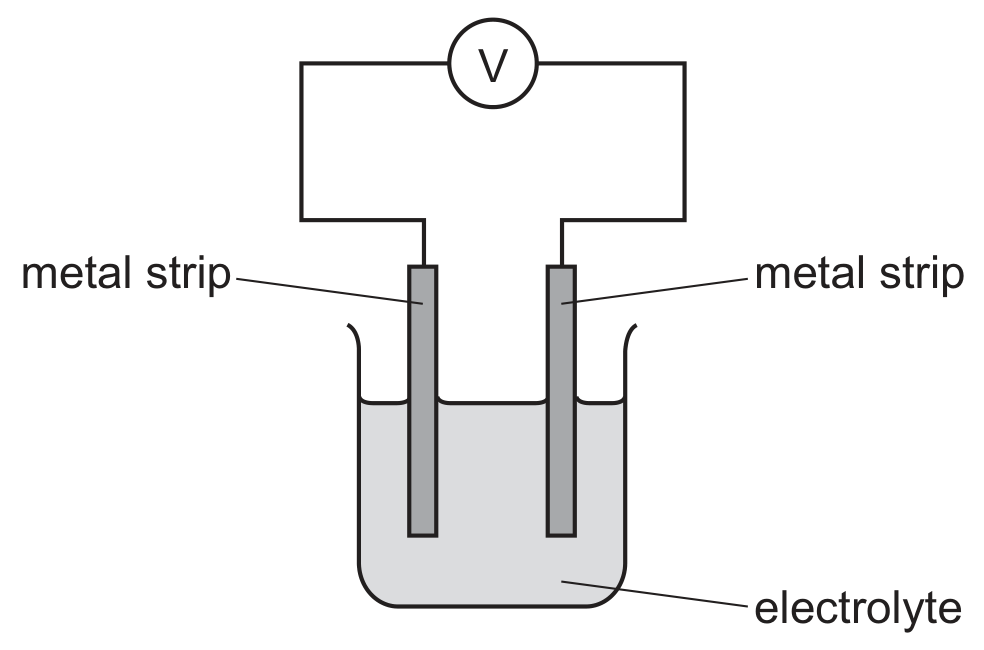
The diagram shows different metal strips dipped into an electrolyte.

Question image

Which pair of metals produces the highest voltage?

A

copper and magnesium

B

magnesium and platinum

C

magnesium and zinc

D

silver and platinum

Question 10

[Maximum number: 1]

Which metal combination produces the highest voltage reading in the cells shown?

0 selected