EduNinja

IGCSE Chemistry7.2 OxidesQuestion Bank

Question 1

[Maximum number: 1]

A list of substances is shown.
> barium nitrate carbon monoxide hydrated cobalt(II) chloride copper(II) oxide anhydrous copper(II) sulfate ethane potassium iodide propene sodium bromide sulfur dioxide zinc oxide

Answer the following questions using only the substances from the list. Each substance may be used once, more than once or not at all.

Give the name of the substance that:

Question 1(c)

(a)

is an acidic oxide

[ 1 ]

Question 1

[Maximum number: 2]

Iron ore contains iron(III) oxide, Fe2O3\mathrm{Fe}_{2} \mathrm{O}_{3}. A blast furnace is used to extract iron from Fe2O3\mathrm{Fe}_{2} \mathrm{O}_{3}.
Equations for some of the reactions in the blast furnace are shown.

equation 1C+O2CO21 \mathrm{C}+\mathrm{O}_{2} \rightarrow \mathrm{CO}_{2}

equation 2CaCO3CaO+CO22 \mathrm{CaCO}_{3} \rightarrow \mathrm{CaO}+\mathrm{CO}_{2}

equation 3CaO+SiO2CaSiO33 \quad \mathrm{CaO}+\mathrm{SiO}_{2} \rightarrow \mathrm{CaSiO}_{3}

Question 1(d)

Question 1(d)(i)

(a)
(i)

Explain why the reaction in equation 3 can be described as an acid-base reaction.

[ 2 ]

Question 1

[Maximum number: 1]

Period 3 of the Periodic Table is shown.

Table

Answer the following questions using only these elements.
Each element may be used once, more than once or not at all.
State which element:

Question 1(b)

(a)

forms a basic oxide with a formula of the form X2O\mathrm{X}_{2} \mathrm{O}

[ 1 ]

Question 1

Question 1(a)

(a)

This question is about elements.
> aluminium
> carbon iron hydrogen oxygen silicon sodium sulfur

Answer the following questions about these elements.
Each element may be used once, more than once or not at all.

[ 1 ]

Question 1(a)(iii)

(i)

Name the element that forms an amphoteric oxide.

[ 1 ]

Question 1

[Maximum number: 1]

The symbols of the elements of Period 3 of the Periodic Table are shown.

Table

Answer the following questions about these elements.
Each element may be used once, more than once or not at all.
Write the symbol of an element which:

Question 1(h)

(a)

forms an amphoteric oxide

[ 1 ]

Question 1

[Maximum number: 1]

The names of the elements of Period 2 of the Periodic Table are shown.
lithium beryllium boron carbon nitrogen oxygen fluorine neon Answer the following questions about these elements. Each element may be used once, more than once or not at all.

Identify the element which:

Question 1(c)

(a)

forms a basic oxide with the formula X2O\mathrm{X}_{2} \mathrm{O}

[ 1 ]

Question 2

[Maximum number: 3]

Period 3 contains the elements sodium to argon. This question asks about the chemistry of each of the Period 3 elements or their compounds.

Question 2(c)

(a)

Aluminium oxide is amphoteric. It is insoluble in water.

Describe experiments to show that aluminium oxide is amphoteric.

[ 3 ]

Question 2

[Maximum number: 7]

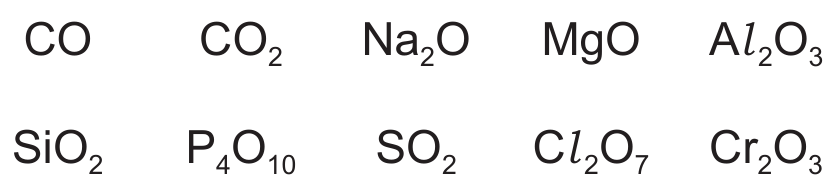
Some oxides of some elements are listed.

Table

Question 2(a)

(a)

Answer the following questions using only oxides from the list. Each oxide may be used once, more than once or not at all.

Give the formula of an oxide

[ 6 ]

Question 2(a)(v)

(i)

which is amphoteric,

Question 2(a)(vi)

(ii)

which is neutral.

[ 6 ]

Question 2(b)

(b)

Amphoteric oxides and neutral oxides are different from each other.

[ 1 ]

Question 2(b)(i)

(i)

What is meant by the term amphoteric oxide?

[ 1 ]

Question 2

Question 2(a)

(a)

The symbols of the elements in Period 3 of the Periodic Table are shown.

Table

Use the symbols of the elements in Period 3 to answer the questions that follow. Each symbol may be used once, more than once, or not at all.

Give the symbol of the element that:

[ 1 ]

Question 2(a)(iv)

(i)

forms an amphoteric oxide [1]

[ 1 ]

Question 2

[Maximum number: 1]

Flerovium, Fl, atomic number 114, was first made in research laboratories in 1998.

Question 2(e)

(a)

Only a relatively small number of atoms of flerovium have been made in the laboratory and the properties of flerovium have not yet been investigated.

It has been suggested that flerovium is a typical metal.

[ 1 ]

Question 2(e)(ii)

(i)

Suggest one chemical property of flerovium oxide.

[ 1 ]
0 selected