EduNinja

IGCSE Chemistry8.3 Group VII propertiesQuestion Bank

Question 1

[Maximum number: 1]

The table shows the numbers of protons, neutrons and electrons in particles A to I.
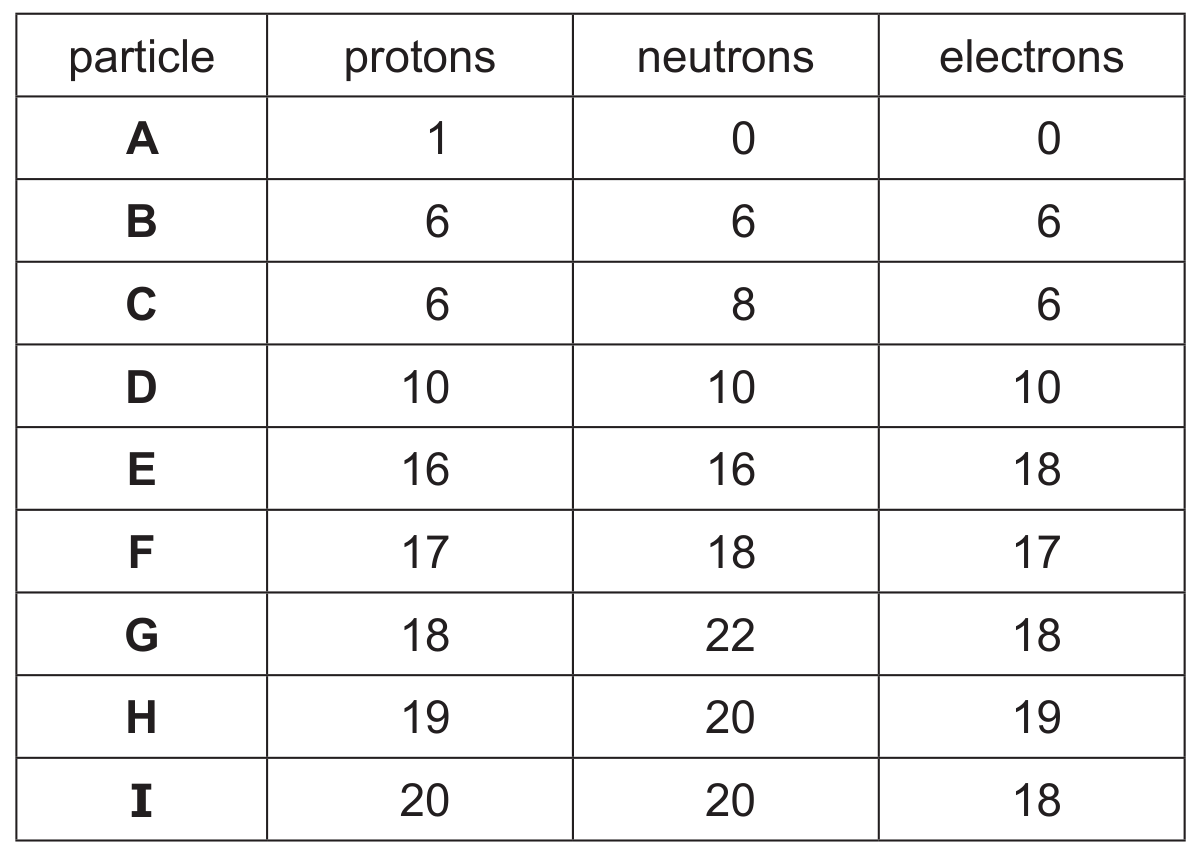
Table

Answer the following questions about particles A to I. Each letter may be used once, more than once or not at all.

Question 1(a)

(a)

State which of the particles A to I:

[ 1 ]

Question 1(a)(iv)

(i)

is a halogen atom

[ 1 ]

Question 1

[Maximum number: 1]

The symbols of the elements of Period 3 of the Periodic Table are shown.

Table

Answer the following questions about these elements.
Each element may be used once, more than once or not at all.
Write the symbol of an element which:

Question 1(i)

(a)

exists as diatomic molecules

[ 1 ]

Question 1

[Maximum number: 1]

Period 3 of the Periodic Table is shown.

Table

Answer the following questions using only these elements.
Each element may be used once, more than once or not at all.
State which element:

Question 1(g)

(a)

consists of diatomic molecules.

[ 1 ]

Question 1

[Maximum number: 1]

Some symbol equations and word equations, A to J, are shown.

A H++OHH2O\mathrm{H}^{+}+\mathrm{OH}^{-} \rightarrow \mathrm{H}_{2} \mathrm{O}

B Cr3++3OHCr(OH)3\mathrm{Cr}^{3+}+3 \mathrm{OH}^{-} \rightarrow \mathrm{Cr}(\mathrm{OH})_{3}

C methane + chlorine → chloromethane + hydrogen chloride
D propene + bromine → 1,2-dibromopropane

E C10H22C8H18+C2H4\quad \mathrm{C}_{10} \mathrm{H}_{22} \rightarrow \mathrm{C}_{8} \mathrm{H}_{18}+\mathrm{C}_{2} \mathrm{H}_{4}

F chlorine + aqueous potassium bromide → bromine + aqueous potassium chloride
G methane + oxygen → carbon monoxide + water

H C2H5COOH+CH3OHC2H5COOCH3+H2O\mathrm{C}_{2} \mathrm{H}_{5} \mathrm{COOH}+\mathrm{CH}_{3} \mathrm{OH} \rightarrow \mathrm{C}_{2} \mathrm{H}_{5} \mathrm{COOCH}_{3}+\mathrm{H}_{2} \mathrm{O}

I hydrogen + oxygen → water

J 6CO2+6H2OC6H12O6+6O26 \mathrm{CO}_{2}+6 \mathrm{H}_{2} \mathrm{O} \rightarrow \mathrm{C}_{6} \mathrm{H}_{12} \mathrm{O}_{6}+6 \mathrm{O}_{2}

Use the equations to answer the questions that follow.
Each equation may be used once, more than once, or not at all.
Give the letter, A to J, for the equation which represents:

Question 1(e)

(a)

a displacement reaction [1]

[ 1 ]

Question 2

[Maximum number: 1]

This question is about the elements in Period 3 of the Periodic Table.

Table

For each of the following, identify a Period 3 element which matches the description. Each element may be used once, more than once or not at all.

State which Period 3 element:

Question 2(d)

(a)

is a green gas at room temperature and pressure

[ 1 ]

Question 2

[Maximum number: 7]

Fluorine, chlorine and bromine are in Group VII of the Periodic Table.

Question 2(a)

(a)

State the name given to Group VII elements.

[ 1 ]

Question 2(c)

(b)

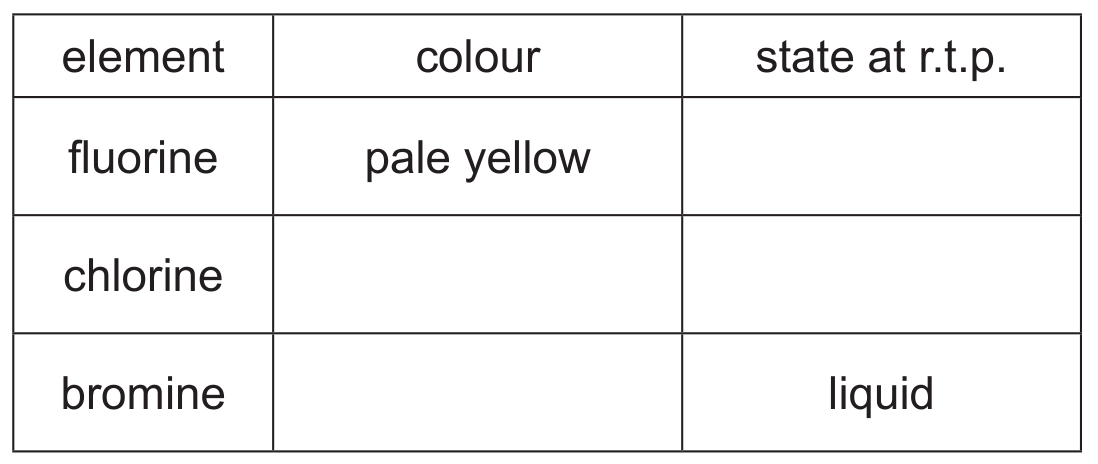
Complete Table 2.1 to show the colour and state at r.t.p. of some Group VII elements.

Table 2.1

Table 2.1

[ 3 ]

Question 2(e)

(c)

Chlorine displaces bromine from aqueous potassium bromide but does not displace fluorine from aqueous sodium fluoride.

[ 3 ]

Question 2(e)(i)

(i)

Write the symbol equation for the reaction between chlorine and aqueous potassium bromide.

[ 2 ]

Question 2(e)(ii)

(ii)

State why chlorine does not displace fluorine from aqueous sodium fluoride.

[ 1 ]

Question 12

[Maximum number: 1]

Chlorine gas is bubbled into aqueous potassium iodide.
What is the ionic equation for the reaction that takes place?

A

Cl+ICl+I\mathrm{Cl}+\mathrm{I}^{-} \rightarrow \mathrm{Cl}^{-}+\mathrm{I}

B

Cl2+2ICl2+I2\mathrm{Cl}_{2}+2 \mathrm{I}^{-} \rightarrow \mathrm{Cl}_{2}^{-}+\mathrm{I}_{2}

C

Cl2+2I2Cl+I2\mathrm{Cl}_{2}+2 \mathrm{I}^{-} \rightarrow 2 \mathrm{Cl}^{-}+\mathrm{I}_{2}

D

Cl2+2I2Cl+2I\mathrm{Cl}_{2}+2 \mathrm{I}^{-} \rightarrow 2 \mathrm{Cl}^{-}+2 \mathrm{I}

Question 2

[Maximum number: 2]

The elements shown are gases at room temperature and pressure.
> hydrogen nitrogen oxygen chlorine

Question 2(a)

(a)

State which one of these gases is green.

[ 1 ]

Question 2(b)

(b)

The gases shown exist as diatomic molecules.

State the name of another element which has diatomic molecules and is a gas at room temperature and pressure.

[ 1 ]

Question 3

[Maximum number: 2]

Fluorine is a Group VII element. Fluorine forms compounds with metals and non-metals.

Question 3(a)

(a)

Predict the physical state of fluorine at room temperature and pressure.

[ 1 ]

Question 3(d)

(b)

Explain why chlorine does not react with aqueous sodium fluoride.

[ 1 ]

Question 21

[Maximum number: 1]

Chlorine, bromine and iodine are elements in Group VII of the Periodic Table.
Which statement about these elements is correct?

A

The colour gets lighter down the group.

B

The density decreases down the group.

C

They are all gases at room temperature and pressure.

D

They are all non-metals.

0 selected