Question 1
[Maximum number: 2]
Give the name of the process that is used:
Question 1(a)
(a)
to obtain water from aqueous sodium chloride
[ 1 ]
Question 1(c)
(b)
to separate an insoluble solid from a liquid
[ 1 ]
 EduNinja
Give the name of the process that is used:
to obtain water from aqueous sodium chloride
to separate an insoluble solid from a liquid
Substances can be classified as elements, compounds or mixtures.
Mixtures can be separated by physical processes.
A sequence of physical processes can be used to separate common salt (sodium chloride) from a mixture containing sand and common salt only.
Give the order and the correct scientific term for the physical processes used to separate the common salt from the mixture.
1
2
3
The boiling points of four different alcohols, A, B, C and D, are shown.

A student suggested that the apparatus shown could be used to separate the mixture of alcohols.
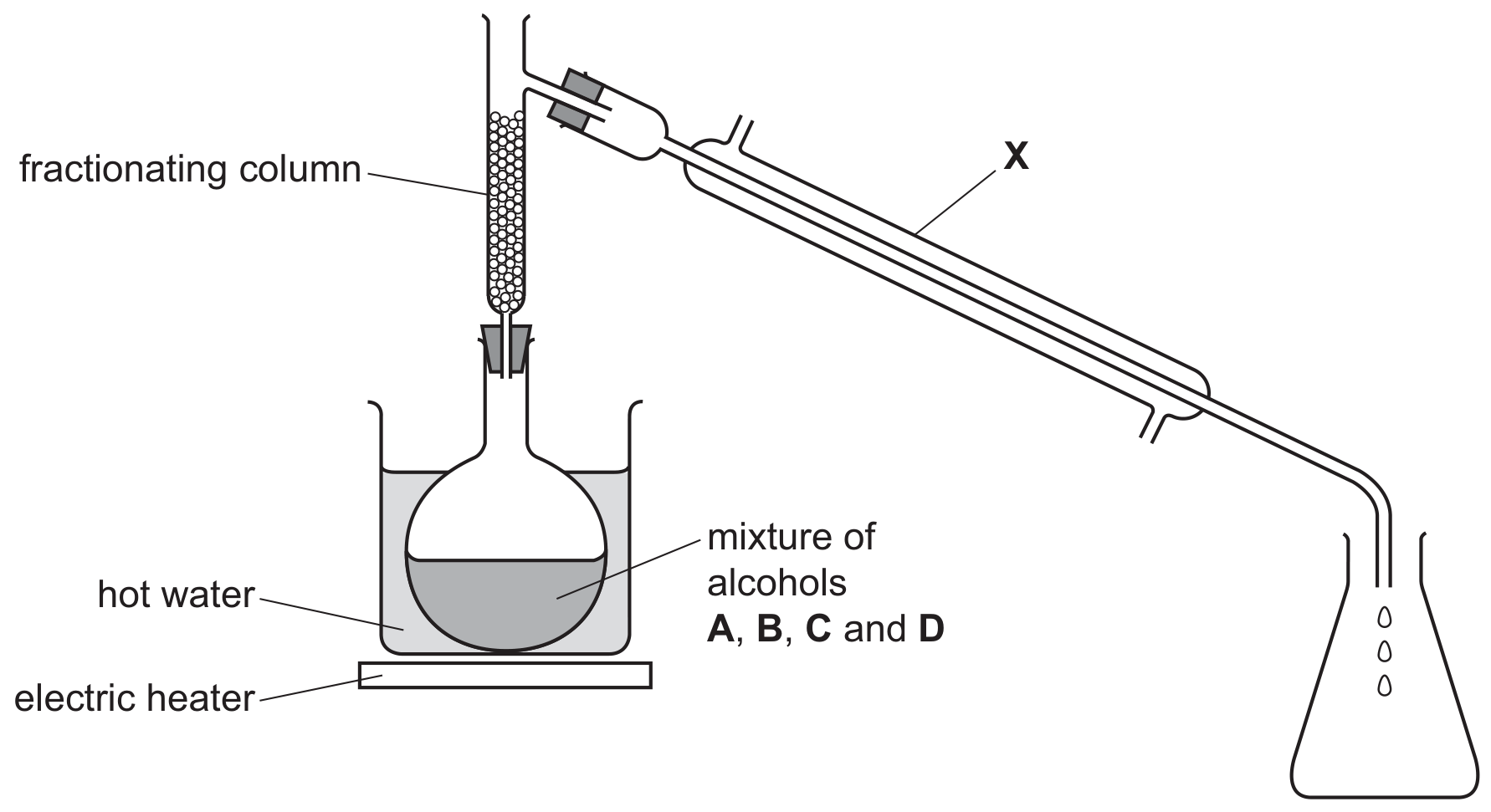
Apparatus X needs to have cold water flowing through it.
- Draw an arrow on the diagram to show where the cold water enters apparatus X.
- Name apparatus X.
Part of the fractionating column is missing. This means that the experiment will not work.
- Draw on the diagram the part of the fractionating column which is missing.
- Explain why the experiment will not work with this part of the fractionating column missing.
A hot water bath cannot be used to separate alcohols C and D.
Explain why.
Name the process used to:
separate an insoluble solid from a mixture of an insoluble solid and a solution
separate a mixture of several liquids with different boiling points
State the name of the process that is used to
separate oxygen from liquid air,
obtain water from aqueous sodium chloride,
separate the precipitate formed when aqueous silver nitrate is added to aqueous sodium chloride.
Give the name of the process that:
is used to separate a mixture of liquids with different boiling points
Give the name of the process that is used:
to separate nitrogen from liquid air
to separate an undissolved solid from an aqueous solution
Give the name of the process that is used:
to separate oxygen from liquid air
to separate water from aqueous sodium chloride
to separate an aqueous solution from an undissolved solid.
This question is about gases.
Air is a mixture. Nitrogen and oxygen are the two most common gases in air.
Describe the steps in the industrial process which enables nitrogen and oxygen to be separated from clean dry air.
Use scientific terms in your answer.
Which physical property of nitrogen and oxygen allows them to be separated?
Which method should be used to separate a mixture of two liquids?
crystallisation
electrolysis
filtration
fractional distillation
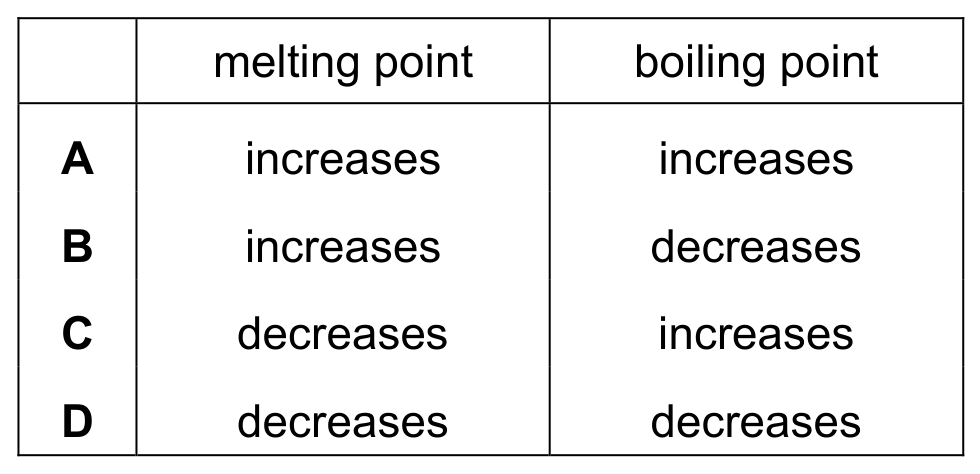
Impurities change the melting and boiling points of substances.
Sodium chloride is added to a sample of pure water.
How does the addition of sodium chloride affect the melting point and boiling point of the water?