

EduNinja

CAIE IGCSE Chemistry Catalysts Lower Activation Energy

CAIE IGCSE Chemistry Catalysts Lower Activation Energy
Cambridge IGCSE Chemistry 0620 syllabus for exams in 2026, 2027 and 20282026–2028

Practise stating that a catalyst provides a lower-activation-energy pathway and showing the lower peak without changing reactant or product energy levels.

How this is tested

  • state that a catalyst provides an alternative pathway with lower activation energy
  • draw a lower pathway peak while keeping reactant and product energy levels unchanged

Question 4(e)(iii)

[Maximum number: 1]

Hydrogen iodide thermally decomposes into iodine and hydrogen. The reaction is reversible.

2HI( g) colourless gas I2( g) purple gas +H2( g) colourless gas \underset{\text { colourless gas }}{2 \mathrm{HI}(\mathrm{~g})} \rightarrow \underset{\substack{\mathrm{I}_{2}(\mathrm{~g}) \\ \text { purple gas }}}{\rightleftharpoons}+\underset{\substack{\mathrm{H}_{2}(\mathrm{~g}) \\ \text { colourless gas }}}{ }

Fig. 4.1 shows a gas syringe containing a mixture of hydrogen iodide, iodine and hydrogen gases. The gas syringe is sealed and the mixture is heated to 300C300^{\circ} \mathrm{C}. The mixture of gases reaches equilibrium and is purple.
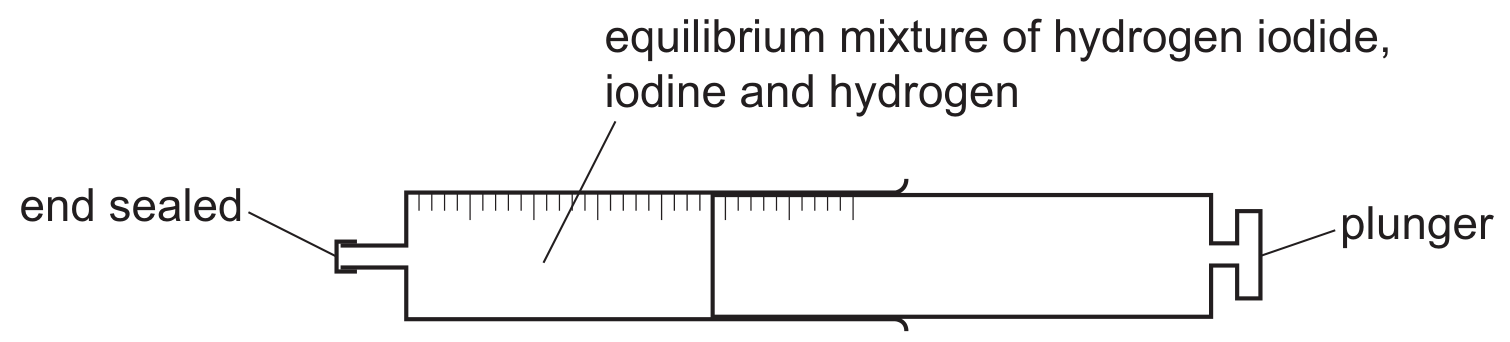
Fig. 4.1

Fig. 4.1

Methanol is manufactured by reacting carbon monoxide with hydrogen.

CO( g)+2H2( g)CH3OH( g)\mathrm{CO}(\mathrm{~g})+2 \mathrm{H}_{2}(\mathrm{~g}) \rightleftharpoons \mathrm{CH}_{3} \mathrm{OH}(\mathrm{~g})

The rate of formation of methanol increases when a catalyst is used.

State the effect that a catalyst has on the activation energy, EaE_{\mathrm{a}}, of a reaction.