

EduNinja

CAIE IGCSE Chemistry Relative Atomic Mass from Isotopes

CAIE IGCSE Chemistry Relative Atomic Mass from Isotopes
Cambridge IGCSE Chemistry 0620 syllabus for exams in 2026, 2027 and 20282026–2028

Practise calculating relative atomic mass as an abundance-weighted mean, handling percentages or ratios and explaining why the result may be non-integral.

How this is tested

  • multiply each isotope mass by its abundance, sum the products and divide by total abundance
  • use percentage or ratio data and infer a missing abundance before calculating the weighted mean
  • explain a non-integral relative atomic mass as the weighted average of naturally occurring isotopes

Question 5(a)(v)

[Maximum number: 2]

Sulfur is a Group VI element.

A sample of sulfur contains two isotopes, 32 S{ }^{32} \mathrm{~S} and 34 S{ }^{34} \mathrm{~S}.

Table 5.2 shows the relative abundance of these isotopes of sulfur in the sample.
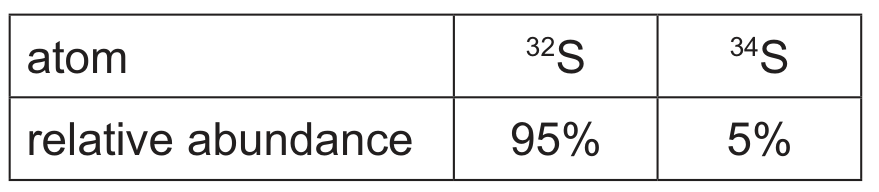
Table 5.2

Table 5.2

Calculate the relative atomic mass of sulfur in this sample to one decimal place.
relative atomic mass =