

EduNinja

CAIE IGCSE Chemistry 12.4.3 Substances & assess their purity

CAIE IGCSE Chemistry 12.4.3 Substances & assess their purity
Cambridge IGCSE Chemistry 0620 syllabus for exams in 2026, 2027 and 20282026–2028

Practise using melting and boiling point data to identify substances, judge purity and compare pure samples with mixtures.

How this is tested

  • compare melting and boiling points of pure and impure samples against data values
  • predict lower melting points and higher boiling points when impurities are present

Question 3(d)(v)

[Maximum number: 2]

The chemical equation for the complete combustion of ethanol, C2H5OH\mathrm{C}_{2} \mathrm{H}_{5} \mathrm{OH}, is shown.

C2H5OH+3O22CO2+3H2O\mathrm{C}_{2} \mathrm{H}_{5} \mathrm{OH}+3 \mathrm{O}_{2} \rightarrow 2 \mathrm{CO}_{2}+3 \mathrm{H}_{2} \mathrm{O}

The energy released when one mole of ethanol undergoes complete combustion is 1280 kJ .
Part of the energy level diagram for this reaction is shown.
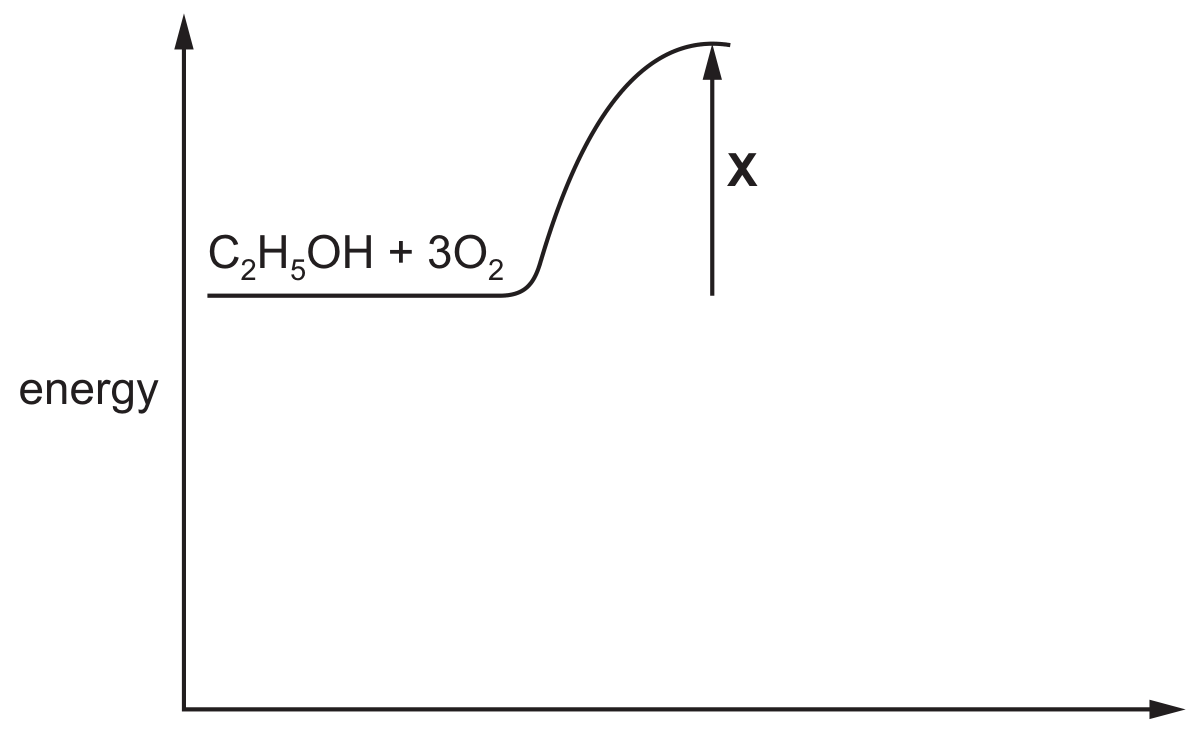
Figure for Question 3(d)(v) — CAIE IGCSE Chemistry

Dodecane is an alkane containing 12 carbon atoms. Ethanol can be manufactured from dodecane in a two-stage process.

In stage 1, each molecule of dodecane is converted into three molecules of ethene and one molecule of another hydrocarbon.

Suggest how to test the purity of the ethanol produced.