

EduNinja

CAIE IGCSE Chemistry Temperature Pressure and Gas Volume

CAIE IGCSE Chemistry Temperature Pressure and Gas Volume
Cambridge IGCSE Chemistry 0620 syllabus for exams in 2026, 2027 and 20282026–2028

Practise explaining a compressed gas's darker colour by relating unchanged particle number to smaller volume and closer average particle spacing.

How this is tested

  • explain darker gas colour as the same number of molecules occupying a smaller volume and lying closer together

Question 4(b)(ii)

[Maximum number: 1]

Hydrogen iodide, HI, decomposes into iodine and hydrogen. The reaction is reversible.

2HI( g) colourless gas  purple gas I2( g)+H2( g) colourless gas \underset{\text { colourless gas }}{2 \mathrm{HI}(\mathrm{~g})} \rightleftharpoons \underset{\substack{\text { purple gas } \\ \mathrm{I}_{2}(\mathrm{~g})}}{ }+\underset{\text { colourless gas }}{\mathrm{H}_{2}(\mathrm{~g})}

A gas syringe containing a mixture of hydrogen iodide, iodine and hydrogen gases was sealed. After reaching equilibrium the mixture was a pale purple colour.
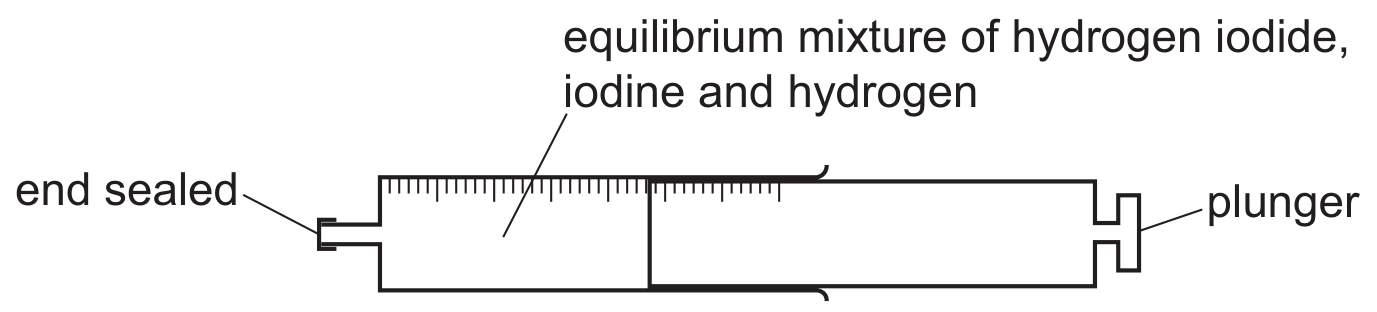
Figure for Question 4(b)(ii) — CAIE IGCSE Chemistry

The plunger of the gas syringe is pushed in. The position of equilibrium does not change. The colour of the gaseous mixture turns darker purple.

The temperature remains constant.

2HI( g) colourless gas  purple gas I2( g)+H2( g) colourless gas \underset{\text { colourless gas }}{2 \mathrm{HI}(\mathrm{~g})} \rightleftharpoons \underset{\substack{\text { purple gas } \\ \mathrm{I}_{2}(\mathrm{~g})}}{\rightleftharpoons}+\underset{\text { colourless gas }}{\mathrm{H}_{2}(\mathrm{~g})}

Suggest why the colour of the gaseous mixture turns darker purple even though the position of equilibrium does not change.