(a)
Paper chromatography and gas/liquid chromatography both rely on the partition of compounds between mobile and stationary phases.
(i)
Suggest what type of liquid is used for the stationary phase in gas / liquid chromatography.
 EduNinja
Paper chromatography and gas/liquid chromatography both rely on the partition of compounds between mobile and stationary phases.
Suggest what type of liquid is used for the stationary phase in gas / liquid chromatography.
A mixture containing three organic compounds is analysed by gas chromatography and mass spectrometry. The gas chromatogram is shown.
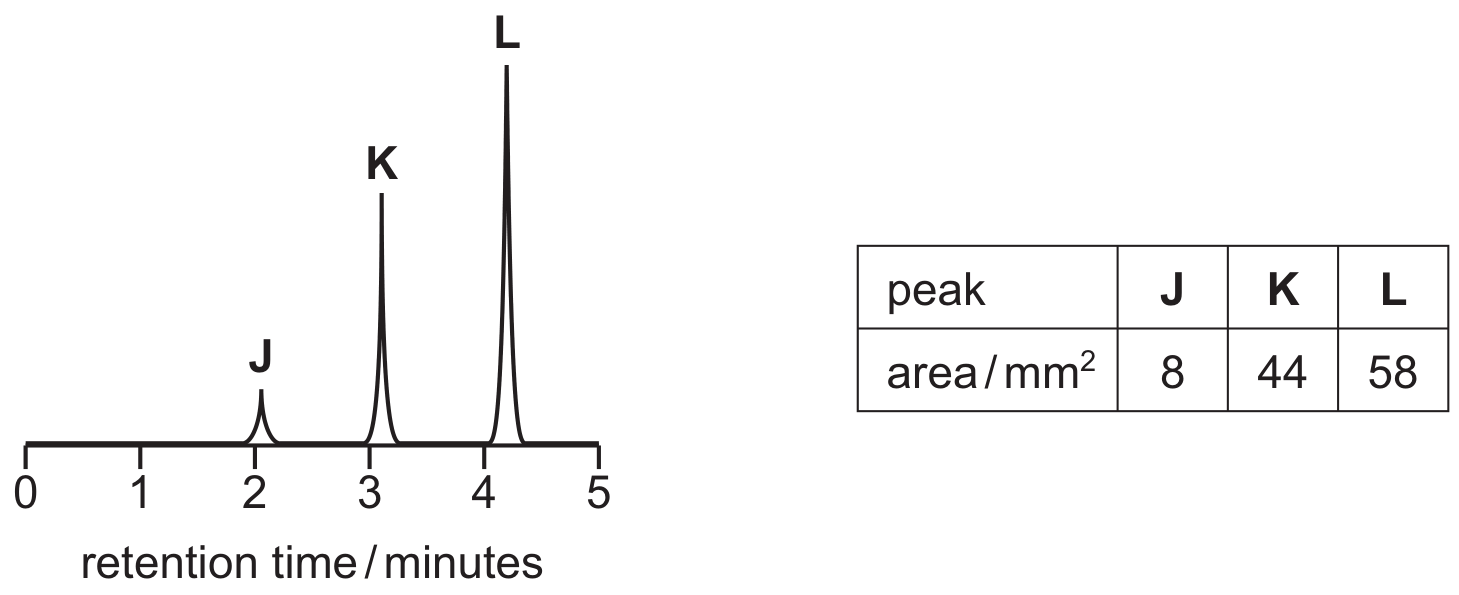
Fig. 6.5
The area underneath each peak is proportional to the mass of the respective compound in the mixture.
The concentration of K in the mixture is .
Calculate the concentration, in , of compound L in the mixture.
concentration of L=
Four esters, A, B, C and D, with the molecular formula are shown in Fig. 7.1.
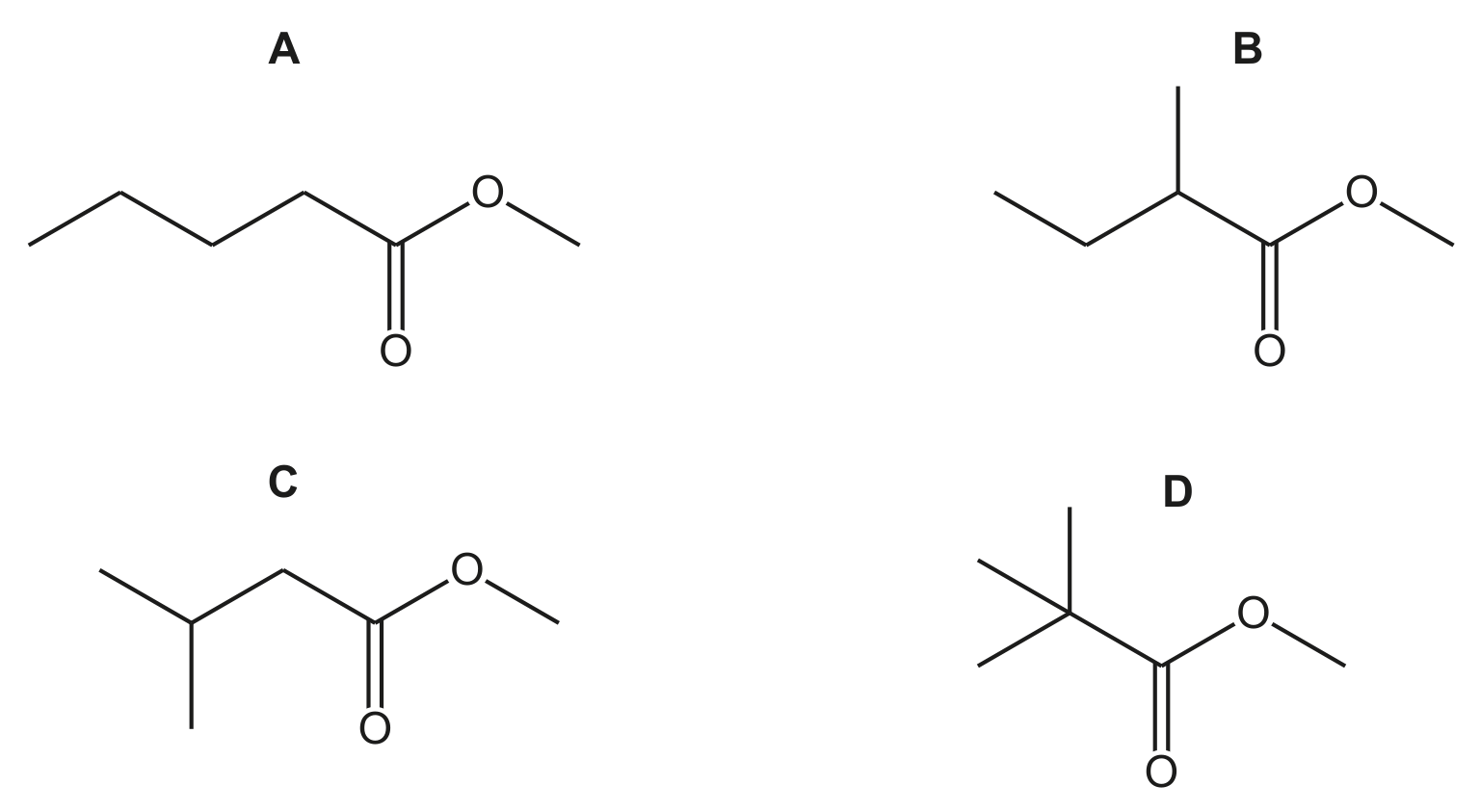
Fig. 7.1
A mixture of these esters, A, B, C and D, is analysed by gas-liquid chromatography.
The chromatogram produced is shown in Fig. 7.2. The number above each peak represents the area under the peak.
The area under each peak is proportional to the mass of the respective ester in the mixture.
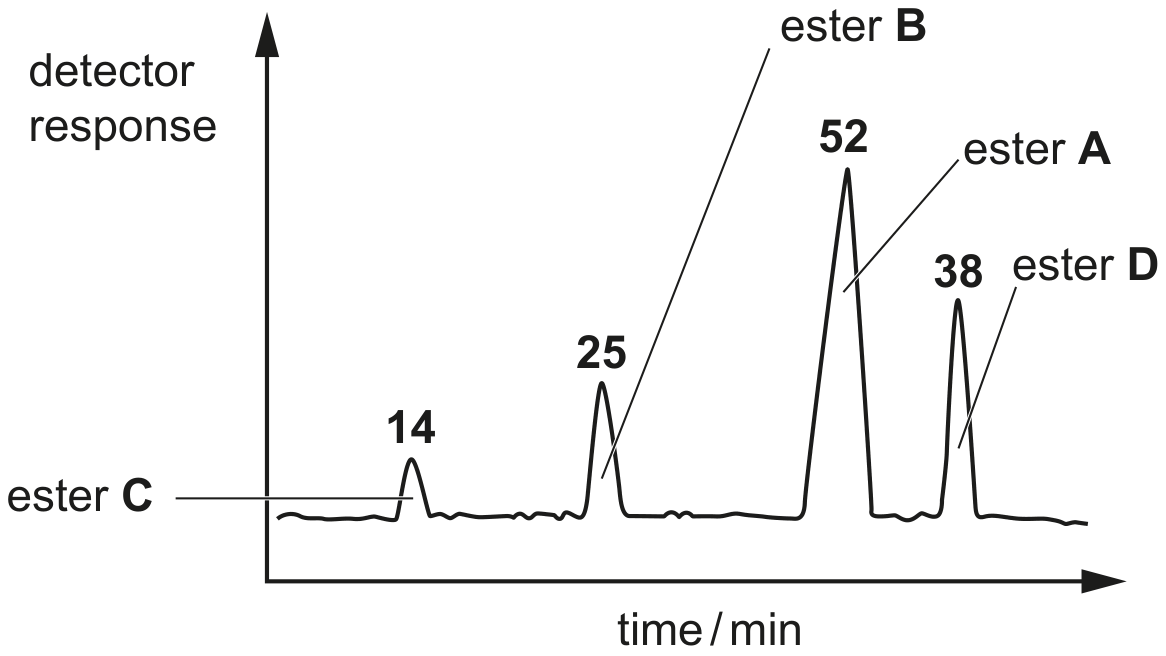
Fig. 7.2
State what is meant by retention time.
Calculate the percentage by mass of ester D in the original mixture.
percentage by mass of ester D= \%
Instrumental methods of analysis have become increasingly important in recent years. The use of chromatography to separate substances, and NMR spectroscopy to identify them, has become routine in many laboratories.
Chromatography relies on either partition or adsorption to help separate substances.
Briefly explain how each method brings about separation.
partition
adsorption
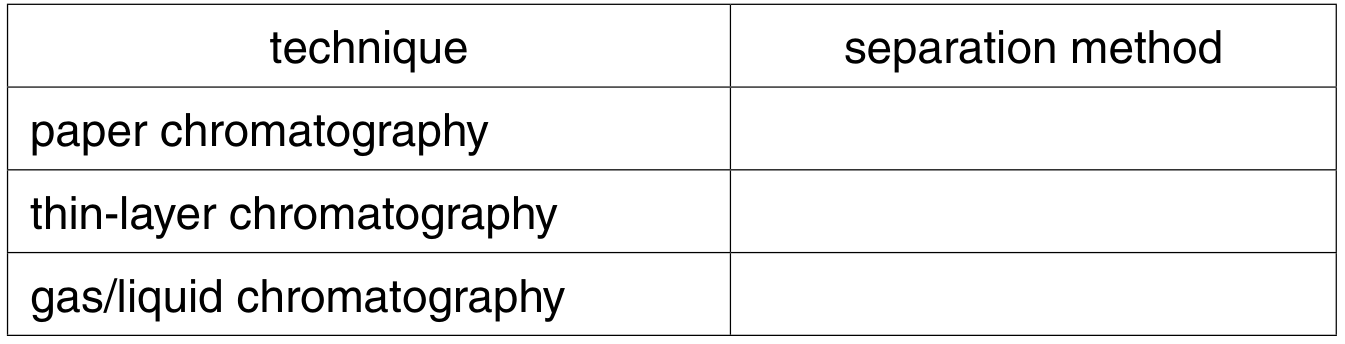
The table shows three different techniques of chromatography. Identify which separation method, partition or adsorption, applies to each.
The diagram represents the output from gas/liquid chromatography carried out on a mixture.
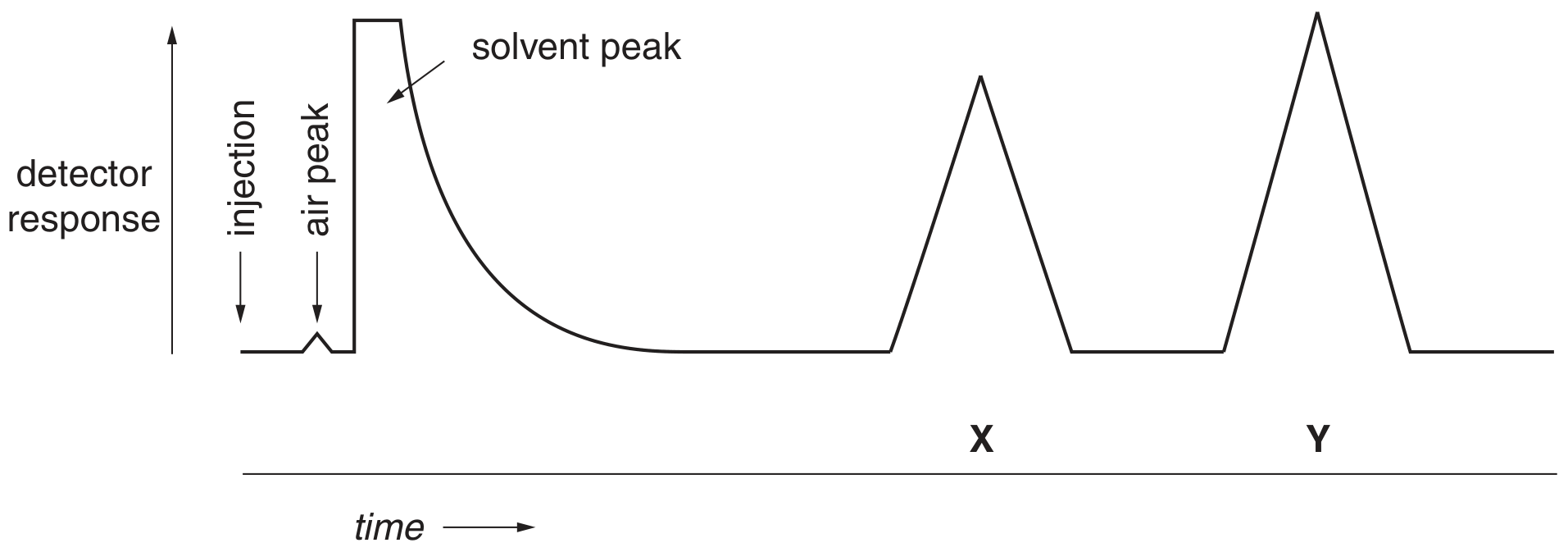
Determine the percentage of each of the two components X and Y in the mixture.
Lactic acid, , is the only monomer needed to form the polymer polylactic acid, PLA.
An impure sample of contains pentan-3-one as the only contaminant. The mixture is analysed using gas/liquid chromatography. The pentan-3-one is found to have a longer retention time than the lactic acid.
Explain what is meant by retention time.
Suggest suitable substances, or types of substances, that could be used as the mobile and stationary phases.
mobile phase
stationary phase
Describe how the percentage composition of the mixture can be determined from the gas/liquid chromatogram.
Gas-liquid chromatography involves a stationary phase and a mobile phase.
Name, or describe in detail, a suitable substance that could be used for each phase.
stationary
mobile
A mixture of three organic compounds is separated by gas-liquid chromatography. The chromatogram obtained is shown in Fig. 9.1. The amount of each substance is proportional to the area under its peak.
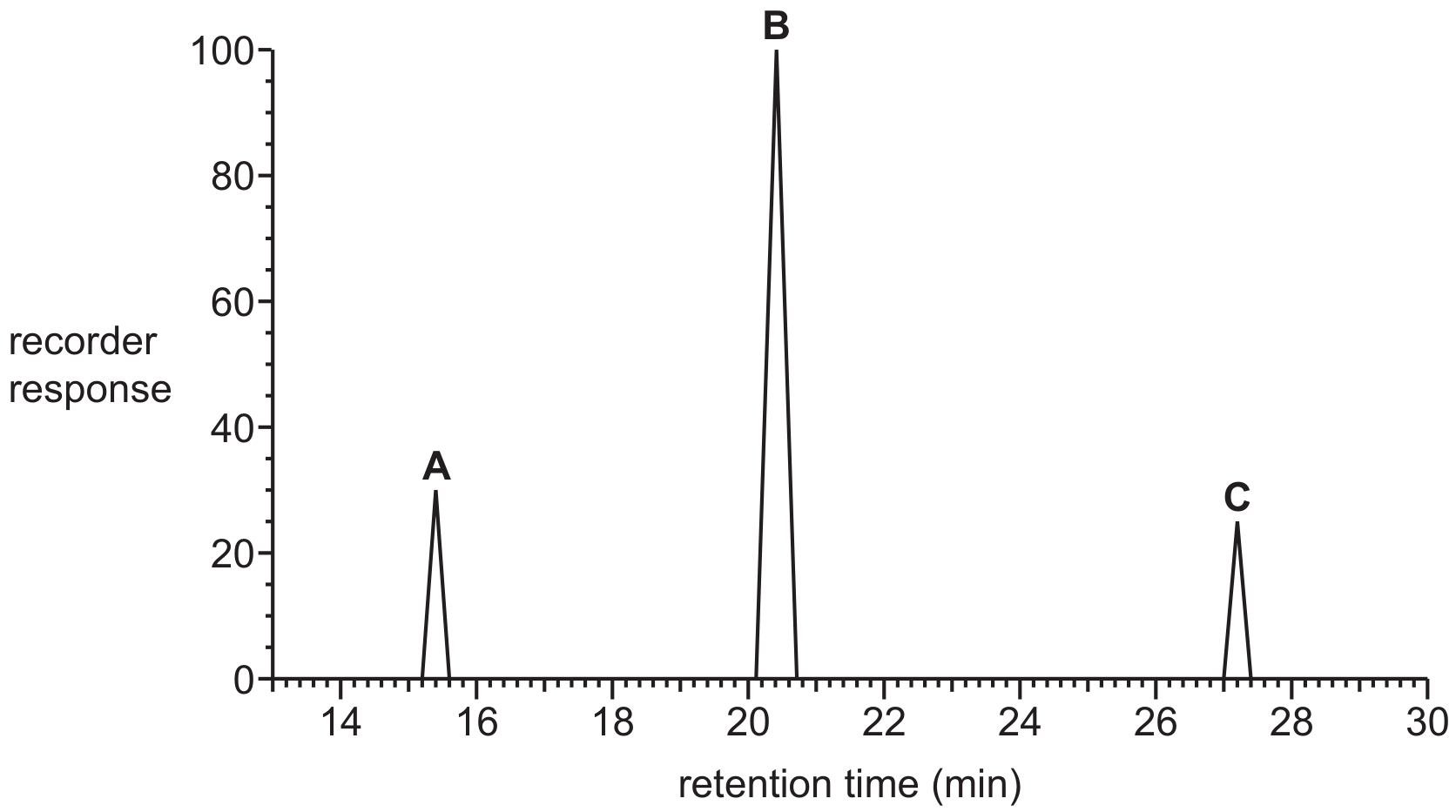
Fig. 9.1
Explain the meaning of retention time.
Calculate the percentage of B in the mixture. Show your working.
percentage of B= \%