(a)
(i)
Catalysts can be heterogeneous or homogeneous.
Explain what is meant by a homogeneous catalyst.
[ 1 ]
(ii)
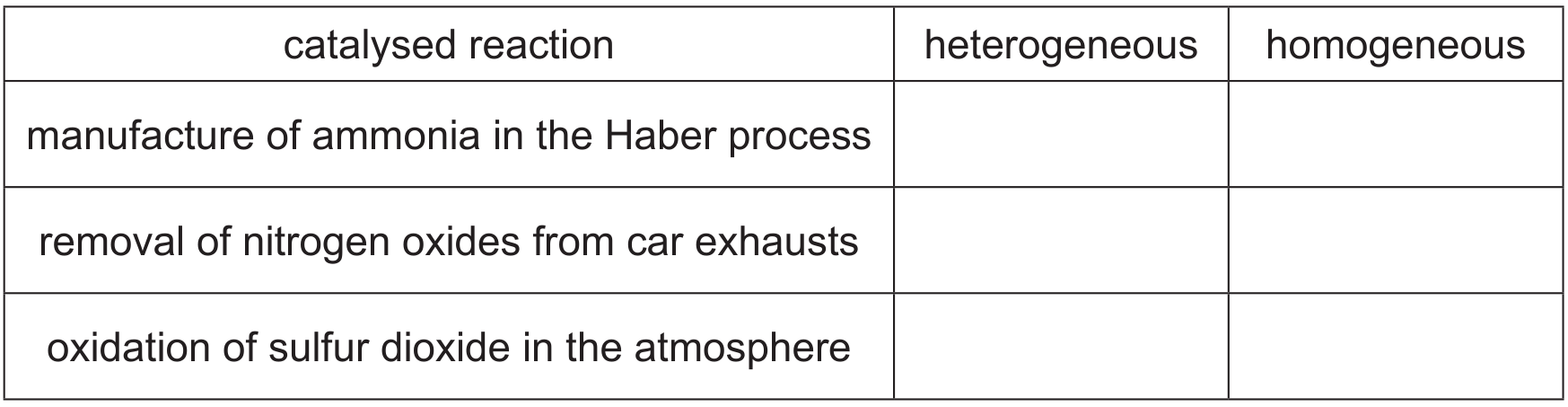
Complete the table by placing one tick in each row to indicate the mode of action of the catalyst in each reaction.
[ 1 ]
 EduNinja
Catalysts can be heterogeneous or homogeneous.
Explain what is meant by a homogeneous catalyst.
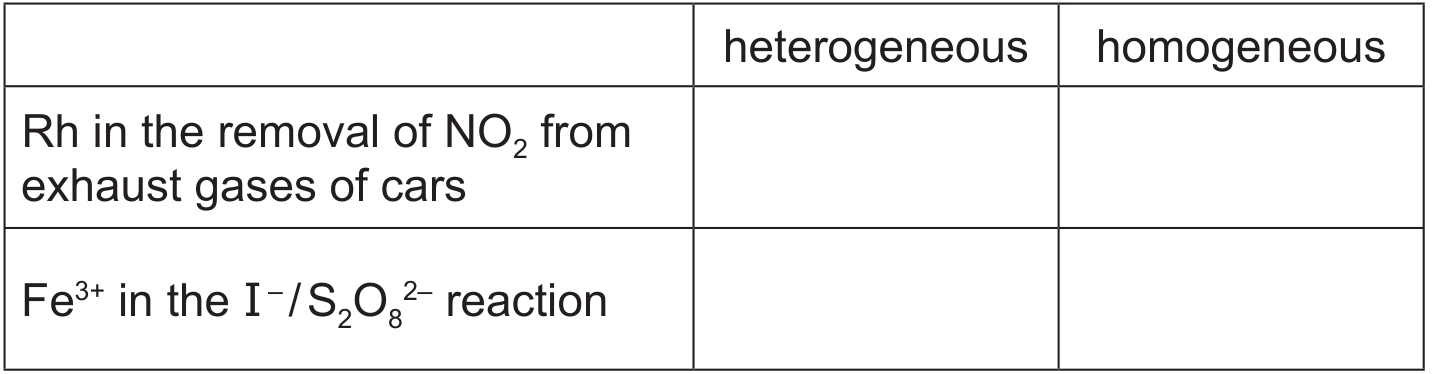
Complete the table by placing one tick in each row to indicate the mode of action of the catalyst in each reaction.
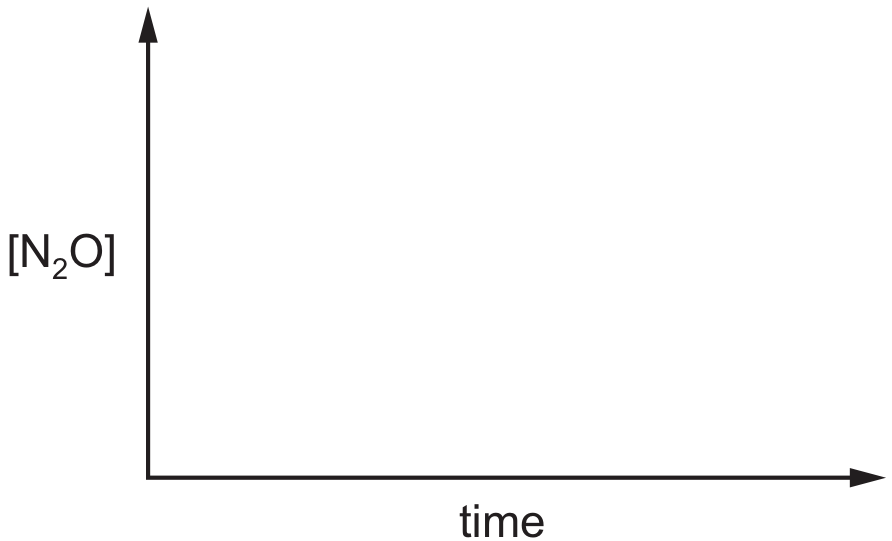
Nitrous oxide, , decomposes into its elements.
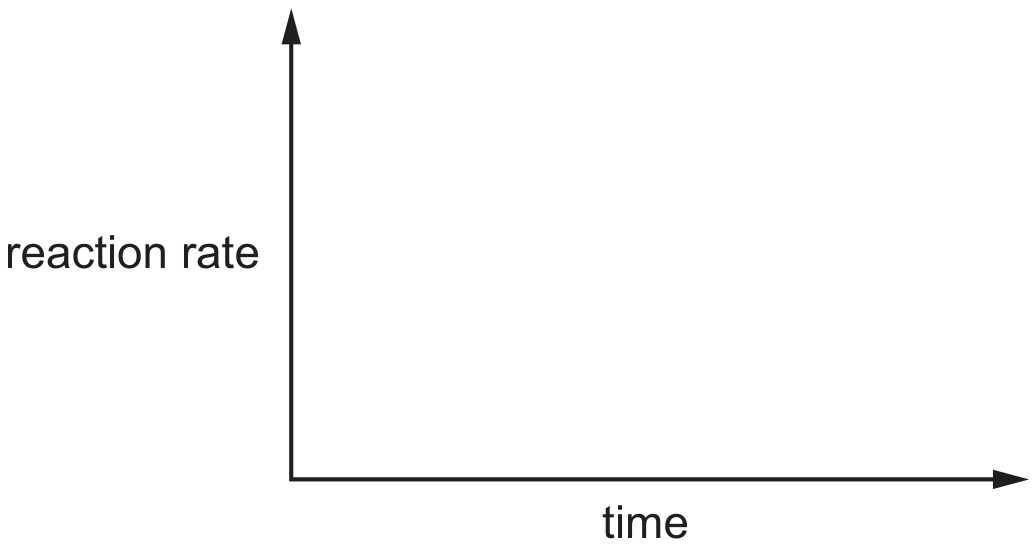
At a high temperature, a small amount of platinum wire is added to a large amount of nitrous oxide. The reaction follows zero order kinetics. The platinum wire behaves as a catalyst.
Sketch a graph, on the axes below, of reaction rate against time for the catalysed decomposition of under these conditions.
Sketch a graph, on the axes below, of against time for this reaction.
Platinum behaves as a heterogeneous catalyst in this reaction.
Describe the mode of action of a heterogeneous catalyst.
Manganese(IV) oxide, , acts as a heterogeneous catalyst in the decomposition of hydrogen peroxide, .
Explain what is meant by a heterogeneous catalyst.
Describe the mode of action of a heterogeneous catalyst in a reaction.
Explain what is meant by the following terms:
homogeneous catalyst
heterogeneous catalyst
Iodide ions react with peroxydisulfate ions.
This reaction is slow, but it is catalysed by ions.
Write two equations to explain how this reaction is catalysed by ions.
1
2
Suggest why the alternative route in the presence of ions has a lower activation energy than the route in the absence of a catalyst.
Explain what is meant by the following terms:
homogeneous catalyst
heterogeneous catalyst
Iodide ions react with peroxydisulfate ions.
This reaction is slow, but it is catalysed by ions.
Write two equations to explain how this reaction is catalysed by ions.
1
2
Suggest why the alternative route in the presence of ions has a lower activation energy than the route in the absence of a catalyst.
Hypophosphorous acid is an inorganic acid.
The conjugate base of hypophosphorous acid is .
A student suggests that the reaction between and might happen more quickly in the presence of a heterogeneous catalyst.
Describe the mode of action of a heterogeneous catalyst.
Elements and their compounds are important as catalysts.
In which process is a compound used, rather than an element?
catalytic converters
Contact process
Haber process
hydrogenation of alkenes
The reaction between and is catalysed by adding a few drops of .
Use equations to show the catalytic role of in this reaction.
When aqueous solutions of and tartrate ions are mixed the reaction proceeds very slowly. However, this reaction proceeds quickly in the presence of an catalyst. The overall equation for this reaction is shown.
tartrate ions

Suggest why this reaction is slow without the catalyst.
Iron has atomic number 26.
can act as a homogeneous catalyst in the reaction between peroxodisulfate ions and iodide ions.
What is meant by a homogeneous catalyst?
Suggest why, in the absence of a catalyst, the activation energy for this reaction is high.
Write two equations to show how ions can catalyse the reaction between ions and ions.
equation 1 equation 2
Explain the difference between heterogeneous and homogeneous catalysts.
Complete the table using ticks to indicate whether the catalyst used in the reaction is heterogeneous or homogeneous.