EduNinja
(a)

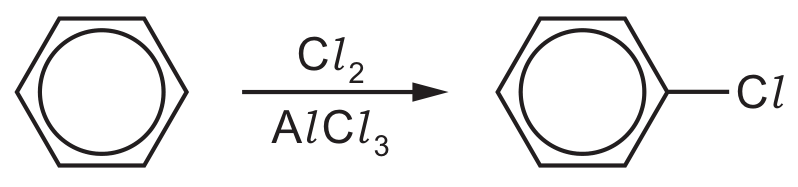
Chlorobenzene can be prepared from benzene as shown.
Question image

Aluminium chloride, AlCl 3 , catalyses this reaction.

[ 6 ]
(i)

Write an equation to show how AlCl3\mathrm{AlCl}_{3} generates the electrophile needed in this reaction.

[ 1 ]
(ii)

Draw the mechanism of the reaction between this electrophile and benzene to form chlorobenzene. Include all relevant curly arrows and charges.

[ 4 ]
(iii)

Write an equation to show how the catalyst is regenerated.

[ 1 ]

(a)

Gaseous aluminium chloride is dimeric at low temperatures, but the dimer dissociates on heating.

Al2Cll6( g)2AlCl3( g)\mathrm{Al}_{2} \mathrm{Cl} l_{6}(\mathrm{~g}) \rightleftharpoons 2 \mathrm{AlCl}_{3}(\mathrm{~g})
[ 3 ]
(i)

Choose one reaction in organic chemistry that is catalysed by AlCl3\mathrm{AlCl}_{3}, and write the structural formulae of the reactants and products in the boxes below.

Question image
[ 3 ]
(a)

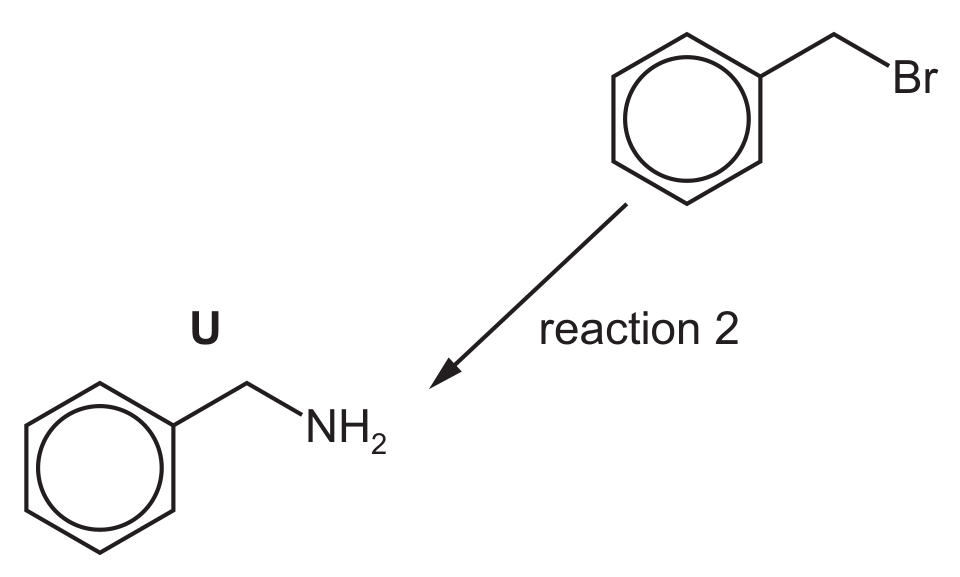
Compound U can be prepared by two different methods as shown.

Question image
Question image
[ 4 ]
(i)

Suggest reagents and conditions for reaction 1 and for reaction 2.
reaction 1
reaction 2

[ 2 ]
(ii)

State the type of reaction in reaction 1 and name the mechanism in reaction 2 . type of reaction in reaction 1 mechanism of reaction 2

[ 2 ]
(a)

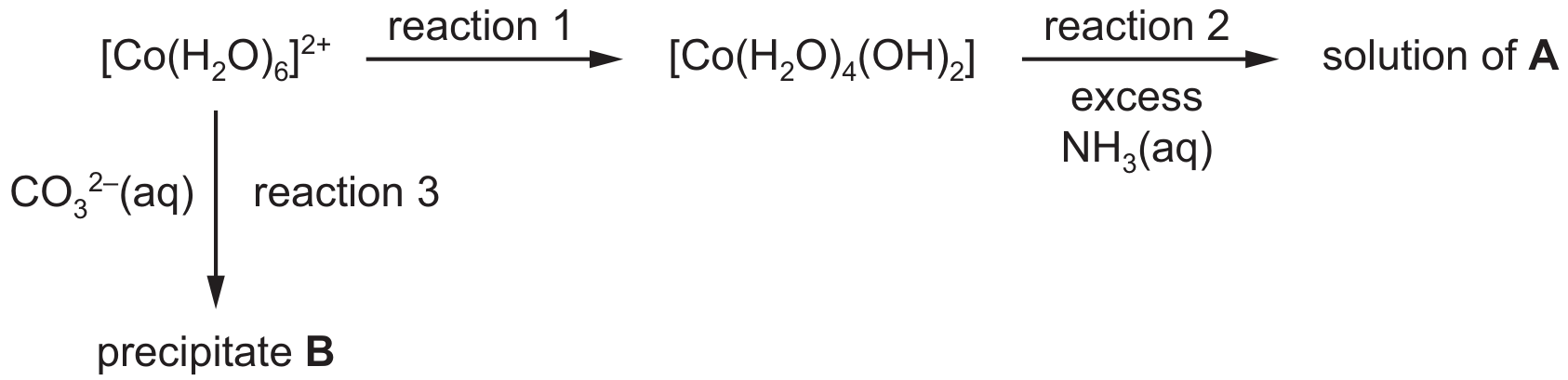
The reaction scheme shows some reactions of [Co(H2O)6]2+\left[\mathrm{Co}\left(\mathrm{H}_{2} \mathrm{O}\right)_{6}\right]^{2+}.

Question image
[ 3 ]
(i)

State a suitable reagent for reaction 1 .

[ 1 ]
(ii)

Write an equation for reaction 2 .

[ 1 ]
(iii)

Write an ionic equation for reaction 3 .

[ 1 ]
[Maximum number: 6]

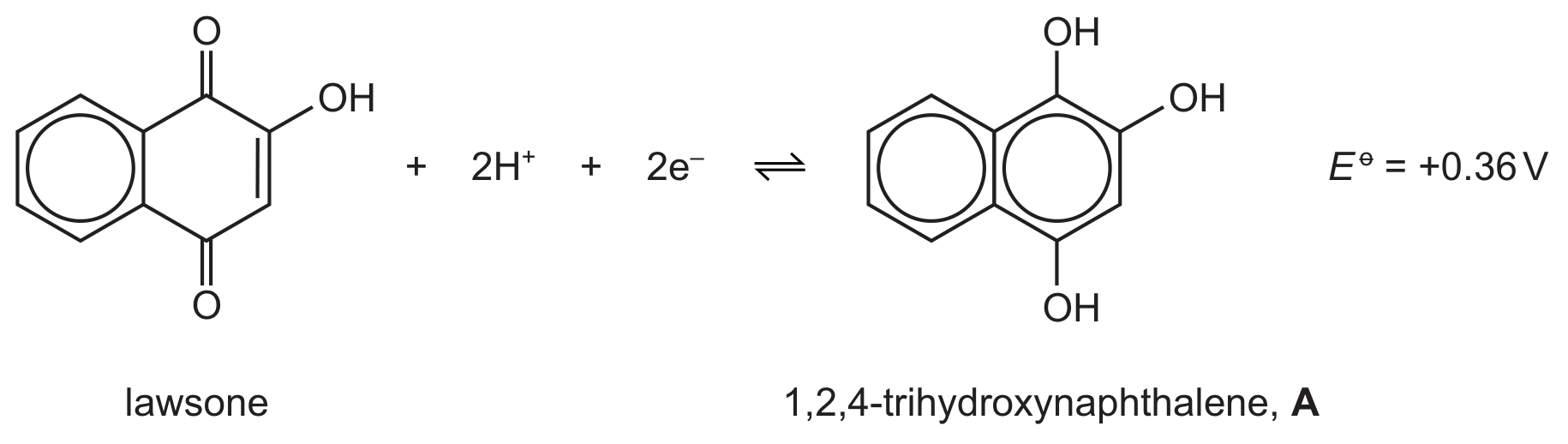
Lawsone is the dye that is extracted from the henna plant, Lawsonia inermis. Although its natural colour is yellow, lawsone reacts with the proteins in hair and skin to produce the characteristic brown henna colour.

Lawsone can readily be reduced to 1,2,4-trihydroxynaphthalene, compound A.

Question image
(a)
(i)

Draw the structural formula of the compound formed when lawsone is reacted with Br2(aq)\mathrm{Br}_{2}(\mathrm{aq}).

[ 6 ]
[Maximum number: 3]

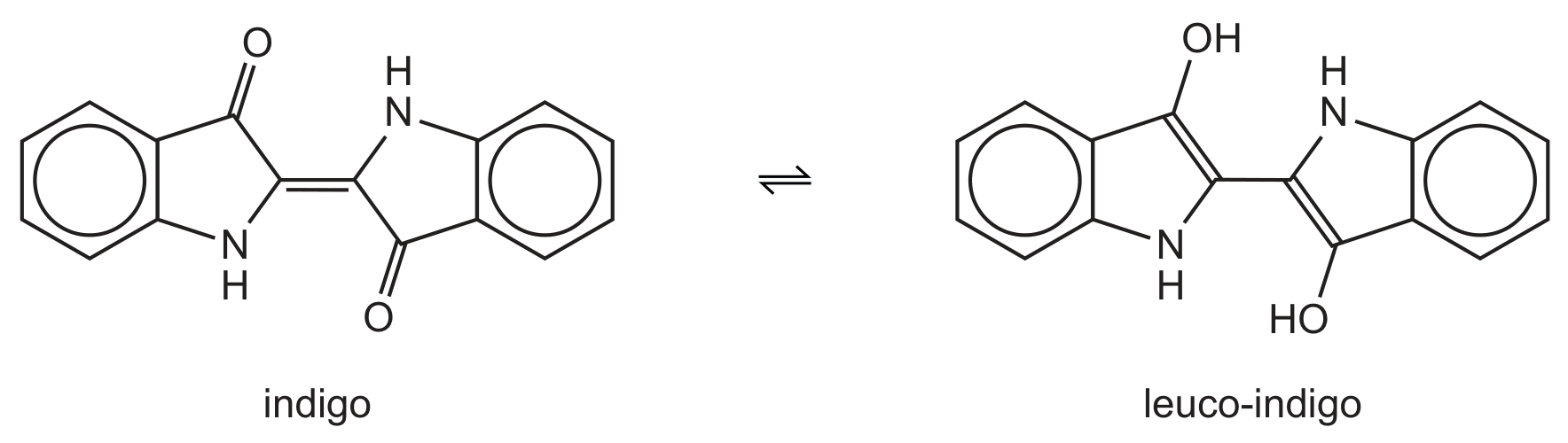
Indigo is the dye used in blue jeans. Although originally extracted from plants of the type indigofera, it is now almost entirely made artificially.

Indigo is insoluble in water but this disadvantage can be overcome by converting it into the water-soluble colourless leuco-indigo. If cloth soaked in a solution of leuco-indigo is left to dry in the air, the leuco-indigo is converted into the insoluble blue indigo, which is precipitated out onto the fibres of the cloth.

Question image
(a)

Suggest the structure of the product formed when indigo reacts with an excess of Br2(aq)\mathrm{Br}_{2}(\mathrm{aq}).

[ 3 ]
(a)

Benzene reacts with bromine in the presence of an aluminium bromide catalyst, AlBr3\mathrm{AlBr}_{3}, to form bromobenzene. This is a substitution reaction. No addition reaction takes place.

[ 5 ]
(i)

Explain why no addition reaction takes place.

AlBr 3 reacts with bromine to generate an electrophile, Br+\mathrm{Br}{ }^{+}.

[ 1 ]
(ii)

Draw the mechanism of the reaction between benzene and Br+\mathrm{Br}^{+}ions. Include all relevant arrows and charges.

[ 3 ]
(iii)

Write an equation to show how the AlBr 3 catalyst is reformed.

[ 1 ]
[Maximum number: 12]

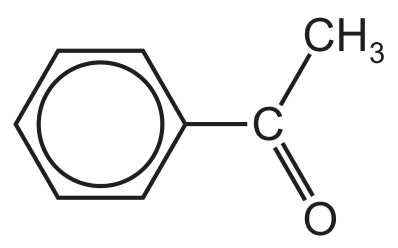
Phenylethanone is an important chemical with many uses.

phenylethanone

phenylethanone

(a)

Phenylethanone can be synthesised using benzene as one of the starting materials.

Identify the other reagents used and describe any essential reaction conditions.

[ 2 ]
(b)

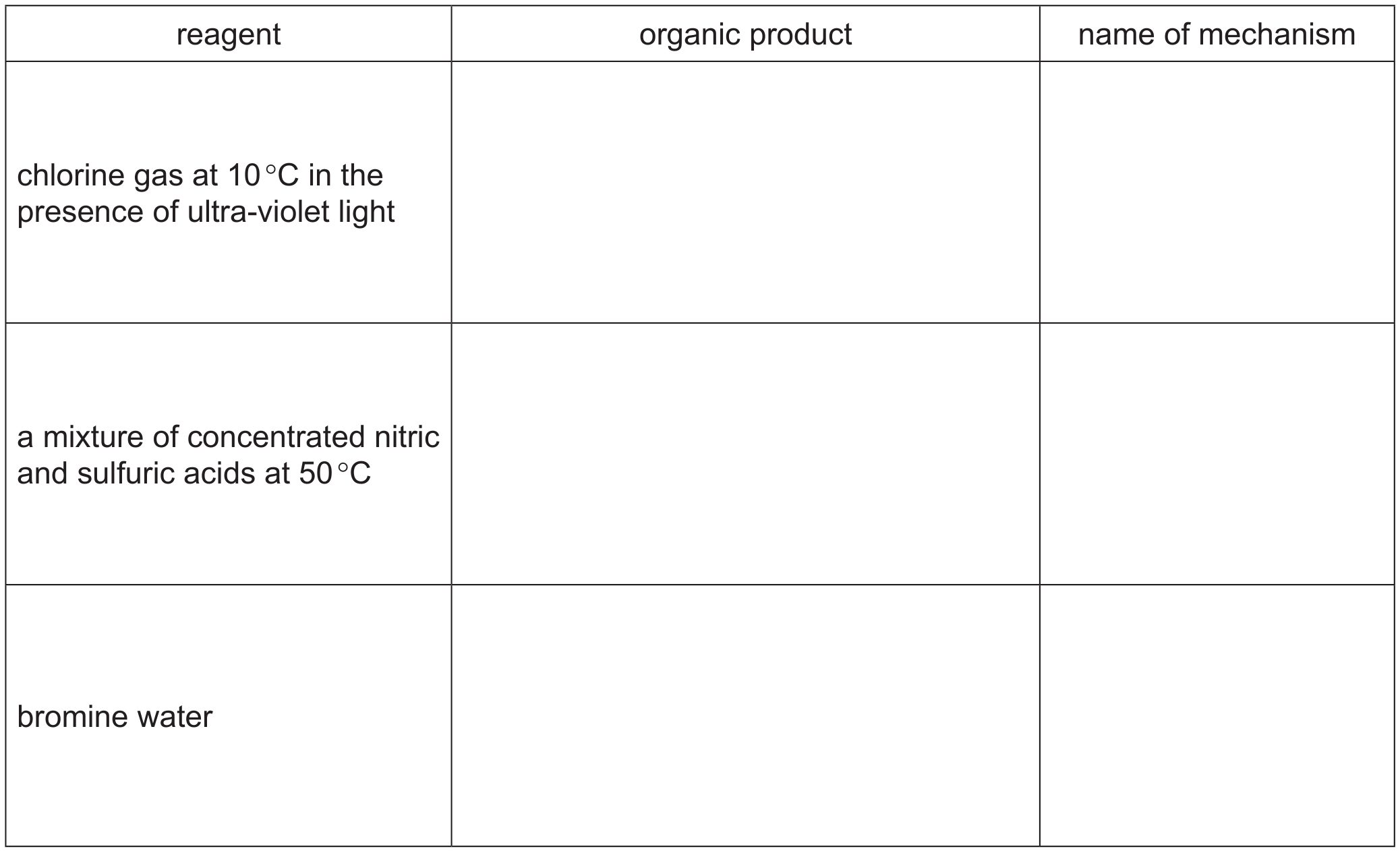
Phenylethanone is treated separately with three reagents.

Complete the table, for each reagent, to give the structural formula of one organic product formed and the name of the mechanism involved. If there is no reaction you should write 'no reaction'.

Table
[ 5 ]
(c)

Phenylethanone reacts with HCN in the presence of a small amount of NaCN .

[ 5 ]
(i)

Name the mechanism of this reaction.

[ 1 ]
(ii)

Draw the mechanism of this reaction below. Include all relevant charges, dipoles, lone pairs and curly arrows. Your mechanism should show the catalytic role of CN\mathrm{CN}^{-}ions.
phenylethanone
intermediate
product

Question image
[ 4 ]
[Maximum number: 1]

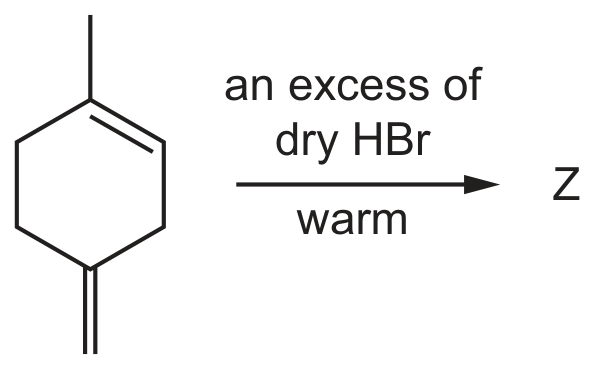
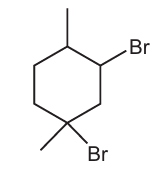
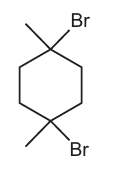
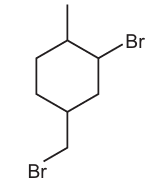
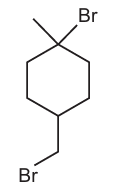
What is the major product Z of the following reaction?

Question image
A
Question image
B
Question image
C
Question image
D
Question image
(a)
(i)

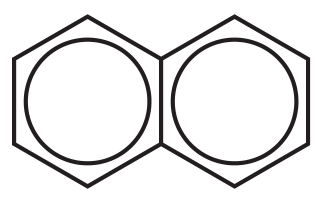
Naphthalene, C10H8\mathrm{C}_{10} \mathrm{H}_{8}, is an arene hydrocarbon.

naphthalene

naphthalene

When naphthalene undergoes nitration, a mixture of two organic compounds is formed. Each compound contains one nitro group.

Suggest the structures of these compounds.

Question image
Question image
[ 1 ]
0