EduNinja
[Maximum number: 4]

Copper is a transition element and has atomic number 29.

(a)

Nickel forms the complex ion [Ni(en)3]2+\left[\mathrm{Ni}(e n)_{3}\right]^{2+} in which it is surrounded octahedrally by six nitrogen atoms.

[ 4 ]
(i)

Name the type of stereoisomerism displayed by [Ni(en)3]2+\left[\mathrm{Ni}(e n)_{3}\right]^{2+}.

[ 1 ]
(ii)

Draw three-dimensional diagrams to show the two stereoisomers of [Ni(en)3]2+\left[\mathrm{Ni}(e n)_{3}\right]^{2+}.

[ 3 ]
(a)

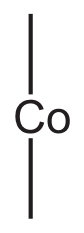
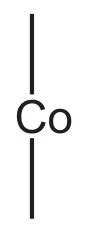
The [Co(NH3)3Cl3]\left[\mathrm{Co}\left(\mathrm{NH}_{3}\right)_{3} \mathrm{Cl}_{3}\right] complex shows stereoisomerism.

Complete the three-dimensional diagrams to show the two isomers of [Co(NH3)3Cl3]\left[\mathrm{Co}\left(\mathrm{NH}_{3}\right)_{3} \mathrm{Cl}_{3}\right].
Suggest the type of stereoisomerism.

Question image
Question image

type of stereoisomerism

[ 2 ]
[Maximum number: 2]

Iron is a transition element in the fourth period. Iron forms compounds containing the ions Fe2+\mathrm{Fe}^{2+} and Fe3+\mathrm{Fe}^{3+}.

(a)

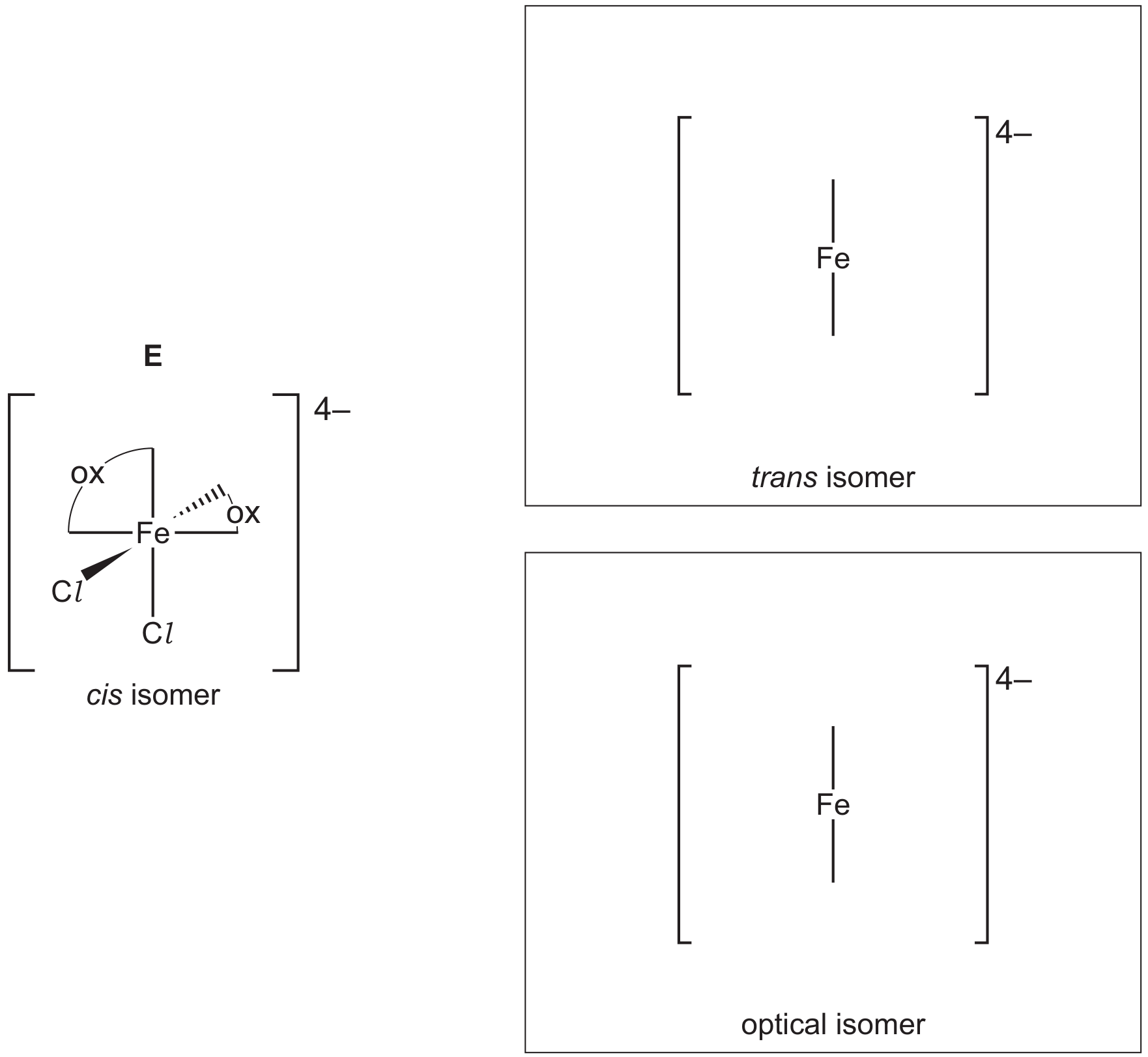
E is a complex ion, [Fe(C2O4)2Cl2]4\left[\mathrm{Fe}\left(\mathrm{C}_{2} \mathrm{O}_{4}\right)_{2} \mathrm{C} l_{2}\right]^{4-}, containing Fe2+\mathrm{Fe}^{2+} with a coordination number of 6 .

[ 2 ]
(i)

E shows both optical isomerism and cis-trans isomerism.

One isomer of E is shown. The C2O42\mathrm{C}_{2} \mathrm{O}_{4}{ }^{2-} ion is represented as

Question image

ox\mathrm{ox}^{-}.

In the boxes, draw three-dimensional diagrams to show:
- the trans isomer of E
- the optical isomer of E.

Question image
[ 2 ]
[Maximum number: 4]

Transition elements are important metals because of their characteristic properties.

(a)

The [CrCl2(H2O)4]+\left[\mathrm{CrCl}_{2}\left(\mathrm{H}_{2} \mathrm{O}\right)_{4}\right]^{+}complex ion shows stereoisomerism.

[ 4 ]
(i)

Name this type of stereoisomerism.

[ 1 ]
(ii)

Draw three-dimensional diagrams to show the two stereoisomers of [CrCl2(H2O)4]+\left[\mathrm{CrCl}{ }_{2}\left(\mathrm{H}_{2} \mathrm{O}\right)_{4}\right]^{+}.

[ 3 ]
(a)

NO reacts with iron pentacarbonyl, Fe(CO)5\mathrm{Fe}(\mathrm{CO})_{5}, as shown. NO and CO are both monodentate ligands.

Fe(CO)5+2NOFe(CO)2(NO)2+3CO\mathrm{Fe}(\mathrm{CO})_{5}+2 \mathrm{NO} \rightarrow \mathrm{Fe}(\mathrm{CO})_{2}(\mathrm{NO})_{2}+3 \mathrm{CO}

During this reaction the co-ordination number of the iron changes.

[ 1 ]
(i)

Only one stereoisomer of Fe(CO)2(NO)2\mathrm{Fe}(\mathrm{CO})_{2}(\mathrm{NO})_{2} exists.

Use this information to suggest the geometry of the complex.

[ 1 ]
(b)

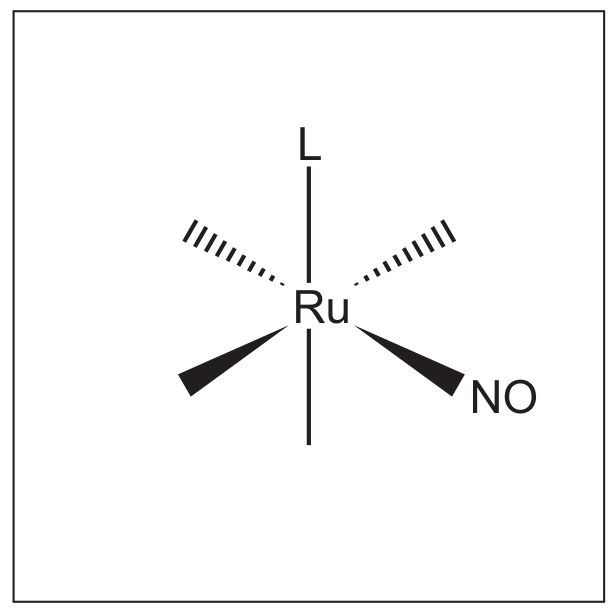
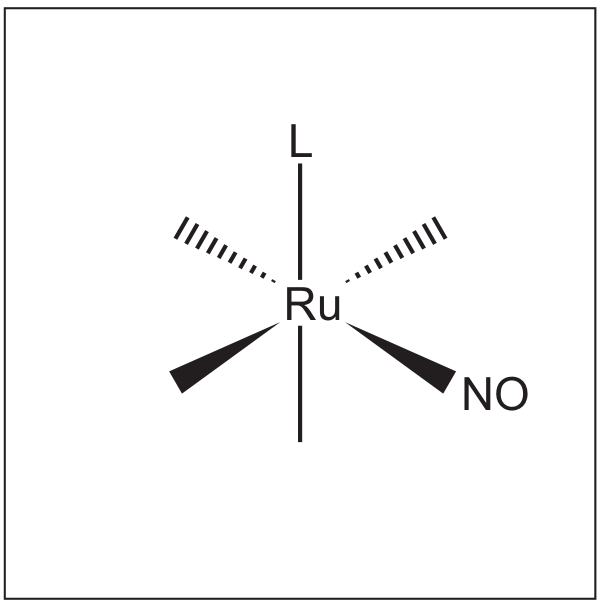
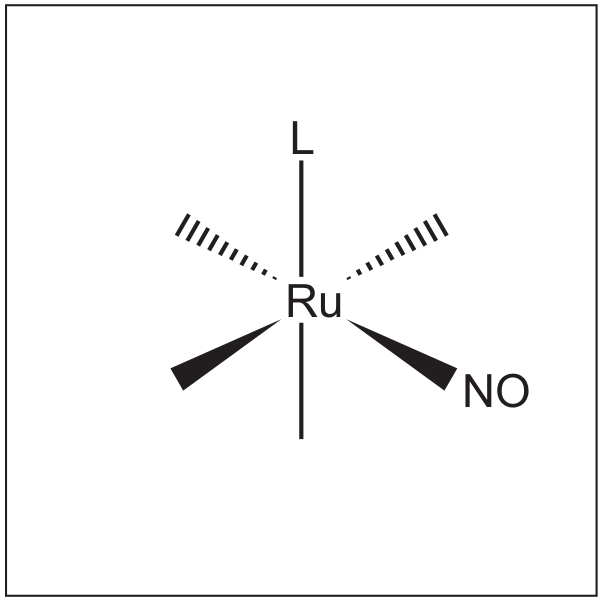
The complex Ru(NO)L2Cl3\mathrm{Ru}(\mathrm{NO}) \mathrm{L}_{2} \mathrm{Cl}_{3} exists in three isomeric forms. L represents the monodentate ligand C6H5P(CH3)2\mathrm{C}_{6} \mathrm{H}_{5} \mathrm{P}\left(\mathrm{CH}_{3}\right)_{2}.

[ 3 ]
(i)

Complete the three-dimensional diagrams to show the three isomers of Ru(NO)L2Cl3\mathrm{Ru}(\mathrm{NO}) \mathrm{L}_{2} \mathrm{Cl}_{3}.

Question image
Question image
Question image
[ 2 ]
(ii)

Suggest the type of isomerism shown.

[ 1 ]
(a)

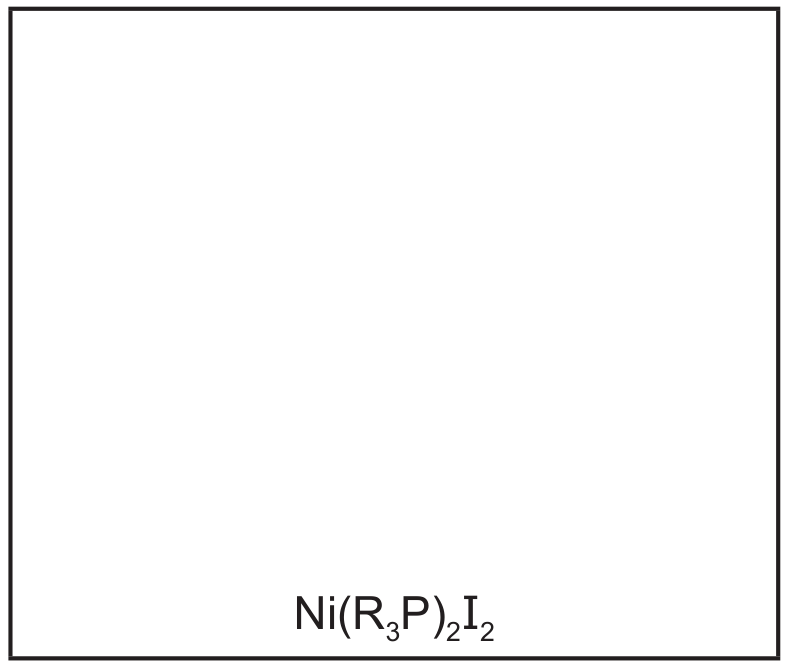
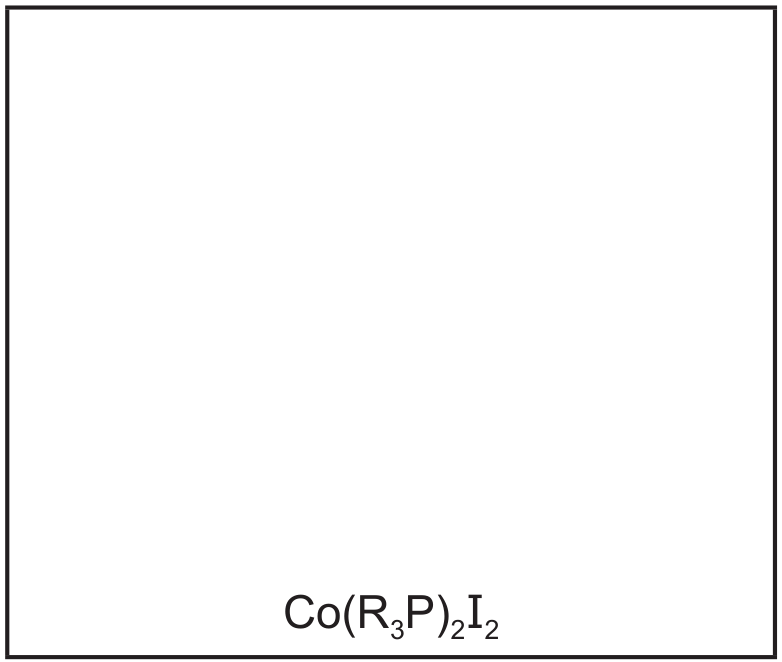
There are two isomers with the formula Ni(R3P)2I2\mathrm{Ni}\left(\mathrm{R}_{3} \mathrm{P}\right)_{2} \mathrm{I}_{2}, but only one structure with the formula Co(R3P)2I2\mathrm{Co}\left(\mathrm{R}_{3} \mathrm{P}\right)_{2} \mathrm{I}_{2}. (R=\left(\mathrm{R}=\right. alkyl, R3P\mathrm{R}_{3} \mathrm{P} is a monodentate ligand)

Draw diagrams showing the structure of Co(R3P)2I2\mathrm{Co}\left(\mathrm{R}_{3} \mathrm{P}\right)_{2} \mathrm{I}_{2} and the two isomers of Ni(R3P)2I2\mathrm{Ni}\left(\mathrm{R}_{3} \mathrm{P}\right)_{2} \mathrm{I}_{2}.
Ni(R3P)2I2\mathrm{Ni}\left(\mathrm{R}_{3} \mathrm{P}\right)_{2} \mathrm{I}_{2}

Question image
Question image
[ 3 ]
(a)

The ethanedioate ion, C2O42\mathrm{C}_{2} \mathrm{O}_{4}{ }^{2-}, can act as a bidentate ligand.

[ 3 ]
(i)

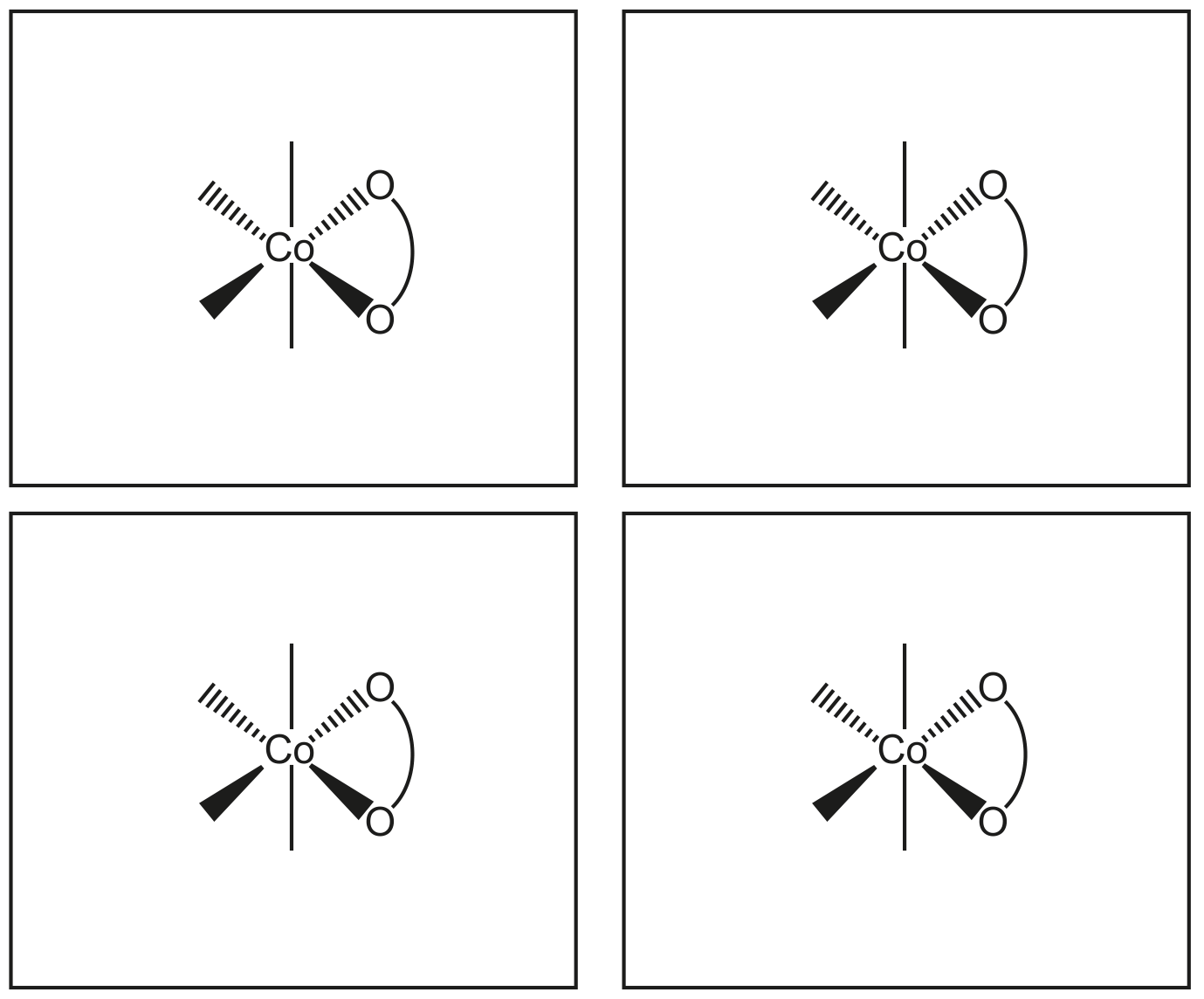
The complex [Co(H2O)2(C2O4)BrCl]\left[\mathrm{Co}\left(\mathrm{H}_{2} \mathrm{O}\right)_{2}\left(\mathrm{C}_{2} \mathrm{O}_{4}\right) \mathrm{BrCl}\right]^{-}exists as stereoisomers.

Complete the three-dimensional diagrams in Fig. 2.2 to show four stereoisomers of [Co(H2O)2(C2O4)BrCl]\left[\mathrm{Co}\left(\mathrm{H}_{2} \mathrm{O}\right)_{2}\left(\mathrm{C}_{2} \mathrm{O}_{4}\right) \mathrm{BrCl}\right]^{-}.

The C2O42\mathrm{C}_{2} \mathrm{O}_{4}{ }^{2-} ligand is represented using

Question image

.

Fig. 2.2

Fig. 2.2

[ 3 ]
(a)
(i)

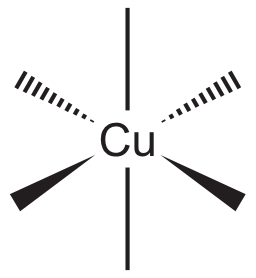
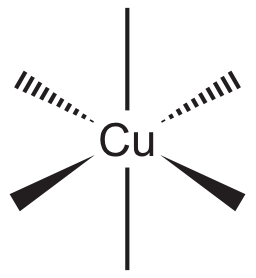
Cu2+\mathrm{Cu}^{2+} ions and en form the complex ion [Cu(en)3]2+\left[\mathrm{Cu}(e n)_{3}\right]^{2+}.

Draw the two optical isomers of this complex ion.
You may use NN\underset{\mathrm{N}}{\mathrm{N}} to represent en.

Question image
Question image
[ 2 ]
(a)

Some transition element complexes can show stereoisomerism.
State two types of stereoisomerism shown by transition element complexes.
1
2

[ 1 ]
(b)

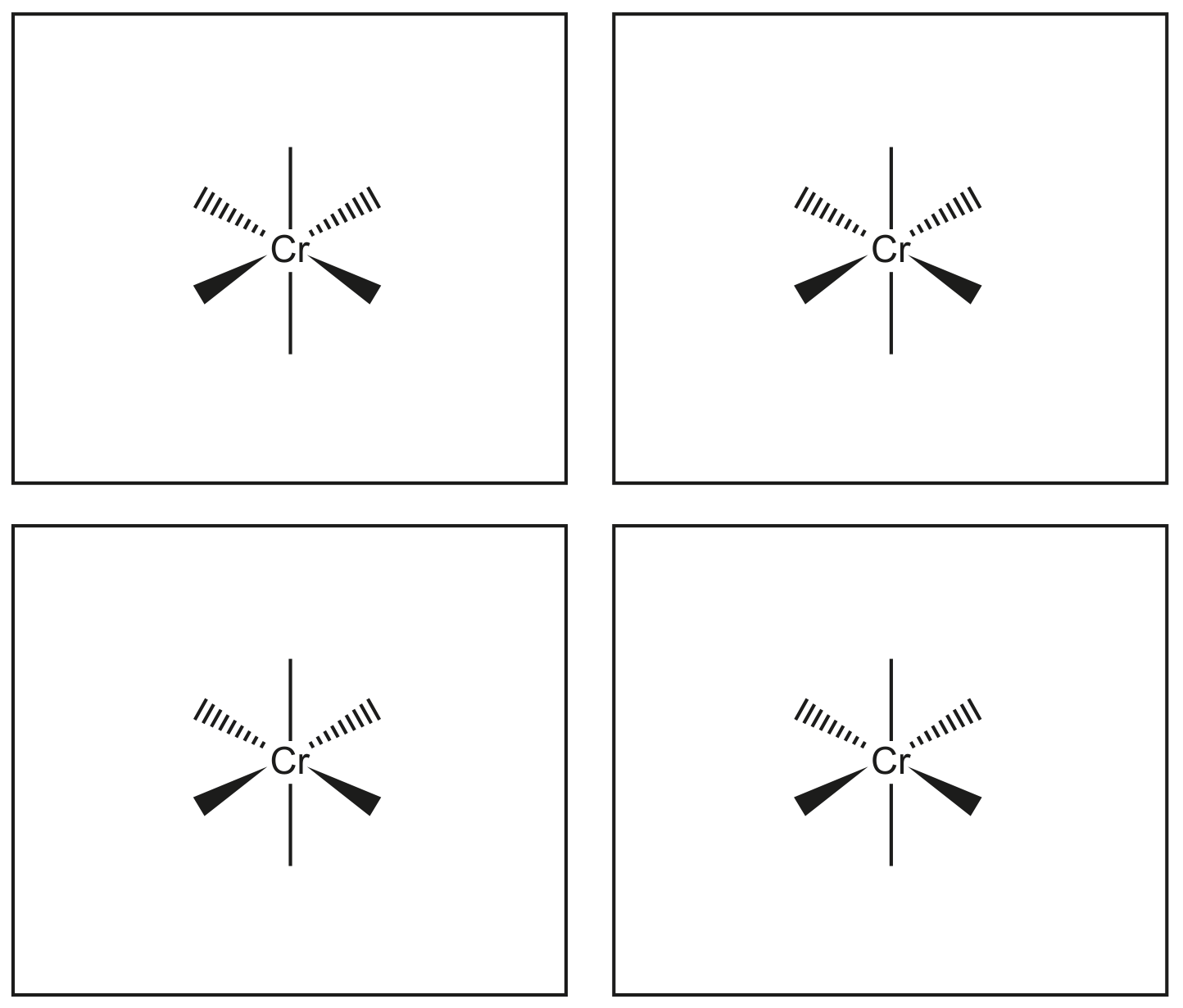
The complex [Cr(en)3]2+\left[\mathrm{Cr}(e n)_{3}\right]^{2+} exists as two stereoisomers whereas the complex [Cr(OCH2CH2NH2)3]\left[\mathrm{Cr}\left(\mathrm{OCH}_{2} \mathrm{CH}_{2} \mathrm{NH}_{2}\right)_{3}\right]^{-}exists as four stereoisomers.

Complete the three-dimensional diagrams in Fig. 2.1 to show the four stereoisomers of [Cr(OCH2CH2NH2)3]\left[\mathrm{Cr}\left(\mathrm{OCH}_{2} \mathrm{CH}_{2} \mathrm{NH}_{2}\right)_{3}\right]^{-}.

Represent the ligand OCH2CH2NH2-\mathrm{OCH}_{2} \mathrm{CH}_{2} \mathrm{NH}_{2} by using O\overbrace{\mathrm{O}}.

Fig. 2.1

Fig. 2.1

[ 3 ]
[Maximum number: 7]

The ions of transition elements form complexes by reacting with ligands.

(a)
(i)

Platinum forms square-planar complexes, in which all four ligands lie in the same plane as the Pt atom.
There are two isomeric complexes with the formula Pt(NH3)2Cl2\mathrm{Pt}\left(\mathrm{NH}_{3}\right)_{2} \mathrm{Cl}_{2}.
Suggest the structures of the two isomers, and, by comparison with a similar type of isomerism in organic chemistry, suggest the type of isomerism shown here.

Structures of isomers:
isomer 1
isomer 2

Type of isomerism:

[ 7 ]
0