EduNinja
(a)

An aqueous solution of cobalt(II) contains the [Co(H2O)6]2+\left[\mathrm{Co}\left(\mathrm{H}_{2} \mathrm{O}\right)_{6}\right]^{2+} complex ion.

[ 7 ]
(i)

Define the term complex ion.

[ 1 ]
(ii)

Samples of [Co(H2O)6]2+\left[\mathrm{Co}\left(\mathrm{H}_{2} \mathrm{O}\right)_{6}\right]^{2+} are reacted separately with aqueous sodium hydroxide and with an excess of aqueous ammonia.

Give the following information about these reactions.
- the reaction of [Co(H2O)6]2+\left[\mathrm{Co}\left(\mathrm{H}_{2} \mathrm{O}\right)_{6}\right]^{2+} with aqueous sodium hydroxide
colour and state of the cobalt-containing species
ionic equation
type of reaction
- the reaction of [Co(H2O)6]2+\left[\mathrm{Co}\left(\mathrm{H}_{2} \mathrm{O}\right)_{6}\right]^{2+} with an excess of aqueous ammonia
colour and state of the cobalt-containing species
ionic equation
type of reaction

[ 6 ]
(b)

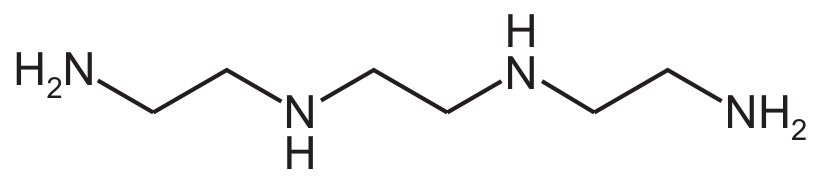
Compound X,C6H18 N4\mathbf{X}, \mathrm{C}_{6} \mathrm{H}_{18} \mathrm{~N}_{4}, is a tetradentate ligand.

X

Question image
[ 2 ]
(i)

Suggest why one molecule of X can form four dative bonds.

[ 1 ]
(ii)

C6H18 N4\mathrm{C}_{6} \mathrm{H}_{18} \mathrm{~N}_{4} reacts with aqueous cobalt(II) ions, [Co(H2O)6]2+\left[\mathrm{Co}\left(\mathrm{H}_{2} \mathrm{O}\right)_{6}\right]^{2+}, in a 1: 1 ratio to form a new complex ion.

Construct an equation for this reaction.

[ 1 ]
[Maximum number: 2]

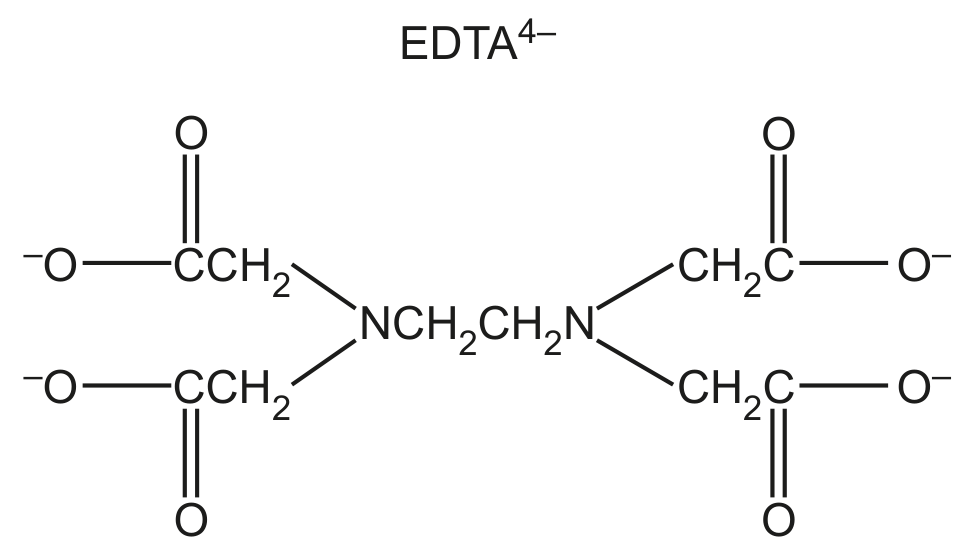
1EDTA41 \mathrm{EDTA}^{4-}, is a polydentate ligand.

(a)
(i)

Explain what is meant by the term polydentate ligand.

[ 2 ]
(ii)

When a solution containing EDTA 4{ }^{4-} is added to a solution containing [Cd(H2O)6]2+\left[\mathrm{Cd}\left(\mathrm{H}_{2} \mathrm{O}\right)_{6}\right]^{2+} a new complex is formed, [CdEDTA] 2{ }^{2-}.
equilibrium 1[Cd(H2O)6]2++1\left[\mathrm{Cd}\left(\mathrm{H}_{2} \mathrm{O}\right)_{6}\right]^{2+}+ EDTA 4[CdEDTA]2+6H2O^{4-} \rightleftharpoons[\mathrm{CdEDTA}]^{2-}+6 \mathrm{H}_{2} \mathrm{O}
Circle, on the structure of EDTA 4{ }^{4-}, the six atoms that form bonds with the metal ion.

EDTA \({

EDTA \({

(a)

Many commercial copper and brass polishes contain ammonia. The tarnish that forms on the surface of copper is often copper sulfide, CuS . In the presence of O2\mathrm{O}_{2} from the air, NH3\mathrm{NH}_{3} can combine with this copper sulfide to produce the soluble cuprammonium sulfate, [Cu(NH3)4]SO4\left[\mathrm{Cu}\left(\mathrm{NH}_{3}\right)_{4}\right] \mathrm{SO}_{4}.

[ 3 ]
(i)

Describe what you would see if a solution of cuprammonium sulfate was diluted with water. Explain your answer.

[ 3 ]
(b)

When sulfuric acid is added to Cu2+(aq)\mathrm{Cu}^{2+}(\mathrm{aq}), no colour change occurs, but when concentrated hydrochloric acid is added to Cu2+(aq)\mathrm{Cu}^{2+}(\mathrm{aq}), the solution turns yellow-green. The solution reverts to its original colour when it is diluted with water.

Suggest the type of reaction occurring with HCl(aq), suggest what is formed during the reaction, and write an equation for the change.

[ 3 ]
(a)

An aqueous solution of chromium(III) contains the green [Cr(H2O)6]3+\left[\mathrm{Cr}\left(\mathrm{H}_{2} \mathrm{O}\right)_{6}\right]^{3+} complex ion.

[ 1 ]
(i)

Define the term complex ion.

[ 1 ]
(b)

[Cr(H2O)6]3+(aq)\left[\mathrm{Cr}\left(\mathrm{H}_{2} \mathrm{O}\right)_{6}\right]^{3+}(\mathrm{aq}) shows some similar chemical properties to [Co(H2O)6]2+(aq)\left[\mathrm{Co}\left(\mathrm{H}_{2} \mathrm{O}\right)_{6}\right]^{2+}(\mathrm{aq}).

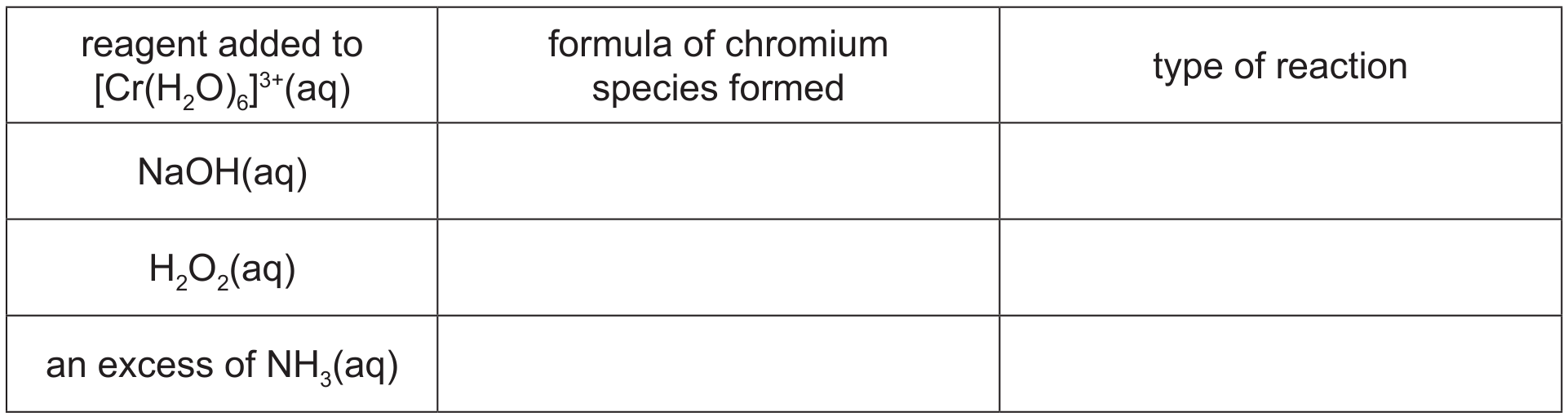
Samples of [Cr(H2O)6]3+\left[\mathrm{Cr}\left(\mathrm{H}_{2} \mathrm{O}\right)_{6}\right]^{3+} are reacted separately with either NaOH(aq),H2O2(aq)\mathrm{NaOH}(\mathrm{aq}), \mathrm{H}_{2} \mathrm{O}_{2}(\mathrm{aq}), or excess NH3(aq)\mathrm{NH}_{3}(\mathrm{aq}).

Use this information and the Data Booklet to suggest the formula of the chromium species formed. State the type of reaction taking place in each case.

Table
[ 5 ]
(c)

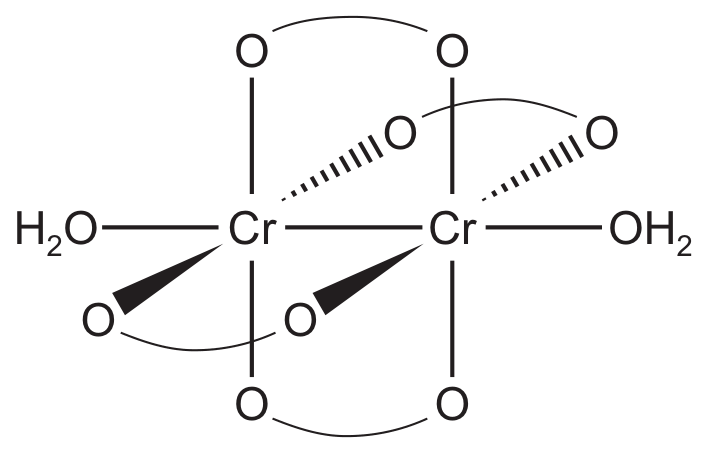
The structure of [Cr2(O2CCH3)4(H2O)2]\left[\mathrm{Cr}_{2}\left(\mathrm{O}_{2} \mathrm{CCH}_{3}\right)_{4}\left(\mathrm{H}_{2} \mathrm{O}\right)_{2}\right] is shown. Ethanoate ions act as ligands in this complex. The ethanoate ligand, CH3CO2\mathrm{CH}_{3} \mathrm{CO}_{2}{ }^{-}, is shown as O .

Question image
[ 2 ]
(i)

Water and ethanoate ions behave as different types of ligand in this complex.

Suggest an explanation for this statement.

[ 1 ]
(ii)

Deduce the coordination number of Cr and the geometry around each Cr atom in this structure.
coordination number
geometry around Cr atom

[ 1 ]
(a)

When concentrated HCl is added to a solution of Cu2+(aq)\mathrm{Cu}^{2+}(\mathrm{aq}) ions, the solution turns yellow.

[ 7 ]
(i)

State the formula of the species responsible for the yellow colour and name the type of reaction that has occurred.

(ii)

Ammonia can react as a base or as a ligand.

Describe the colour changes that occur when NH3(aq)\mathrm{NH}_{3}(\mathrm{aq}) is gradually added, with stirring, to the yellow solution, until the NH3(aq)\mathrm{NH}_{3}(\mathrm{aq}) is in excess.
Identify the three ions or compounds responsible for the new colours.

[ 7 ]
[Maximum number: 7]

Iron is a transition element in the fourth period. Iron forms compounds containing the ions Fe2+\mathrm{Fe}^{2+} and Fe3+\mathrm{Fe}^{3+}.

(a)

When an excess of CN(aq)\mathrm{CN}^{-}(\mathrm{aq}) ions is added to green [Fe(H2O)6]2+(aq)\left[\mathrm{Fe}\left(\mathrm{H}_{2} \mathrm{O}\right)_{6}\right]^{2+}(\mathrm{aq}) ions, yellow [Fe(CN)6]4\left[\mathrm{Fe}(\mathrm{CN})_{6}\right]^{4-} complex ions are formed.

Heating [Fe(CN)6]4\left[\mathrm{Fe}(\mathrm{CN})_{6}\right]^{4-} with dilute nitric acid and then neutralising the product with Na2CO3(aq)\mathrm{Na}_{2} \mathrm{CO}_{3}(\mathrm{aq}) produces red crystals, containing the [Fe(CN)5NO]2\left[\mathrm{Fe}(\mathrm{CN})_{5} \mathrm{NO}\right]^{2-} complex ion.

NO is a neutral, monodentate ligand.

[ 6 ]
(i)

State the shape of the [Fe(H2O)6]2+(aq)\left[\mathrm{Fe}\left(\mathrm{H}_{2} \mathrm{O}\right)_{6}\right]^{2+}(\mathrm{aq}) complex ion.

[ 1 ]
(ii)

Write the equation for the reaction between [Fe(H2O)6]2+(aq)\left[\mathrm{Fe}\left(\mathrm{H}_{2} \mathrm{O}\right)_{6}\right]^{2+}(\mathrm{aq}) ions and an excess of CN(aq)\mathrm{CN}^{-}(\mathrm{aq}) ions.

[ 1 ]
(iii)

Deduce the oxidation states of iron in:
[Fe(CN)6]4\left[\mathrm{Fe}(\mathrm{CN})_{6}\right]^{4-}[Fe(CN)5NO]2\left[\mathrm{Fe}(\mathrm{CN})_{5} \mathrm{NO}\right]^{2-}.

[ 1 ]
(iv)

Define the term monodentate ligand.

[ 2 ]
(v)

Complete the diagram to show the three-dimensional structure of the [Fe(CN)5NO]2\left[\mathrm{Fe}(\mathrm{CN})_{5} \mathrm{NO}\right]^{2-} complex ion.

Question image
[ 1 ]
(b)

E is a complex ion, [Fe(C2O4)2Cl2]4\left[\mathrm{Fe}\left(\mathrm{C}_{2} \mathrm{O}_{4}\right)_{2} \mathrm{C} l_{2}\right]^{4-}, containing Fe2+\mathrm{Fe}^{2+} with a coordination number of 6 .

[ 1 ]
(i)

Define the term coordination number.

[ 1 ]
(a)

Aqueous solutions of copper(II) salts contain the blue-coloured [Cu(H2O)6]2+\left[\mathrm{Cu}\left(\mathrm{H}_{2} \mathrm{O}\right)_{6}\right]^{2+} complex ion. Separate portions of this blue solution react with aqueous sodium hydroxide and with concentrated hydrochloric acid.

Give the following information for each of these reactions.
- reaction with aqueous sodium hydroxide
ionic equation
type of reaction
colour and state of the copper-containing product
- reaction with concentrated hydrochloric acid
ionic equation
type of reaction
colour and state of the copper-containing product

[ 6 ]
(a)

Copper(II) nitrate decomposes in a similar manner to Group 2 nitrates.

Write an equation for the decomposition of Cu(NO3)2\mathrm{Cu}\left(\mathrm{NO}_{3}\right)_{2}.

[ 1 ]
(b)

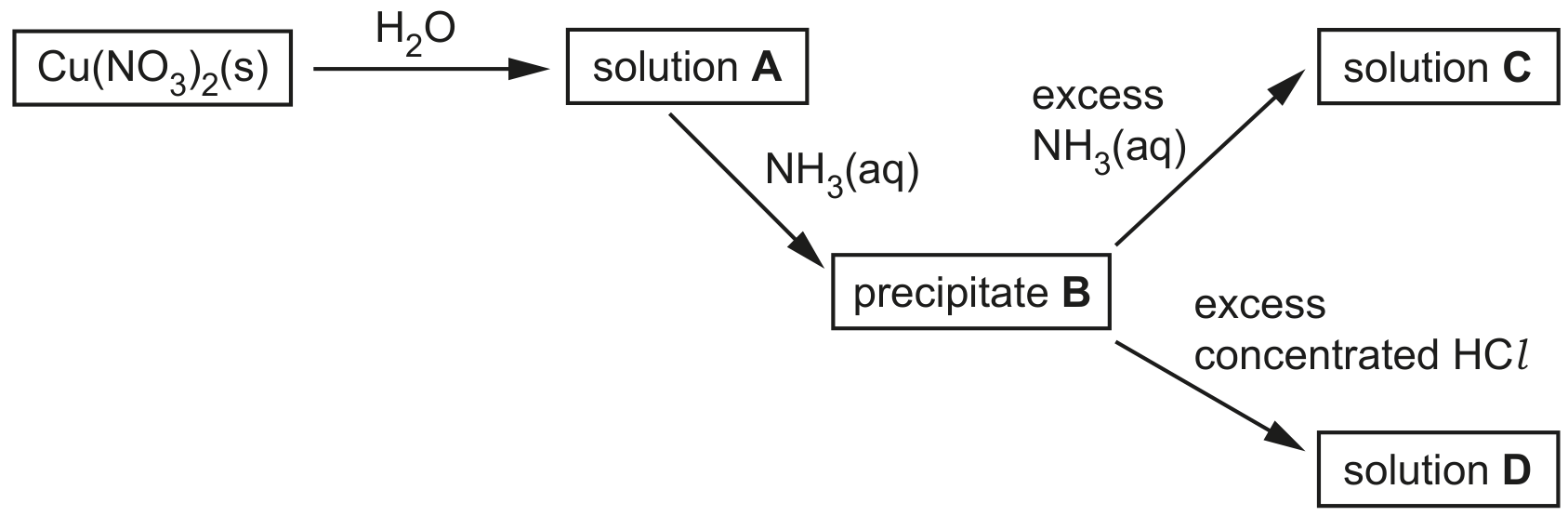
Cu(NO3)2\mathrm{Cu}\left(\mathrm{NO}_{3}\right)_{2} is added to water to form solution A.

Fig. 1.1 shows some reactions of solution A.

Fig. 1.1

Fig. 1.1

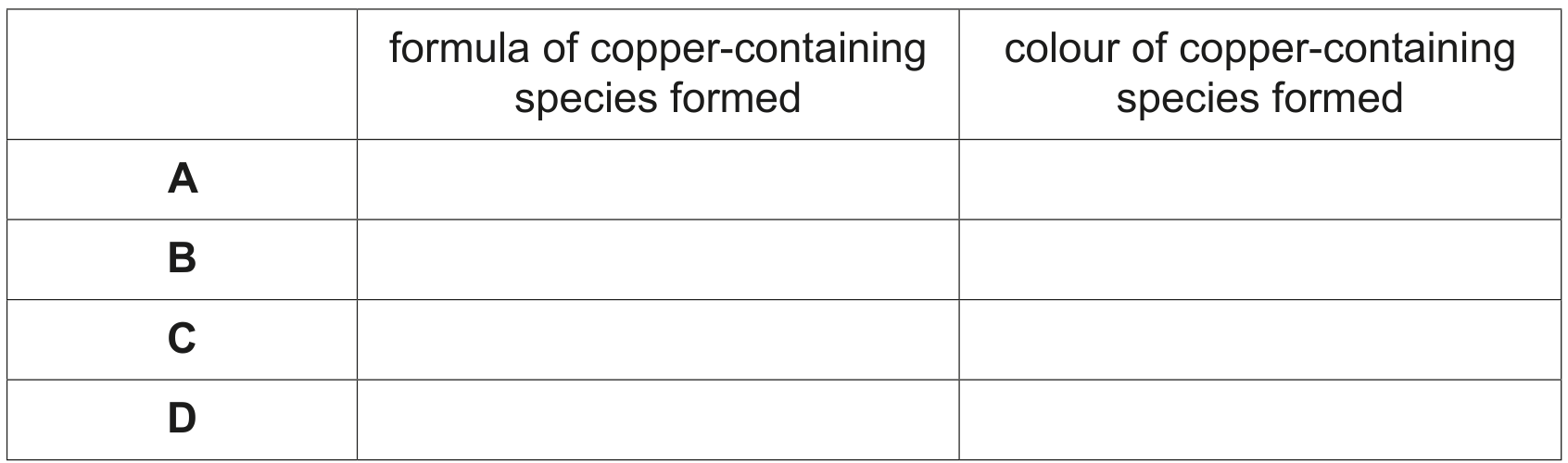
Complete Table 1.1 to show the formula and colour of each of the copper-containing species present in A, B, C and D.

Table 1.1

Table 1.1

[ 4 ]
(c)

EDTA 4{ }^{4-} is a polydentate ligand.

[ 4 ]
(i)

Explain what is meant by a polydentate ligand.

[ 2 ]
(ii)

Group 2 metal ions can form complexes similar to those of transition elements.

A solution of EDTA 4{ }^{4-} is added to water containing [Ca(H2O)6]2+\left[\mathrm{Ca}\left(\mathrm{H}_{2} \mathrm{O}\right)_{6}\right]^{2+} to form a new complex, [CaEDTA] 2{ }^{2-}, as shown.
equilibrium 1

[Ca(H2O)6]2++ EDTA 4[ CaEDTA ]2+6H2O\left[\mathrm{Ca}\left(\mathrm{H}_{2} \mathrm{O}\right)_{6}\right]^{2+}+\text { EDTA }^{4-} \rightleftharpoons[\text { CaEDTA }]^{2-}+6 \mathrm{H}_{2} \mathrm{O}

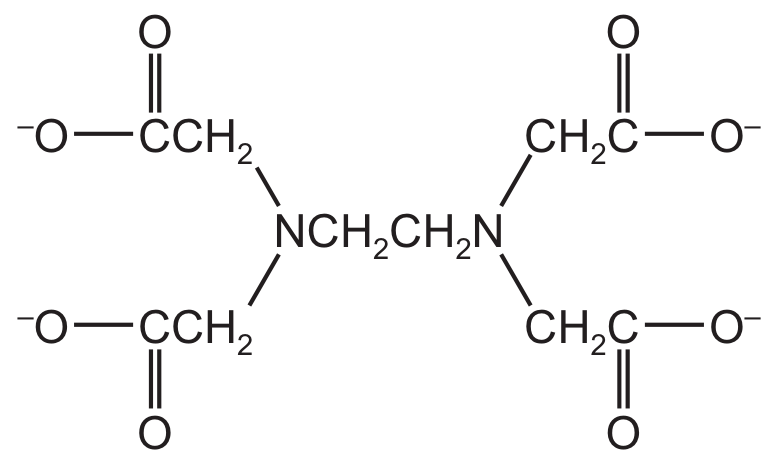
Circle on the structure of EDTA 4{ }^{4-} in Fig. 1.2 the six atoms that form bonds with the metal ion.

Fig. 1.2

Fig. 1.2

[ 1 ]
(iii)

The calcium ions in [Ca(H2O)6]2+\left[\mathrm{Ca}\left(\mathrm{H}_{2} \mathrm{O}\right)_{6}\right]^{2+} and [CaEDTA]2[\mathrm{CaEDTA}]^{2-} have a coordination number of 6 .

Explain what is meant by coordination number.

[ 1 ]
(a)

NO reacts with iron pentacarbonyl, Fe(CO)5\mathrm{Fe}(\mathrm{CO})_{5}, as shown. NO and CO are both monodentate ligands.

Fe(CO)5+2NOFe(CO)2(NO)2+3CO\mathrm{Fe}(\mathrm{CO})_{5}+2 \mathrm{NO} \rightarrow \mathrm{Fe}(\mathrm{CO})_{2}(\mathrm{NO})_{2}+3 \mathrm{CO}

During this reaction the co-ordination number of the iron changes.

[ 2 ]
(i)

State what is meant by the term co-ordination number.

[ 1 ]
(ii)

Describe how the co-ordination number of the iron changes during this reaction.
from to

[ 1 ]
(a)

Be(OH)2\mathrm{Be}(\mathrm{OH})_{2} is soluble in aqueous solutions containing an excess of hydroxide ions and forms the complex ion [Be(OH)4]2\left[\mathrm{Be}(\mathrm{OH})_{4}\right]^{2-}. This complex ion has a similar shape to that of [CuCl4]2\left[\mathrm{CuCl}_{4}\right]^{2-}.

[ 2 ]
(i)

Define the term complex ion.

[ 1 ]
(ii)

Draw a three-dimensional diagram to show the structure of the complex ion [Be(OH)4]2\left[\mathrm{Be}(\mathrm{OH})_{4}\right]^{2-}. Name the shape of the [Be(OH)4]2\left[\mathrm{Be}(\mathrm{OH})_{4}\right]^{2-} complex ion.
shape

[ 1 ]
(b)
(i)

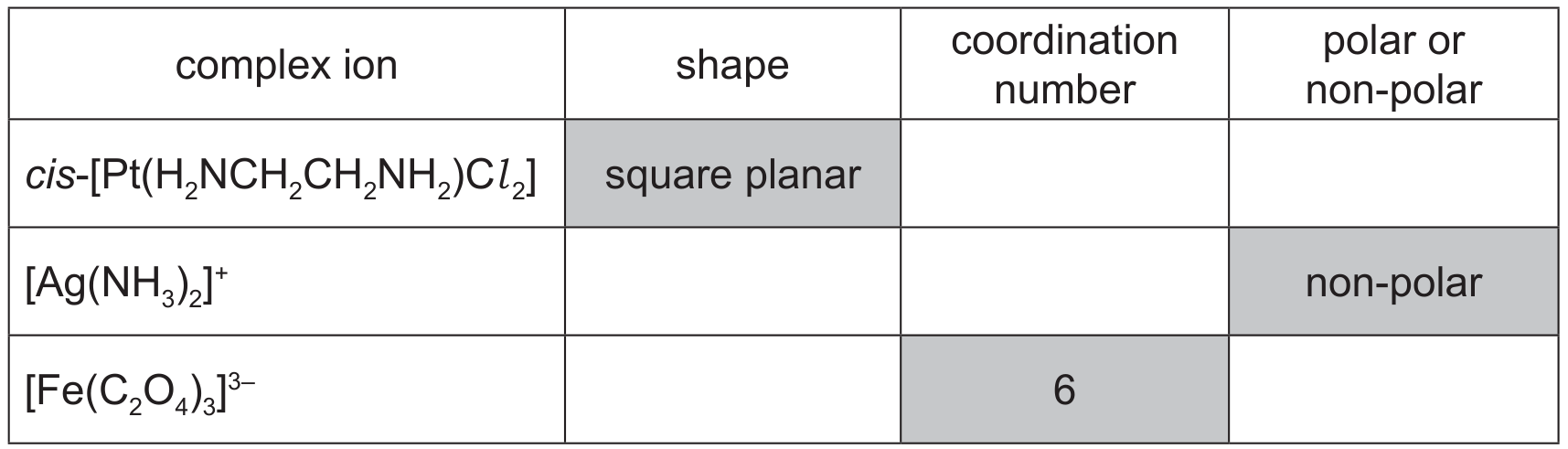
Complete Table 1.1 to show the coordination number of each metal ion, and the shapes and overall polarities of the complex ions listed.

Table 1.1

Table 1.1

[ 2 ]
0