
EduNinja
[Maximum number: 4]

Potassium iodide, KI, is used as a reagent in both inorganic and organic chemistry.

(a)

A student electrolyses a solution of KI(aq) for 8 minutes using a direct current. The half-equation for the reaction that occurs at the anode is given.

2I(aq)I2(aq)+2e2 \mathrm{I}^{-}(\mathrm{aq}) \rightarrow \mathrm{I}_{2}(\mathrm{aq})+2 \mathrm{e}^{-}
[ 4 ]
(i)

Write a half-equation for the reaction that occurs at the cathode.

Include state symbols.

[ 1 ]
(ii)

After the electrolysis, the I2(aq)I_{2}(a q) produced requires 21.35 cm321.35 \mathrm{~cm}^{3} of 0.100moldm3Na2 S2O3(aq)0.100 \mathrm{moldm}^{-3} \mathrm{Na}_{2} \mathrm{~S}_{2} \mathrm{O}_{3}(\mathrm{aq}) to react completely.

I2(aq)+2Na2 S2O3(aq)2NaI(aq)+Na2 S4O6(aq)\mathrm{I}_{2}(\mathrm{aq})+2 \mathrm{Na}_{2} \mathrm{~S}_{2} \mathrm{O}_{3}(\mathrm{aq}) \rightarrow 2 \mathrm{NaI}(\mathrm{aq})+\mathrm{Na}_{2} \mathrm{~S}_{4} \mathrm{O}_{6}(\mathrm{aq})

Calculate the average current used in 8 minutes during the electrolysis.
current = A

[ 3 ]
[Maximum number: 6]

An electrochemical cell is constructed using two half-cells.
- a Br2/Br\mathrm{Br}_{2} / \mathrm{Br}^{-}half-cell
- an Mn3+/Mn2+\mathrm{Mn}^{3+} / \mathrm{Mn}^{2+} half-cell

(a)

An aqueous solution of copper(II) sulfate is electrolysed using copper electrodes. A current of 1.50 A is passed for 3.00 hours. 5.09 g of copper is deposited on the cathode.

The charge on one electron is 1.60×10¹⁹C-1.60 \times 10^{-19} \mathrm{C}.
The relative atomic mass of copper is 63.5.
Use these data to calculate an experimentally determined value for the Avogadro constant, L. Give your answer to three significant figures.

L=mol1\begin{aligned} & L= \\ & \mathrm{mol}^{-1} \end{aligned}
[ 4 ]
(b)

Explain why magnesium metal cannot be obtained by the electrolysis of dilute aqueous magnesium sulfate. Your answer should include data from the Data Booklet.

[ 2 ]
[Maximum number: 6]

An electrochemical cell is constructed using two half-cells.
- an Sn4+/Sn2+\mathrm{Sn}^{4+} / \mathrm{Sn}^{2+} half-cell
- an Al3+/Al\mathrm{A} l^{3+} / \mathrm{A} l half-cell

(a)

Aluminium is produced industrially by electrolysis of a melt containing large amounts of Al3+\mathrm{A} l^{3+} ions.

Calculate the mass of aluminium that is obtained when a current of 300000 A is passed for 24 hours. Give your answer to three significant figures.
mass = units =

[ 4 ]
(b)

Explain why chromium metal cannot be obtained by the electrolysis of dilute aqueous chromium(II) sulfate. Your answer should include data from the Data Booklet.

[ 2 ]
(a)

Iron(III) chloride, FeCl3\mathrm{FeCl}_{3}, is used to dissolve unwanted copper from printed circuit boards (PCBs) by the following reaction.

2FeCl3(aq)+Cu( s)2FeCl2(aq)+CuCl2(aq)2 \mathrm{FeCl}_{3}(\mathrm{aq})+\mathrm{Cu}(\mathrm{~s}) \rightarrow 2 \mathrm{FeCl}_{2}(\mathrm{aq})+\mathrm{CuCl}_{2}(\mathrm{aq})

A solution in which [Fe3+(aq)]\left[\mathrm{Fe}^{3+}(\mathrm{aq})\right] was originally equal to 1.50 moldm31.50 \mathrm{~mol} \mathrm{dm}^{-3} was re-used several times to dissolve copper from the PCBs, and was then titrated as follows.

A 2.50 cm32.50 \mathrm{~cm}^{3} sample of the partially-used-up solution was acidified and titrated with 0.0200 moldm3KMnO40.0200 \mathrm{~mol} \mathrm{dm}^{-3} \mathrm{KMnO}_{4}.
This oxidised any FeCl2\mathrm{FeCl}_{2} in the solution back to FeCl3\mathrm{FeCl}_{3}.
It was found that 15.0 cm315.0 \mathrm{~cm}^{3} of KMnO4(aq)\mathrm{KMnO}_{4}(\mathrm{aq}) was required to reach the end point.

[ 6 ]
(i)

Calculate the number of moles of MnO4\mathrm{MnO}_{4}^{-}used in the titration.

(ii)

Calculate the number of moles of Fe2+\mathrm{Fe}^{2+} in 2.50 cm32.50 \mathrm{~cm}^{3} of the partially-used-up solution.

(iii)

Calculate the [Fe2+]\left[\mathrm{Fe}^{2+}\right] in the partially-used-up solution.

[Maximum number: 5]

When dilute sulfuric acid is electrolysed, water is split into hydrogen and oxygen.

2H2O(l)2H2( g)+O2( g)2 \mathrm{H}_{2} \mathrm{O}(\mathrm{l}) \rightarrow 2 \mathrm{H}_{2}(\mathrm{~g})+\mathrm{O}_{2}(\mathrm{~g})

A current of x A is passed through the solution for 14.0 minutes. 462 cm3462 \mathrm{~cm}^{3} of hydrogen are produced at the cathode, measured under room conditions.

(a)

Calculate the number of hydrogen molecules produced during the electrolysis.

number of hydrogen molecules =
[ 2 ]
(b)

Calculate the total number of electrons transferred to produce this number of hydrogen molecules.
total number of electrons =

[ 1 ]
(c)

Calculate the quantity of charge, in coulombs, of the total number of electrons calculated in (b).
quantity of charge = C

[ 1 ]
(d)

Calculate the current, x, passed during this experiment.
x = A

[ 1 ]
[Maximum number: 1]

Aluminium is the most abundant metal in the Earth's crust. The extraction of aluminium is carried out by the electrolysis of aluminium oxide dissolved in molten cryolite.

Which material is used for each of the electrodes in this electrolysis?

anode

cathode

aluminium

carbon

carbon

carbon

carbon

steel

steel

aluminium

[Maximum number: 1]

Impure copper is purified by electrolysis. The electrolyte used in this process is aqueous copper(II) sulfate.

Which reaction takes place at the anode?

A

Cu(s)Cu2+(aq)+2e\mathrm{Cu}(\mathrm{s}) \rightarrow \mathrm{Cu}^{2+}(\mathrm{aq})+2 \mathrm{e}^{-}

B

Cu2+(aq)+2eCu(s)\mathrm{Cu}^{2+}(\mathrm{aq})+2 \mathrm{e}^{-} \rightarrow \mathrm{Cu}(\mathrm{s})

C

2OH(aq)12O2( g)+H2O(l)+2e2 \mathrm{OH}^{-}(\mathrm{aq}) \rightarrow \frac{1}{2} \mathrm{O}_{2}(\mathrm{~g})+\mathrm{H}_{2} \mathrm{O}(\mathrm{l})+2 \mathrm{e}^{-}

D

2H2O(l)+2eH2( g)+2OH(aq)2 \mathrm{H}_{2} \mathrm{O}(\mathrm{l})+2 \mathrm{e}^{-} \rightarrow \mathrm{H}_{2}(\mathrm{~g})+2 \mathrm{OH}^{-}(\mathrm{aq})

[Maximum number: 1]

Aluminium is extracted by the electrolysis of a molten mixture containing aluminium oxide.
By a similar method, magnesium is extracted by the electrolysis of a molten mixture containing magnesium chloride.

Which statement about this electrolysis is correct?

A

Chloride ions travel to the anode and are oxidised to chlorine gas.

B

Chloride ions travel to the anode and are reduced to chlorine gas.

C

Chloride ions travel to the cathode and are oxidised to chlorine gas.

D

Chloride ions travel to the cathode and are reduced to chlorine gas.

[Maximum number: 1]

The electrolysis of brine using the diaphragm cell is an important industrial process.
What happens at the anode?

A

Chloride ions are oxidised.

B

Hydrogen gas is produced.

C

Hydroxide ions are formed.

D The electrode reaction is 2Cl(aq)+2eCl2( g)2 \mathrm{Cl}^{-}(\mathrm{aq})+2 \mathrm{e}^{-} \rightarrow \mathrm{Cl}_{2}(\mathrm{~g}).

[Maximum number: 1]

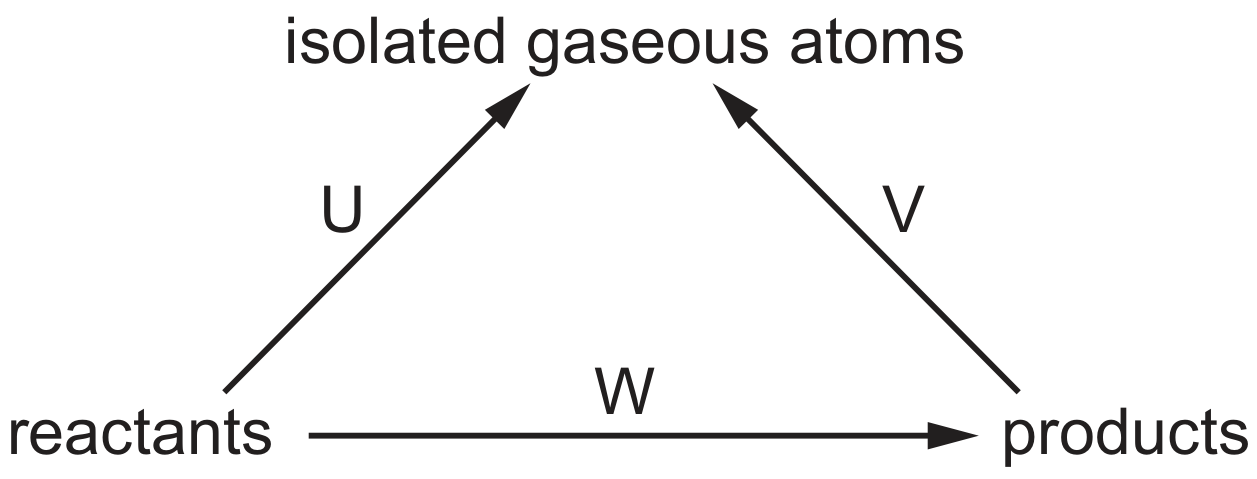
Hess' law may be used to determine enthalpy changes using average bond energies, as shown in the diagram.

Question image

U is the sum of the average bond energies of the reactants, and V is the sum of the average bond energies of the products.

For the reaction shown below, which expression will give a value for W , the enthalpy change of combustion of methane?

CH4+2O2CO2+2H2O\mathrm{CH}_{4}+2 \mathrm{O}_{2} \rightarrow \mathrm{CO}_{2}+2 \mathrm{H}_{2} \mathrm{O}
A

U-V

B

U+V

C

2(U-V)

D

V-U

0