Potassium iodide, KI, is used as a reagent in both inorganic and organic chemistry.
KI slowly oxidises in air, forming .
reaction
Table 1.2 shows some data relevant to this question.
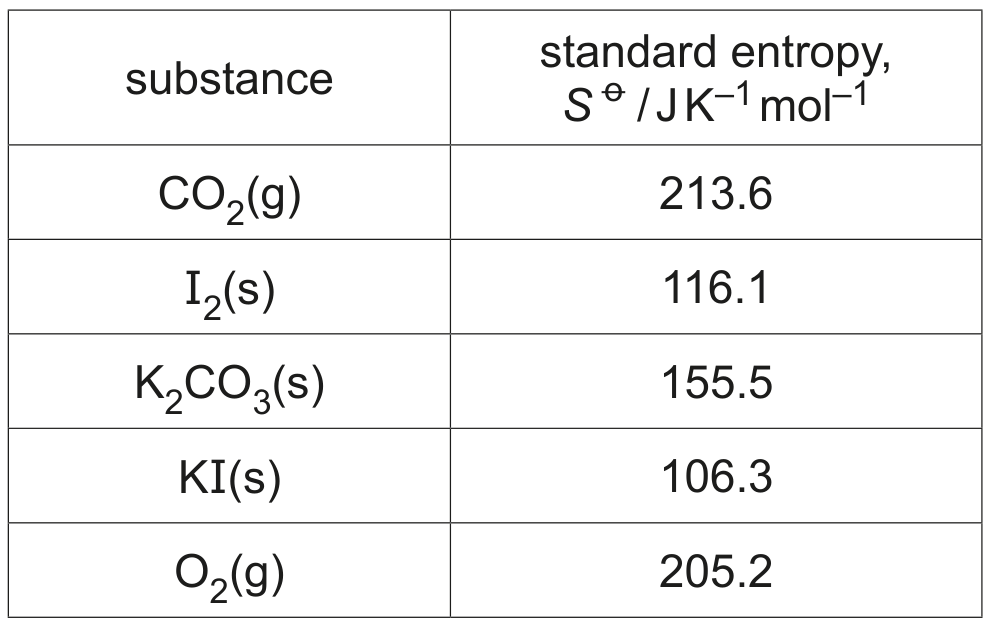
Table 1.2
Calculate the standard entropy change, , of reaction 1 .
EduNinjaPotassium iodide, KI, is used as a reagent in both inorganic and organic chemistry.
KI slowly oxidises in air, forming I2.
reaction 14KI(s)+2CO2( g)+O2( g)→2 K2CO3( s)+2I2( s)ΔH⊖=−203.4 kJ mol−1
Table 1.2 shows some data relevant to this question.

Table 1.2
Calculate the standard entropy change, ΔS⊖, of reaction 1 .
Zinc metal can be obtained in a two-step process as shown.
step 12ZnS(s)+3O2( g)→2ZnO(s)+2SO2( g)
step 2ZnO(s)+C(s)→Zn(l)+CO(g)
The reactions are carried out at 800∘C.
Predict the sign of the entropy change, ΔS⊖, of the reaction in step 1.
Explain your answer.
Use the data in Table 1.1 to calculate ΔS⊖ of the reaction shown in step 2.

Table 1.1
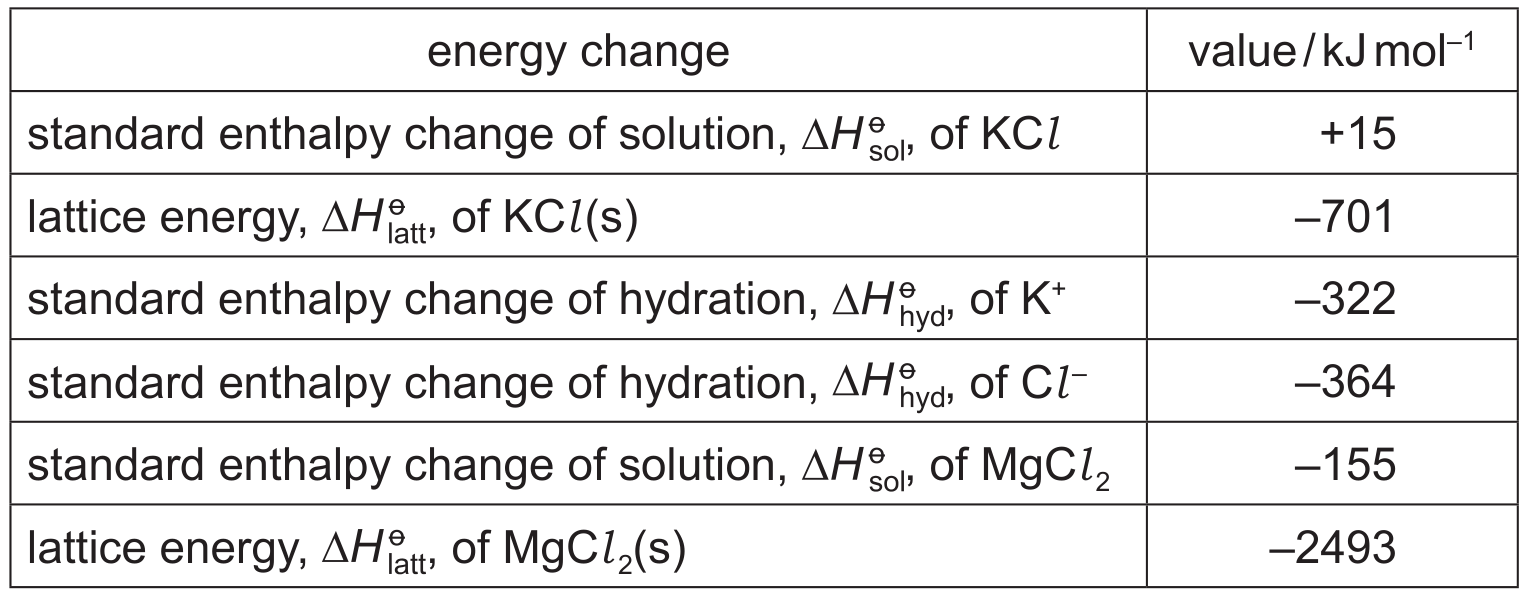
Potassium chloride, KCl , and magnesium chloride, MgCl2, are both ionic solids.

Table 1.1
Explain what is meant by entropy, S.
Potassium chloride is very soluble in water at 20∘C.
Explain the solubility of potassium chloride by reference to change in entropy, ΔS.
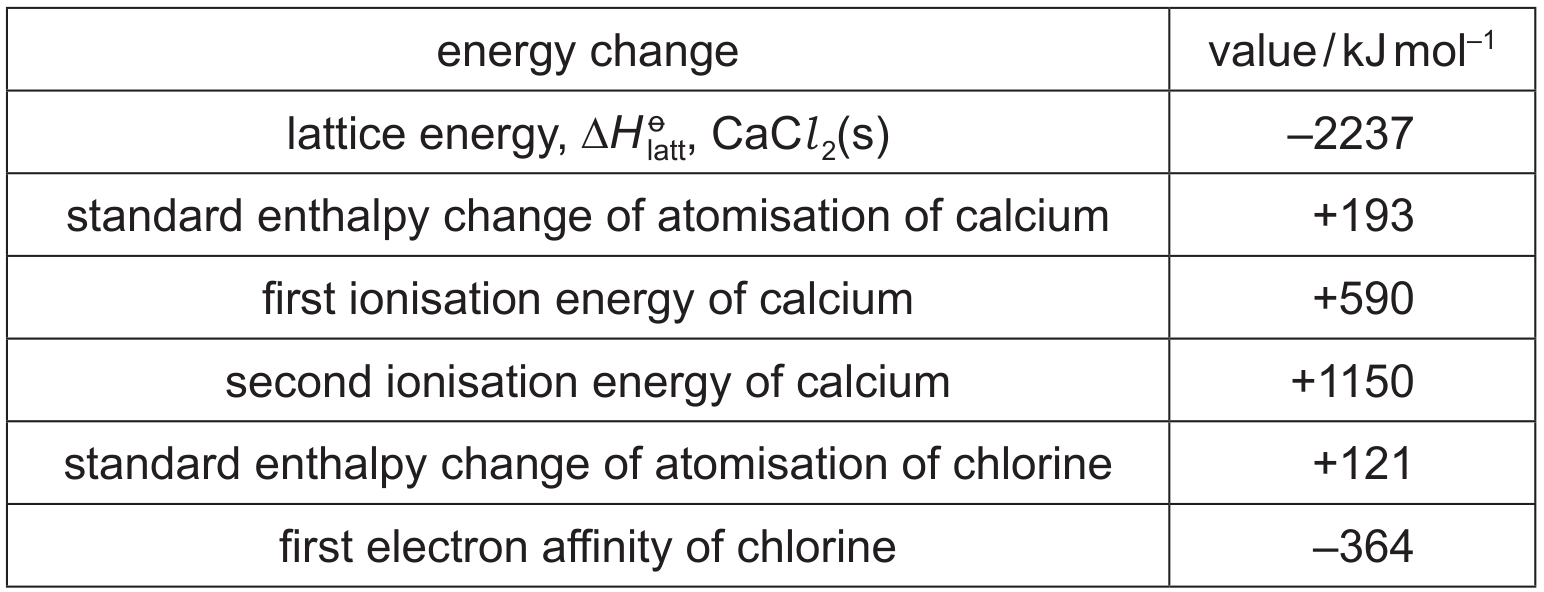
Calcium chloride, CaCl2, is an ionic solid.
The values of some energy changes are shown in Table 1.1.

Table 1.1
Calcium fluoride, CaF2( s), can be synthesised directly from its elements.
The value of ΔHf⊖(CaF2( s)) is −1214 kJ mol−1.
Predict the sign of the entropy change, ΔS⊖, for this synthesis. Explain your answer.
The sign of the entropy change is .
explanation
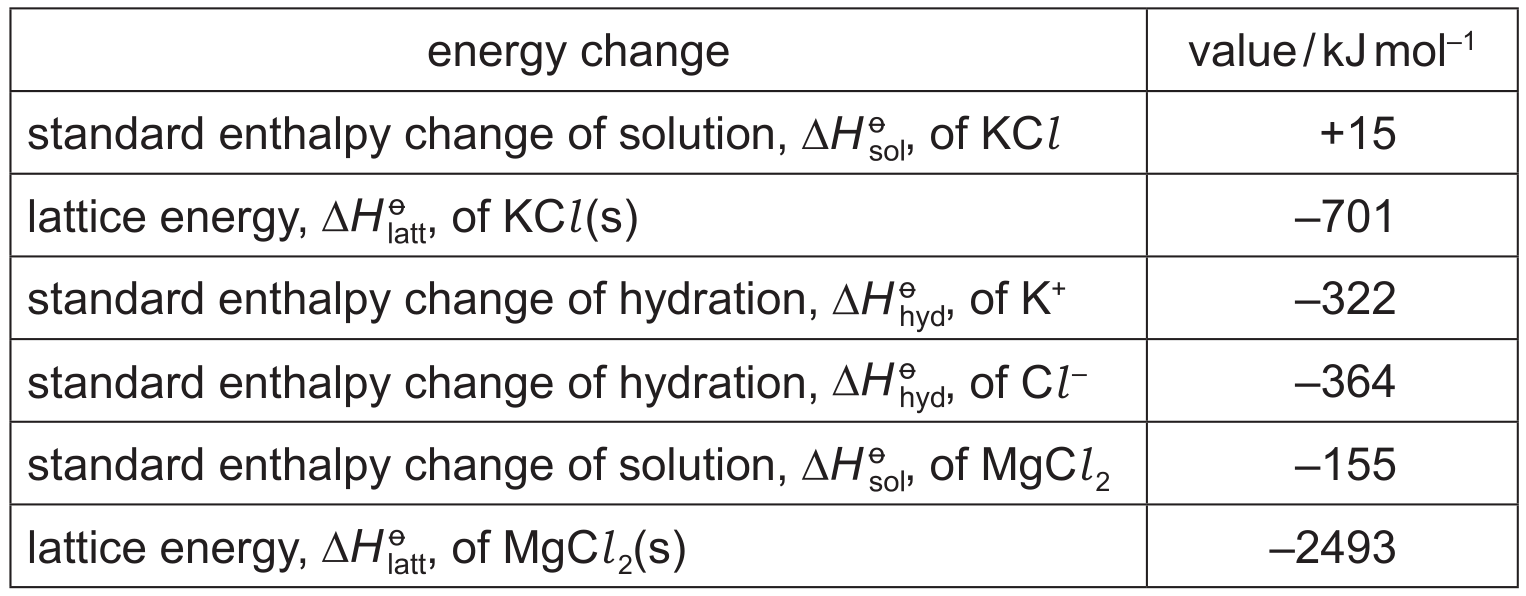
Potassium chloride, KCl , and magnesium chloride, MgCl2, are both ionic solids.

Table 1.1
Explain what is meant by entropy, S.
Potassium chloride is very soluble in water at 20∘C.
Explain the solubility of potassium chloride by reference to change in entropy, ΔS.
The standard entropy change for reaction 1 is ΔSr1⊖.
Suggest, with a reason, how the standard entropy change for reaction 3 might compare with ΔSr1e.
Silicon tetrachloride, SiCl4, is formed when silicon reacts with chlorine under suitable conditions. It is a colourless liquid with a low boiling point.
Silicon tetrachloride can be prepared according to reaction 1.
reaction 1

Calculate the standard entropy of chlorine, S⊖Cl2( g). Show all your working.
Explain why the entropy change for reaction 1 is negative.
Under conditions of high pressure and a catalyst, nitrogen monoxide, NO, forms two other oxides of nitrogen, dinitrogen monoxide, N2O, and dinitrogen trioxide, N2O3.
Calculate the entropy change for the reaction at 298 K . Include the units in your answer.
State whether the sign of ΔS⊖ calculated in (iii) agrees with that predicted from your balanced equation in (i). Explain your answer.
One method of producing hydrogen from natural gas is the reaction between hydrogen sulfide and methane.
Predict the sign of ΔS⊖ for this reaction. Explain your answer.
The free energy change, ΔGe, for this reaction at 1000 K is +51 kJ mol−1.
Calculate the value of ΔS⊖ for this reaction, stating its units.
units
Silicon is the second most abundant element by mass in the Earth's crust.
In industry, silicon is extracted from SiO2 by reaction with carbon at over 2000∘C.
Explain why the entropy change, ΔS, of reaction 1 is positive.
Silicon is purified by first heating it in a stream of HCl(g) to form SiHCl3. The SiHCl3 formed is then distilled to remove other impurities.
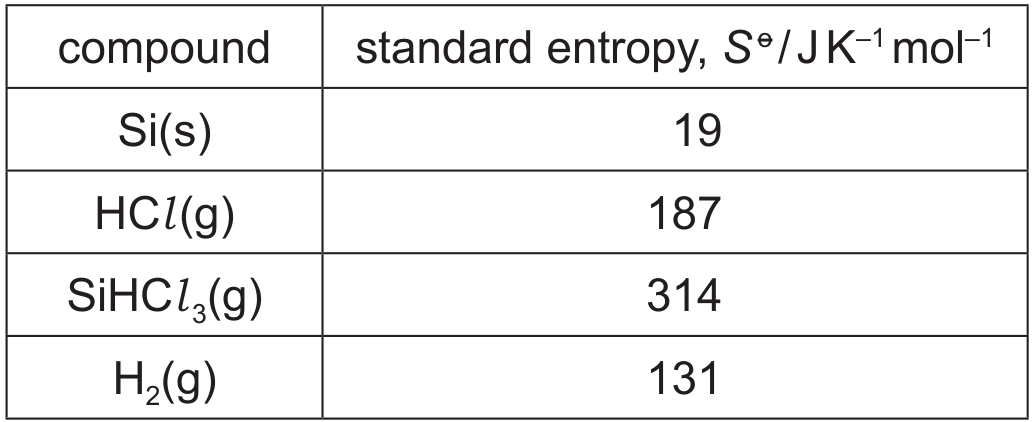
Table 2.1 shows some standard entropy data.

Table 2.1
Use the data in Table 2.1 to calculate ΔSe for reaction 2.