EduNinja
(a)
(i)

What is meant by the term enthalpy change of hydration, ΔHhyd \Delta H_{\text {hyd }}^{\ominus} ?

(ii)

Write an equation that represents the ΔHhyd \Delta H_{\text {hyd }}^{\ominus} of the Mg2+\mathrm{Mg}^{2+} ion.

(iii)

Suggest a reason why ΔHhyd \Delta H_{\text {hyd }}^{\ominus} of the Mg2+\mathrm{Mg}^{2+} ion is greater than ΔHhyd \Delta H_{\text {hyd }}^{\ominus} of the Ca2+\mathrm{Ca}^{2+} ion.

(iv)

Suggest why it is impossible to determine the enthalpy change of hydration of the oxide ion, O2\mathrm{O}^{2-}.

[ 5 ]
(b)

The enthalpy change of solution for MgCl2,ΔHsol (MgCl2( s))\mathrm{MgCl}_{2}, \Delta H_{\text {sol }}^{\ominus}\left(\mathrm{MgCl}_{2}(\mathrm{~s})\right), is represented by the following equation.

MgCl2( s)+aqMg2+(aq)+2Cl(aq)\mathrm{MgCl}_{2}(\mathrm{~s})+\mathrm{aq} \rightarrow \mathrm{Mg}^{2+}(\mathrm{aq})+2 \mathrm{Cl}^{-}(\mathrm{aq})

Describe the simple apparatus you could use, and the measurements you would make, in order to determine a value for ΔHsol (MgCl2( s))\Delta H_{\text {sol }}^{\ominus}\left(\mathrm{MgCl}_{2}(\mathrm{~s})\right) in the laboratory.

[ 4 ]
(c)

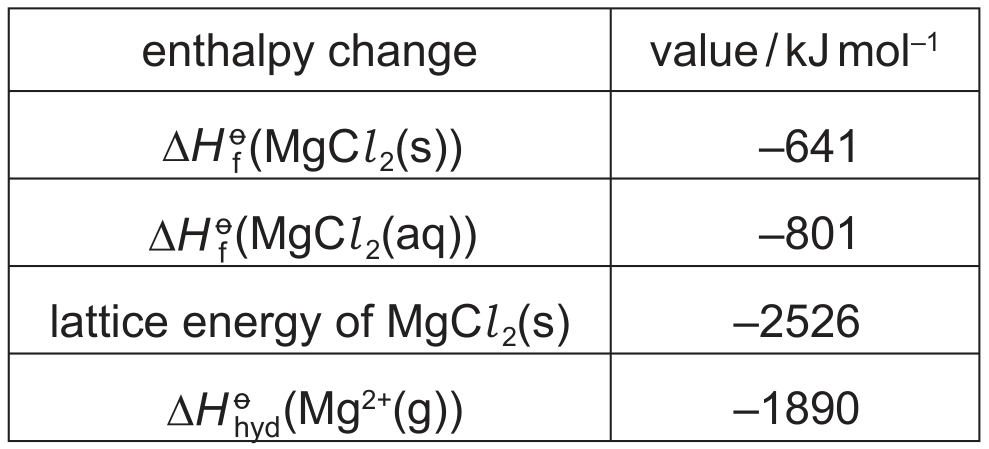
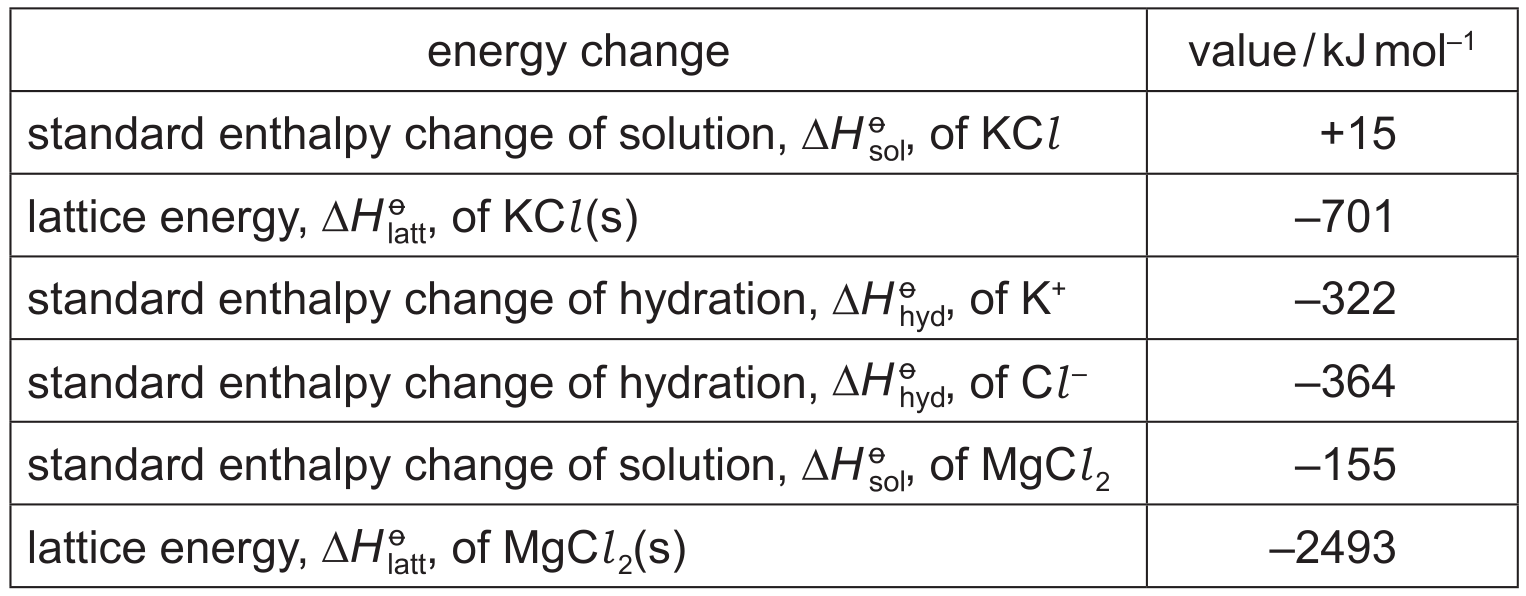
The table below lists data relevant to the formation of MgCl2(aq)\mathrm{MgCl}_{2}(\mathrm{aq}).

Table

By constructing relevant thermochemical cycles, use the above data to calculate a value for

[ 3 ]
(i)

ΔHsol (MgCl2( s))\Delta H_{\text {sol }}^{\ominus}\left(\mathrm{MgCl}_{2}(\mathrm{~s})\right),

ΔHsol =..................kJ mol1\Delta H_{\text {sol }}^{\ominus}=\ldots \ldots \ldots \ldots \ldots \ldots \ldots . . \ldots \ldots . . . . . . . . . . . . . . . . k J ~ m o l-1
(ii)

ΔHhyd (Cl(g))\quad \Delta H_{\text {hyd }}^{\ominus}\left(\mathrm{C} l^{-}(\mathrm{g})\right).

ΔHhyd =\Delta H_{\text {hyd }}^{\ominus}=
[ 3 ]
(a)
(i)

What is meant by the term standard enthalpy change of hydration, ΔHhyd \Delta H_{\text {hyd }}^{\ominus} ?

[ 2 ]
(b)

The standard enthalpy change of hydration for Ba2+,ΔHhyd (Ba2+(g))\mathrm{Ba}^{2+}, \Delta H_{\text {hyd }}^{\ominus}\left(\mathrm{Ba}^{2+}(\mathrm{g})\right), is 1305 kJ mol1-1305 \mathrm{~kJ} \mathrm{~mol}^{-1}.

Suggest an explanation for why the ΔHhyd \Delta H_{\text {hyd }}^{\ominus} of the Ba2+\mathrm{Ba}^{2+} ion is less exothermic than the ΔHhyd \Delta H_{\text {hyd }}^{\ominus} of the Ca2+\mathrm{Ca}^{2+} ion.

[ 2 ]
(a)

The dissolving of an ionic compound in water is accompanied by an energy change, the enthalpy change of solution, ΔHsol \Delta H_{\text {sol }}.

MgCl2( s)+aqMg2+(aq)+2Cl(aq)\mathrm{MgCl}_{2}(\mathrm{~s})+\mathrm{aq} \rightarrow \mathrm{Mg}^{2+}(\mathrm{aq})+2 \mathrm{Cl}^{-}(\mathrm{aq})

Describe, in terms of bond breaking and bond making, what happens to the solid ionic lattice when an ionic compound dissolves in water.

[ 2 ]
(b)
(i)

What is meant by the term enthalpy change of solution, ΔHsol \Delta H_{\text {sol }} ?

[ 1 ]
(ii)

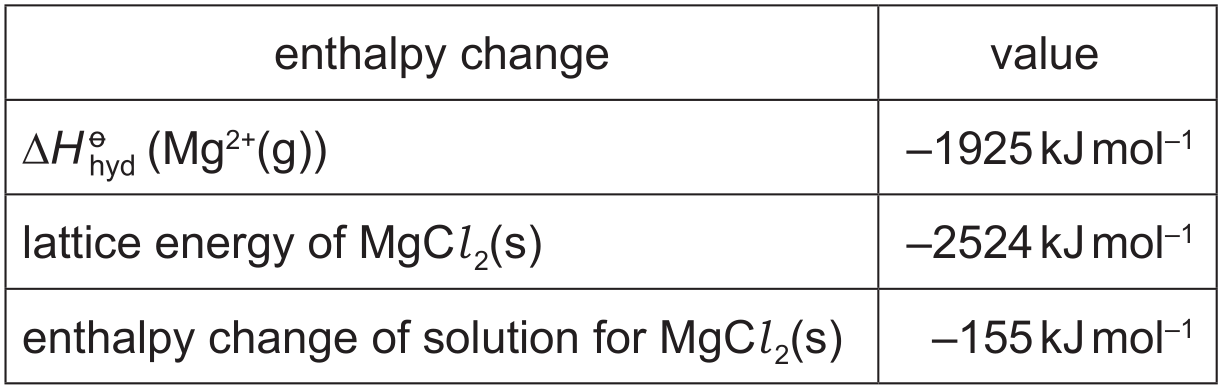
Use the following data to calculate the standard enthalpy change of hydration, ΔHhyd \Delta H_{\text {hyd }}^{\ominus}, of chloride ions, Cl(g)\mathrm{Cl}^{-}(\mathrm{g}).
You may find it helpful to construct an energy cycle.

Table

ΔHhyd (Cl(g))=\Delta H_{\text {hyd }}^{\ominus}\left(\mathrm{C} l^{-}(\mathrm{g})\right)=kJmol1\mathrm{kJ} \mathrm{mol}^{-1}

[ 2 ]
(iii)

The enthalpy change of hydration for Na+,ΔHhyd (Na+(g))\mathrm{Na}^{+}, \Delta H_{\text {hyd }}^{\ominus}\left(\mathrm{Na}^{+}(\mathrm{g})\right), is 410 kJ mol1-410 \mathrm{~kJ} \mathrm{~mol}^{-1}.

Suggest an explanation for why the ΔHhyd \Delta H_{\text {hyd }}^{\ominus} of the Na+\mathrm{Na}^{+}ion is less exothermic than the ΔHhyd \Delta H_{\text {hyd }}^{\ominus} of the Mg2+\mathrm{Mg}^{2+} ion.

[ 2 ]
[Maximum number: 8]

Potassium iodide, KI, is used as a reagent in both inorganic and organic chemistry.

(a)

KI forms an ionic lattice that is soluble in water.

[ 3 ]
(i)

Define enthalpy change of solution, ΔHsol \Delta H_{\text {sol }}.

[ 1 ]
(ii)

KI(s) has a high solubility in water although its enthalpy change of solution is endothermic.

Explain how this high solubility is possible.

[ 2 ]
(b)

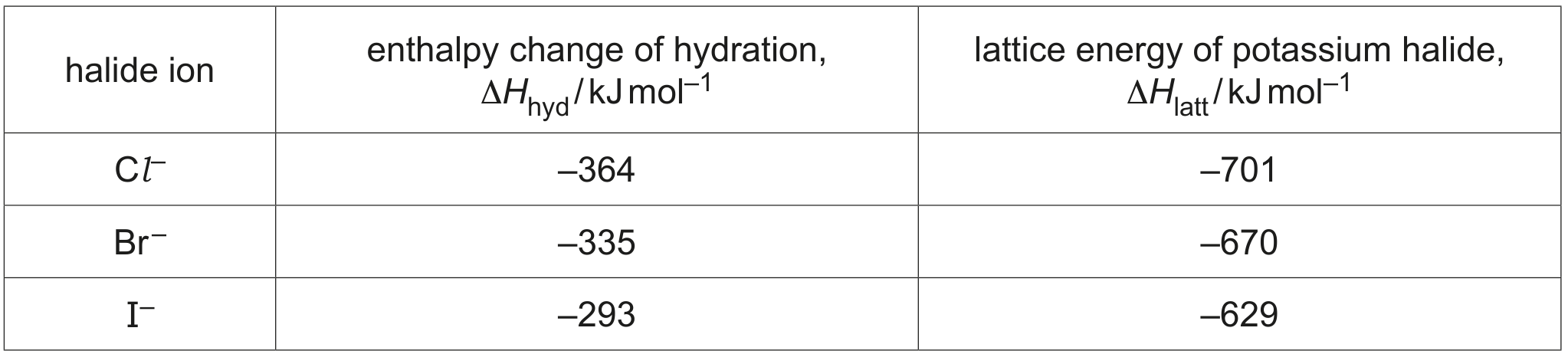
Table 1.1 gives some data about the halide ions, Cl,Br\mathrm{Cl}^{-}, \mathrm{Br}^{-}and I\mathrm{I}^{-}, and their potassium salts.

Table 1.1

Table 1.1

[ 5 ]
(i)

Explain the trend in the enthalpy change of hydration of the halide ions.

[ 2 ]
(ii)

The ΔHsol \Delta H_{\text {sol }} values of these potassium halides are almost constant.

Use the ΔHhyd \Delta H_{\text {hyd }} and ΔHlatt \Delta H_{\text {latt }} data in Table 1.1 to suggest why.

[ 1 ]
(iii)

The enthalpy change of solution of KI(s) is +21.0 kJ mol1+21.0 \mathrm{~kJ} \mathrm{~mol}^{-1}.

Use this information and the data in Table 1.1 to calculate the enthalpy change of hydration of the potassium ion, K+(g)\mathrm{K}^{+}(\mathrm{g}).

ΔHhyd  of K+(g)=..kJ mol1\Delta H_{\text {hyd }} \text { of } \mathrm{K}^{+}(\mathrm{g})=\ldots \ldots \ldots \ldots \ldots \ldots \ldots \ldots \ldots \ldots \ldots \ldots \ldots \ldots . . \mathrm{kJ} \mathrm{~mol}^{-1}
[ 2 ]
[Maximum number: 1]

Iodine is found naturally in compounds in many different oxidation states.

(a)

The Group 1 iodides all form stable ionic lattices and are soluble in water.

[ 1 ]
(i)

Define enthalpy change of solution.

[ 1 ]
(ii)

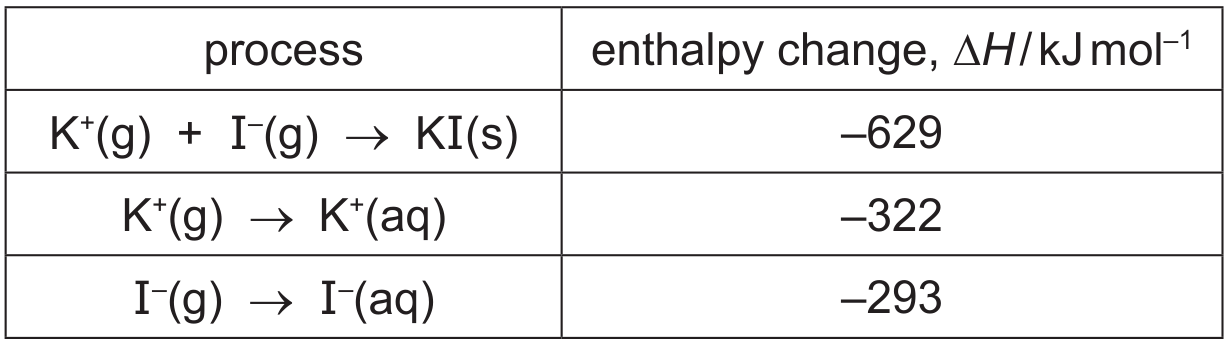
Use the data in Table 1.1 to calculate the enthalpy change of solution of potassium iodide, KI.

Table 1.1

Table 1.1

enthalpy change of solution = kJmol1\mathrm{kJ} \mathrm{mol}^{-1}

[Maximum number: 4]

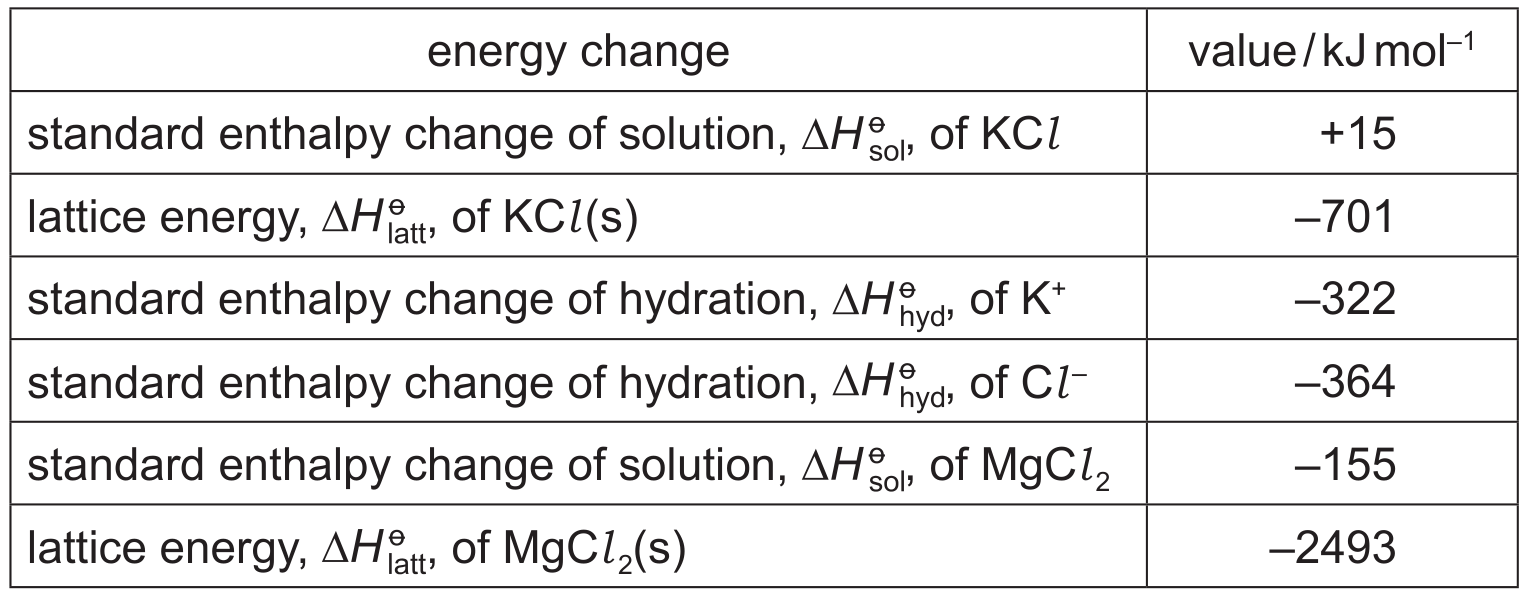
Potassium chloride, KCl , and magnesium chloride, MgCl2\mathrm{MgCl}_{2}, are both ionic solids.

Table 1.1

Table 1.1

(a)

Complete the energy cycle involving the enthalpy change of solution and the lattice energy of potassium chloride, KCl, and the relevant enthalpy changes of hydration. Label your diagram.

State symbols should be used.

Question image
Question image
[ 2 ]
(b)

Use the data in Table 1.1 to calculate the enthalpy change of hydration of magnesium ions, Mg2+\mathrm{Mg}^{2+}. Show your working.

ΔHhyd  of magnesium ions, Mg2+=..kJ mol1\Delta H_{\text {hyd }}^{\ominus} \text { of magnesium ions, } \mathrm{Mg}^{2+}=\ldots \ldots \ldots \ldots \ldots \ldots \ldots \ldots \ldots \ldots . . \mathrm{kJ} \mathrm{~mol}^{-1}
[ 2 ]
[Maximum number: 4]

Calcium chloride, CaCl2\mathrm{CaCl}_{2}, is an ionic solid.
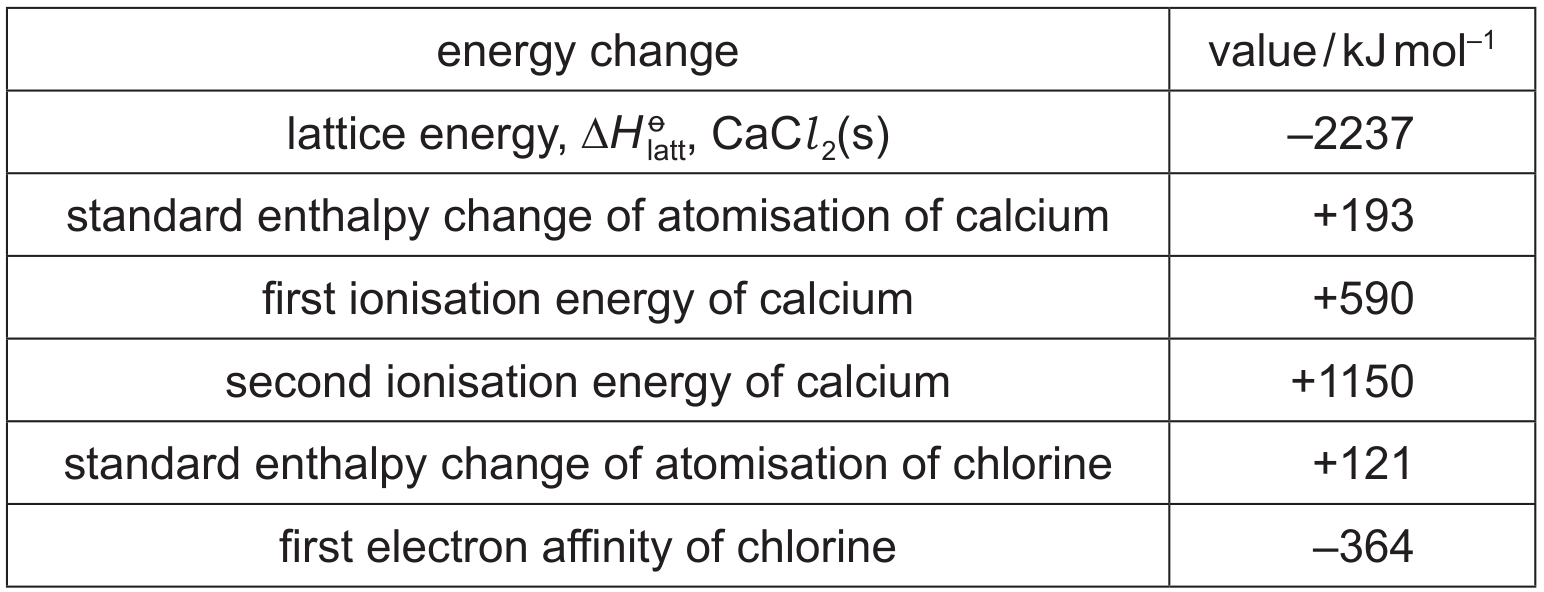
The values of some energy changes are shown in Table 1.1.

Table 1.1

Table 1.1

(a)

The enthalpy change of hydration of the chloride ion can be calculated using the lattice energy of calcium chloride and the data shown in Table 1.3.

Table 1.3

Table 1.3

[ 4 ]
(i)

Define the following terms.
enthalpy change of solution
enthalpy change of hydration

[ 2 ]
(ii)

Calculate the standard enthalpy change of hydration of the chloride ion, Cl(g)\mathrm{Cl}^{-}(\mathrm{g}). It may be helpful to draw an energy cycle. Show all your working.

kJ mol1\mathrm{kJ} \mathrm{~mol}^{-1}
[ 2 ]
[Maximum number: 4]

Potassium chloride, KCl , and magnesium chloride, MgCl2\mathrm{MgCl}_{2}, are both ionic solids.

Table 1.1

Table 1.1

(a)

Complete the energy cycle involving the enthalpy change of solution and the lattice energy of potassium chloride, KCl, and the relevant enthalpy changes of hydration. Label your diagram.

State symbols should be used.

Question image
Question image
[ 2 ]
(b)

Use the data in Table 1.1 to calculate the enthalpy change of hydration of magnesium ions, Mg2+\mathrm{Mg}^{2+}. Show your working.

ΔHhyd  of magnesium ions, Mg2+=..kJ mol1\Delta H_{\text {hyd }}^{\ominus} \text { of magnesium ions, } \mathrm{Mg}^{2+}=\ldots \ldots \ldots \ldots \ldots \ldots \ldots \ldots \ldots \ldots . . \mathrm{kJ} \mathrm{~mol}^{-1}
[ 2 ]
[Maximum number: 1]

Use of the Data Booklet is relevant to this question.
The enthalpy change of formation, ΔHf\Delta H_{\mathrm{f}}, of hydrated calcium ions is the enthalpy change of the following reaction.

Ca( s)+aq2eCa2+(aq)\mathrm{Ca}(\mathrm{~s})+\mathrm{aq}-2 \mathrm{e}^{-} \rightarrow \mathrm{Ca}^{2+}(\mathrm{aq})

The following enthalpy changes are not quoted in the Data Booklet.

Ca( s)Ca( g)ΔHa=177 kJ mol1Ca2+(g)+aqCa2+(aq)ΔHhyd=1565 kJ mol1\begin{aligned} \mathrm{Ca}(\mathrm{~s}) \rightarrow \mathrm{Ca}(\mathrm{~g}) & \Delta H_{\mathrm{a}}=177 \mathrm{~kJ} \mathrm{~mol}^{-1} \\ \mathrm{Ca}^{2+}(\mathrm{g})+\mathrm{aq} \rightarrow \mathrm{Ca}^{2+}(\mathrm{aq}) & \Delta H_{\mathrm{hyd}}=-1565 \mathrm{~kJ} \mathrm{~mol}^{-1} \end{aligned}

What is the enthalpy change of formation of hydrated calcium ions?

A

1388 kJ mol1-1388 \mathrm{~kJ} \mathrm{~mol}^{-1}

B

798 kJ mol1-798 \mathrm{~kJ} \mathrm{~mol}^{-1}

C

238 kJ mol1-238 \mathrm{~kJ} \mathrm{~mol}^{-1}

D

+352 kJ mol1+352 \mathrm{~kJ} \mathrm{~mol}^{-1}

[Maximum number: 1]

Chemical reactions are accompanied by enthalpy changes.

(a)

The enthalpy change of hydration of anhydrous magnesium sulfate, ΔHhyd MgSO4\Delta H_{\text {hyd }} \mathrm{MgSO}_{4}, can be calculated by carrying out two separate experiments.

In the first experiment 45.00 g of water was weighed into a polystyrene cup and 3.01 g of MgSO4\mathrm{MgSO}_{4} was added and stirred until it was completely dissolved. The temperature of the water rose from 23.4C23.4^{\circ} \mathrm{C} to 34.7C34.7^{\circ} \mathrm{C}.

[ 1 ]
(i)

Use the equation below for the hydration of anhydrous magnesium sulfate to construct a suitable, fully labelled energy cycle that will allow you to calculate the enthalpy change for this reaction, ΔHhyd MgSO4\Delta H_{\text {hyd }} \mathrm{MgSO}_{4}.

MgSO4( s)+7H2O(l)MgSO47H2O( s)\mathrm{MgSO}_{4}(\mathrm{~s})+7 \mathrm{H}_{2} \mathrm{O}(\mathrm{l}) \rightarrow \mathrm{MgSO}_{4} \cdot 7 \mathrm{H}_{2} \mathrm{O}(\mathrm{~s})
[ 1 ]
(ii)

Calculate the enthalpy change for this reaction, ΔHhyd MgSO4\Delta H_{\text {hyd }} \mathrm{MgSO}_{4}. Include a sign in your answer.

ΔHhyd MgSO4=\Delta H_{\text {hyd }} \mathrm{MgSO}_{4}=

kJmol1\mathrm{kJ} \mathrm{mol}^{-1}

0