(a)
(i)
Complete the following table to show the structures of the organic products formed when tartaric acid reacts separately with each reagent. Identify each type of reaction.
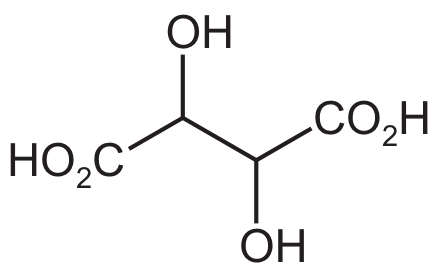
tartaric acid
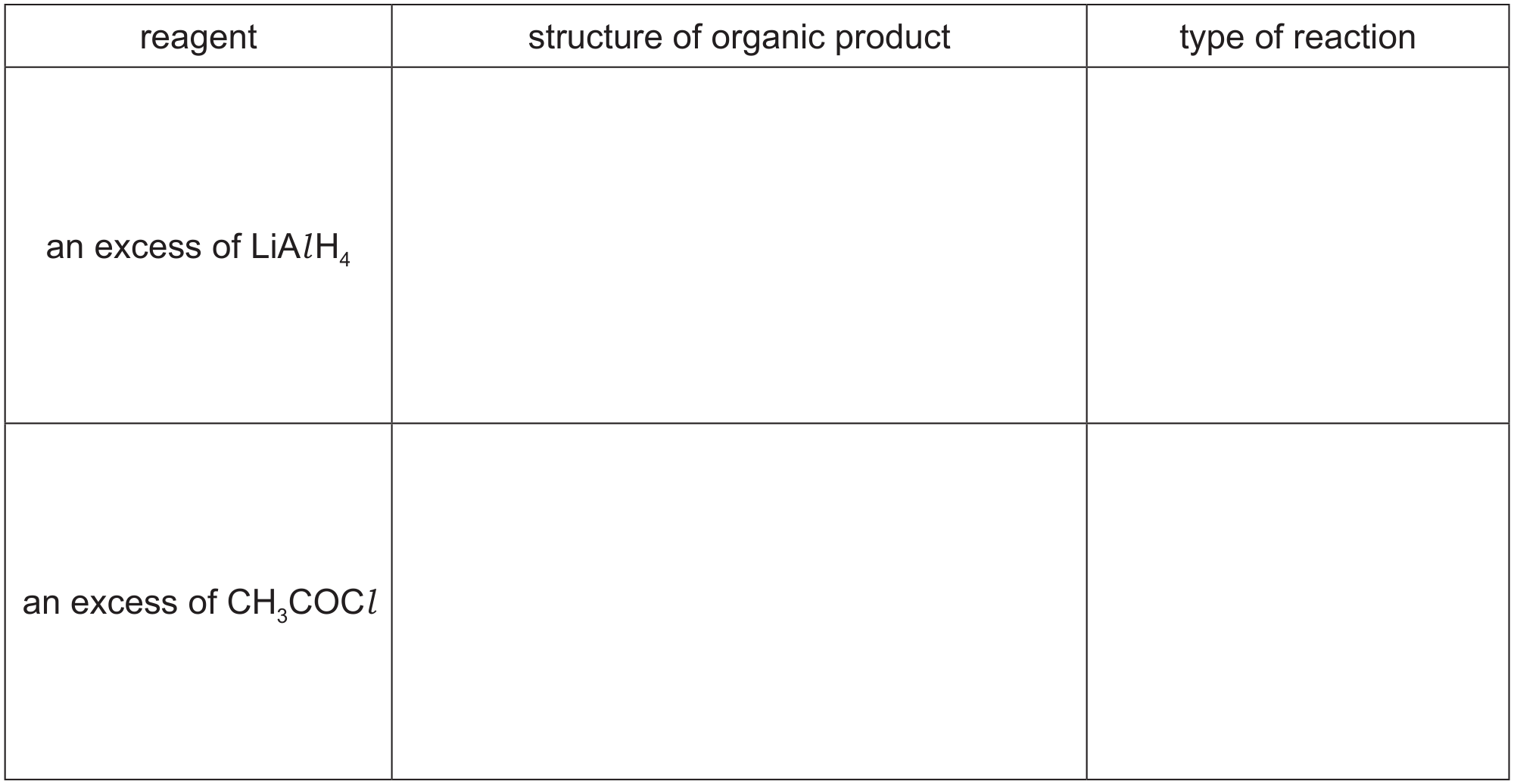
[ 3 ]
 EduNinja
Complete the following table to show the structures of the organic products formed when tartaric acid reacts separately with each reagent. Identify each type of reaction.
tartaric acid
Phenylethanone is an important chemical with many uses.
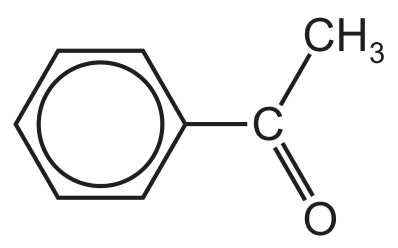
phenylethanone
Phenylethanone can be used as a starting material to make phenylethene in a two-step synthesis.
phenylethene phenylethanone
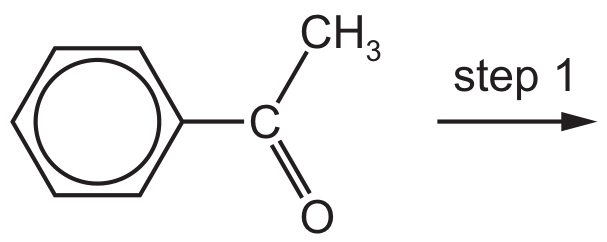
D
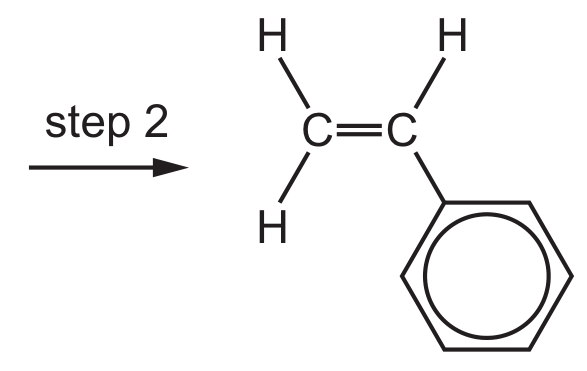
step 2
Draw the structure of compound D in the box.
Identify a suitable reagent for step 1 .
Identify a suitable reagent for step 2 .
Compare and explain the relative acidities of 2-chloropropanoic acid, 3-chloropropanoic acid, and propanoic acid. Explain your answer. > >
most acidic
least acidic
explanation
Three tests were carried out on separate samples of the organic acids shown in the table.
The following results were obtained.
✓ = observed change
x= no observed reaction
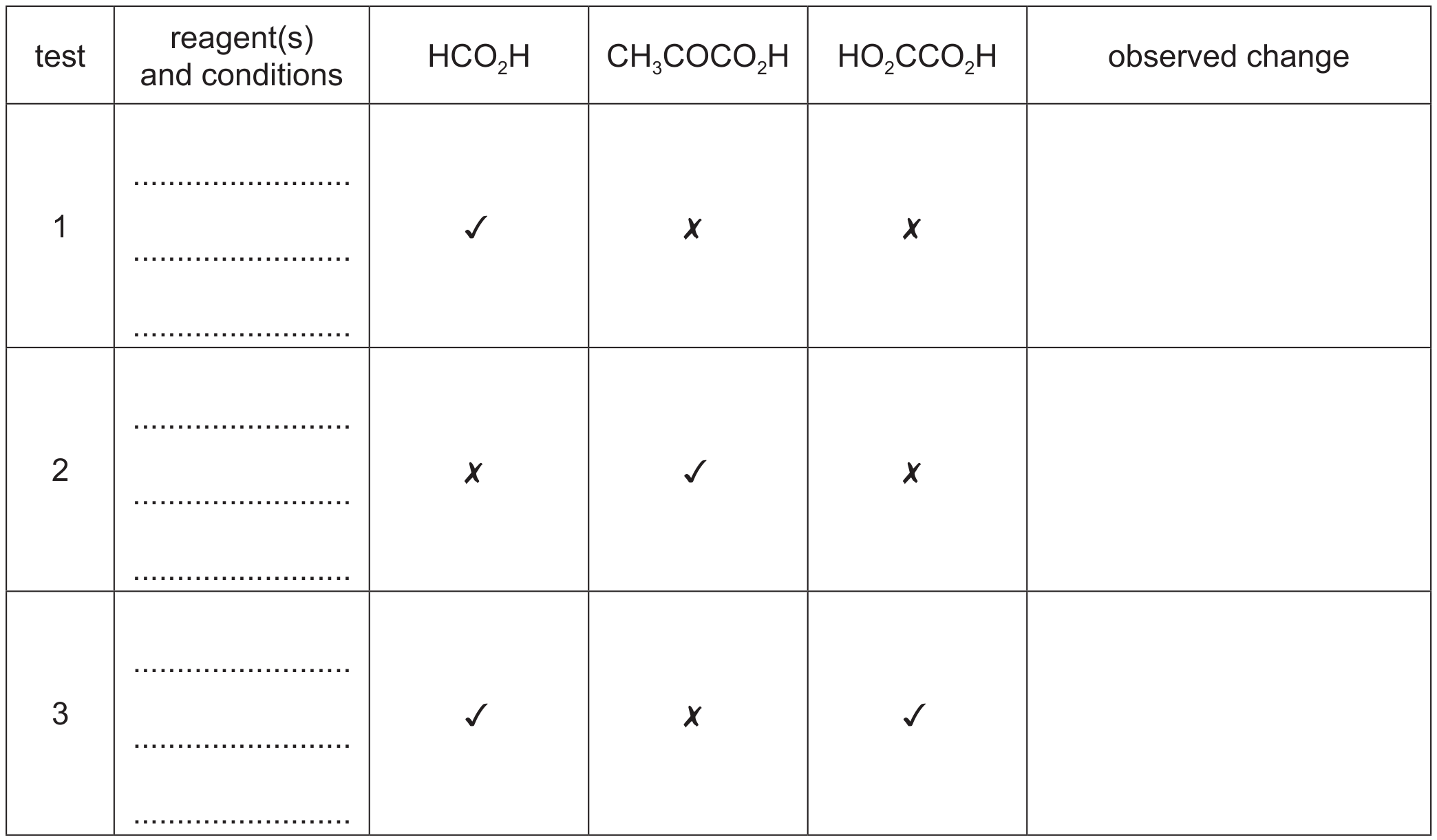
Complete the table with the reagent(s) and conditions and the observed change for each test. Assume these organic acids all have a similar acid strength.
Describe and explain the relative acidities of chloroethanoic acid and ethanoic acid.
An oxidising agent that can oxidise ethanal to ethanoic acid or ethanoate ions will also oxidise methanoic acid, , to carbon dioxide and water.
Which reagents, on heating, will react differently with and ?
1
2 Fehling's reagent
3 dilute acidified
1, 2 and 3 are correct
1 and 2 only are correct
2 and 3 only are correct
1 only is correct
Describe and explain how the acidities of and compare to each other, and to the acidity of ethanoic acid.
Compare the relative acidities of benzoic acid , phenylmethanol , and phenol .
Explain your reasoning. > >
most acidic
least acidic
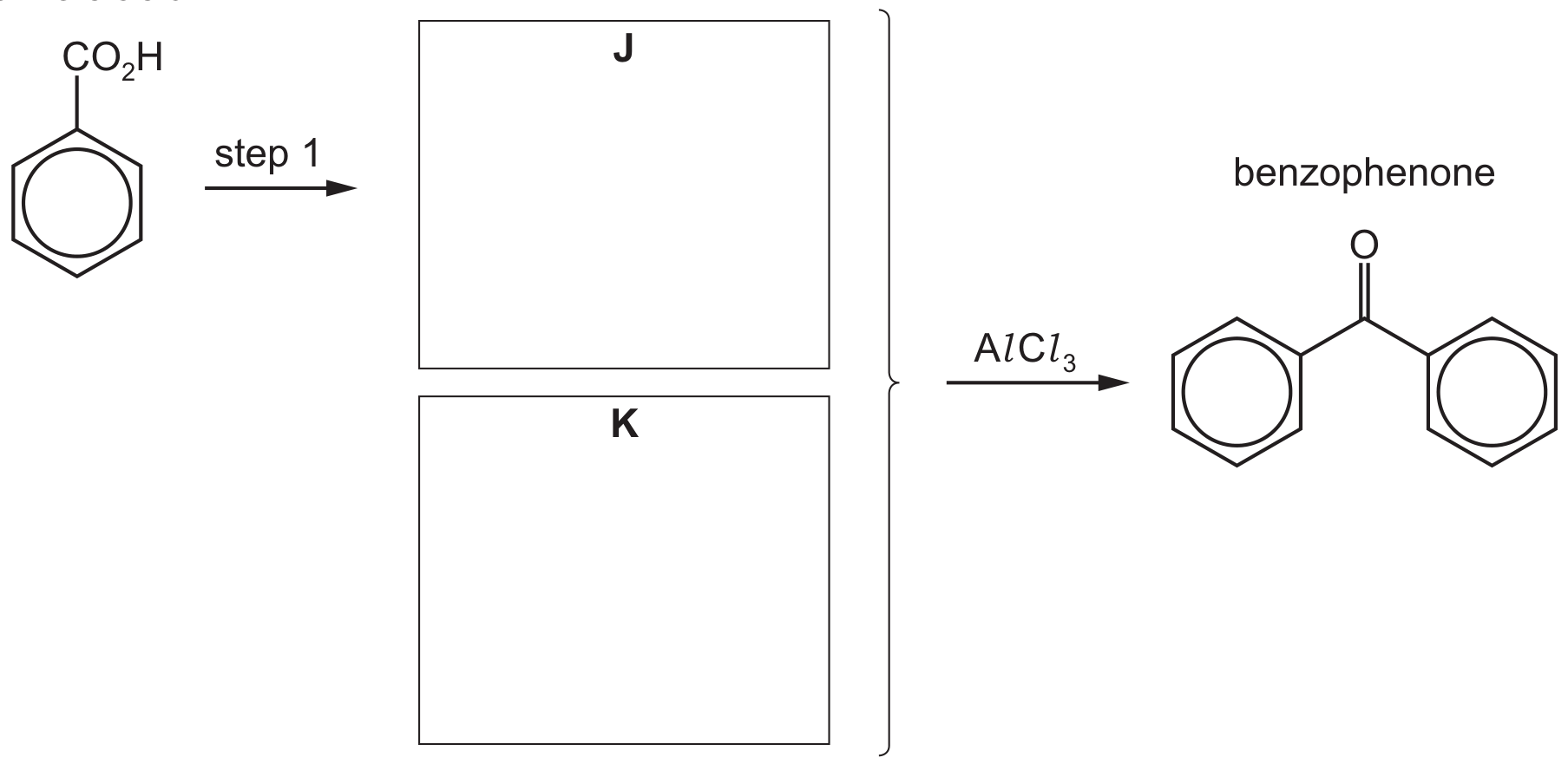
Benzophenone can be synthesised from benzoic acid in two steps as shown.
In step 1 compound J, a reactive reaction intermediate, is formed.
Compound J then reacts with an organic compound, K, to form benzophenone.
benzoic acid
Deduce the identities of organic compounds J and K and draw their structures in the boxes.
Suggest reagents and conditions for step 1.
Benzophenone can also be synthesised in two steps from bromomethylbenzene.
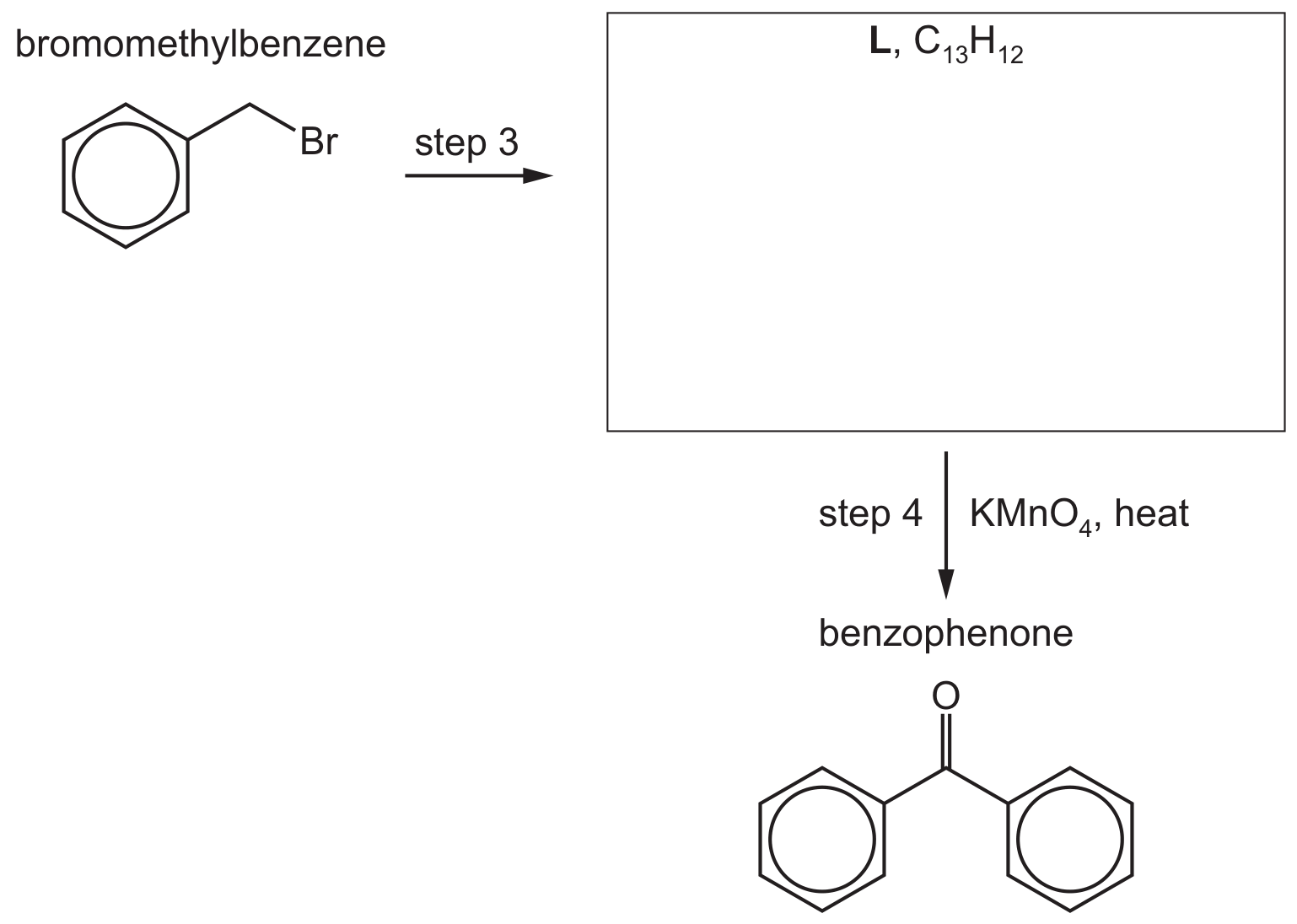
Deduce the identity of compound L and draw its structure in the box.
The structure of phenylethanoic acid is shown.
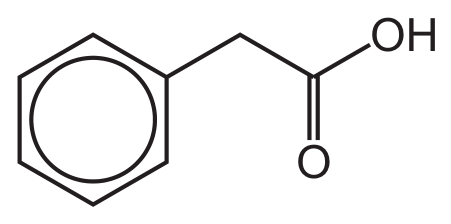
A three-step synthesis of phenylethanoic acid from methylbenzene is shown.

State reagents and conditions for steps 2 and 3 .
step 2
step 3
The structure of benzene-1,3-dicarboxylic acid is shown.
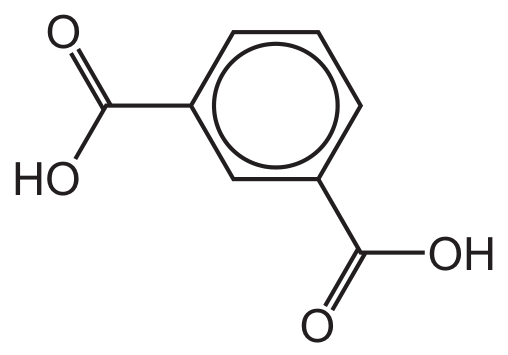
benzene-1,3-dicarboxylic acid
Benzene-1,3-dicarboxylic acid can be made by the two-step synthesis shown below.
benzene-1,3-dicarboxylic acid
compound P

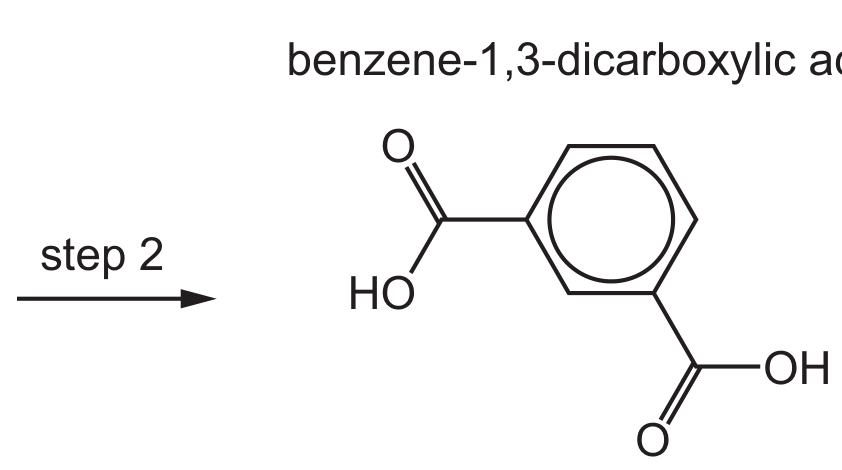
compound Q
Suggest a reagent and conditions to convert compound Q into benzene-1,3-dicarboxylic acid, in step 2.