EduNinja
[Maximum number: 2]

Potassium iodide, KI, is used as a reagent in both inorganic and organic chemistry.

(a)

KI slowly oxidises in air, forming I2\mathrm{I}_{2}.

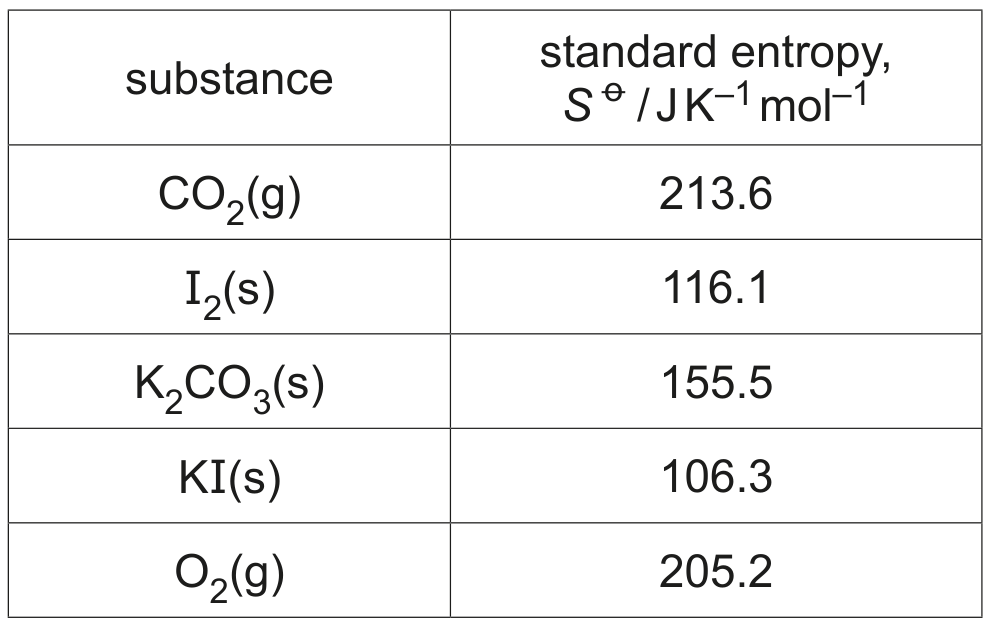
reaction 14KI(s)+2CO2( g)+O2( g)2 K2CO3( s)+2I2( s)ΔH=203.4 kJ mol11 \quad 4 \mathrm{KI}(\mathrm{s})+2 \mathrm{CO}_{2}(\mathrm{~g})+\mathrm{O}_{2}(\mathrm{~g}) \rightarrow 2 \mathrm{~K}_{2} \mathrm{CO}_{3}(\mathrm{~s})+2 \mathrm{I}_{2}(\mathrm{~s}) \quad \Delta H^{\ominus}=-203.4 \mathrm{~kJ} \mathrm{~mol}^{-1}

Table 1.2 shows some data relevant to this question.

Table 1.2

Table 1.2

[ 2 ]
(i)

Use your answer to (c)(i) to show that reaction 1 is spontaneous at 298 K .

[ 2 ]
[Maximum number: 2]

Silicon tetrachloride, SiCl4\mathrm{SiCl}_{4}, is formed when silicon reacts with chlorine under suitable conditions. It is a colourless liquid with a low boiling point.

(a)

The standard enthalpy change of formation of silicon tetrachloride, ΔHfSiCl4(I)\Delta H_{\mathrm{f}}^{\ominus} \mathrm{SiCl}_{4}(\mathrm{I}), is 640 kJ mol1-640 \mathrm{~kJ} \mathrm{~mol}^{-1}.

Reaction 1 is spontaneous at lower temperatures, but it is not spontaneous at very high temperatures.

Calculate the temperature above which reaction 1 is not spontaneous.
temperature = K

[ 2 ]
[Maximum number: 1]

1EDTA41 \mathrm{EDTA}^{4-}, is a polydentate ligand.

(a)

Cadmium ions form complexes with methylamine, CH3NH2\mathrm{CH}_{3} \mathrm{NH}_{2}, and with 1,2-diaminoethane, H2NCH2CH2NH2\mathrm{H}_{2} \mathrm{NCH}_{2} \mathrm{CH}_{2} \mathrm{NH}_{2}, as shown in equilibriums 2 and 3. 1,2-diaminoethane is shown as en.
equilibrium 2[Cd(H2O)6]2++4CH3NH2[Cd(CH3NH2)4(H2O)2]2++4H2OKstab2 =3.60×1062\left[\mathrm{Cd}\left(\mathrm{H}_{2} \mathrm{O}\right)_{6}\right]^{2+}+4 \mathrm{CH}_{3} \mathrm{NH}_{2} \rightleftharpoons\left[\mathrm{Cd}\left(\mathrm{CH}_{3} \mathrm{NH}_{2}\right)_{4}\left(\mathrm{H}_{2} \mathrm{O}\right)_{2}\right]^{2+}+4 \mathrm{H}_{2} \mathrm{O} \quad K_{\text {stab2 }}=3.60 \times 10^{6}
equilibrium 3[Cd(H2O)6]2++2en[Cd(en)2(H2O)2]2++4H2OKstab3 =4.20×10103\left[\mathrm{Cd}\left(\mathrm{H}_{2} \mathrm{O}\right)_{6}\right]^{2+}+2 \mathrm{en} \rightleftharpoons\left[\mathrm{Cd}(\mathrm{en})_{2}\left(\mathrm{H}_{2} \mathrm{O}\right)_{2}\right]^{2+}+4 \mathrm{H}_{2} \mathrm{O} \quad \mathrm{K}_{\text {stab3 }}=4.20 \times 10^{10}

An equilibrium is set up between these two complexes as shown in equilibrium 4.
equilibrium 4[Cd(CH3NH2)4(H2O)2]2++2en[Cd(en)2(H2O)2]2++4CH3NH24\left[\mathrm{Cd}\left(\mathrm{CH}_{3} \mathrm{NH}_{2}\right)_{4}\left(\mathrm{H}_{2} \mathrm{O}\right)_{2}\right]^{2+}+2 \mathrm{en} \rightleftharpoons\left[\mathrm{Cd}(\mathrm{en})_{2}\left(\mathrm{H}_{2} \mathrm{O}\right)_{2}\right]^{2+}+4 \mathrm{CH}_{3} \mathrm{NH}_{2}

ΔH=+0.840 kJ mol1ΔS=+80.9JK1 mol1\begin{aligned} & \Delta H^{\ominus}=+0.840 \mathrm{~kJ} \mathrm{~mol}^{-1} \\ & \Delta S^{\ominus}=+80.9 \mathrm{JK}^{-1} \mathrm{~mol}^{-1} \end{aligned}
[ 1 ]
(i)

State how the value of ΔGe\Delta G^{e} changes as the temperature increases. Explain your answer.

[ 1 ]
[Maximum number: 1]

When dilute sulfuric acid is electrolysed, water is split into hydrogen and oxygen.

2H2O(l)2H2( g)+O2( g)2 \mathrm{H}_{2} \mathrm{O}(\mathrm{l}) \rightarrow 2 \mathrm{H}_{2}(\mathrm{~g})+\mathrm{O}_{2}(\mathrm{~g})

A current of x A is passed through the solution for 14.0 minutes. 462 cm3462 \mathrm{~cm}^{3} of hydrogen are produced at the cathode, measured under room conditions.

(a)

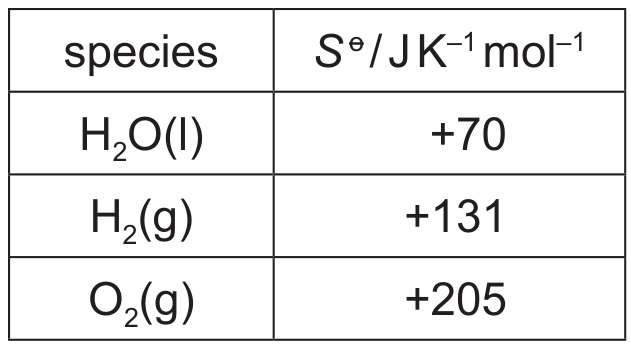
The standard entropies, SS^{\ominus}, of three species are given in the table.

Table

(i) Calculate ΔSe\Delta \mathrm{S}^{e} for the reaction 2H2O(l)2H2( g)+O2( g)2 \mathrm{H}_{2} \mathrm{O}(\mathrm{l}) \rightarrow 2 \mathrm{H}_{2}(\mathrm{~g})+\mathrm{O}_{2}(\mathrm{~g}).

ΔS=..JK1 mol1[1]\Delta S^{\ominus}=\ldots \ldots \ldots \ldots \ldots \ldots \ldots \ldots \ldots \ldots . . \mathrm{JK}^{-1} \mathrm{~mol}^{-1}[1]

(ii) ΔH\Delta \mathrm{H}^{\ominus} for the reaction 2H2O(l)2H2( g)+O2( g)2 \mathrm{H}_{2} \mathrm{O}(\mathrm{l}) \rightarrow 2 \mathrm{H}_{2}(\mathrm{~g})+\mathrm{O}_{2}(\mathrm{~g}) is +572 kJ mol1+572 \mathrm{~kJ} \mathrm{~mol}^{-1}.

Calculate ΔG\Delta G^{\ominus} for this reaction at 298 K .

ΔG=...................kJ mol1\Delta G^{\ominus}=\ldots \ldots \ldots \ldots . . . . . . . . . . . . . . . . . . . k J \mathrm{~mol}^{-1}
[ 1 ]
(i)

Predict the effect of increasing temperature on the spontaneity of this reaction. Explain your answer.

[ 1 ]
(a)

The reaction of solid hydrated barium hydroxide, Ba(OH)28H2O\mathrm{Ba}(\mathrm{OH})_{2} \cdot 8 \mathrm{H}_{2} \mathrm{O}, with ammonium salts is endothermic.

[ 5 ]
(i)

Calculate the minimum temperature at which the reaction of Ba(OH)28H2O\mathrm{Ba}(\mathrm{OH})_{2} \cdot 8 \mathrm{H}_{2} \mathrm{O} with NH4NO3\mathrm{NH}_{4} \mathrm{NO}_{3} becomes feasible. Show all your working.

Ba(OH)28H2O(s)+2NH4NO3( s)2NH3( g)+Ba(NO3)2( s)+10H2O(l)\mathrm{Ba}(\mathrm{OH})_{2} \cdot 8 \mathrm{H}_{2} \mathrm{O}(\mathrm{s})+2 \mathrm{NH}_{4} \mathrm{NO}_{3}(\mathrm{~s}) \rightarrow 2 \mathrm{NH}_{3}(\mathrm{~g})+\mathrm{Ba}\left(\mathrm{NO}_{3}\right)_{2}(\mathrm{~s})+10 \mathrm{H}_{2} \mathrm{O}(\mathrm{l})

ΔHr=+132 kJ mol1ΔS=+616JK1 mol1\begin{aligned} & \Delta H_{\mathrm{r}}^{\ominus}=+132 \mathrm{~kJ} \mathrm{~mol}^{-1} \\ & \Delta S^{\ominus}=+616 \mathrm{JK}^{-1} \mathrm{~mol}^{-1} \end{aligned}

temperature = C{ }^{\circ} \mathrm{C}

[ 2 ]
(ii)

Barium hydroxide reacts readily with ammonium chloride on mixing at room temperature.

Ba(OH)28H2O(s)+2NH4Cl(s)2NH3( g)+BaCl22H2O(s)+8H2O(l)ΔHr=+133 kJ mol1\mathrm{Ba}(\mathrm{OH})_{2} \cdot 8 \mathrm{H}_{2} \mathrm{O}(\mathrm{s})+2 \mathrm{NH}_{4} \mathrm{Cl}(\mathrm{s}) \rightarrow 2 \mathrm{NH}_{3}(\mathrm{~g})+\mathrm{BaCl}_{2} \cdot 2 \mathrm{H}_{2} \mathrm{O}(\mathrm{s})+8 \mathrm{H}_{2} \mathrm{O}(\mathrm{l}) \quad \Delta H_{\mathrm{r}}^{\ominus}=+133 \mathrm{~kJ} \mathrm{~mol}^{-1}

Some relevant standard entropies are given in Table 1.2.

Table 1.2

Table 1.2

Calculate the standard Gibbs free energy change, ΔG\Delta G^{\ominus}, for this reaction at 25C25^{\circ} \mathrm{C}.
kJmol1\mathrm{kJmol}^{-1}

[ 3 ]
[Maximum number: 1]

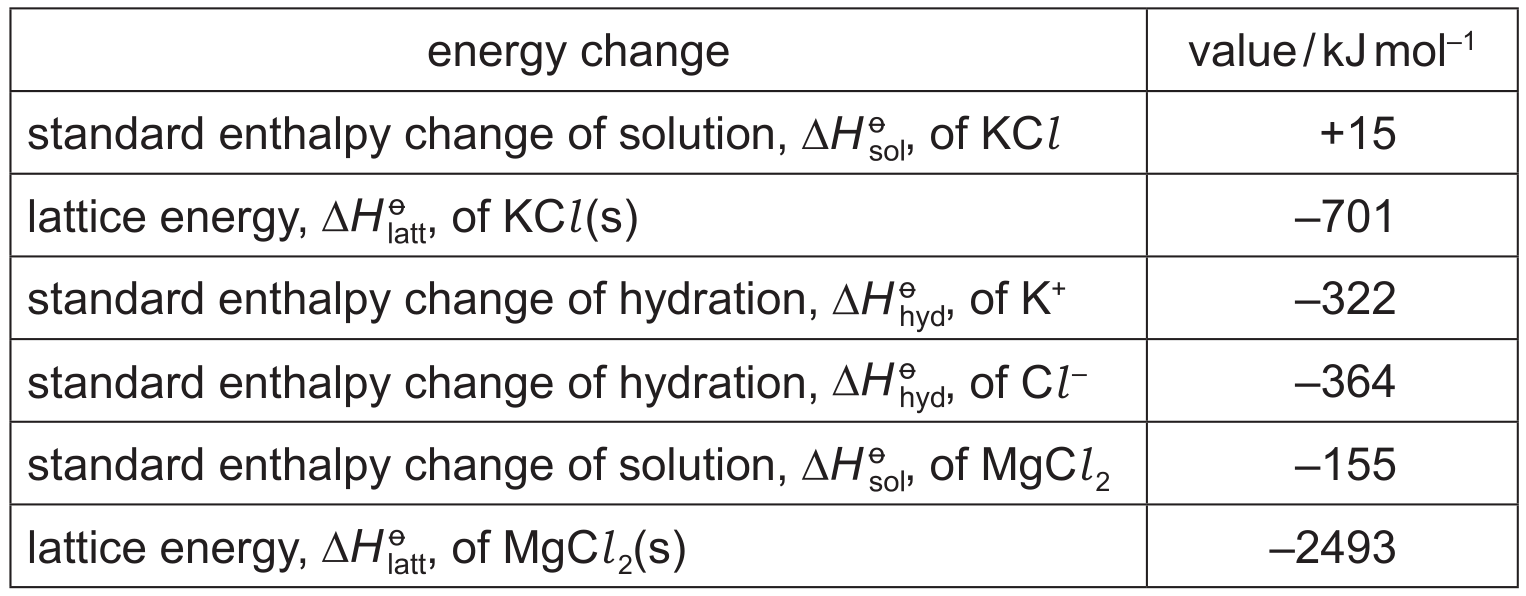
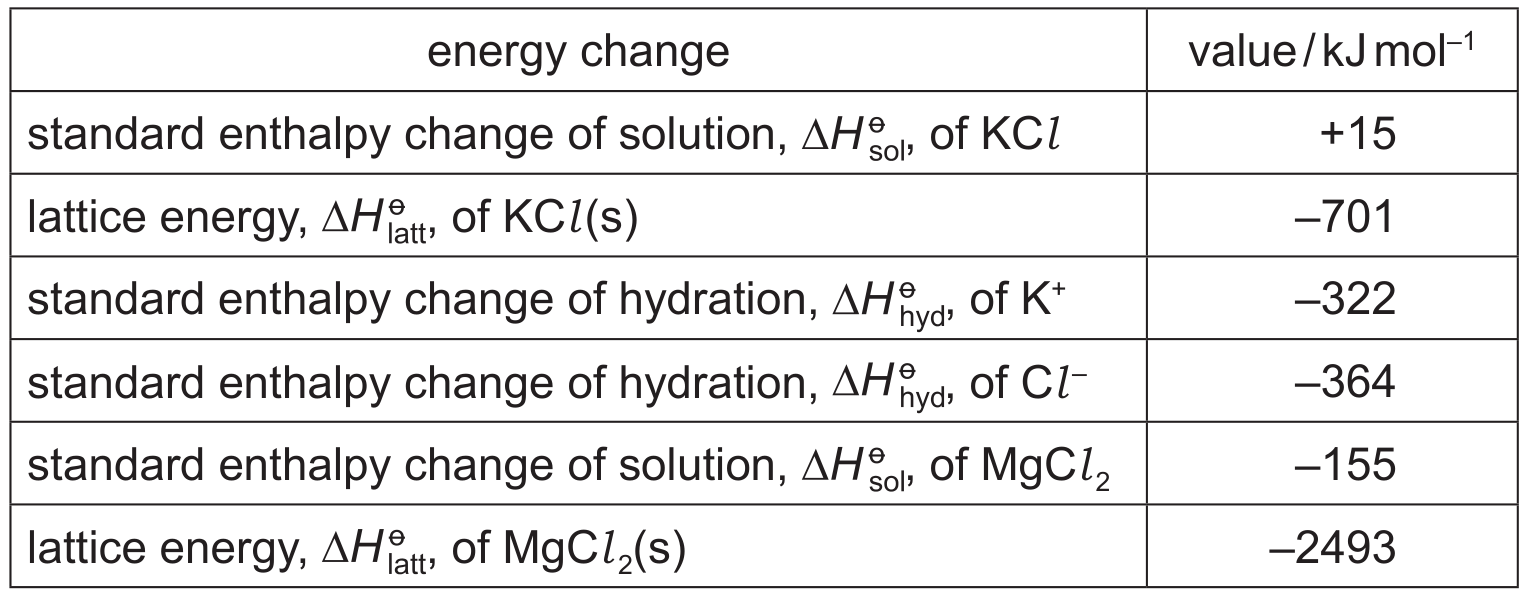
Potassium chloride, KCl , and magnesium chloride, MgCl2\mathrm{MgCl}_{2}, are both ionic solids.

Table 1.1

Table 1.1

(a)
(i)

Use the Gibbs equation and your answer to (e)(ii) to predict whether potassium chloride is more soluble in water at 20C20^{\circ} \mathrm{C} or at 80C80^{\circ} \mathrm{C}. Explain your answer.

[ 1 ]
[Maximum number: 2]

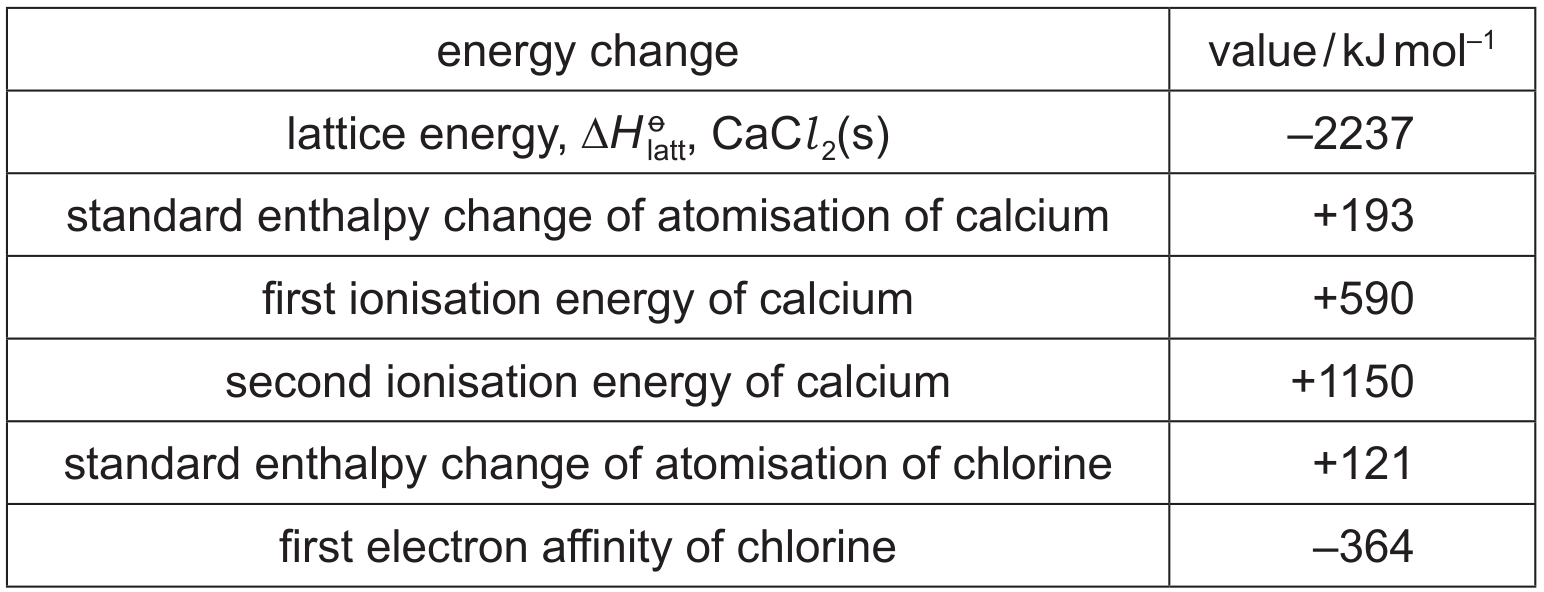
Calcium chloride, CaCl2\mathrm{CaCl}_{2}, is an ionic solid.
The values of some energy changes are shown in Table 1.1.

Table 1.1

Table 1.1

(a)

Calcium fluoride, CaF2( s)\mathrm{CaF}_{2}(\mathrm{~s}), can be synthesised directly from its elements.

The value of ΔHf(CaF2( s))\Delta H_{\mathrm{f}}^{\ominus}\left(\mathrm{CaF}_{2}(\mathrm{~s})\right) is 1214 kJ mol1-1214 \mathrm{~kJ} \mathrm{~mol}^{-1}.

[ 2 ]
(i)

Use the value of ΔHf(CaF2( s))\Delta H_{\mathrm{f}}^{\ominus}\left(\mathrm{CaF}_{2}(\mathrm{~s})\right) given in (e) and your answer to (e)(i) to predict how the feasibility for this synthesis will change with increasing temperature.

[ 2 ]
[Maximum number: 1]

Potassium chloride, KCl , and magnesium chloride, MgCl2\mathrm{MgCl}_{2}, are both ionic solids.

Table 1.1

Table 1.1

(a)
(i)

Use the Gibbs equation and your answer to (e)(ii) to predict whether potassium chloride is more soluble in water at 20C20^{\circ} \mathrm{C} or at 80C80^{\circ} \mathrm{C}. Explain your answer.

[ 1 ]
(a)

Zinc metal can be obtained in a two-step process as shown.

step 12ZnS(s)+3O2( g)2ZnO(s)+2SO2( g)12 \mathrm{ZnS}(\mathrm{s})+3 \mathrm{O}_{2}(\mathrm{~g}) \rightarrow 2 \mathrm{ZnO}(\mathrm{s})+2 \mathrm{SO}_{2}(\mathrm{~g})

step 2ZnO(s)+C(s)Zn(l)+CO(g)2 \mathrm{ZnO}(\mathrm{s})+\mathrm{C}(\mathrm{s}) \rightarrow \mathrm{Zn}(\mathrm{l})+\mathrm{CO}(\mathrm{g})

The reactions are carried out at 800C800^{\circ} \mathrm{C}.

(i)

An equation for the direct reduction of ZnS by carbon is shown.

2ZnS( s)+C( s)2Zn(I)+CS2( g)ΔH=+733 kJ mol1ΔS=+218JK1 mol1\begin{array}{ll} 2 \mathrm{ZnS}(\mathrm{~s})+\mathrm{C}(\mathrm{~s}) \rightarrow 2 \mathrm{Zn}(\mathrm{I})+\mathrm{CS}_{2}(\mathrm{~g}) \quad & \begin{array}{l} \Delta H^{\ominus}=+733 \mathrm{~kJ} \mathrm{~mol}^{-1} \\ \Delta S^{\ominus}=+218 \mathrm{JK}^{-1} \mathrm{~mol}^{-1} \end{array} \end{array}

This reaction is not feasible at 800C800^{\circ} \mathrm{C}.
Calculate ΔG\Delta G^{\ominus} for this reaction at 800C800^{\circ} \mathrm{C}.

ΔG=\Delta G^{\ominus}=
kJ mol1\mathrm{kJ} \mathrm{~mol}^{-1}
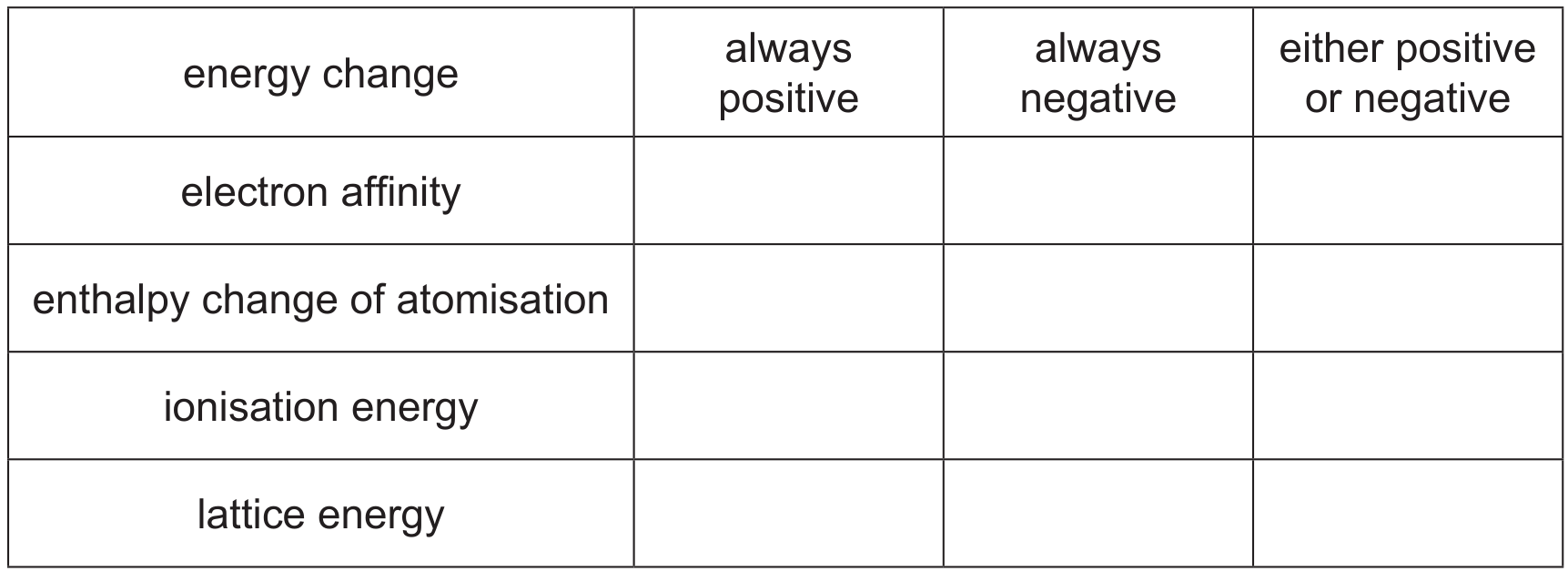
(a)

Complete the table using ticks ( ✓ ) to indicate whether the sign of each type of energy change, under standard conditions, is always positive, always negative or could be either positive or negative.

Table
[ 2 ]
(b)

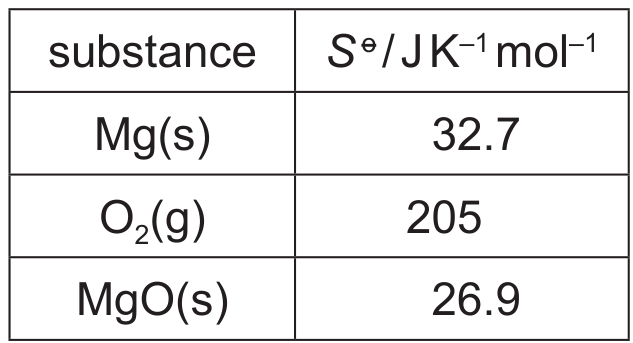
The equation for the formation of magnesium oxide from its elements is shown.

Mg( s)+12O2( g)MgO( s)ΔH=602 kJ mol1\mathrm{Mg}(\mathrm{~s})+\frac{1}{2} \mathrm{O}_{2}(\mathrm{~g}) \rightarrow \mathrm{MgO}(\mathrm{~s}) \quad \Delta H^{\ominus}=-602 \mathrm{~kJ} \mathrm{~mol}^{-1}
Table

Use the equation and the data given in the table to calculate ΔG\Delta G^{\ominus} for the reaction at 25C25^{\circ} \mathrm{C}.

ΔG=\Delta G^{\ominus}=

units

[ 4 ]
0