(a)
(i)
Use the above diagrams to explain why ions are coloured, whereas ions are colourless.
[ 4 ]
 EduNinja
Use the above diagrams to explain why ions are coloured, whereas ions are colourless.
A solution of and a solution of have different colours.
Explain why the two complexes have different colours.
Copper is a transition element and has atomic number 29.
The following equilibrium exists between two complex ions of copper in the +2 oxidation state.
State the colours of these two complex ions.
Iron is a transition element in the fourth period. Iron forms compounds containing the ions and .
Aqueous ions form coloured complexes.
Explain the origin of the colour in transition element complexes.
When an excess of ions is added to green ions, yellow complex ions are formed.
Heating with dilute nitric acid and then neutralising the product with produces red crystals, containing the complex ion.
NO is a neutral, monodentate ligand.
The two complex ions and are different colours.
Explain why the colours of the two complex ions are different.
and are both complexes of chromium(II) and have different colours.
Explain why the colours of these complexes are different.
Explain why chromium complexes are coloured.
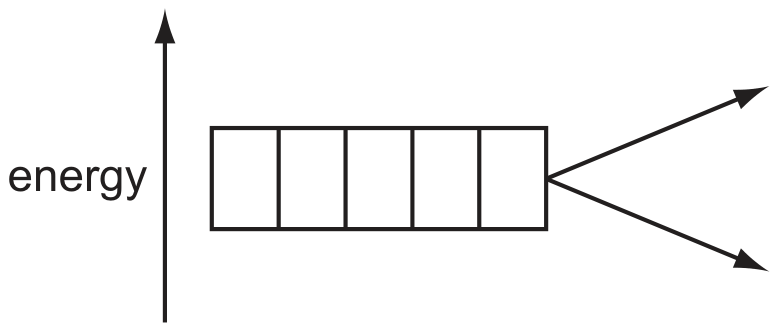
The 3d orbitals in an isolated ion are degenerate.
Define degenerate d orbitals.
The presence of electrons in d orbitals is responsible for the colours of transition element compounds.
The d orbitals in an isolated transition metal atom or ion are all at the same energy level. What term is used to describe orbitals that are at the same energy level?
Complete the diagram to show the splitting of the d orbital energy levels in an octahedral complex ion.
On the axes below, sketch the shapes of one d orbital from the lower energy level and one d orbital from the higher energy level.
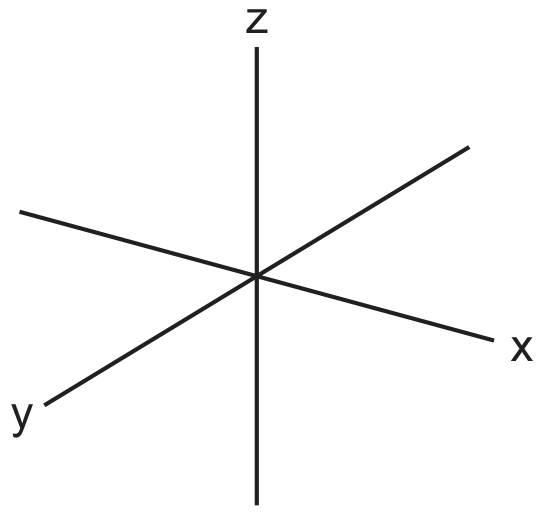
lower energy level
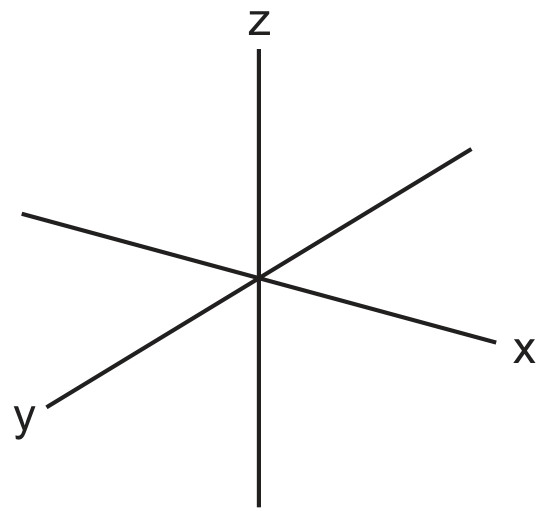
higher energy level
The octahedral complex is green. Explain the origin of the colour of this complex.
Explain why complexes of transition elements are often coloured.
Carbon monoxide, CO, occurs in the exhaust gases of internal combustion engines.
Carbon monoxide reacts with a ruthenium(II) chloride complex according to the equation
During the reaction, the colour of the solution changes from deep blue to green. Explain the origin of colour in transition element complexes, and why different complexes often have different colours.
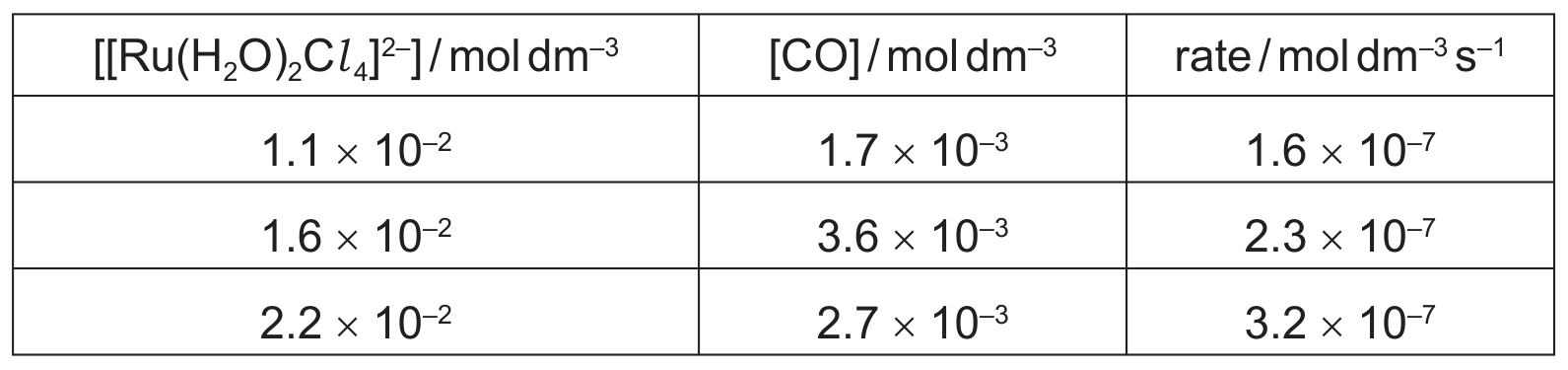
The following table shows how the initial rate of this reaction varies with different concentrations of reactants.