EduNinja
(a)
(i)

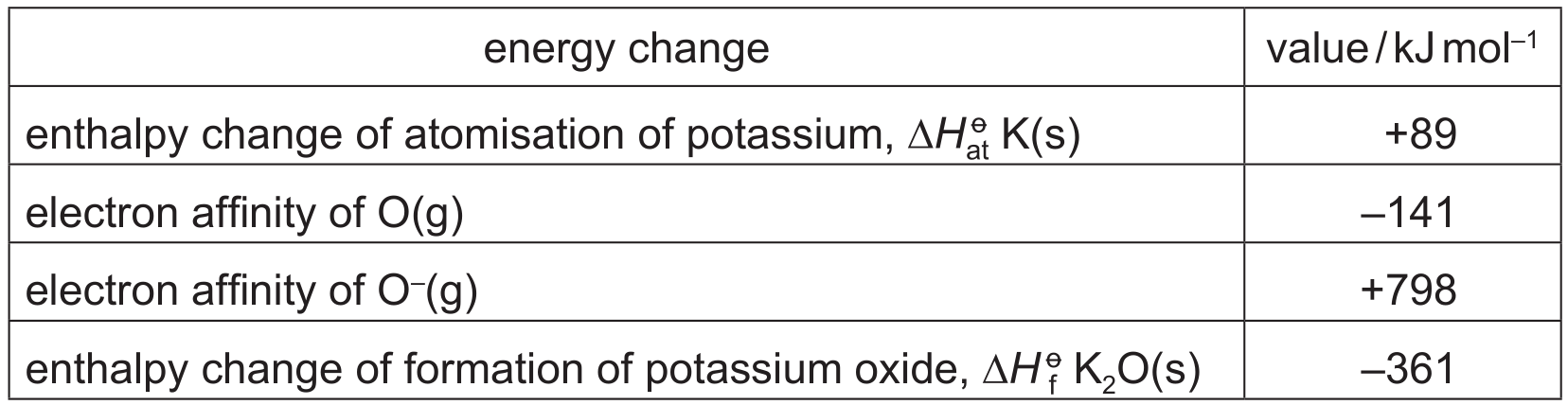
Use the data in the table below, and relevant data from the Data Booklet, to calculate the lattice energy, ΔHlatt \Delta H_{\text {latt }}^{\ominus}, of potassium oxide, K2O(s)\mathrm{K}_{2} \mathrm{O}(\mathrm{s}).

Table
ΔHlatt =..............kJ  mol1\Delta H_{\text {latt }}^{\ominus}=\ldots \ldots \ldots \ldots \ldots \ldots \ldots . . . . . . . . . . . . . . k J ~ \mathrm{~mol}^{-1}
[ 3 ]
(ii)

State whether the lattice energy of Na2O\mathrm{Na}_{2} \mathrm{O} would be more negative, less negative or the same as that of K2O\mathrm{K}_{2} \mathrm{O}. Give reasons for your answer.

[ 1 ]
[Maximum number: 2]

Iodine is found naturally in compounds in many different oxidation states.

(a)

The Group 1 iodides all form stable ionic lattices and are soluble in water.

[ 2 ]
(i)

Suggest the trend in the magnitude of the lattice energies of the Group 1 iodides, LiI, NaI, KI.
Explain your answer.

[ 2 ]
(a)
(i)

The equation for the formation of a gaseous sulfate ion is shown.

S( s)+2O2( g)+2eSO42(g)ΔH=ΔHf of SO42(g)\mathrm{S}(\mathrm{~s})+2 \mathrm{O}_{2}(\mathrm{~g})+2 \mathrm{e}^{-} \rightarrow \mathrm{SO}_{4}{ }^{2-}(\mathrm{g}) \quad \Delta H=\Delta H_{\mathrm{f}}^{\ominus} \text { of } \mathrm{SO}_{4}{ }^{2-}(\mathrm{g})

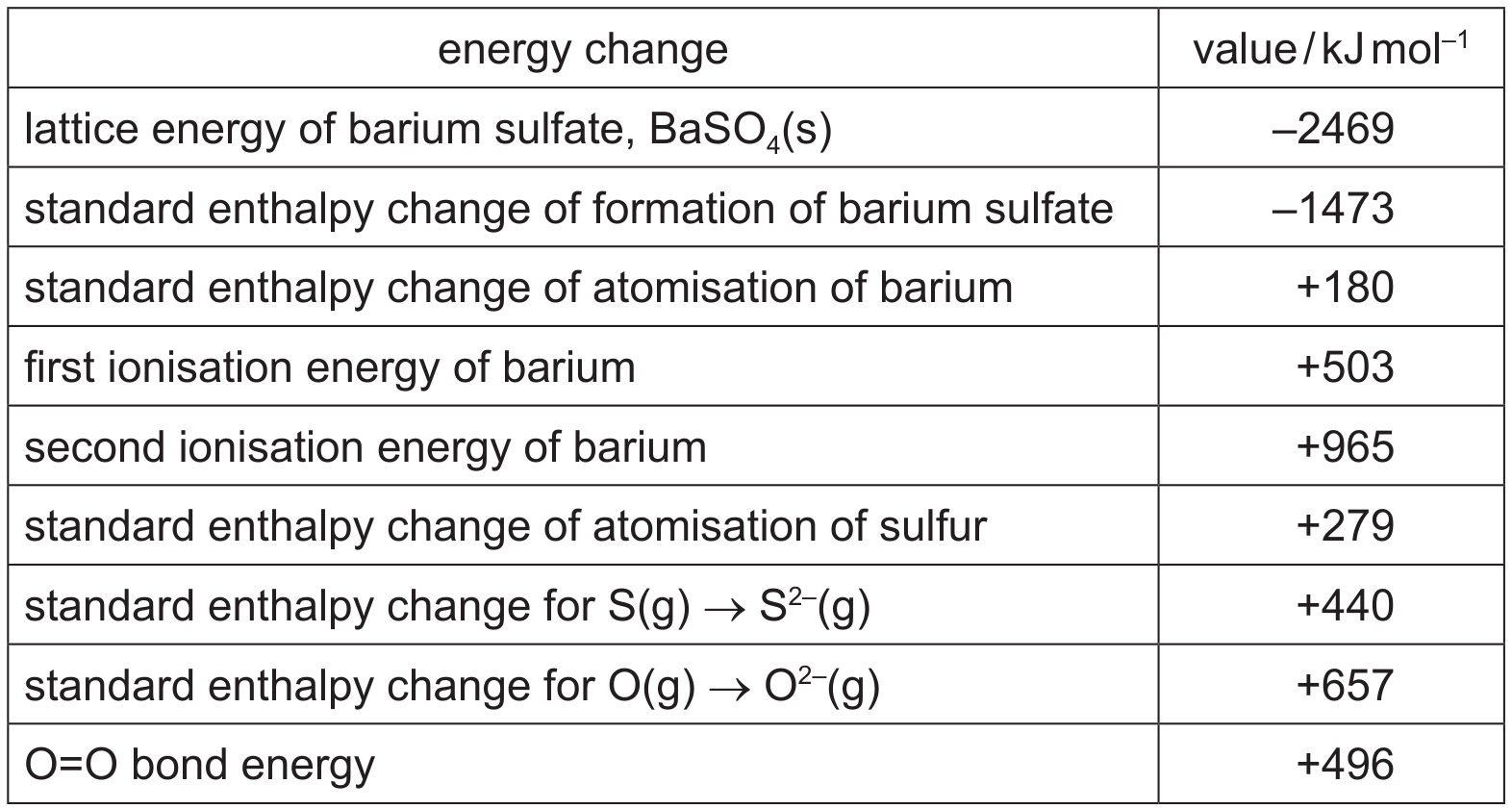
Calculate the standard enthalpy change of formation, ΔHf\Delta H_{\mathrm{f}}^{\ominus}, of SO42(g)\mathrm{SO}_{4}{ }^{2-}(\mathrm{g}). It may be helpful to draw a labelled energy cycle. Use relevant data from Table 1.1 in your calculations.

Table 1.1

Table 1.1

ΔHf\Delta H_{\mathrm{f}}^{\ominus} of SO42(g)=\mathrm{SO}_{4}{ }^{2-}(\mathrm{g})=kJmol1\mathrm{kJ} \mathrm{mol}^{-1}

[ 3 ]
(ii)

Suggest how the lattice energy of BaSO4( s)\mathrm{BaSO}_{4}(\mathrm{~s}) differs from the lattice energy of Cs2SO4( s)\mathrm{Cs}_{2} \mathrm{SO}_{4}(\mathrm{~s}). Explain your answer.

[ 2 ]
[Maximum number: 4]

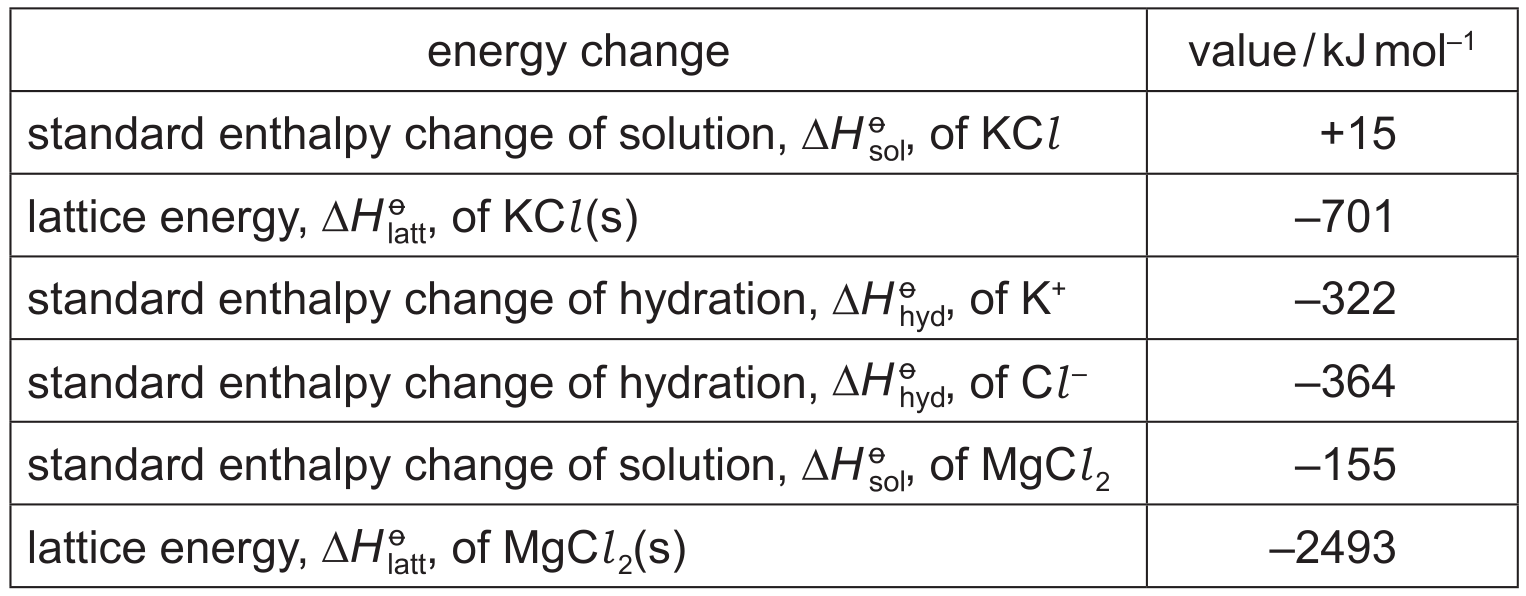
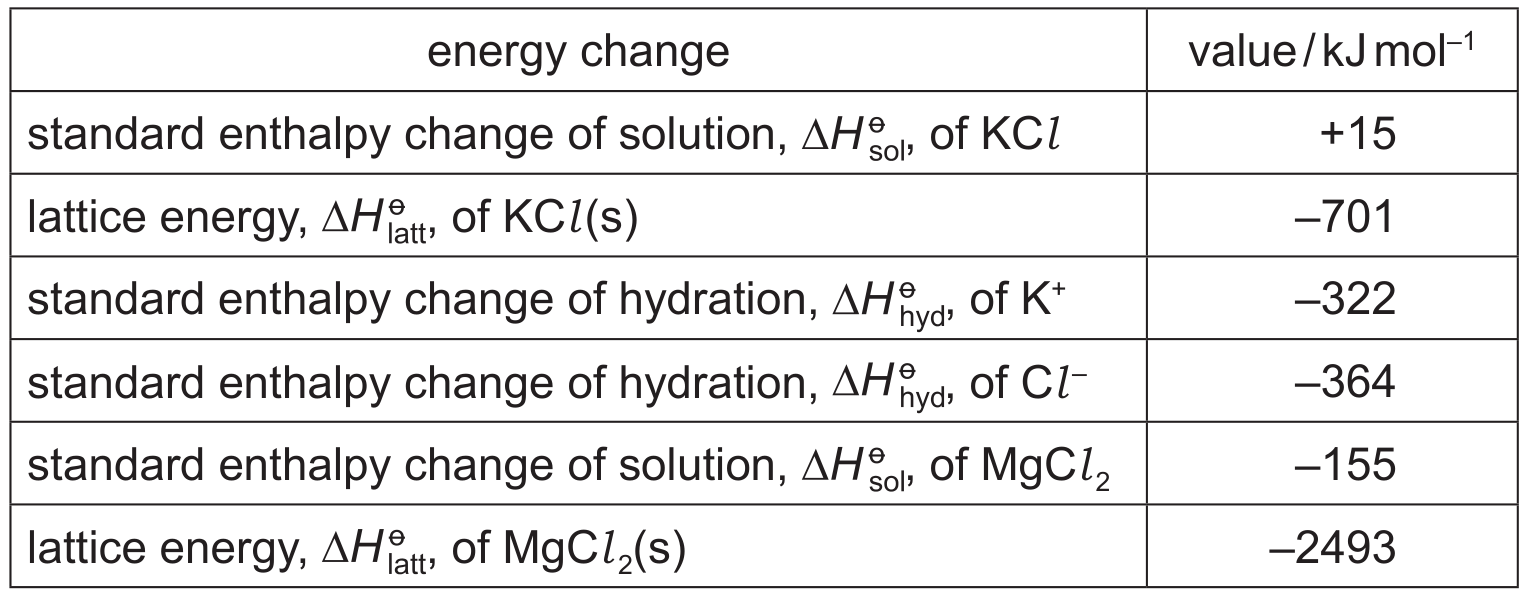
Potassium chloride, KCl , and magnesium chloride, MgCl2\mathrm{MgCl}_{2}, are both ionic solids.

Table 1.1

Table 1.1

(a)

Explain the reasons why the lattice energy of MgCl2\mathrm{MgCl}_{2} is more exothermic than the lattice energy of KCl.

[ 2 ]
(b)

Define the following terms.

[ 2 ]
(i)

enthalpy change of atomisation

[ 1 ]
(ii)

first electron affinity

[ 1 ]
[Maximum number: 4]

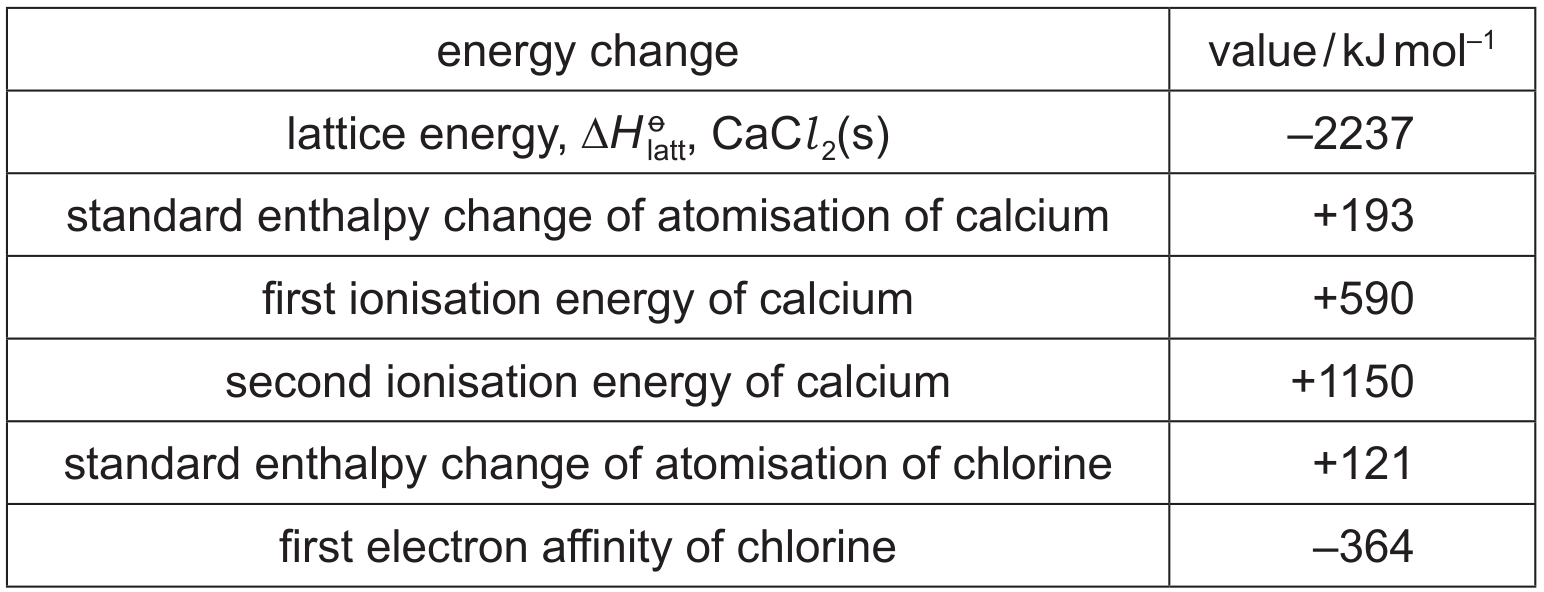
Calcium chloride, CaCl2\mathrm{CaCl}_{2}, is an ionic solid.
The values of some energy changes are shown in Table 1.1.

Table 1.1

Table 1.1

(a)

Define lattice energy.

[ 1 ]
(b)

Use the data in Table 1.1 to calculate the standard enthalpy change of formation, ΔHf\Delta H_{\mathrm{f}}^{\ominus}, of calcium chloride. It may be helpful to draw an energy cycle. Show all your working.

ΔHf(CaCl2( s))=...kJ mol1\Delta H_{\mathrm{f}}^{\ominus}\left(\mathrm{CaCl}_{2}(\mathrm{~s})\right)=\ldots \ldots \ldots \ldots \ldots \ldots \ldots \ldots \ldots \ldots \ldots . . . \mathrm{kJ} \mathrm{~mol}^{-1}
[ 2 ]
(c)

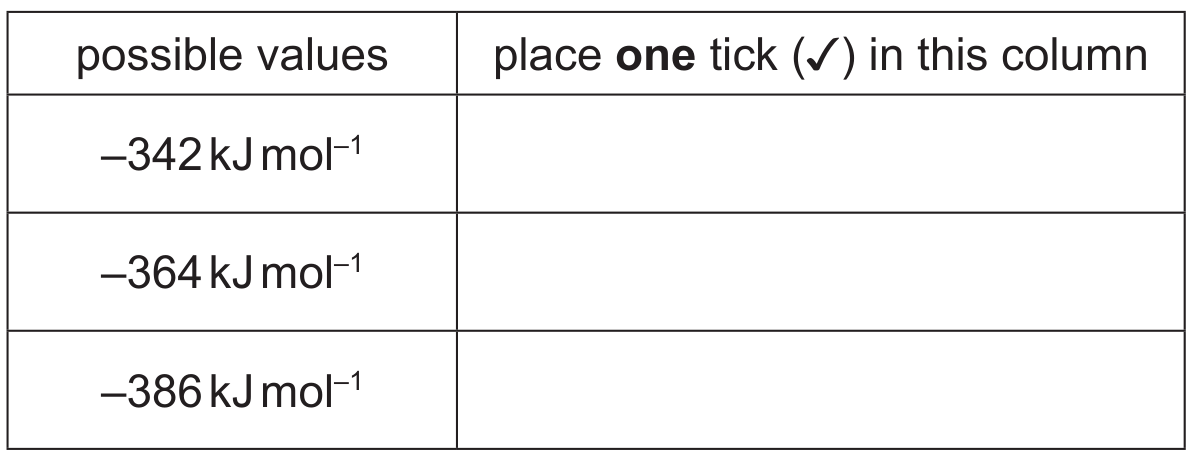
Three possible values for the first electron affinity of bromine are shown in Table 1.2. One of them is correct.

Place a tick by the correct value. Explain your choice.

Table 1.2

Table 1.2

explanation

[ 1 ]
[Maximum number: 4]

Potassium chloride, KCl , and magnesium chloride, MgCl2\mathrm{MgCl}_{2}, are both ionic solids.

Table 1.1

Table 1.1

(a)

Explain the reasons why the lattice energy of MgCl2\mathrm{MgCl}_{2} is more exothermic than the lattice energy of KCl.

[ 2 ]
(b)

Define the following terms.

[ 2 ]
(i)

enthalpy change of atomisation

[ 1 ]
(ii)

first electron affinity

[ 1 ]
(a)

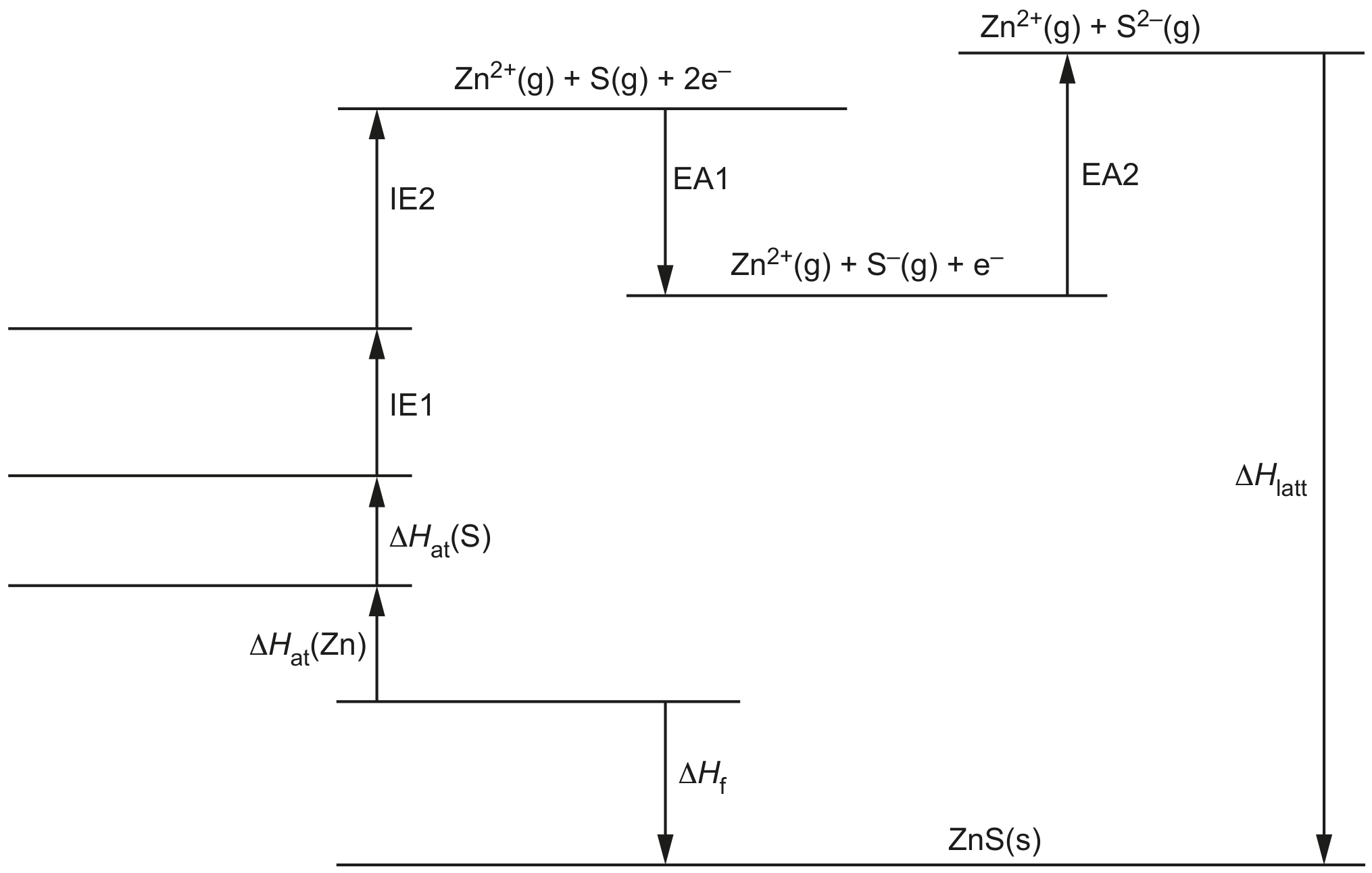
The most common zinc mineral contains zinc(II) sulfide, ZnS .

[ 7 ]
(i)

Complete Fig. 1.2 to show the Born-Haber diagram for the ionic solid ZnS .

Include state symbols of relevant species.

Fig. 1.2

Fig. 1.2

[ 3 ]
(ii)

Describe the trend in the first electron affinity of the Group 16 elements S to Te .

Explain your answer.

[ 2 ]
(iii)

Explain why the lattice energy, ΔHlatt \Delta H_{\text {latt }}, of ZnO is more exothermic than that of ZnS .

[ 2 ]
[Maximum number: 13]

Radium is a Group 2 element.
The predicted lattice energy, ΔHlatt \Delta H_{\text {latt }}^{\ominus}, of radium sulfide, RaS , is 2612 kJ mol1-2612 \mathrm{~kJ} \mathrm{~mol}^{-1}.

(a)

Define ΔHlatt \Delta H_{\text {latt }}^{\ominus}.

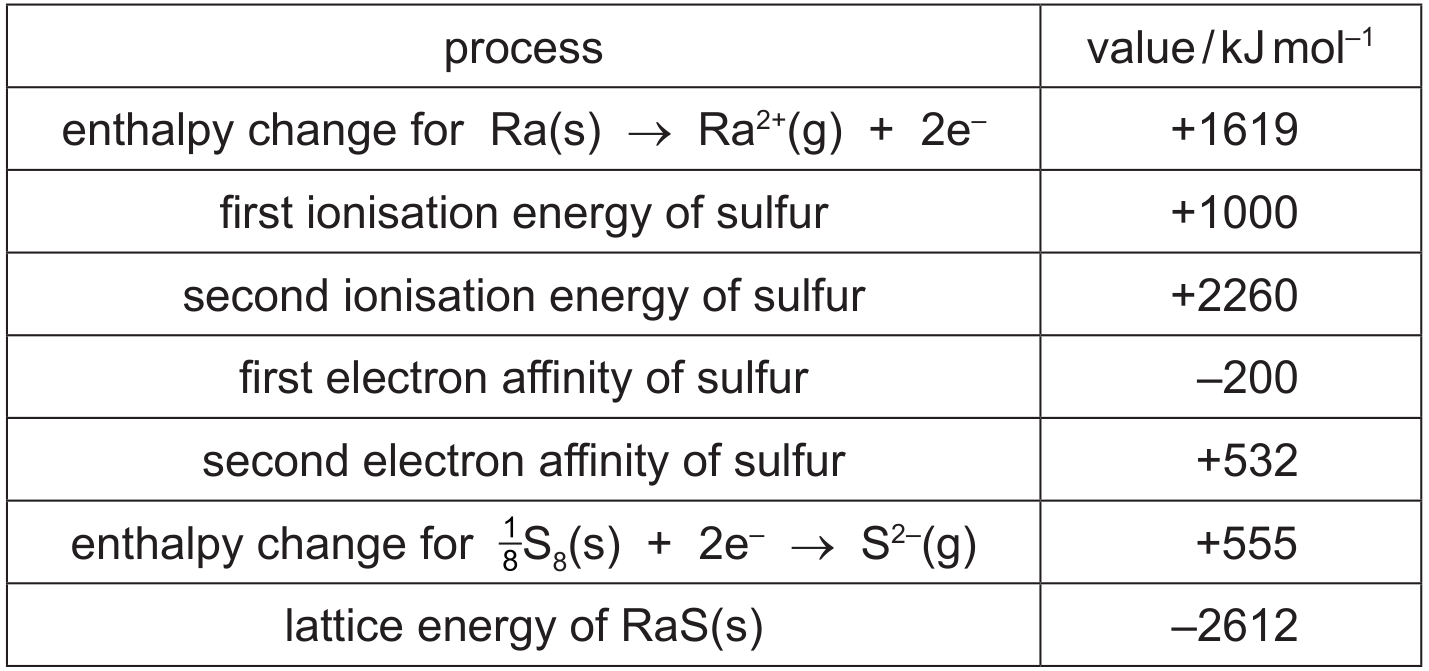
Some data relating to radium and sulfur are listed. Select relevant data from this list for use in your answers to parts (b) to (e).

Table
[ 2 ]
(b)

Write an equation for the process corresponding to the second electron affinity of sulfur. Include state symbols.

[ 1 ]
(c)

Sulfur exists as S8\mathrm{S}_{8} molecules in the solid state.

Use the data in this question to calculate the enthalpy change for the reaction S8( s)8 S( g)\mathrm{S}_{8}(\mathrm{~s}) \rightarrow 8 \mathrm{~S}(\mathrm{~g}).

enthalpy change = kJmol1\mathrm{kJ} \mathrm{mol}^{-1}

[ 3 ]
(d)

Calculate the standard enthalpy change of formation, ΔHf\Delta H_{\mathrm{f}}^{\ominus}, of radium sulfide.
standard enthalpy change, ΔHf=\Delta H_{\mathrm{f}}^{\ominus}=kJmol1\mathrm{kJmol}^{-1}

[ 2 ]
(e)
(i)

State the two major factors that affect the numerical magnitude of a lattice energy.

[ 2 ]
(ii)

For each factor you have identified in (e)(i), state whether it tends to make the lattice energy of radium sulfide more or less exothermic than that of sodium chloride.

Explain your answer.

[ 2 ]
(iii)

The lattice energies of sodium chloride, NaCl , and radium sulfide, RaS , are 771 kJ mol1-771 \mathrm{~kJ} \mathrm{~mol}^{-1} and 2612 kJ mol1-2612 \mathrm{~kJ} \mathrm{~mol}^{-1}, respectively.

Identify the dominant factor in determining the relative numerical magnitudes of the lattice energies of radium sulfide and sodium chloride.

Explain your answer.

[ 1 ]
[Maximum number: 3]

Taken together, nitrogen and oxygen make up 99 % of the air. Oxygen is by far the more reactive of the two gases, and most of the substances that react with air combine with the oxygen rather than with the nitrogen.

(a)

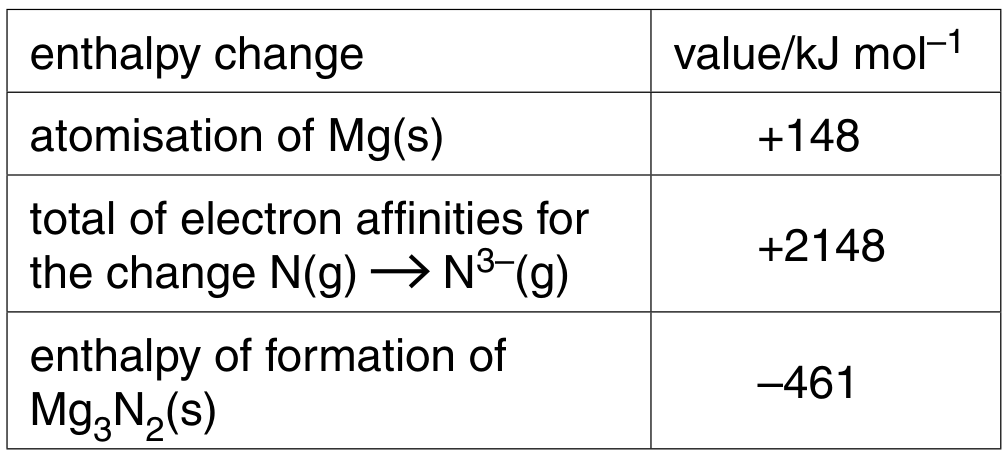
Calculate the lattice energy of magnesium nitride using the following data, in addition to relevant data from the Data Booklet.

Table

lattice energy = kJmol1\mathrm{kJ} \mathrm{mol}{ }^{-1}

[ 3 ]
(a)
(i)

Define lattice energy.

[ 2 ]
(ii)

The lattice energy of the Group 2 carbonates, ΔHlatt θ(MCO3)\Delta H_{\text {latt }}^{\theta}\left(\mathrm{MCO}_{3}\right), becomes less exothermic down the group.

The lattice energy of the Group 2 oxides, ΔHlatt θ(MO)\Delta H_{\text {latt }}^{\theta}(\mathrm{MO}), also becomes less exothermic down the group.
ΔHlatt θ(MCO3)\Delta H_{\text {latt }}^{\theta}\left(\mathrm{MCO}_{3}\right) and ΔHlatt θ(MO)\Delta H_{\text {latt }}^{\theta}(\mathrm{MO}) change by different amounts going down the group.
Suggest how the standard enthalpy change of the decomposition reaction for Group 2 carbonates changes down the group.

Explain your reasoning in terms of the relative sizes of the anions and the relative changes in lattice energy down the group.

[ 2 ]
0