EduNinja
[Maximum number: 21]

Phenacyl chloride has been used as a component of some tear gases. Its lachrymatory and irritant properties are due to it reacting with water inside body tissues to produce hydrochloric acid.

It undergoes a nucleophilic substitution reaction with NaOH(aq).
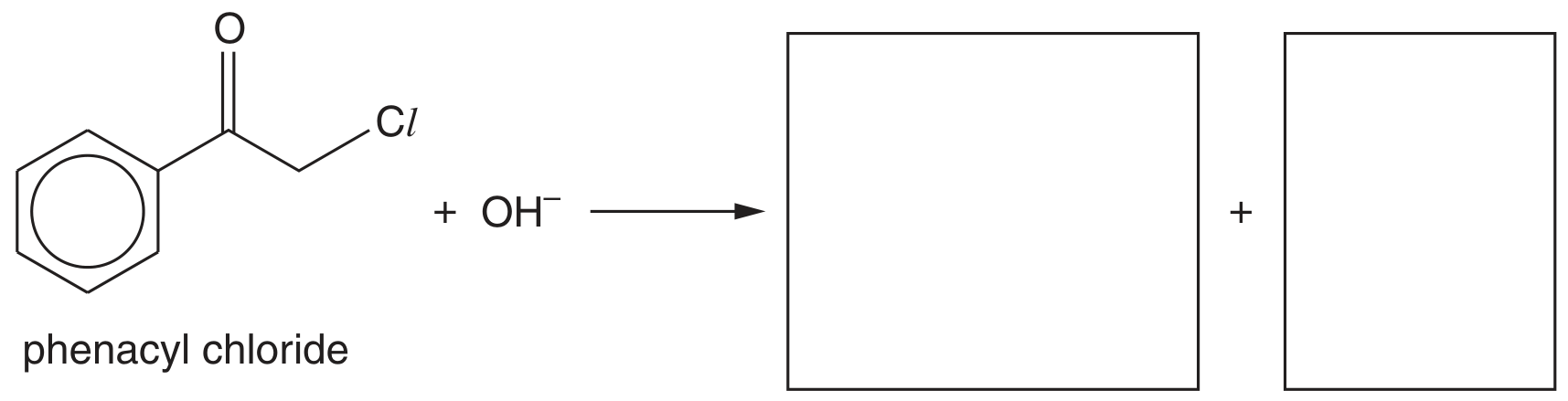
Question image
(a)
(i)

What is meant by the term order of reaction?

[ 7 ]
(ii)

Use the above data to deduce the order with respect to each reactant. Explain your reasoning.

[ 7 ]
(iii)

Write the overall rate equation for the reaction.

[ 7 ]
(a)

NO reacts readily with oxygen.

2NO( g)+O2( g)2NO2( g)2 \mathrm{NO}(\mathrm{~g})+\mathrm{O}_{2}(\mathrm{~g}) \rightarrow 2 \mathrm{NO}_{2}(\mathrm{~g})

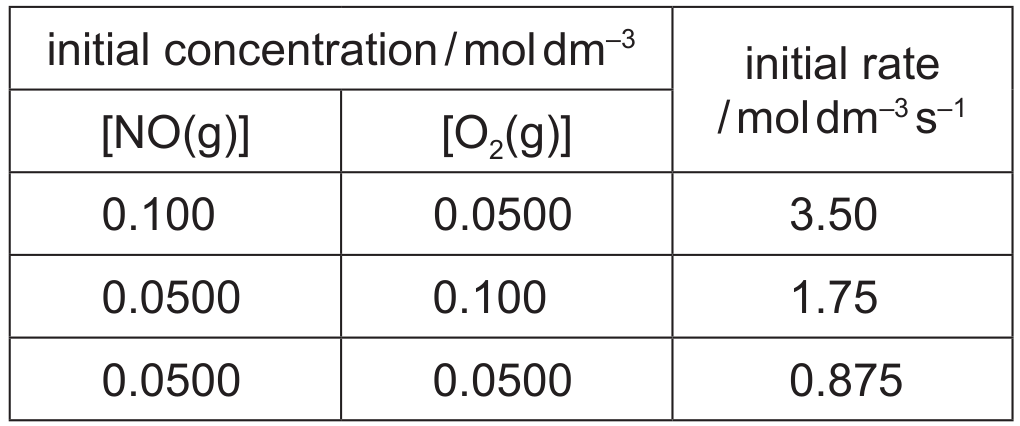
The table shows how the initial rate of this reaction at 25C25^{\circ} \mathrm{C} depends on the initial concentrations of the reactants.

Table
[ 5 ]
(i)

Deduce the order of reaction with respect to each reactant. Explain your reasoning. order with respect to [NO(g)][\mathrm{NO}(\mathrm{g})]
order with respect to [O2( g)]\left[\mathrm{O}_{2}(\mathrm{~g})\right]

[ 2 ]
(ii)

State the rate equation for this reaction. Use the rate equation to calculate the rate constant. Include the units for the rate constant in your answer.
rate =
rate constant, k=
units of k=

[ 3 ]
[Maximum number: 8]

The rate of the reaction H2( g)+I2( g)2HI(g)\mathrm{H}_{2}(\mathrm{~g})+\mathrm{I}_{2}(\mathrm{~g}) \rightleftharpoons 2 \mathrm{HI}(\mathrm{g}) is studied.

(a)

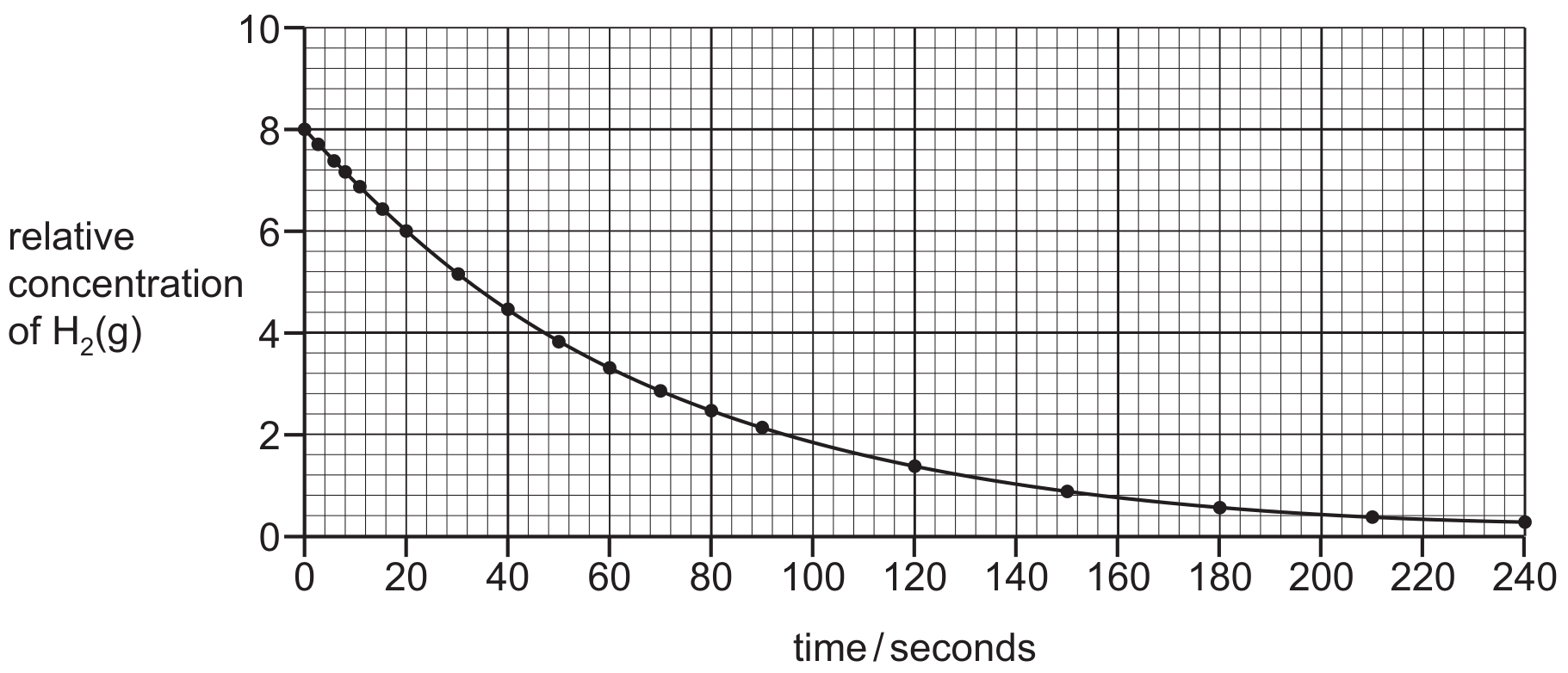
A small amount of H2( g)\mathrm{H}_{2}(\mathrm{~g}) is mixed with a large excess of I2( g)\mathrm{I}_{2}(\mathrm{~g}) at a temperature of 400 K and the reaction is monitored. The graph obtained is shown.

Question image
[ 2 ]
(i)

The reaction is first order with respect to H2( g)\mathrm{H}_{2}(\mathrm{~g}).

Use data from the graph to confirm this statement.

[ 2 ]
(b)

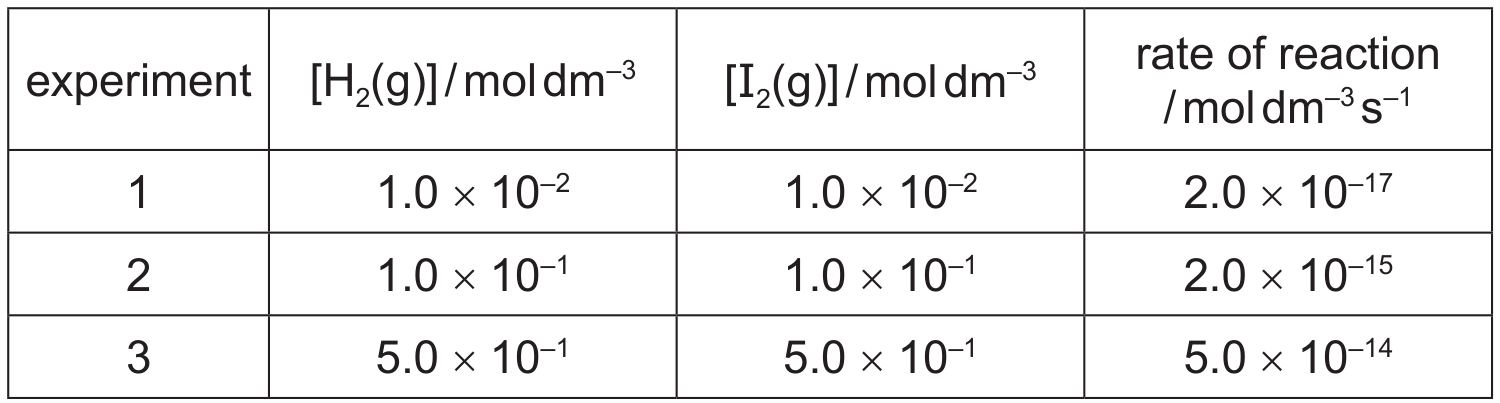
Three separate experiments were carried out at 400 K with different starting concentrations of H2( g)\mathrm{H}_{2}(\mathrm{~g}) and I2( g)\mathrm{I}_{2}(\mathrm{~g}). The results are shown in the table.

Table
[ 6 ]
(i)

Use the data, and the order of reaction with respect to H2( g)\mathrm{H}_{2}(\mathrm{~g}) given in (a)(ii), to deduce the order of reaction with respect to I2( g)\mathrm{I}_{2}(\mathrm{~g}).

Explain your answer, giving data in support of your explanation.

[ 3 ]
(ii)

Use information from (a)(ii) and your answer to (b)(i) to write the rate equation for the forward reaction.
rate =

[ 1 ]
(iii)

Use your rate equation and data from experiment 1 to calculate the value of the rate constant, k, for the forward reaction at 400 K . Include units for k.
k= units =

[ 2 ]
[Maximum number: 6]

Fluorine reacts with chlorine dioxide, ClO2\mathrm{ClO}_{2}, as shown.

F2( g)+2ClO2( g)2FClO2( g)\mathrm{F}_{2}(\mathrm{~g})+2 \mathrm{ClO}_{2}(\mathrm{~g}) \rightarrow 2 \mathrm{FClO}_{2}(\mathrm{~g})

The rate of the reaction is first order with respect to the concentration of F2F_{2} and first order with respect to the concentration of ClO2\mathrm{ClO}_{2}. No catalyst is involved.

(a)
(i)

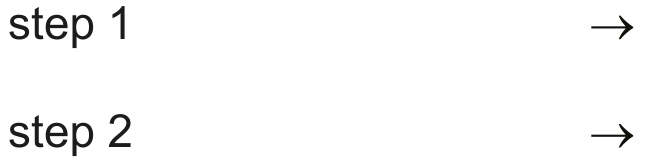
Suggest a two-step mechanism for this reaction.

Question image
[ 2 ]
(ii)

Identify the rate-determining step in this mechanism. Explain your answer.

[ 1 ]
(b)

When the rate of the reaction is measured in moldm3 s1\mathrm{mol} \mathrm{dm}^{-3} \mathrm{~s}^{-1} the numerical value of the rate constant, k, is 1.22 under certain conditions.

(i)

Complete the rate equation for this reaction, stating the overall order of the reaction.

 rate = overall order of reaction =\begin{array}{r} \text { rate }= \\ \text { overall order of reaction }= \end{array}
(ii)

Use your rate equation in (i) to calculate the rate of the reaction when the concentrations of F2\mathrm{F}_{2} and ClO2\mathrm{ClO}_{2} are both 2.00×10³moldm32.00 \times 10^{-3} \mathrm{moldm}^{-3}.
rate = moldm3 s1\mathrm{mol} \mathrm{dm}^{-3} \mathrm{~s}^{-1}

(c)

Under different conditions, and in the presence of a large excess of ClO2\mathrm{ClO}_{2}, the rate equation is as shown.

 rate =k1[F2]\text { rate }=k_{1}\left[F_{2}\right]

The half-life, t12t_{\frac{1}{2}}, of the concentration of F2F_{2} is 4.00 s under these conditions.

[ 3 ]
(i)

Calculate the numerical value of k1k_{1}, giving its units.

Give your answer to three significant figures.

k1=. units k_{1}=\ldots \ldots \ldots \ldots \ldots \ldots \ldots \ldots \ldots \ldots . \text { units }
[ 2 ]
(ii)

An experiment is performed under these conditions in which the starting concentration of F2F_{2} is 0.00200moldm30.00200 \mathrm{moldm}^{-3}.

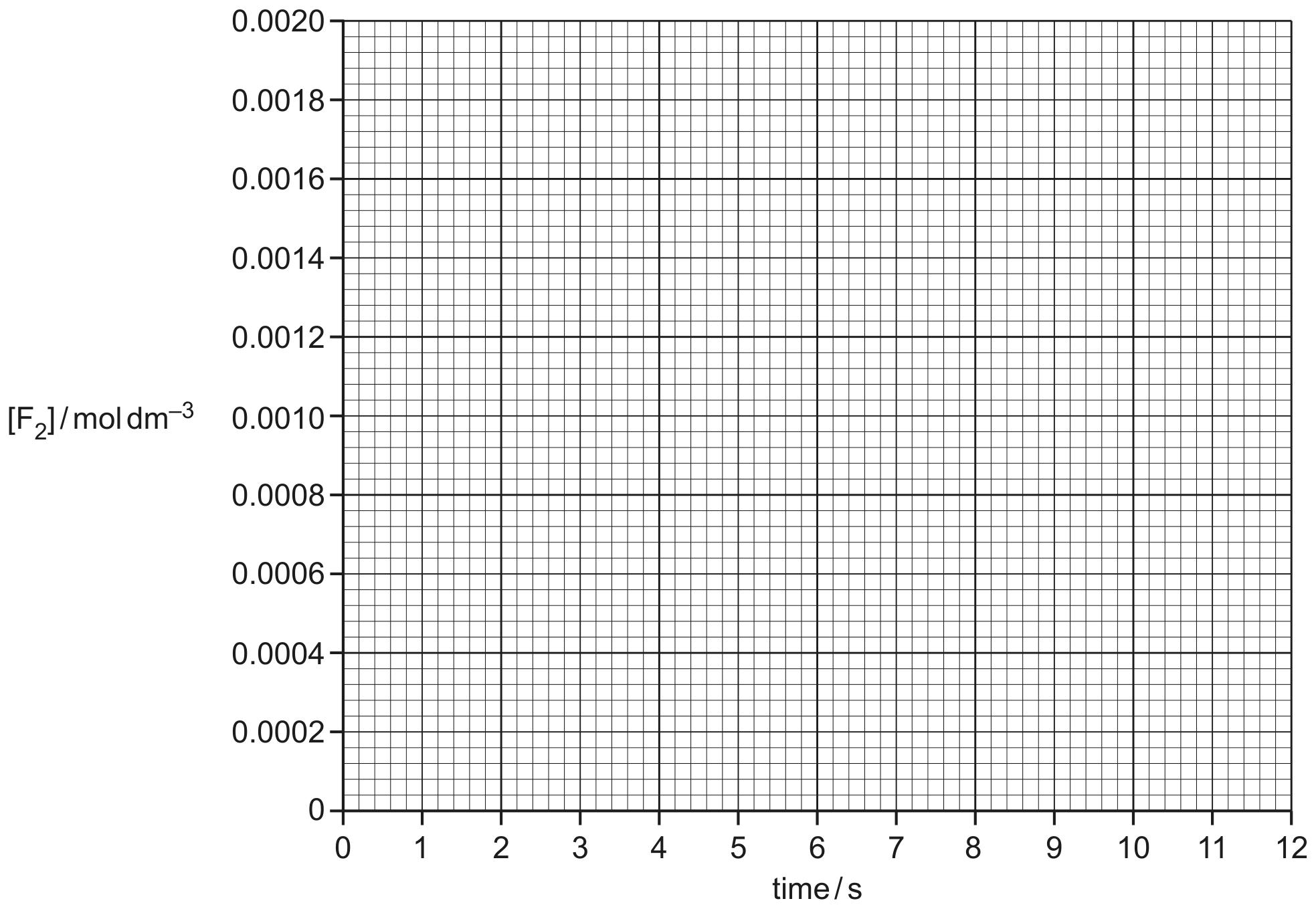
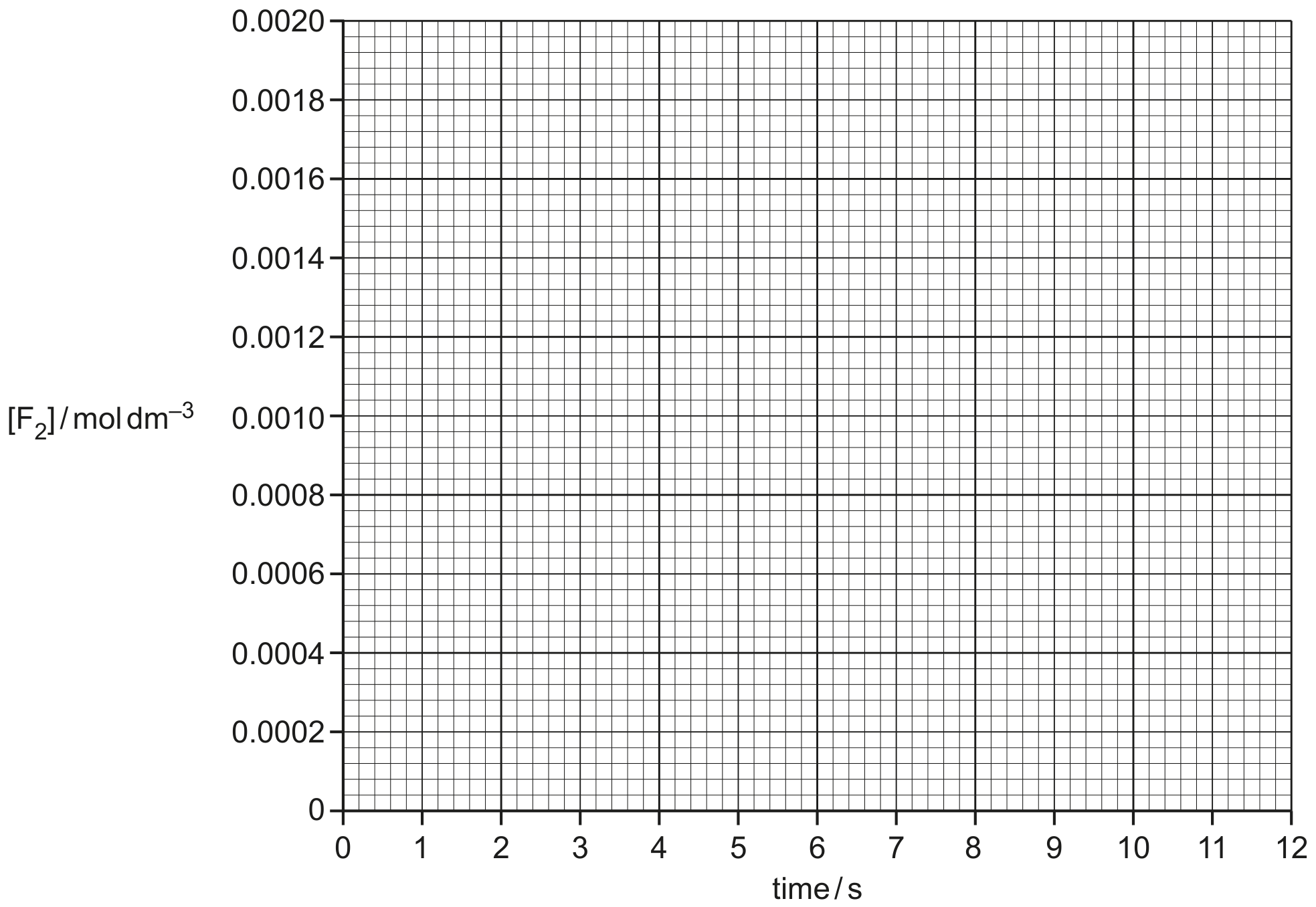
Draw a graph on the grid in Fig. 1.1 to show how the concentration of F2F_{2} changes over the first 12s of the reaction.

Fig. 1.1

Fig. 1.1

[ 1 ]
(iii)

Use your graph in Fig. 1.1 to find the rate of the reaction when the concentration of F2F_{2} is 0.00100 moldm30.00100 \mathrm{~mol} \mathrm{dm}^{-3}. Show your working on the graph.
rate = moldm m3 s1\mathrm{m}^{-3} \mathrm{~s}^{-1}

[Maximum number: 7]

Propanone, CH3COCH3\mathrm{CH}_{3} \mathrm{COCH}_{3}, reacts with iodine, I2\mathrm{I}_{2}, in the presence of an acid catalyst.

CH3COCH3+I2CH3COCH2I+H++I\mathrm{CH}_{3} \mathrm{COCH}_{3}+\mathrm{I}_{2} \rightarrow \mathrm{CH}_{3} \mathrm{COCH}_{2} \mathrm{I}+\mathrm{H}^{+}+\mathrm{I}^{-}

The rate equation for this reaction is shown.

 rate =k[CH3COCH3][H+]\text { rate }=k\left[\mathrm{CH}_{3} \mathrm{COCH}_{3}\right]\left[\mathrm{H}^{+}\right]
(a)

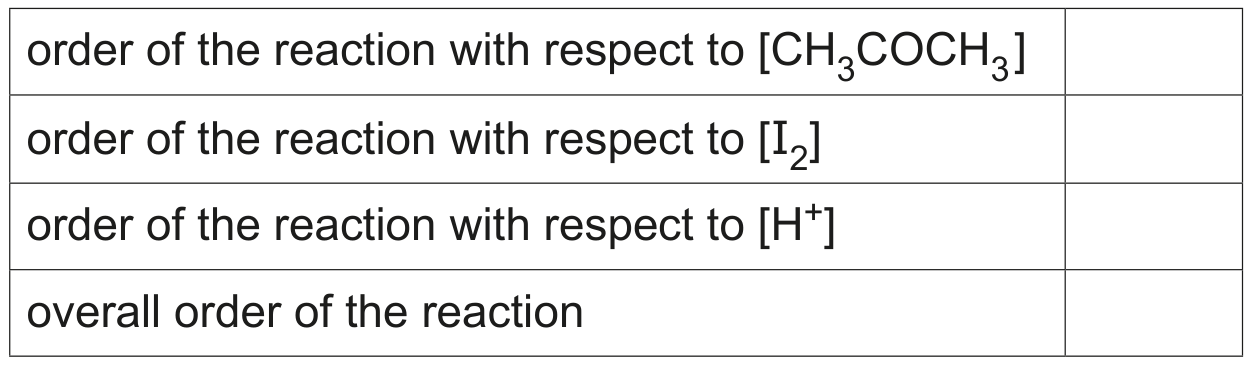
Complete Table 1.1 to describe the order of the reaction.

Table 1.1

Table 1.1

[ 2 ]
(b)

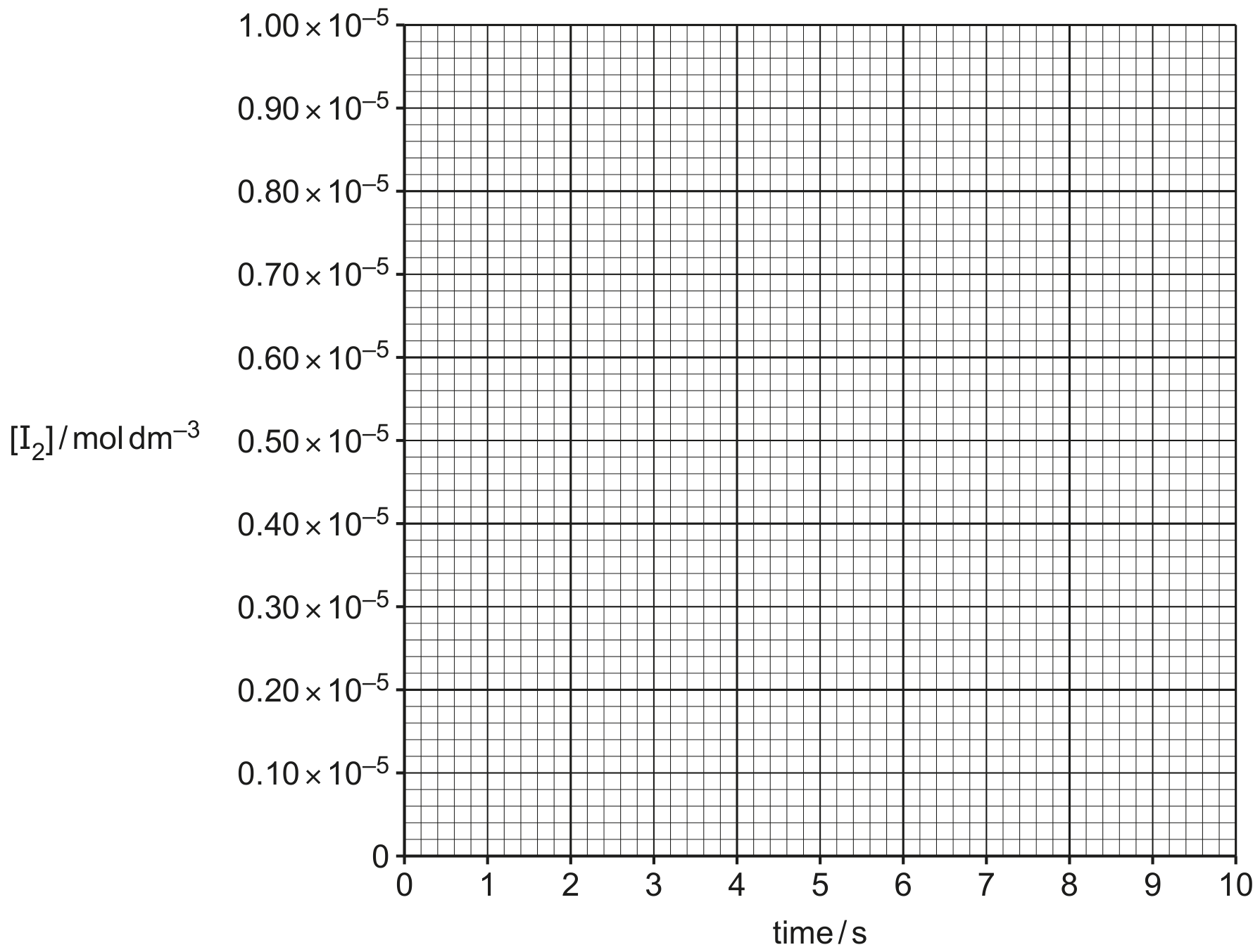
An experiment is performed using a large excess of CH3COCH3\mathrm{CH}_{3} \mathrm{COCH}_{3} and a large excess of H+\mathrm{H}^{+}(aq). The initial concentration of I2\mathrm{I}_{2} is 1.00×10⁵moldm31.00 \times 10^{-5} \mathrm{moldm}^{-3}. The initial rate of decrease in the I2\mathrm{I}_{2} concentration is 2.27×10⁷moldm3 s12.27 \times 10^{-7} \mathrm{moldm}^{-3} \mathrm{~s}^{-1}.

[ 2 ]
(i)

Use the axes to draw a graph of [I2]\left[\mathrm{I}_{2}\right] against time for the first 10 seconds of the reaction.

Question image
[ 1 ]
(ii)

State whether it is possible to calculate the numerical value of the rate constant, k, for this reaction from your graph. Explain your answer.

[ 1 ]
(c)

The experiment is repeated at a different temperature. The initial concentrations of H+\mathrm{H}^{+}ions, I2\mathrm{I}_{2} and CH3COCH3\mathrm{CH}_{3} \mathrm{COCH}_{3} are all 0.200 moldm30.200 \mathrm{~mol} \mathrm{dm}^{-3}.

The value of k at this temperature is 2.31×10⁵ mol1dm3 s12.31 \times 10^{-5} \mathrm{~mol}^{-1} \mathrm{dm}^{3} \mathrm{~s}^{-1}.
Calculate the initial rate of this reaction.
rate = moldm3 s1\mathrm{mol} \mathrm{dm}^{-3} \mathrm{~s}^{-1}

(d)

The experiment is repeated using an excess of H+(aq)\mathrm{H}^{+}(\mathrm{aq}). The new rate equation is shown.

 rate =k1[CH3COCH3]\text { rate }=k_{1}\left[\mathrm{CH}_{3} \mathrm{COCH}_{3}\right]
[ 1 ]
(i)

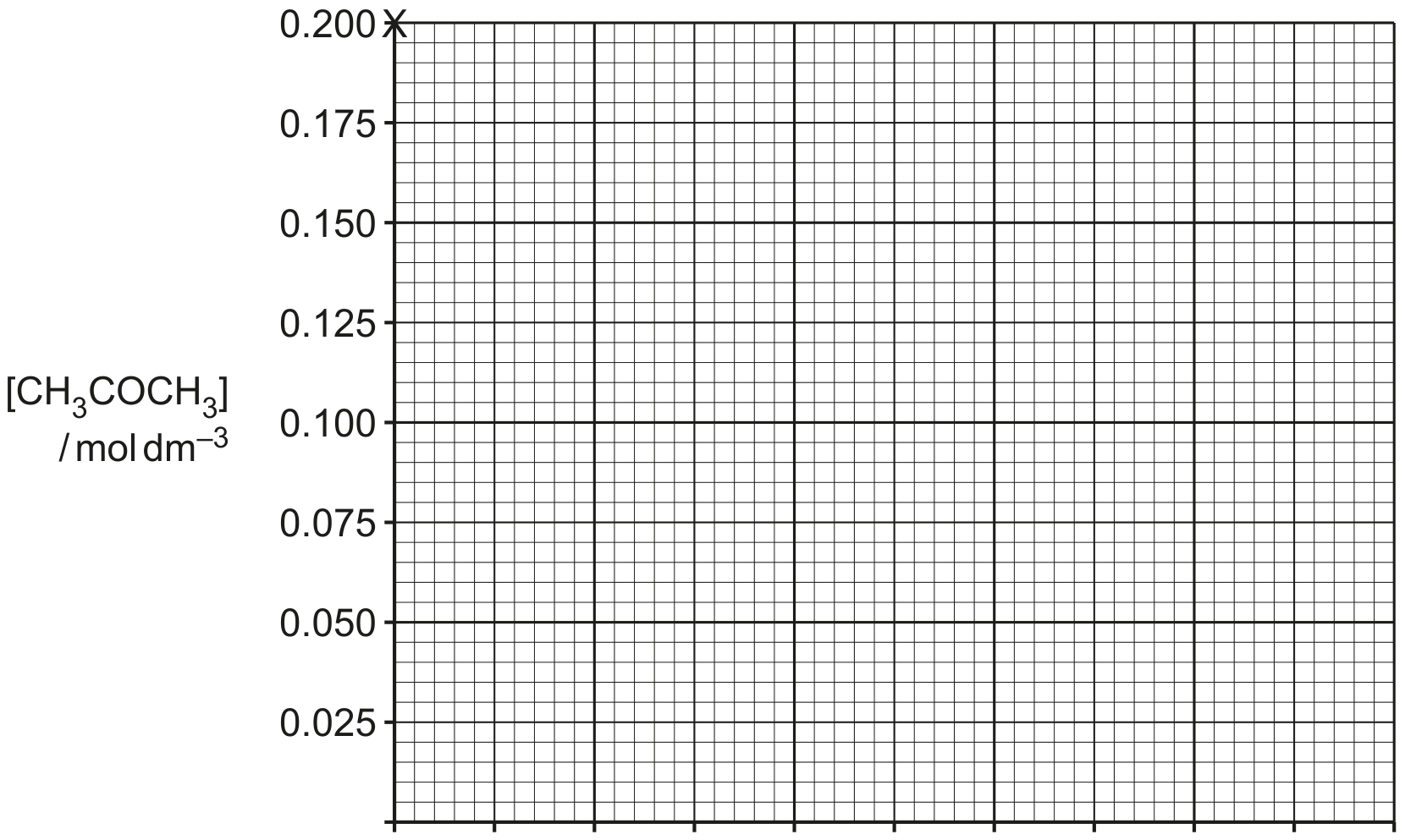
The value of k1k_{1} is 1.1×10³ s11.1 \times 10^{-3} \mathrm{~s}^{-1}. Calculate the value of the half-life, t12t_{\frac{1}{2}}.

t12=t_{\frac{1}{2}}=
(ii)

Use your answer to (i) to draw a graph of [CH3COCH3]\left[\mathrm{CH}_{3} \mathrm{COCH}_{3}\right] against time for this reaction. The initial value of [CH3COCH3]\left[\mathrm{CH}_{3} \mathrm{COCH}_{3}\right] on your graph should be 0.200 moldm30.200 \mathrm{~mol} \mathrm{dm}^{-3}. The final value of [CH3COCH3]\left[\mathrm{CH}_{3} \mathrm{COCH}_{3}\right] on your graph should be 0.0250 moldm30.0250 \mathrm{~mol} \mathrm{dm}^{-3}.

Question image

time/s

[ 1 ]
(e)

A four-step mechanism is suggested for the overall reaction.

CH3COCH3+I2CH3COCH2I+H++I rate =k[CH3COCH3][H+]\mathrm{CH}_{3} \mathrm{COCH}_{3}+\mathrm{I}_{2} \rightarrow \mathrm{CH}_{3} \mathrm{COCH}_{2} \mathrm{I}+\mathrm{H}^{+}+\mathrm{I}^{-} \quad \text { rate }=k\left[\mathrm{CH}_{3} \mathrm{COCH}_{3}\right]\left[\mathrm{H}^{+}\right]

Part of this mechanism is shown.

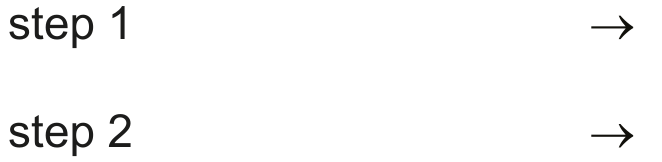
step 1: CH3COCH3+H+CH3C+(OH)CH3\mathrm{CH}_{3} \mathrm{COCH}_{3}+\mathrm{H}^{+} \rightarrow \mathrm{CH}_{3} \mathrm{C}^{+}(\mathrm{OH}) \mathrm{CH}_{3}

step 2: CH3C+(OH)CH3CH3C(OH)=CH2+H+\quad \mathrm{CH}_{3} \mathrm{C}^{+}(\mathrm{OH}) \mathrm{CH}_{3} \rightarrow \mathrm{CH}_{3} \mathrm{C}(\mathrm{OH})=\mathrm{CH}_{2}+\mathrm{H}^{+}

step 3: →

step 4: CH3C+(OH)CH2ICH3COCH2I+H+\quad \mathrm{CH}_{3} \mathrm{C}^{+}(\mathrm{OH}) \mathrm{CH}_{2} \mathrm{I} \rightarrow \mathrm{CH}_{3} \mathrm{COCH}_{2} \mathrm{I}+\mathrm{H}^{+}

[ 2 ]
(i)

Write an equation for step 3 .

[ 1 ]
(ii)

Suggest the slowest step of the mechanism. Explain your answer.

[ 1 ]
[Maximum number: 6]

Fluorine reacts with chlorine dioxide, ClO2\mathrm{ClO}_{2}, as shown.

F2( g)+2ClO2( g)2FClO2( g)\mathrm{F}_{2}(\mathrm{~g})+2 \mathrm{ClO}_{2}(\mathrm{~g}) \rightarrow 2 \mathrm{FClO}_{2}(\mathrm{~g})

The rate of the reaction is first order with respect to the concentration of F2F_{2} and first order with respect to the concentration of ClO2\mathrm{ClO}_{2}. No catalyst is involved.

(a)
(i)

Suggest a two-step mechanism for this reaction.

Question image
[ 2 ]
(ii)

Identify the rate-determining step in this mechanism. Explain your answer.

[ 1 ]
(b)

When the rate of the reaction is measured in moldm3 s1\mathrm{mol} \mathrm{dm}^{-3} \mathrm{~s}^{-1} the numerical value of the rate constant, k, is 1.22 under certain conditions.

(i)

Complete the rate equation for this reaction, stating the overall order of the reaction.

 rate = overall order of reaction =\begin{array}{r} \text { rate }= \\ \text { overall order of reaction }= \end{array}
(ii)

Use your rate equation in (i) to calculate the rate of the reaction when the concentrations of F2\mathrm{F}_{2} and ClO2\mathrm{ClO}_{2} are both 2.00×10³moldm32.00 \times 10^{-3} \mathrm{moldm}^{-3}.
rate = moldm m3 s1\mathrm{m}^{-3} \mathrm{~s}^{-1}

(c)

Under different conditions, and in the presence of a large excess of ClO2\mathrm{ClO}_{2}, the rate equation is as shown.

 rate =k1[ F2]\text { rate }=k_{1}\left[\mathrm{~F}_{2}\right]

The half-life, t12t_{\frac{1}{2}}, of the concentration of F2F_{2} is 4.00 s under these conditions.

[ 3 ]
(i)

Calculate the numerical value of k1k_{1}, giving its units.

Give your answer to three significant figures.

k1=.. unit k_{1}=\ldots \ldots \ldots \ldots \ldots \ldots \ldots \ldots \ldots . . \text { unit }
[ 2 ]
(ii)

An experiment is performed under these conditions in which the starting concentration of F2F_{2} is 0.00200moldm30.00200 \mathrm{moldm}^{-3}.

Draw a graph on the grid in Fig. 1.1 to show how the concentration of F2F_{2} changes over the first 12s of the reaction.

Fig. 1.1

Fig. 1.1

[ 1 ]
(iii)

Use your graph in Fig. 1.1 to find the rate of the reaction when the concentration of F2F_{2} is 0.00100 moldm30.00100 \mathrm{~mol} \mathrm{dm}^{-3}. Show your working on the graph.
rate = moldm m3 s1\mathrm{m}^{-3} \mathrm{~s}^{-1}

[Maximum number: 8]

The compound nitrosyl bromide, NOBr, can be formed by the reaction shown.

2NO+Br22NOBr2 \mathrm{NO}+\mathrm{Br}_{2} \rightleftharpoons 2 \mathrm{NOBr}
(a)

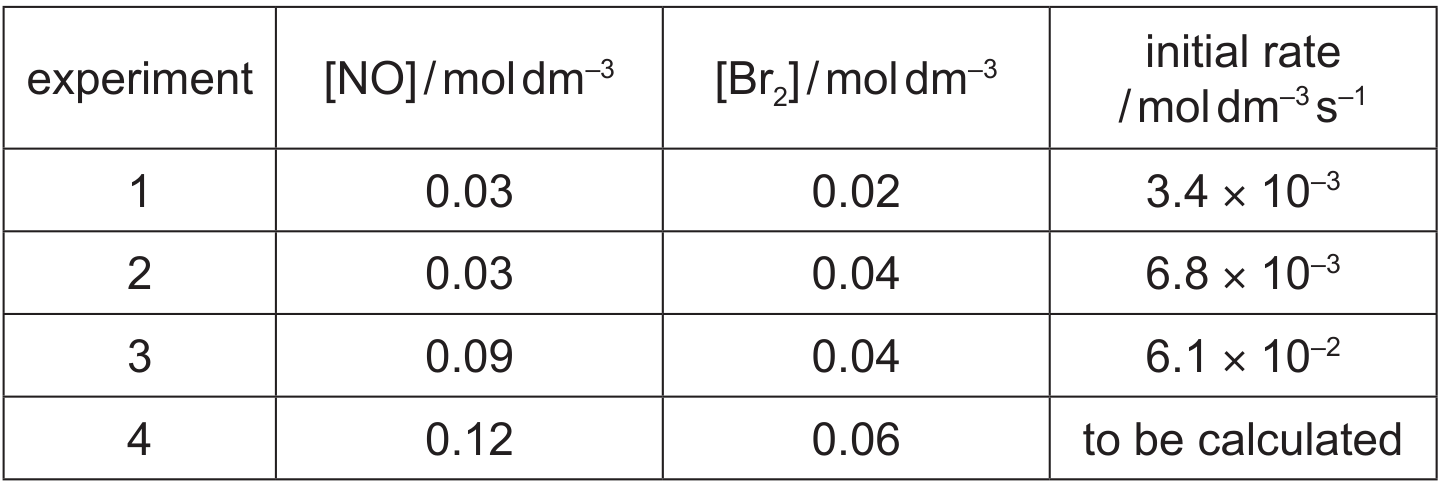
The rate of the reaction was measured at various concentrations of the two reactants, NO and Br2\mathrm{Br}_{2}, and the following results were obtained.

Table

The general form of the rate equation for this reaction is as follows.

 rate =k[NO]a[Br2]b\text { rate }=k[\mathrm{NO}]^{a}\left[\mathrm{Br}_{2}\right]^{b}
[ 7 ]
(i)

What is meant by the term order of reaction with respect to a particular reagent?

[ 1 ]
(ii)

Use the data in the table to deduce the values of a and b in the rate equation. Show your reasoning.

[ 2 ]
(iii)

Use the data in the table to calculate the initial rate for experiment 4.

 initial rate =..moldm3 s1\text { initial rate }=\ldots \ldots \ldots \ldots \ldots \ldots \ldots \ldots \ldots \ldots \ldots . . \mathrm{mol} \mathrm{dm}^{-3} \mathrm{~s}^{-1}
[ 1 ]
(iv)

Use the results of experiment 1 to calculate the rate constant, k, for this reaction. Include the units of k.
rate constant, k= units

[ 2 ]
(v)

By considering the rate equation, explain why the rate decreases with decreasing temperature.

[ 1 ]
(b)

The reaction between X and Y was studied.

2X+YZ2 X+Y \rightarrow Z

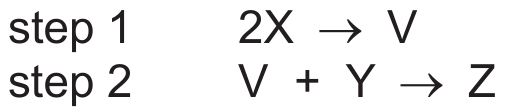
The following sequence of steps is a proposed mechanism for the reaction.

Table

The general form of the rate equation for this reaction is as follows.

 rate =k[X]m[Y]n\text { rate }=k[\mathrm{X}]^{m}[\mathrm{Y}]^{n}

Step 1 is the slower step in the mechanism.
Deduce the values of m and n in the rate equation.
m= n=

[ 1 ]
[Maximum number: 8]

The compound chlorine dioxide, ClO2\mathrm{ClO}_{2}, can be prepared by the reaction shown.

NaClO2+12Cl2ClO2+NaCl\mathrm{NaClO}_{2}+\frac{1}{2} \mathrm{Cl}_{2} \rightarrow \mathrm{ClO}_{2}+\mathrm{NaCl}
(a)

The reaction between ClO2\mathrm{ClO}_{2} and F2\mathrm{F}_{2} is shown.

2ClO2+F22ClO2 F2 \mathrm{ClO}_{2}+\mathrm{F}_{2} \rightarrow 2 \mathrm{ClO}_{2} \mathrm{~F}

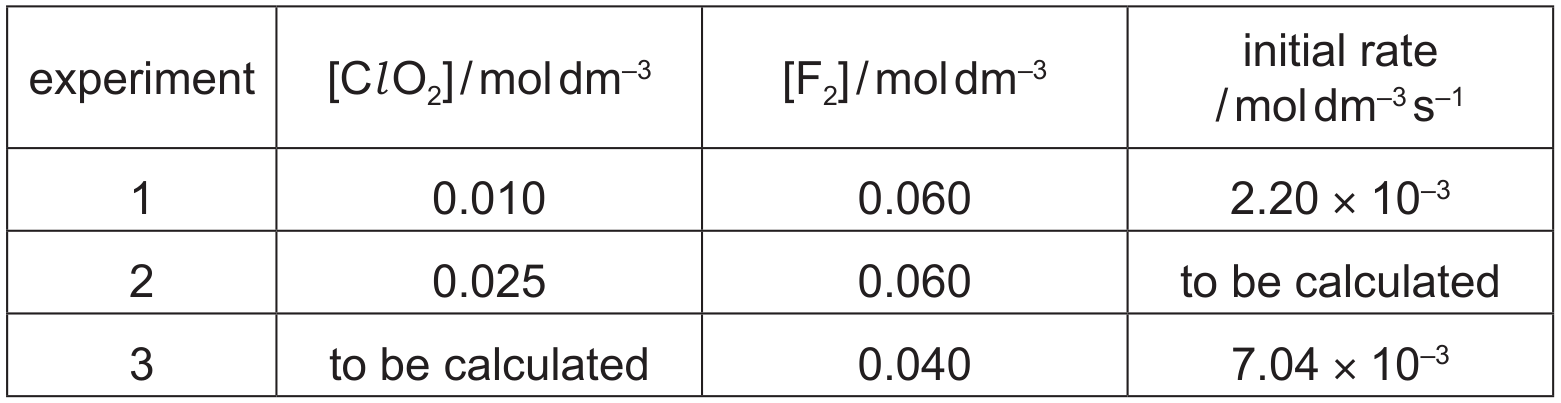
The rate of the reaction was measured at various concentrations of the two reactants and the following results were obtained.

Table

The rate equation is rate =k[ClO2][F2]=k\left[\mathrm{ClO}_{2}\right]\left[\mathrm{F}_{2}\right].

[ 5 ]
(i)

What is meant by the term order of reaction with respect to a particular reagent?

[ 1 ]
(ii)

Use the results of experiment 1 to calculate the rate constant, k, for this reaction. Include the units of k.
rate constant, k= units

[ 2 ]
(iii)

Use the data in the table to calculate
- the initial rate in experiment 2,
initial rate = moldm3 s1\mathrm{mol} \mathrm{dm}^{-3} \mathrm{~s}^{-1}
- [ClO2]\left[\mathrm{ClO}_{2}\right] in experiment 3.

[ClO2]=\left[\mathrm{ClO}_{2}\right]=

moldm 3{ }^{-3}

[ 2 ]
(b)
(i)

What is meant by the term rate-determining step?

[ 1 ]
(ii)

The equation for the reaction between ClO2\mathrm{ClO}_{2} and F2\mathrm{F}_{2} is shown.

2ClO2+F22ClO2 F rate =k[ClO2][F2]\begin{gathered} 2 \mathrm{ClO}_{2}+\mathrm{F}_{2} \rightarrow 2 \mathrm{ClO}_{2} \mathrm{~F} \\ \text { rate }=k\left[\mathrm{ClO}_{2}\right]\left[\mathrm{F}_{2}\right] \end{gathered}

The mechanism for this reaction has two steps.
Suggest equations for the two steps of this mechanism, stating which of the two steps is the rate-determining step.
step 1
step 2
rate-determining step =

[ 2 ]
[Maximum number: 9]

Nitrogen monoxide, NO, reacts with oxygen to form nitrogen dioxide, NO2\mathrm{NO}_{2}.

2NO( g)+O2( g)2NO2( g)2 \mathrm{NO}(\mathrm{~g})+\mathrm{O}_{2}(\mathrm{~g}) \rightleftharpoons 2 \mathrm{NO}_{2}(\mathrm{~g})

The rate equation for the forward reaction is shown.

 rate =k[NO]2[O2]\text { rate }=k[\mathrm{NO}]^{2}\left[\mathrm{O}_{2}\right]
(a)

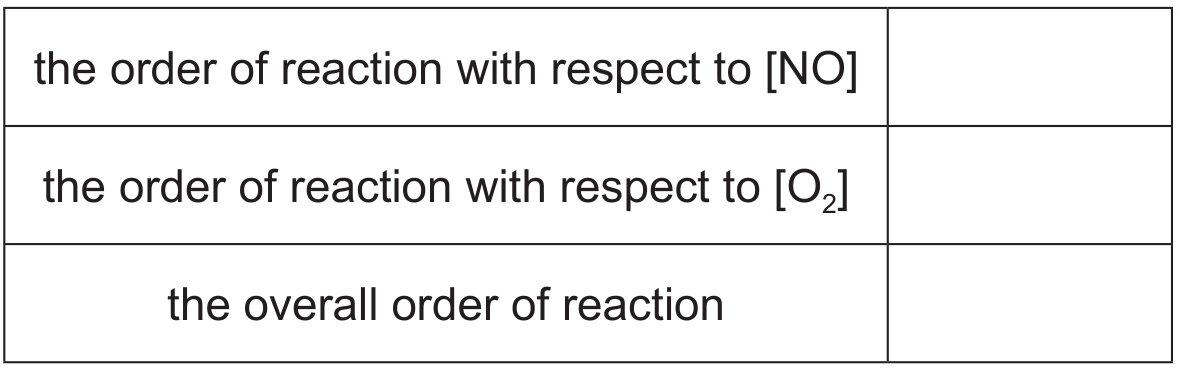
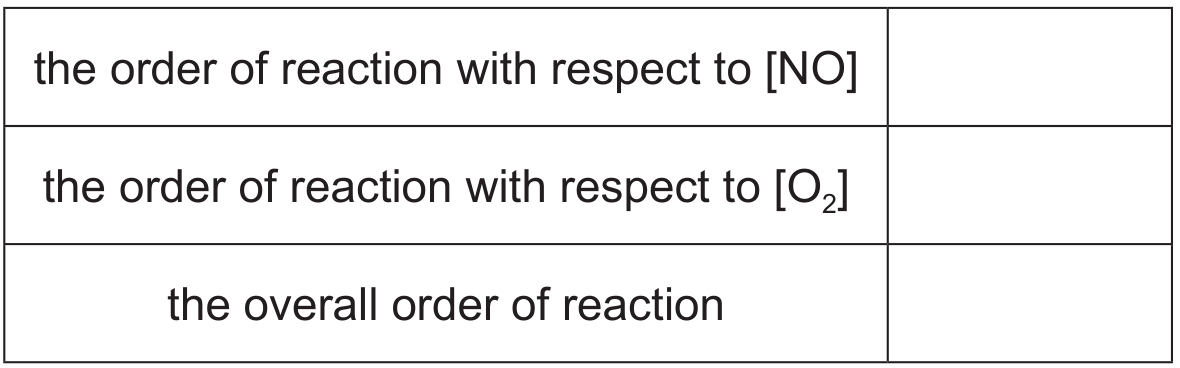
Complete the following table.

Table
[ 1 ]
(b)

Two separate experiments are carried out at 30C30^{\circ} \mathrm{C} to determine the rate of the forward reaction.

Table
[ 3 ]
(i)

Use the data for experiment 1 to calculate the value of the rate constant, k. State the units of k.

k=

units =

[ 2 ]
(ii)

Calculate the value of [NO][\mathrm{NO}] in experiment 2 .

[NO] =

moldm3\mathrm{mol} \mathrm{dm}^{-3}

[ 1 ]
(c)

Define the term rate-determining step.

[ 1 ]
(d)

Peroxodisulfate ions, S2O82\mathrm{S}_{2} \mathrm{O}_{8}{ }^{2-}, react with iodide ions, I\mathrm{I}^{-}.

S2O82+2I2SO42+I2\mathrm{S}_{2} \mathrm{O}_{8}^{2-}+2 \mathrm{I}^{-} \rightarrow 2 \mathrm{SO}_{4}^{2-}+\mathrm{I}_{2}

The rate equation for the reaction in the absence of any catalyst is shown.

 rate =k[ S2O82][I]\text { rate }=k\left[\mathrm{~S}_{2} \mathrm{O}_{8}{ }^{2-}\right]\left[\mathrm{I}^{-}\right]
[ 4 ]
(i)

Suggest equations for a two-step mechanism for this reaction, stating which of the two steps is the rate-determining step.
step 1
step 2
rate-determining step =

[ 2 ]
(ii)

A large excess of peroxodisulfate ions is mixed with iodide ions. Immediately after mixing, [I]=0.00780 moldm3\left[\mathrm{I}^{-}\right]=0.00780 \mathrm{~mol} \mathrm{dm}^{-3}. Under the conditions used, the half-life of [I]\left[\mathrm{I}^{-}\right]is 48 seconds.

Calculate the iodide ion concentration 192 seconds after the peroxodisulfate and iodide ions are mixed.
iodide ion concentration = moldm3\mathrm{mol} \mathrm{dm}^{-3}

[ 2 ]
[Maximum number: 7]

Nitrogen monoxide, NO, reacts with oxygen to form nitrogen dioxide, NO2\mathrm{NO}_{2}.

2NO( g)+O2( g)2NO2( g)2 \mathrm{NO}(\mathrm{~g})+\mathrm{O}_{2}(\mathrm{~g}) \rightleftharpoons 2 \mathrm{NO}_{2}(\mathrm{~g})

The rate equation for the forward reaction is shown.

 rate =k[NO]2[O2]\text { rate }=k[\mathrm{NO}]^{2}\left[\mathrm{O}_{2}\right]
(a)

Complete the following table.

Table
[ 1 ]
(b)

Two separate experiments are carried out at 30C30^{\circ} \mathrm{C} to determine the rate of the forward reaction.

Table
[ 3 ]
(i)

Use the data for experiment 1 to calculate the value of the rate constant, k. State the units of k.

k=

units =

[ 2 ]
(ii)

Calculate the value of [NO][\mathrm{NO}] in experiment 2 .

[NO] =

moldm3\mathrm{mol} \mathrm{dm}^{-3}

[ 1 ]
(c)

Define the term rate-determining step.

[ 1 ]
(d)

Peroxodisulfate ions, S2O82\mathrm{S}_{2} \mathrm{O}_{8}{ }^{2-}, react with iodide ions, I\mathrm{I}^{-}.

S2O82+2I2SO42+I2\mathrm{S}_{2} \mathrm{O}_{8}^{2-}+2 \mathrm{I}^{-} \rightarrow 2 \mathrm{SO}_{4}^{2-}+\mathrm{I}_{2}

The rate equation for the reaction in the absence of any catalyst is shown.

 rate =k[ S2O82][I]\text { rate }=k\left[\mathrm{~S}_{2} \mathrm{O}_{8}{ }^{2-}\right]\left[\mathrm{I}^{-}\right]
[ 2 ]
(i)

Suggest equations for a two-step mechanism for this reaction, stating which of the two steps is the rate-determining step.
step 1
step 2
rate-determining step =

[ 2 ]
(ii)

A large excess of peroxodisulfate ions is mixed with iodide ions. Immediately after mixing, [I]=0.00780 moldm3\left[\mathrm{I}^{-}\right]=0.00780 \mathrm{~mol} \mathrm{dm}^{-3}. Under the conditions used, the half-life of [I]\left[\mathrm{I}^{-}\right]is 48 seconds.

Calculate the iodide ion concentration 192 seconds after the peroxodisulfate and iodide ions are mixed.
iodide ion concentration = moldm3\mathrm{mol} \mathrm{dm}^{-3}

0