EduNinja
[Maximum number: 9]

1EDTA41 \mathrm{EDTA}^{4-}, is a polydentate ligand.

(a)

Cadmium ions form complexes with methylamine, CH3NH2\mathrm{CH}_{3} \mathrm{NH}_{2}, and with 1,2-diaminoethane, H2NCH2CH2NH2\mathrm{H}_{2} \mathrm{NCH}_{2} \mathrm{CH}_{2} \mathrm{NH}_{2}, as shown in equilibriums 2 and 3. 1,2-diaminoethane is shown as en.
equilibrium 2[Cd(H2O)6]2++4CH3NH2[Cd(CH3NH2)4(H2O)2]2++4H2OKstab2 =3.60×1062\left[\mathrm{Cd}\left(\mathrm{H}_{2} \mathrm{O}\right)_{6}\right]^{2+}+4 \mathrm{CH}_{3} \mathrm{NH}_{2} \rightleftharpoons\left[\mathrm{Cd}\left(\mathrm{CH}_{3} \mathrm{NH}_{2}\right)_{4}\left(\mathrm{H}_{2} \mathrm{O}\right)_{2}\right]^{2+}+4 \mathrm{H}_{2} \mathrm{O} \quad K_{\text {stab2 }}=3.60 \times 10^{6}
equilibrium 3[Cd(H2O)6]2++2en[Cd(en)2(H2O)2]2++4H2OKstab3 =4.20×10103\left[\mathrm{Cd}\left(\mathrm{H}_{2} \mathrm{O}\right)_{6}\right]^{2+}+2 \mathrm{en} \rightleftharpoons\left[\mathrm{Cd}(\mathrm{en})_{2}\left(\mathrm{H}_{2} \mathrm{O}\right)_{2}\right]^{2+}+4 \mathrm{H}_{2} \mathrm{O} \quad \mathrm{K}_{\text {stab3 }}=4.20 \times 10^{10}

An equilibrium is set up between these two complexes as shown in equilibrium 4.
equilibrium 4[Cd(CH3NH2)4(H2O)2]2++2en[Cd(en)2(H2O)2]2++4CH3NH24\left[\mathrm{Cd}\left(\mathrm{CH}_{3} \mathrm{NH}_{2}\right)_{4}\left(\mathrm{H}_{2} \mathrm{O}\right)_{2}\right]^{2+}+2 \mathrm{en} \rightleftharpoons\left[\mathrm{Cd}(\mathrm{en})_{2}\left(\mathrm{H}_{2} \mathrm{O}\right)_{2}\right]^{2+}+4 \mathrm{CH}_{3} \mathrm{NH}_{2}

ΔH=+0.840 kJ mol1ΔS=+80.9JK1 mol1\begin{aligned} & \Delta H^{\ominus}=+0.840 \mathrm{~kJ} \mathrm{~mol}^{-1} \\ & \Delta S^{\ominus}=+80.9 \mathrm{JK}^{-1} \mathrm{~mol}^{-1} \end{aligned}
(i)

Calculate the value of the standard Gibbs free energy change, ΔG\Delta G^{\ominus}, for equilibrium 4 at 298 K .
ΔG=\Delta G^{\ominus}=kJmol1\mathrm{kJ} \mathrm{mol}^{-1}

(a)

The [Cr2(O2CCH3)4(H2O)2]\left[\mathrm{Cr}_{2}\left(\mathrm{O}_{2} \mathrm{CCH}_{3}\right)_{4}\left(\mathrm{H}_{2} \mathrm{O}\right)_{2}\right] complex reacts with aqueous acid to form Cr2+(aq)\mathrm{Cr}^{2+}(\mathrm{aq}) ions. Cr2+(aq)\mathrm{Cr}^{2+}(\mathrm{aq}) ions react with O2(aq)\mathrm{O}_{2}(\mathrm{aq}) under acidic conditions. Cr3+(aq)\mathrm{Cr}^{3+}(\mathrm{aq}) ions are formed.

Use the Data Booklet to answer the following questions.

[ 3 ]
(i)

Construct an ionic equation for the reaction of Cr2+(aq)\mathrm{Cr}^{2+}(\mathrm{aq}) with O2(aq)\mathrm{O}_{2}(\mathrm{aq}) under acidic conditions.

[ 2 ]
(ii)

Calculate Ecell E_{\text {cell }}^{\ominus} for the reaction in (e)(i).

Ecell =E_{\text {cell }}^{\ominus}=

V

[ 1 ]
[Maximum number: 6]

An electrochemical cell is constructed using two half-cells.
- an Sn4+/Sn2+\mathrm{Sn}^{4+} / \mathrm{Sn}^{2+} half-cell
- an Al3+/Al\mathrm{A} l^{3+} / \mathrm{A} l half-cell

(a)

State the material used for the electrode in each half-cell.
- Sn4+/Sn2+\mathrm{Sn}^{4+} / \mathrm{Sn}^{2+} half-cell
- Al3+/Al\mathrm{A} l^{3+} / \mathrm{A} l half-cell

[ 1 ]
(b)

The cell is operated at 298 K .

The Al3+/Al\mathrm{A} l^{3+} / \mathrm{A} l half-cell has standard concentrations.
The Sn4+/Sn2+\mathrm{Sn}^{4+} / \mathrm{Sn}^{2+} half-cell has [Sn4+]=0.300 moldm3\left[\mathrm{Sn}^{4+}\right]=0.300 \mathrm{~mol} \mathrm{dm}^{-3} and [Sn2+]=0.150 moldm3\left[\mathrm{Sn}^{2+}\right]=0.150 \mathrm{~mol} \mathrm{dm}^{-3}.

[ 5 ]
(i)

Use the Nernst equation to calculate the electrode potential, E, of the Sn4+/Sn2+\mathrm{Sn}^{4+} / \mathrm{Sn}^{2+} half-cell under these conditions.

E =V
[ 2 ]
(ii)

Calculate the Ecell E_{\text {cell }} under these conditions.

Ecell =E_{\text {cell }}=

V

[ 1 ]
(iii)

Write an equation for the overall cell reaction that occurs.

[ 2 ]
[Maximum number: 6]

An electrochemical cell is constructed using two half-cells.
- a Br2/Br\mathrm{Br}_{2} / \mathrm{Br}^{-}half-cell
- an Mn3+/Mn2+\mathrm{Mn}^{3+} / \mathrm{Mn}^{2+} half-cell

(a)

State the material used for the electrode in each half-cell.
Br2/Br\mathrm{Br}_{2} / \mathrm{Br}^{-}half-cell
Mn3+/Mn2+\mathrm{Mn}^{3+} / \mathrm{Mn}^{2+} half-cell

[ 1 ]
(b)

The cell is operated at 298 K .

The Br2/Br\mathrm{Br}_{2} / \mathrm{Br}^{-}half-cell has standard concentrations.
The Mn3+/Mn2+\mathrm{Mn}^{3+} / \mathrm{Mn}^{2+} half-cell has [Mn3+]=0.500moldm3\left[\mathrm{Mn}^{3+}\right]=0.500 \mathrm{moldm}{ }^{-3} and [Mn2+]=0.100moldm3\left[\mathrm{Mn}^{2+}\right]=0.100 \mathrm{moldm}{ }^{-3}.

[ 5 ]
(i)

Use the Nernst equation to calculate the electrode potential, E, of the Mn3+/Mn2+\mathrm{Mn}^{3+} / \mathrm{Mn}^{2+} half-cell under these conditions.

E=
[ 2 ]
(ii)

Calculate the Ecell E_{\text {cell }} under these conditions.

Ecell =E_{\text {cell }}=
[ 1 ]
(iii)

Write an equation for the overall cell reaction that occurs.

[ 2 ]
[Maximum number: 3]

Iodine is found naturally in compounds in many different oxidation states.

(a)

The concentration of Cu2+(aq)\mathrm{Cu}^{2+}(\mathrm{aq}) in a solution can be determined by the reaction of Cu2+\mathrm{Cu}^{2+} ions with I\mathrm{I}^{-}ions.

reaction 12Cu2++4I2CuI+I212 \mathrm{Cu}^{2+}+4 \mathrm{I}^{-} \rightarrow 2 \mathrm{CuI}+\mathrm{I}_{2}

The I2\mathrm{I}_{2} produced in reaction 1 is titrated against a solution containing thiosulfate ions, S2O32\mathrm{S}_{2} \mathrm{O}_{3}{ }^{2-}, using a suitable indicator.

 reaction 22 S2O32+I2 S4O62+2I\text { reaction } 2 \quad 2 \mathrm{~S}_{2} \mathrm{O}_{3}^{2-}+\mathrm{I}_{2} \rightarrow \mathrm{~S}_{4} \mathrm{O}_{6}^{2-}+2 \mathrm{I}^{-}
[ 1 ]
(i)

A 25.0 cm325.0 \mathrm{~cm}^{3} portion of a Cu2+(aq)\mathrm{Cu}^{2+}(\mathrm{aq}) solution reacts with an excess of I(aq)\mathrm{I}^{-}(\mathrm{aq}).

The end-point of the titration occurs when 22.30 cm322.30 \mathrm{~cm}^{3} of 0.150 moldm3 S2O32(aq)0.150 \mathrm{~mol} \mathrm{dm}^{-3} \mathrm{~S}_{2} \mathrm{O}_{3}{ }^{2-}(\mathrm{aq}) is added.
Calculate the concentration of Cu2+(aq)\mathrm{Cu}^{2+}(\mathrm{aq}) in the original solution.

(ii)

Identify a suitable indicator for the titration.

[ 1 ]
(b)

The reaction of I\mathrm{I}^{-}ions with persulfate ions, S2O82\mathrm{S}_{2} \mathrm{O}_{8}{ }^{2-}, can be catalysed by Fe3+\mathrm{Fe}^{3+} ions.

2I+S2O82I2+2SO422 \mathrm{I}^{-}+\mathrm{S}_{2} \mathrm{O}_{8}^{2-} \rightarrow \mathrm{I}_{2}+2 \mathrm{SO}_{4}^{2-}

Write equations to show how Fe3+\mathrm{Fe}^{3+} catalyses this reaction.

[ 2 ]
(a)
(i)

Use EE^{\ominus} values from the Data Booklet to predict the relative oxidising abilities of fluorine and chlorine.

[ 2 ]
(ii)

Predict the type of reaction that would occur between the interhalogen compound chlorine fluoride, ClF, and potassium bromide solution.

[ 1 ]
(iii)

Construct an equation for this reaction.

[ 1 ]
(a)

Iron(III) chloride, FeCl3\mathrm{FeCl}_{3}, is used to dissolve unwanted copper from printed circuit boards (PCBs) by the following reaction.

2FeCl3(aq)+Cu( s)2FeCl2(aq)+CuCl2(aq)2 \mathrm{FeCl}_{3}(\mathrm{aq})+\mathrm{Cu}(\mathrm{~s}) \rightarrow 2 \mathrm{FeCl}_{2}(\mathrm{aq})+\mathrm{CuCl}_{2}(\mathrm{aq})

A solution in which [Fe3+(aq)]\left[\mathrm{Fe}^{3+}(\mathrm{aq})\right] was originally equal to 1.50 moldm31.50 \mathrm{~mol} \mathrm{dm}^{-3} was re-used several times to dissolve copper from the PCBs, and was then titrated as follows.

A 2.50 cm32.50 \mathrm{~cm}^{3} sample of the partially-used-up solution was acidified and titrated with 0.0200 moldm3KMnO40.0200 \mathrm{~mol} \mathrm{dm}^{-3} \mathrm{KMnO}_{4}.
This oxidised any FeCl2\mathrm{FeCl}_{2} in the solution back to FeCl3\mathrm{FeCl}_{3}.
It was found that 15.0 cm315.0 \mathrm{~cm}^{3} of KMnO4(aq)\mathrm{KMnO}_{4}(\mathrm{aq}) was required to reach the end point.

[ 6 ]
(i)

Construct an ionic equation for the reaction between Fe2+\mathrm{Fe}^{2+} and MnO4\mathrm{MnO}_{4}^{-}in acid solution.

(ii)

State here the Fe2+:MnO4\mathrm{Fe}^{2+}: \mathrm{MnO}_{4}^{-}ratio from your equation in (i).

(iii)

Calculate the mass of copper that could still be dissolved by 100 cm3100 \mathrm{~cm}^{3} of the partially-used-up solution.
mass of copper =

[ 6 ]
(a)

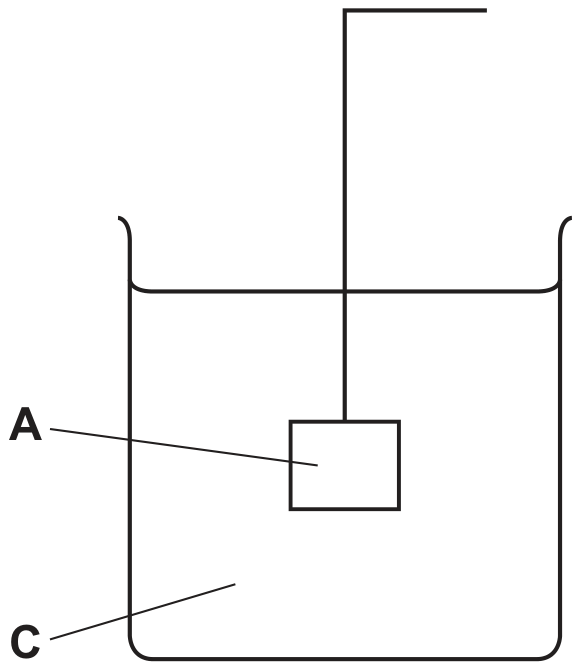
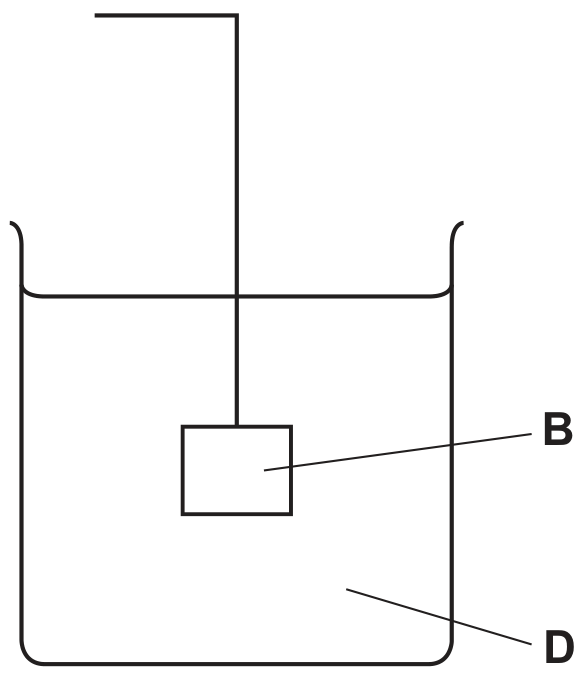
The following diagram shows the apparatus used to measure the standard electrode potential, EE^{\ominus}, of a cell composed of a Cu(II) / Cu electrode and an Fe(II) / Fe electrode.

[ 8 ]
(i)

Finish the diagram by adding components to show the complete circuit. Label the components you add.

Question image
Question image
(ii)

In the spaces below, identify or describe what the four letters A-D represent.

A

B

C

D

(iii)

Use the Data Booklet to calculate the EE^{\ominus} for this cell.

(iv)

Predict how the size of the overall cell potential would change, if at all, as the concentration of solution C is increased.
Explain your reasoning.

[ 8 ]
(a)

When aqueous solutions of KI and K2 S2O8\mathrm{K}_{2} \mathrm{~S}_{2} \mathrm{O}_{8} are mixed almost no reaction occurs, but when a few drops of Fe2+(aq)\mathrm{Fe}^{2+}(\mathrm{aq}) or Fe3+(aq)\mathrm{Fe}^{3+}(\mathrm{aq}) are added, iodine, I2(aq)\mathrm{I}_{2}(\mathrm{aq}), is produced at a steady rate.

(i)

Write an equation for the overall reaction.

[Maximum number: 1]

A transition metal ion, M2+\mathrm{M}^{2+}, reacts with acidified dichromate(VI) ions to form M4+\mathrm{M}^{4+} ions, Cr3+\mathrm{Cr}^{3+} ions, and H2O\mathrm{H}_{2} \mathrm{O}.

Which equation correctly represents this reaction?

A

Cr2O72+14H++M2+2Cr3++7H2O+M4+\mathrm{Cr}_{2} \mathrm{O}_{7}{ }^{2-}+14 \mathrm{H}^{+}+\mathrm{M}^{2+} \rightarrow 2 \mathrm{Cr}^{3+}+7 \mathrm{H}_{2} \mathrm{O}+\mathrm{M}^{4+}

B

Cr2O72+14H++2M2+2Cr3++7H2O+2M4+\mathrm{Cr}_{2} \mathrm{O}_{7}^{2-}+14 \mathrm{H}^{+}+2 \mathrm{M}^{2+} \rightarrow 2 \mathrm{Cr}^{3+}+7 \mathrm{H}_{2} \mathrm{O}+2 \mathrm{M}^{4+}

C

Cr2O72+14H++3M2+2Cr3++7H2O+3M4+\mathrm{Cr}_{2} \mathrm{O}_{7}{ }^{2-}+14 \mathrm{H}^{+}+3 \mathrm{M}^{2+} \rightarrow 2 \mathrm{Cr}^{3+}+7 \mathrm{H}_{2} \mathrm{O}+3 \mathrm{M}^{4+}

D

Cr2O72+14H++6M2+2Cr3++7H2O+6M4+\mathrm{Cr}_{2} \mathrm{O}_{7}^{2-}+14 \mathrm{H}^{+}+6 \mathrm{M}^{2+} \rightarrow 2 \mathrm{Cr}^{3+}+7 \mathrm{H}_{2} \mathrm{O}+6 \mathrm{M}^{4+}

0