EduNinja
(a)

EDTA 4{ }^{4-} is a polydentate ligand.

[ 2 ]
(i)

The complex [CaEDTA] 2{ }^{2-} can be used to remove toxic metals from the body.

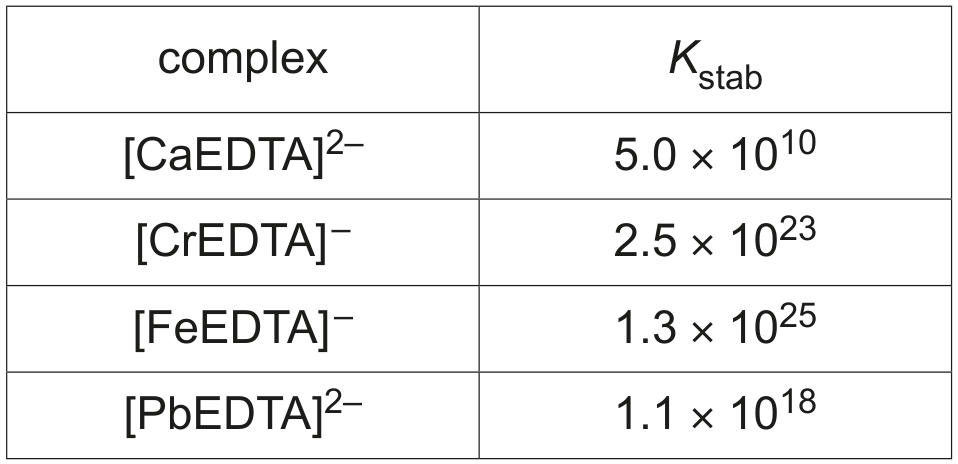
Table 1.2 shows the numerical values for the stability constants, Kstab K_{\text {stab }}, for some metal ions with EDTA 4{ }^{4-}.

Table 1.2

Table 1.2

An aqueous solution containing [CaEDTA] 2{ }^{2-} is added to a solution containing equal concentrations of Cr3+(aq),Fe3+(aq)\mathrm{Cr}^{3+}(\mathrm{aq}), \mathrm{Fe}^{3+}(\mathrm{aq}) and Pb2+(aq)\mathrm{Pb}^{2+}(\mathrm{aq}). The resulting mixture is left to reach a state of equilibrium.

State the type of reaction when [CaEDTA]2[\mathrm{CaEDTA}]^{2-} reacts with Cr3+(aq),Fe3+(aq)\mathrm{Cr}^{3+}(\mathrm{aq}), \mathrm{Fe}^{3+}(\mathrm{aq}) and Pb2+(aq)\mathrm{Pb}^{2+}(\mathrm{aq}).

[ 1 ]
(ii)

Deduce the relative concentrations of [CrEDTA],[FeEDTA][\mathrm{CrEDTA}]^{-},[\mathrm{FeEDTA}]^{-}and [PbEDTA]2[\mathrm{PbEDTA}]^{2-} present in the resulting mixture.

Explain your answer. > >
highest concentration
lowest concentration

[ 1 ]
[Maximum number: 2]

Copper is a transition element and has atomic number 29.

(a)

The following equilibrium exists between two complex ions of copper in the +2 oxidation state.

[Cu(H2O)6]2++4Cl[CuCl4]2+6H2O\left[\mathrm{Cu}\left(\mathrm{H}_{2} \mathrm{O}\right)_{6}\right]^{2+}+4 \mathrm{Cl}^{-} \rightleftharpoons\left[\mathrm{CuCl}_{4}\right]^{2-}+6 \mathrm{H}_{2} \mathrm{O}
[ 1 ]
(i)

Write the expression for the stability constant, Kstab K_{\text {stab }}, for this equilibrium.

Kstab =K_{\text {stab }}=
[ 1 ]
(b)

Copper also forms the complex ions [Cu(NH3)2(H2O)4]2+\left[\mathrm{Cu}\left(\mathrm{NH}_{3}\right)_{2}\left(\mathrm{H}_{2} \mathrm{O}\right)_{4}\right]^{2+} and [Cu(en)(H2O)4]2+\left[\mathrm{Cu}(e n)\left(\mathrm{H}_{2} \mathrm{O}\right)_{4}\right]^{2+} where en is the bidentate ligand ethane-1,2-diamine, H2NCH2CH2NH2\mathrm{H}_{2} \mathrm{NCH}_{2} \mathrm{CH}_{2} \mathrm{NH}_{2}.

[Cu(H2O)6]2++2NH3[Cu(NH3)2(H2O)4]2++2H2O[Cu(H2O)6]2++en[Cu(en)(H2O)4]2++2H2O\begin{gathered} {\left[\mathrm{Cu}\left(\mathrm{H}_{2} \mathrm{O}\right)_{6}\right]^{2+}+2 \mathrm{NH}_{3} \rightleftharpoons\left[\mathrm{Cu}\left(\mathrm{NH}_{3}\right)_{2}\left(\mathrm{H}_{2} \mathrm{O}\right)_{4}\right]^{2+}+2 \mathrm{H}_{2} \mathrm{O}} \\ {\left[\mathrm{Cu}\left(\mathrm{H}_{2} \mathrm{O}\right)_{6}\right]^{2+}+e n \rightleftharpoons\left[\mathrm{Cu}(e n)\left(\mathrm{H}_{2} \mathrm{O}\right)_{4}\right]^{2+}+2 \mathrm{H}_{2} \mathrm{O}} \end{gathered}

equilibrium 1
equilibrium 2

[ 1 ]
(i)

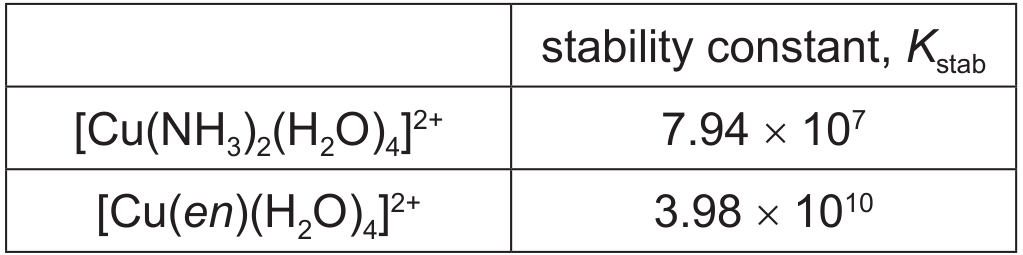
The table lists the values of stability constants for these two complexes.

Table

What do these Kstab K_{\text {stab }} values tell us about the relative positions of equilibria 1 and 2?

[ 1 ]
[Maximum number: 3]

1EDTA41 \mathrm{EDTA}^{4-}, is a polydentate ligand.

(a)
(i)

Write an expression for the stability constant, Kstab1 K_{\text {stab1 }}, for equilibrium 1, and state its units.

Kstab1 =K_{\text {stab1 }}=

units =

[ 2 ]
(b)

Cadmium ions form complexes with methylamine, CH3NH2\mathrm{CH}_{3} \mathrm{NH}_{2}, and with 1,2-diaminoethane, H2NCH2CH2NH2\mathrm{H}_{2} \mathrm{NCH}_{2} \mathrm{CH}_{2} \mathrm{NH}_{2}, as shown in equilibriums 2 and 3. 1,2-diaminoethane is shown as en.
equilibrium 2[Cd(H2O)6]2++4CH3NH2[Cd(CH3NH2)4(H2O)2]2++4H2OKstab2 =3.60×1062\left[\mathrm{Cd}\left(\mathrm{H}_{2} \mathrm{O}\right)_{6}\right]^{2+}+4 \mathrm{CH}_{3} \mathrm{NH}_{2} \rightleftharpoons\left[\mathrm{Cd}\left(\mathrm{CH}_{3} \mathrm{NH}_{2}\right)_{4}\left(\mathrm{H}_{2} \mathrm{O}\right)_{2}\right]^{2+}+4 \mathrm{H}_{2} \mathrm{O} \quad K_{\text {stab2 }}=3.60 \times 10^{6}
equilibrium 3[Cd(H2O)6]2++2en[Cd(en)2(H2O)2]2++4H2OKstab3 =4.20×10103\left[\mathrm{Cd}\left(\mathrm{H}_{2} \mathrm{O}\right)_{6}\right]^{2+}+2 \mathrm{en} \rightleftharpoons\left[\mathrm{Cd}(\mathrm{en})_{2}\left(\mathrm{H}_{2} \mathrm{O}\right)_{2}\right]^{2+}+4 \mathrm{H}_{2} \mathrm{O} \quad \mathrm{K}_{\text {stab3 }}=4.20 \times 10^{10}

An equilibrium is set up between these two complexes as shown in equilibrium 4.
equilibrium 4[Cd(CH3NH2)4(H2O)2]2++2en[Cd(en)2(H2O)2]2++4CH3NH24\left[\mathrm{Cd}\left(\mathrm{CH}_{3} \mathrm{NH}_{2}\right)_{4}\left(\mathrm{H}_{2} \mathrm{O}\right)_{2}\right]^{2+}+2 \mathrm{en} \rightleftharpoons\left[\mathrm{Cd}(\mathrm{en})_{2}\left(\mathrm{H}_{2} \mathrm{O}\right)_{2}\right]^{2+}+4 \mathrm{CH}_{3} \mathrm{NH}_{2}

ΔH=+0.840 kJ mol1ΔS=+80.9JK1 mol1\begin{aligned} & \Delta H^{\ominus}=+0.840 \mathrm{~kJ} \mathrm{~mol}^{-1} \\ & \Delta S^{\ominus}=+80.9 \mathrm{JK}^{-1} \mathrm{~mol}^{-1} \end{aligned}
[ 1 ]
(i)

Keq 4K_{\text {eq } 4} is the equilibrium constant for equilibrium 4.

Write an expression for Keq4 K_{\text {eq4 }} in terms of Kstab2 K_{\text {stab2 }} and Kstab3 K_{\text {stab3 }}.
Keq 4=K_{\text {eq } 4}=

[ 1 ]
(a)
(i)

Define stability constant, Kstab K_{\text {stab }}.

[ 1 ]
(ii)

Nickel can form complexes with the ligands en, H2NCH2CH2NH2\mathrm{H}_{2} \mathrm{NCH}_{2} \mathrm{CH}_{2} \mathrm{NH}_{2}, and tn,H2NCH2CH2CH2NH2t n, \mathrm{H}_{2} \mathrm{NCH}_{2} \mathrm{CH}_{2} \mathrm{CH}_{2} \mathrm{NH}_{2}, as shown.
equilibrium 1[Ni(H2O)6]2++3en[Ni(en)3]2++6H2OKstab =6.76×10171\left[\mathrm{Ni}\left(\mathrm{H}_{2} \mathrm{O}\right)_{6}\right]^{2+}+3 e n \rightleftharpoons\left[\mathrm{Ni}(e n)_{3}\right]^{2+}+6 \mathrm{H}_{2} \mathrm{O} \quad K_{\text {stab }}=6.76 \times 10^{17}
equilibrium 2[Ni(H2O)6]2++3tn[Ni(tn)3]2++6H2OKstab =1.86×10122 \quad\left[\mathrm{Ni}\left(\mathrm{H}_{2} \mathrm{O}\right)_{6}\right]^{2+}+3 t n \rightleftharpoons\left[\mathrm{Ni}(t n)_{3}\right]^{2+}+6 \mathrm{H}_{2} \mathrm{O} \quad K_{\text {stab }}=1.86 \times 10^{12}
Construct an expression for the stability constant, Kstab K_{\text {stab }}, for equilibrium 1. State the units for Kstab K_{\text {stab }}.
Kstab =K_{\text {stab }}=

units =
[ 2 ]
(iii)

Describe what the Kstab K_{\text {stab }} values indicate about the position of equilibrium for equilibrium 1 and 2. Use the Kstab K_{\text {stab }} values to deduce which complex, [Ni(en)3]2+\left[\mathrm{Ni}(e n)_{3}\right]^{2+} or [Ni(tn)3]2+\left[\mathrm{Ni}(t n)_{3}\right]^{2+}, is more stable.

[ 1 ]
(a)
(i)

State what is meant by the term stability constant.

[ 1 ]
(ii)

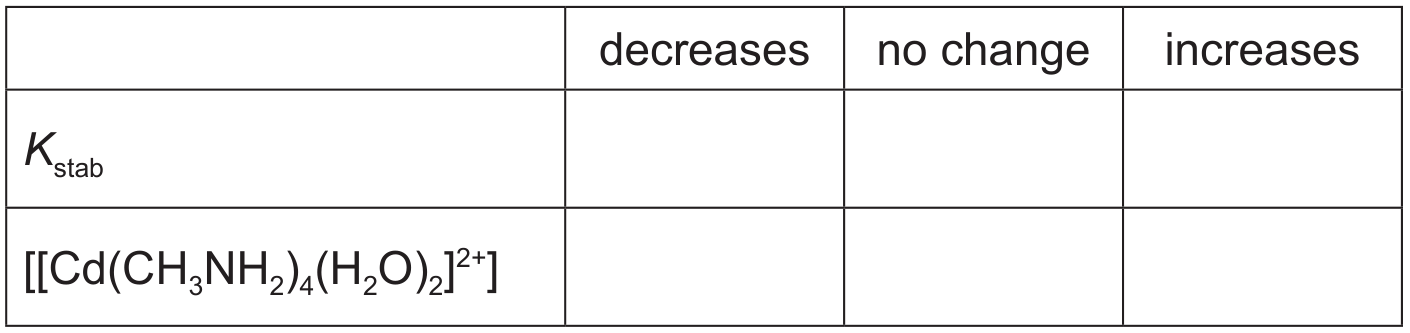
Complete the table by placing one tick ( ✓ ) in each row to suggest how increasing temperature will affect Kstab K_{\text {stab }} and the equilibrium concentration of the cadmium complex, [[Cd(CH3NH2)4(H2O)2]2+]\left[\left[\mathrm{Cd}\left(\mathrm{CH}_{3} \mathrm{NH}_{2}\right)_{4}\left(\mathrm{H}_{2} \mathrm{O}\right)_{2}\right]^{2+}\right], for equilibrium 1. Explain your answer.

Table

explanation

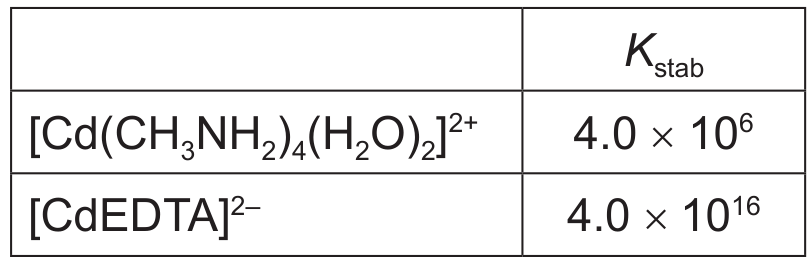
EDTA 4{ }^{4-} is a polydentate ligand. When a solution of EDTA 4{ }^{4-} is added to [Cd(H2O)6]2+\left[\mathrm{Cd}\left(\mathrm{H}_{2} \mathrm{O}\right)_{6}\right]^{2+} a new complex [CdEDTA] 2{ }^{2-} is formed.

The values for the stability constants for two Cd2+\mathrm{Cd}^{2+} complexes are shown.

Table
[ 2 ]
(iii)

A solution containing equal numbers of moles of CH3NH2\mathrm{CH}_{3} \mathrm{NH}_{2} and EDTA is added to [Cd(H2O)6]2+\left[\mathrm{Cd}\left(\mathrm{H}_{2} \mathrm{O}\right)_{6}\right]^{2+}. Predict which complex is formed in the larger amount. Explain your answer.

[ 1 ]
(a)

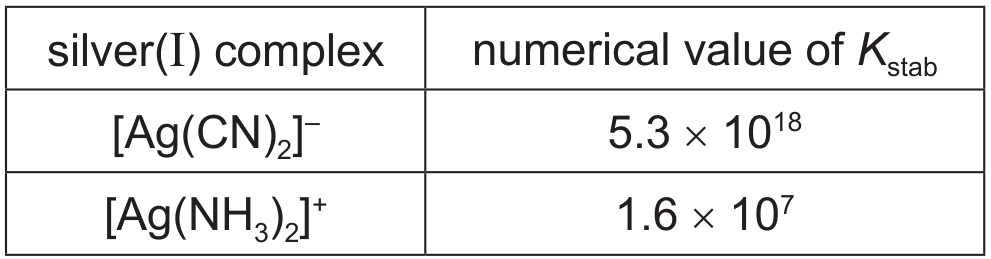
The numerical values for the stability constants, Kstab K_{\text {stab }}, of two other silver(I) complexes are given.

Table

An aqueous solution containing Ag+\mathrm{Ag}^{+}is added to a solution containing equal concentrations of CN(aq),NH3(aq)\mathrm{CN}^{-}(\mathrm{aq}), \mathrm{NH}_{3}(\mathrm{aq}) and S2O32(aq)\mathrm{S}_{2} \mathrm{O}_{3}{ }^{2-}(\mathrm{aq}). The mixture is left to reach equilibrium.

Deduce the relative concentrations of [Ag(CN)2],[Ag(NH3)2]+\left[\mathrm{Ag}(\mathrm{CN})_{2}\right]^{-},\left[\mathrm{Ag}\left(\mathrm{NH}_{3}\right)_{2}\right]^{+}and [Ag(S2O3)2]3\left[\mathrm{Ag}\left(\mathrm{S}_{2} \mathrm{O}_{3}\right)_{2}\right]^{3-} present in the resulting mixture. Explain your answer. > >
highest concentration
lowest concentration

[ 2 ]
[Maximum number: 6]

Bubbling air through different aqueous mixtures of CoCl2,NH4Cl\mathrm{CoCl}_{2}, \mathrm{NH}_{4} \mathrm{Cl} and NH3\mathrm{NH}_{3} produces various complex ions with the general formula [Co(NH3)6nCln]3n\left[\mathrm{Co}\left(\mathrm{NH}_{3}\right)_{6-\mathrm{n}} \mathrm{Cl}_{\mathrm{n}}\right]^{3-\mathrm{n}}.

(a)

Iron(III) forms complexes in separate reactions with both SCN\mathrm{SCN}^{-}ions and Cl\mathrm{Cl}^{-}ions.

Fe3+(aq)+SCN(aq)[FeSCN2+(aq)Fe3+(aq)+4Cl(aq)[FeCl4](aq)\begin{aligned} \mathrm{Fe}^{3+}(\mathrm{aq})+\mathrm{SCN}^{-}(\mathrm{aq}) & \rightleftharpoons\left[\mathrm{FeSCN}^{2+}(\mathrm{aq})\right. \\ \mathrm{Fe}^{3+}(\mathrm{aq})+4 \mathrm{Cl}^{-}(\mathrm{aq}) & \rightleftharpoons\left[\mathrm{FeCl}_{4}\right]^{-}(\mathrm{aq}) \end{aligned}
[ 6 ]
(i)

Write the expressions for the stability constants, Kstab K_{\text {stab }}, for these two equilibria. Include units in your answers.

Kstab1 =K_{\text {stab1 }}=
units =
Kstab2 =K_{\text {stab2 }}=
units =
[ 3 ]
(ii)

An equilibrium can be set up between these two complexes as shown in equilibrium 3 .

[FeCl4](aq)+SCN(aq)[FeSCN]2+(aq)+4Cl(aq)\left[\mathrm{FeCl}_{4}\right]^{-}(\mathrm{aq})+\mathrm{SCN}^{-}(\mathrm{aq}) \rightleftharpoons[\mathrm{FeSCN}]^{2+}(\mathrm{aq})+4 \mathrm{Cl}^{-}(\mathrm{aq})

Write an expression for Keq3 K_{\text {eq3 }} in terms of Kstab1 K_{\text {stab1 }} and Kstab2 K_{\text {stab2 }}.
Keq 3=K_{\text {eq } 3}=

[ 1 ]
(iii)

The numerical values for these stability constants are shown.

Kstab1 =1.4×10²Kstab2 =8.0×10²K_{\text {stab1 }}=1.4 \times 10^{2} \quad K_{\text {stab2 }}=8.0 \times 10^{-2}

Calculate the value of Keq 3K_{\text {eq } 3} stating its units.
Keq 3=K_{\text {eq } 3}= units =

[ 2 ]
[Maximum number: 2]

The transition elements are able to form stable complexes with a wide range of molecules and ions.

(a)

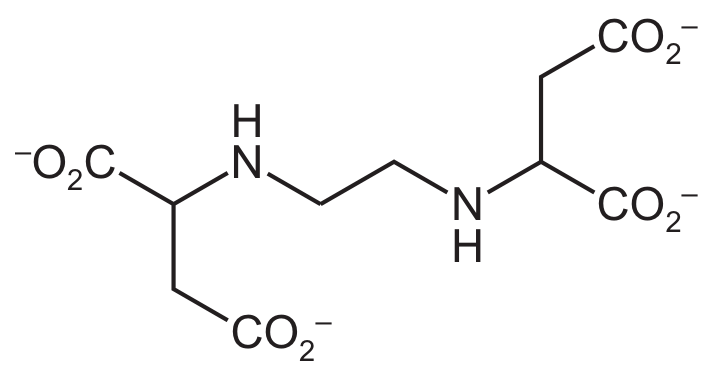
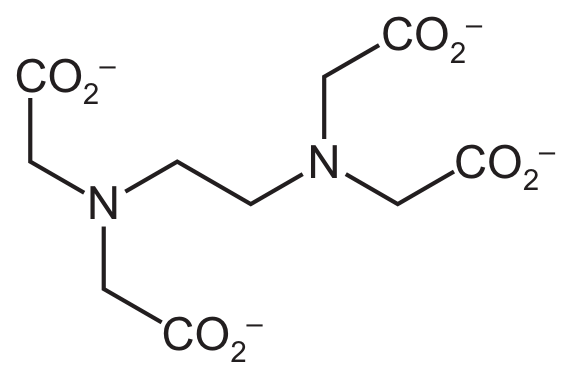
Edds 4{ }^{4-} and edta 4{ }^{4-} are polydentate ligands that form octahedral complexes with Fe3+\mathrm{Fe}^{3+} (aq).

edds \({

edds \({

edta \({

edta \({

The formulae of the complexes are [Fe(edds)][\mathrm{Fe}(\mathrm{edds})]^{-}and [Fe(edta)][\mathrm{Fe}(\mathrm{edta})]^{-}respectively.

[ 2 ]
(i)

Write an expression for the stability constant, Kstab K_{\text {stab }}, of [Fe(edds)](aq)[\mathrm{Fe}(\mathrm{edds})]^{-}(\mathrm{aq}).

Kstab =K_{\text {stab }}=
[ 1 ]
(ii)

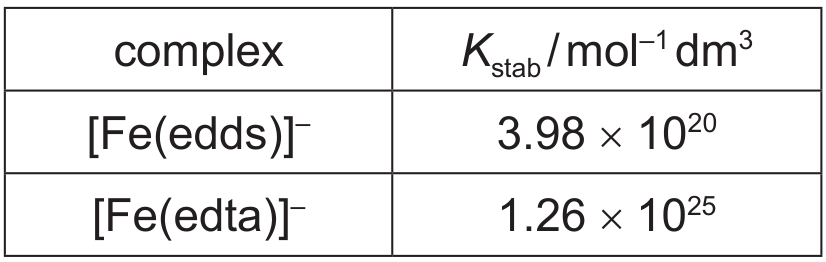
The table shows the values for the stability constants, Kstab K_{\text {stab }}, of both complexes.

Table

Predict which of the [Fe(edds)][\mathrm{Fe}(\mathrm{edds})]^{-}and [Fe(edta)][\mathrm{Fe}(\mathrm{edta})]^{-}complexes is more stable.
Explain your answer with reference to the Kstab K_{\text {stab }} value for each complex.

[ 1 ]
(iii)

When an excess of edta 4{ }^{4-} (aq) is added to [Fe(edds)](aq)[\mathrm{Fe}(\mathrm{edds})]^{-}(\mathrm{aq}), the following equilibrium is established.

[Fe(edds)](aq)+edta4(aq)[Fe(edta)](aq)+edds4(aq)[\mathrm{Fe}(\mathrm{edds})]^{-}(\mathrm{aq})+\mathrm{edta}^{4-}(\mathrm{aq}) \rightleftharpoons[\mathrm{Fe}(\mathrm{edta})]^{-}(\mathrm{aq})+\mathrm{edds}^{4-}(\mathrm{aq})

Calculate the equilibrium constant, KcK_{\mathrm{c}}, for this equilibrium, using the Kstab K_{\text {stab }} values given in the table in (c)(v).

Kc=K_{\mathrm{c}}=
(a)
(i)

Copper(I) chloride is also sparingly soluble in water.

Suggest why the following reaction does not occur.

2Cu2+(aq)+4Cl(aq)XCuCl( s)+Cl2(aq)2 \mathrm{Cu}^{2+}(\mathrm{aq})+4 \mathrm{Cl}^{-}(\mathrm{aq}) \longrightarrow \mathrm{X} \mathrm{CuCl}(\mathrm{~s})+\mathrm{Cl}_{2}(\mathrm{aq})
[ 1 ]
(b)

When chloride ions are added to a solution containing Cu2+(aq)\mathrm{Cu}^{2+}(\mathrm{aq}), the complex ion [CuCl4]2(aq)\left[\mathrm{CuCl}_{4}\right]^{2-}(\mathrm{aq}) is formed.

[ 2 ]
(i)

Write an expression for the stability constant, Kstab K_{\text {stab }}, for [CuCl4]2(aq)\left[\mathrm{CuCl}_{4}\right]^{2-}(\mathrm{aq}). Include the units in your answer.

Kstab =K_{\text {stab }}=

units =

[ 2 ]
[Maximum number: 3]

Many copper compounds, such as CuSO4\mathrm{CuSO}_{4} and Cu(NO3)2\mathrm{Cu}\left(\mathrm{NO}_{3}\right)_{2} contain Cu2+\mathrm{Cu}^{2+} ions. Aqueous solutions of this ion contain the [Cu(H2O)6]2+\left[\mathrm{Cu}\left(\mathrm{H}_{2} \mathrm{O}\right)_{6}\right]^{2+} complex ion, in which water behaves as a monodentate ligand.

(a)

If a solution of chloride ions is added to a solution containing [Fe(H2O)6]3+\left[\mathrm{Fe}\left(\mathrm{H}_{2} \mathrm{O}\right)_{6}\right]^{3+} an equilibrium is established.

[Fe(H2O)6]3++4Cl[FeCl4]+6H2O\left[\mathrm{Fe}\left(\mathrm{H}_{2} \mathrm{O}\right)_{6}\right]^{3+}+4 \mathrm{Cl}^{-} \rightleftharpoons\left[\mathrm{FeCl}_{4}\right]^{-}+6 \mathrm{H}_{2} \mathrm{O}
[ 3 ]
(i)

Write an expression for the stability constant of [FeCl4],Kstab \left[\mathrm{FeCl}_{4}\right]^{-}, K_{\text {stab }}.

Kstab =K_{\text {stab }}=
[ 1 ]
(ii)

For the above equilibrium the numerical value of Kstab =0.080K_{\text {stab }}=0.080.

Calculate the concentration of [Fe(H2O)6]3+\left[\mathrm{Fe}\left(\mathrm{H}_{2} \mathrm{O}\right)_{6}\right]^{3+} in a solution in which the concentration of Cl\mathrm{Cl}^{-}is 2.0 moldm32.0 \mathrm{~mol} \mathrm{dm}^{-3} and the concentration of [FeCl4]\left[\mathrm{FeCl}_{4}\right]^{-}is 0.10 moldm30.10 \mathrm{~mol} \mathrm{dm}^{-3}.
concentration of [Fe(H2O)6]3+=\left[\mathrm{Fe}\left(\mathrm{H}_{2} \mathrm{O}\right)_{6}\right]^{3+}=moldm3\mathrm{mol} \mathrm{dm}^{-3}

[ 2 ]
0