[Maximum number: 1]
Fig. 1.1 is a diagram showing a stage in protein synthesis.
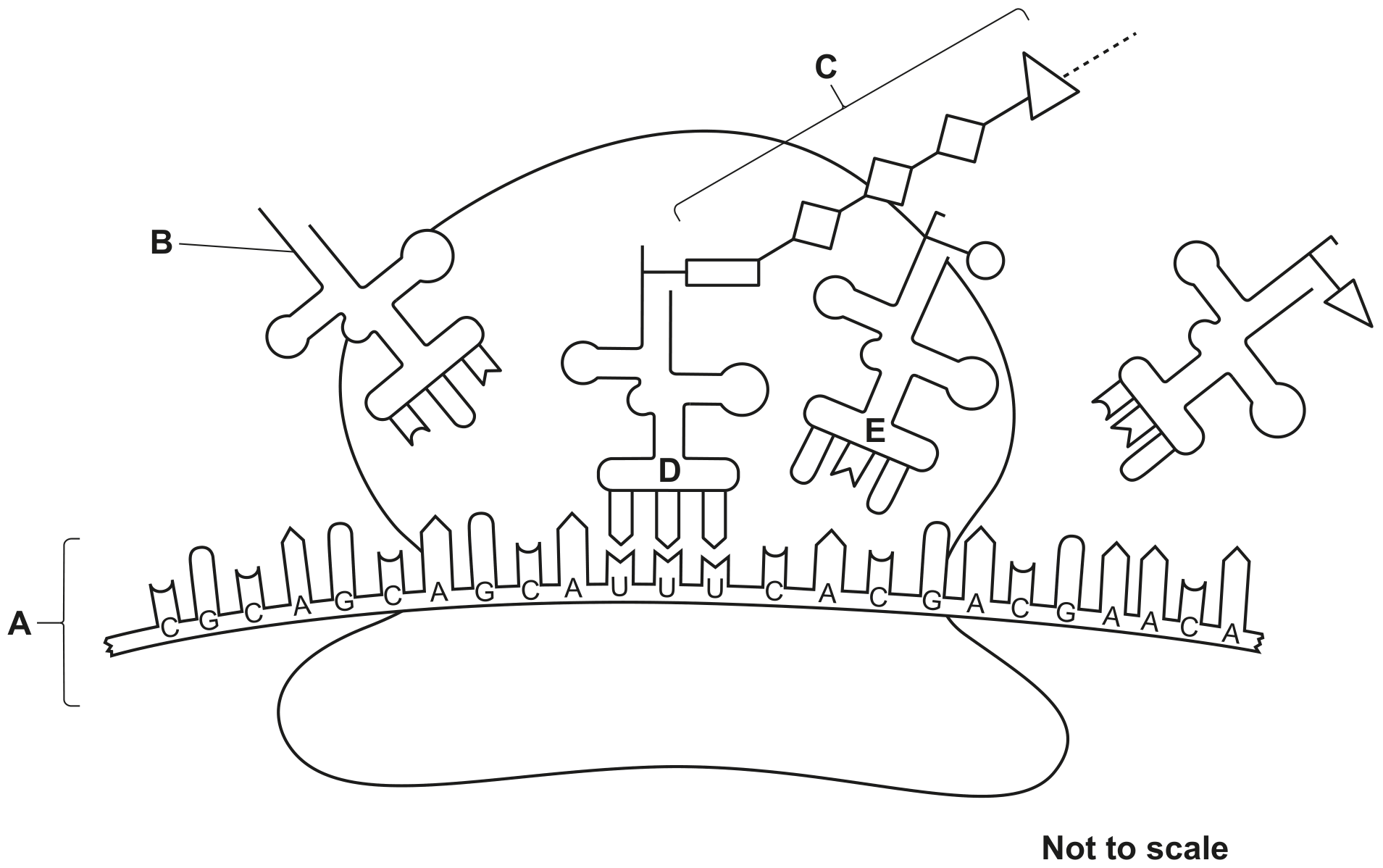
Fig. 1.1
(a)
(i)
State the base sequences at D and E.
D
E
[ 1 ]
 EduNinja
Fig. 1.1 is a diagram showing a stage in protein synthesis.
Fig. 1.1
State the base sequences at D and E.
D
E
Table 2.1 shows two messenger RNA (mRNA) codons. Fill in the complementary transfer RNA (tRNA) anticodons in the spaces provided.

Table 2.1
Row 1 and row 2 of Table 2.1 show the DNA base sequences of part of the normal CFTR allele and the same part of a mutated CFTR allele. The base sequences shown are for the DNA strands used in the synthesis of RNA. When Table 2.1 is completed, row 3 will show the base sequence of the RNA synthesised from the same part of the mutated CFTR allele.
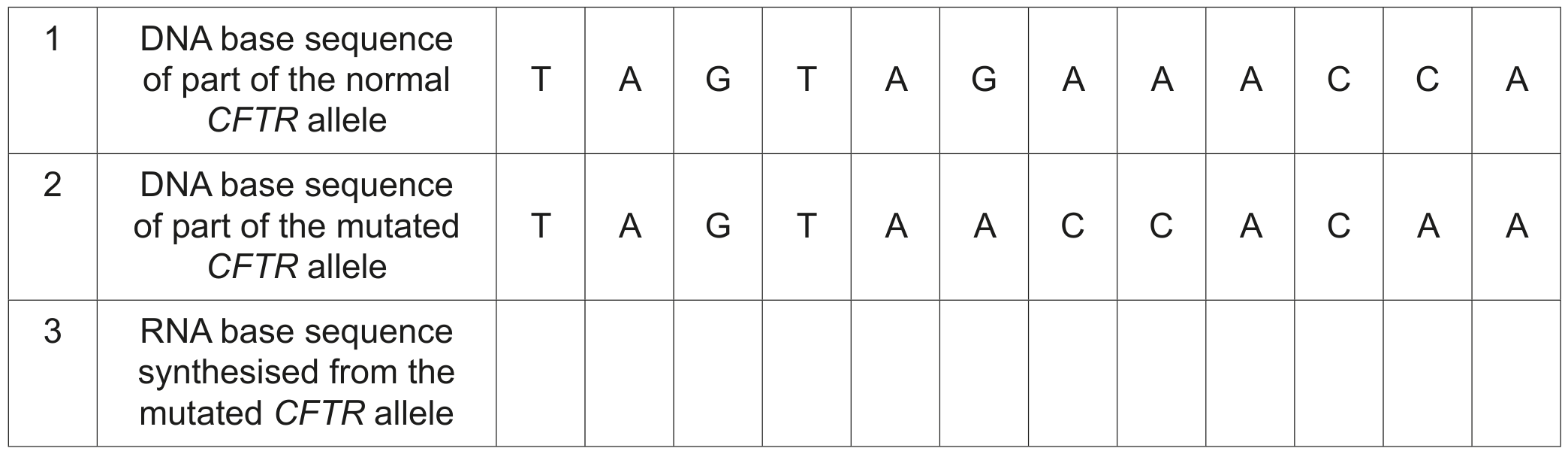
Table 2.1
Complete Table 2.1 to show the missing bases in row 3.
Fig. 2.1 shows the base sequence of a DNA triplet code used to produce mRNA. Fill in the corresponding tRNA anticodon in the space provided.
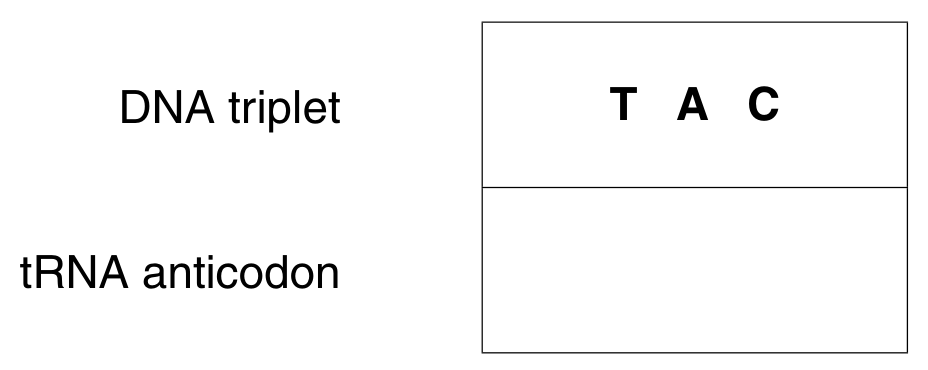
Fig. 2.1
There are many types of amino acids, but only twenty that are polymerised to make polypeptides and proteins in animals.
Angiotensinogen is an inactive protein molecule. When blood pressure decreases, part of angiotensinogen is removed to form a short polypeptide, angiotensin that stimulates an increase in blood pressure.
Fig. 3.2 shows the base sequence within the gene for angiotensinogen that codes for this short polypeptide, the RNA codons and the primary structure of angiotensin.
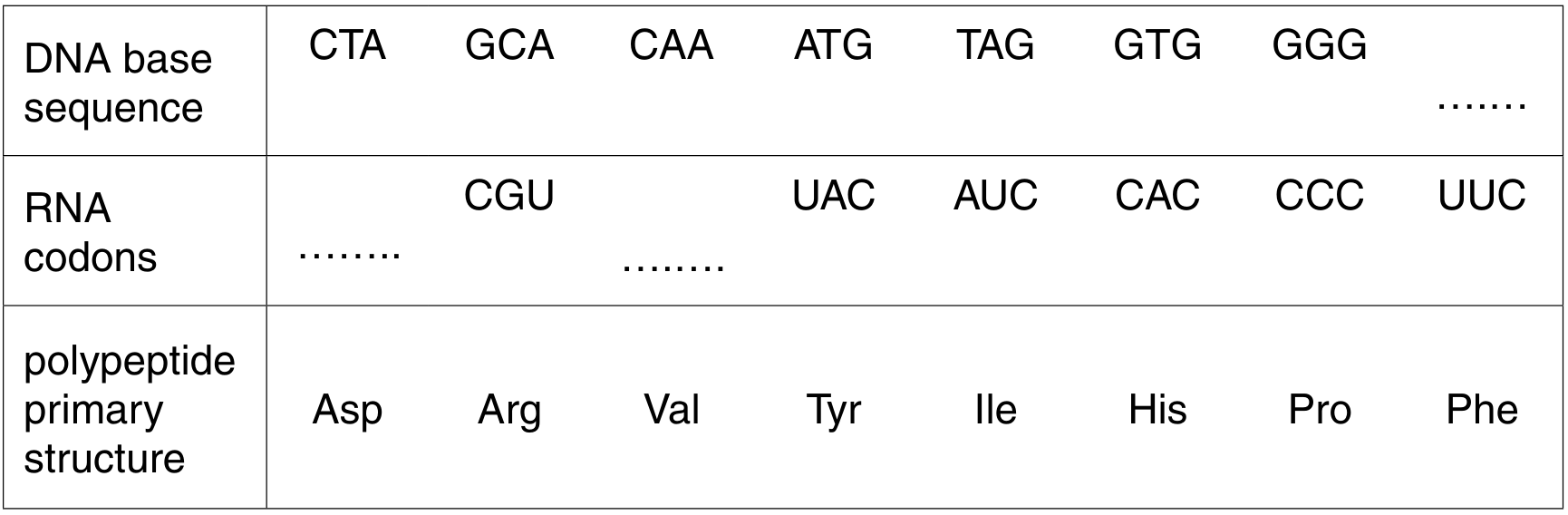
Fig. 3.2
Complete Fig. 3.2 to show the missing DNA triplet and the RNA codons.
The sequence of nucleotides in DNA in a gene that controls the synthesis of a protein is arranged in triplets, each coding for specific amino acids. The table shows three examples of these triplets.
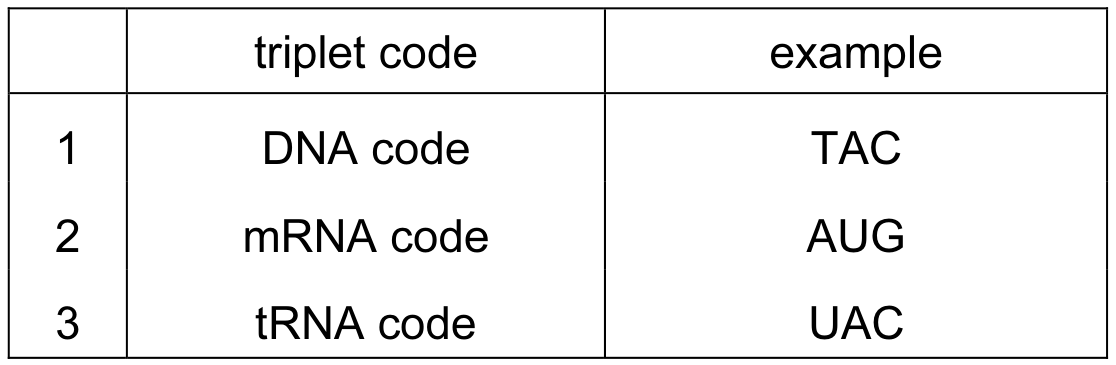
Which are the correct codon and anticodon?
codon
anticodon
1
3
2
3
3
1
3
2
In a genetic engineering experiment, a piece of double-stranded DNA containing nucleotides coding for specific polypeptide is transcribed and translated.
What is the total number of amino acids in this polypeptide?
Which row shows two pairs of nucleotides formed when mRNA is translated?
bases present
number of hydrogen bonds
bases present
number of hydrogen bonds
AT
2
TU
2
AU
2
AT
2
AU
2
GC
3
AU
3
GC
3
One characteristic of DNA is that it is a universal genetic code.
What is meant by a universal genetic code?
All living organisms use the same triplet code for amino acids.
All DNA triplets code for a different amino acid.
Not all DNA triplets code for an amino acid.
All living organisms contain the same four nucleic acids.
Fig. 4.1 shows the structure of the R groups of three amino acids, aspartate (Asp), glutamine (Gln) and isoleucine (Ile).
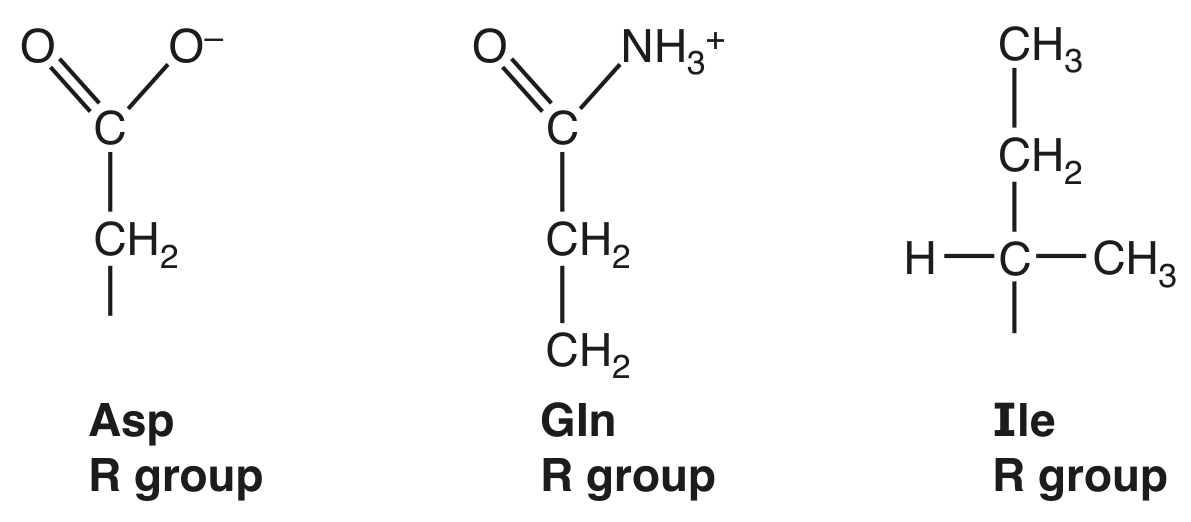
Fig. 4.1
One of the mRNA codons for the amino acid Gln is CAA. A mutation could change this codon from CAA to UAA.
UAA is a STOP codon.
State what is meant by a STOP codon.