[Maximum number: 2]
Fig. 1.1 is a diagram of a molecule of haemoglobin.
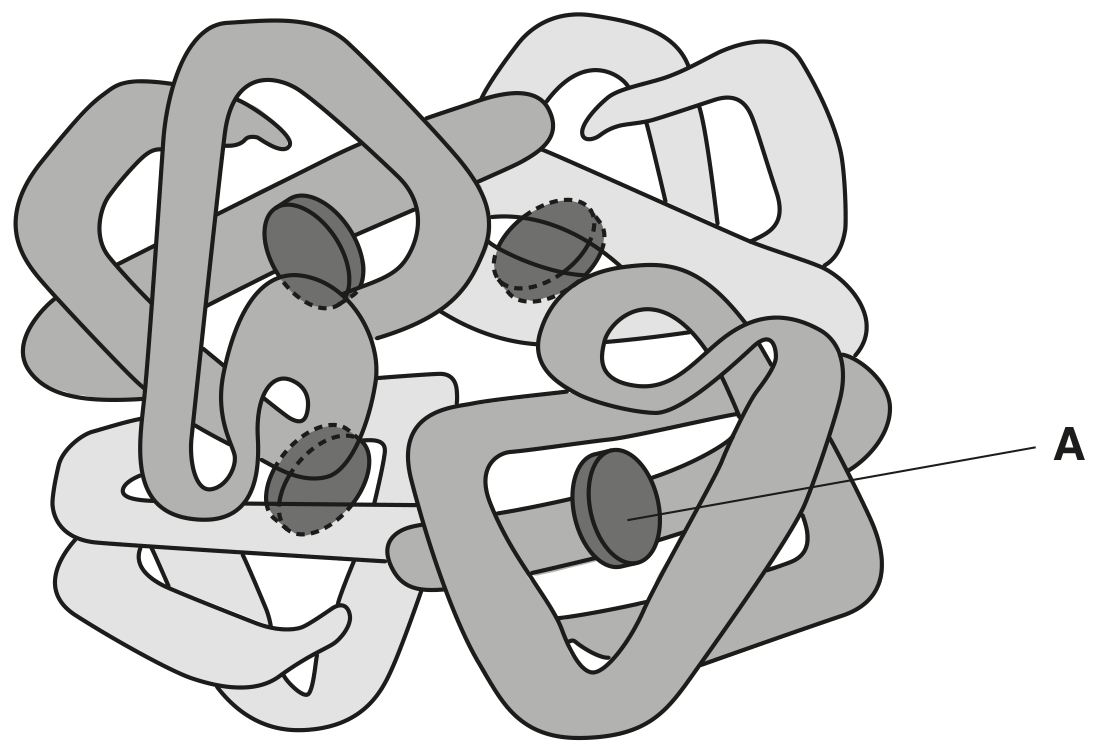
Fig. 1.1
(a)
Haemoglobin is described as a globular protein. Explain why this protein is described as globular.
[ 2 ]
 EduNinja
Fig. 1.1 is a diagram of a molecule of haemoglobin.
Fig. 1.1
Haemoglobin is described as a globular protein. Explain why this protein is described as globular.
Enzymes are globular proteins.
State what is meant by the term globular.
Which feature of haemoglobin makes it a globular protein?
It has four cross-linked polypeptide chains forming a quaternary structure.
It has hydrophobic groups on the inside and hydrophilic groups on the outside.
It has hydrophobic interactions and is insoluble in water.
It has polypeptide chains which are cross-linked to form sheets.
Most plants are C3 plants and are so-called because their first photosynthetic product is a three carbon compound.
The enzyme ribulose bisphosphate carboxylase/oxygenase (rubisco) catalyses the fixation of carbon dioxide in the Calvin cycle and is used by both C3 and C4 plants.
Each molecule is made up of eight large polypeptides and eight small polypeptides. Fig. 2.1 shows a side view of the molecule.
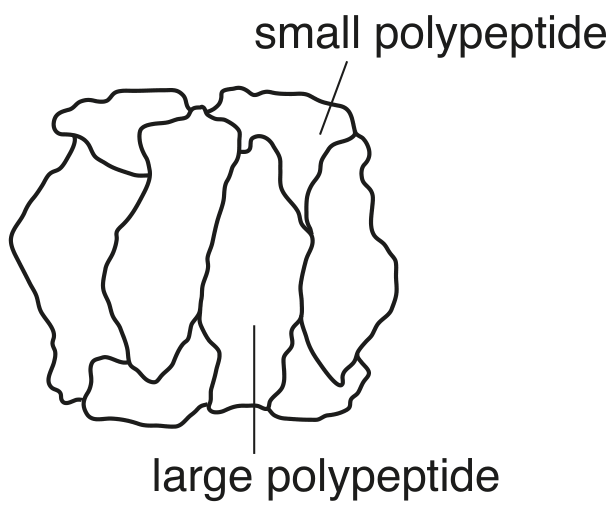
Fig. 2.1
Explain what makes a molecule such as rubisco soluble.
Which comparative statements concerning biological molecules are correct?
1 A collagen molecule is a fibrous protein that contains many amino acids with hydrophobic R-groups whereas a haemoglobin molecule is a globular protein with no amino acids with hydrophobic R-groups.
2 Sucrose hydrolysis results in glycosidic bond breakage and the production of equal proportions of fructose and -glucose molecules, whereas cellulose hydrolysis results in only -glucose molecules.
3 The glycosidic bonds of glycogen have been formed between two -glucose molecules, whereas with amylopectin, the bonds have been formed between an -glucose molecule and a -glucose molecule.
1 and 2
1 and 3
2 only
3 only
Which feature explains why haemoglobin is soluble?
All four polypeptide chains are linked together to form a spherical molecule.
Each polypeptide chain folds due to interactions between hydrophobic R groups.
The hydrophilic R groups are arranged around the outside of the molecule.
The iron-containing haem group of each polypeptide chain is water soluble.
Sugars with a ring structure can also have a linear structure.
Which sugar molecules could be represented by the linear structure shown in the diagram?
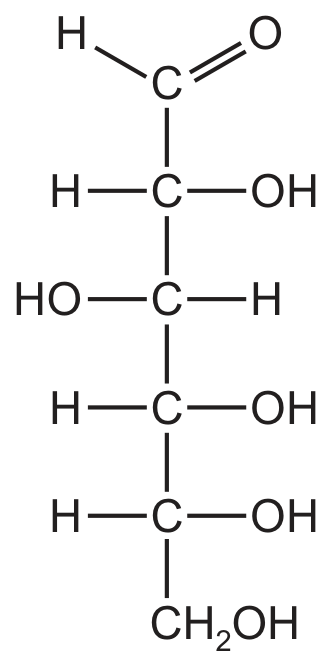
-glucose, deoxyribose and ribose
-glucose only
deoxyribose and ribose only
deoxyribose only
Which row correctly matches the functional and structural features of cellulose, collagen, glycogen or triglyceride?
fibrous
molecules held together by hydrogen bonds
branched chains
support energy source
✓
✓
strengthening support
✓
✓
strengthening storage
✓
✓
✓
storage
✓
✓
key true false
What describes a globular protein that is not soluble in water?
having amino acids with hydrophilic R groups facing out
having amino acids with polar R groups facing out
having a central core of amino acids with hydrophobic R groups
having amino acids with hydrophobic R groups facing out