(a)
Positronium is highly unstable, and after a very short period of time it becomes gamma radiation.
[ 3 ]
(i)
Describe how gamma radiation is formed from the two particles in positronium.
[ 3 ]
 EduNinja
Positronium is highly unstable, and after a very short period of time it becomes gamma radiation.
Describe how gamma radiation is formed from the two particles in positronium.
A nucleus P undergoes -decay to form nucleus Q .
Complete the equation for this decay.
Ions, all of the same isotope, are travelling in a vacuum with a speed of . The ions are incident normally on a uniform magnetic field of flux density 640 mT . The ions follow semicircular paths A and B before reaching a detector, as shown in Fig. 6.1.
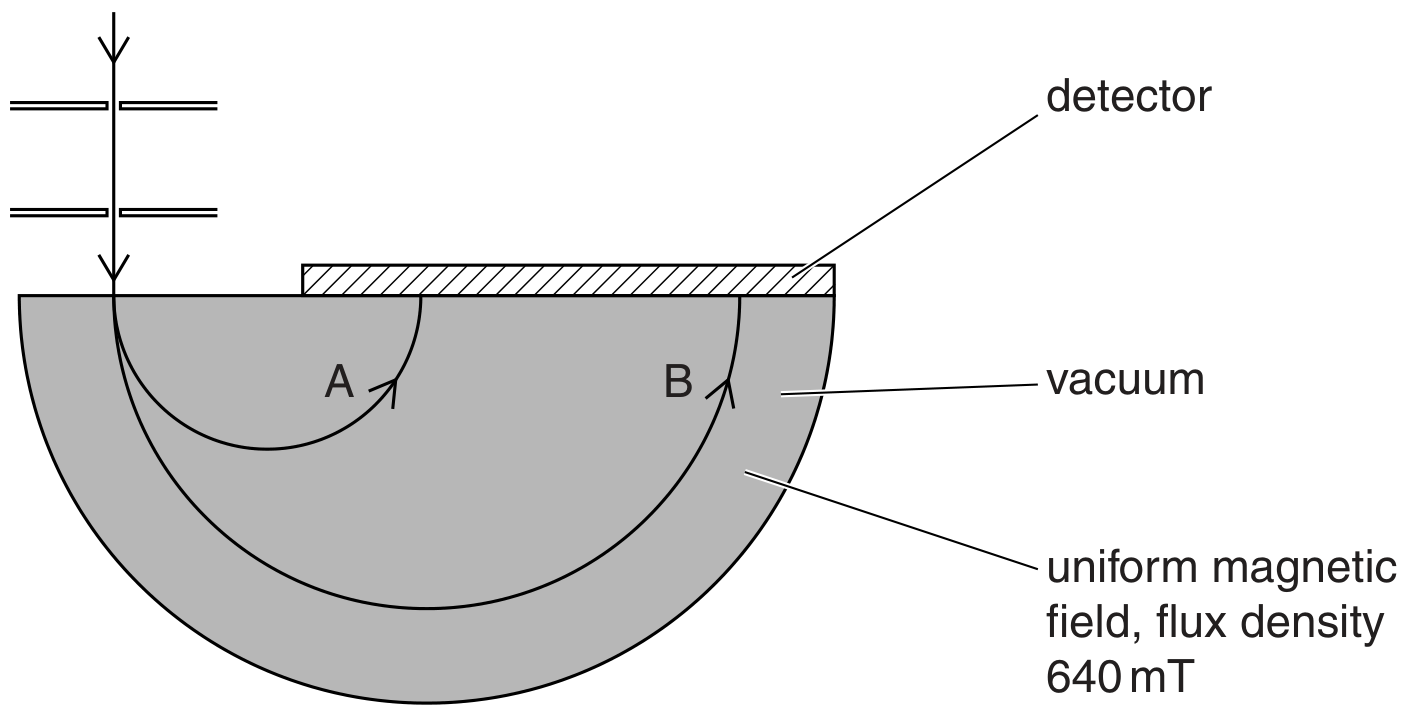
Fig. 6.1
Data for the diameters of the paths are shown in Fig. 6.2.
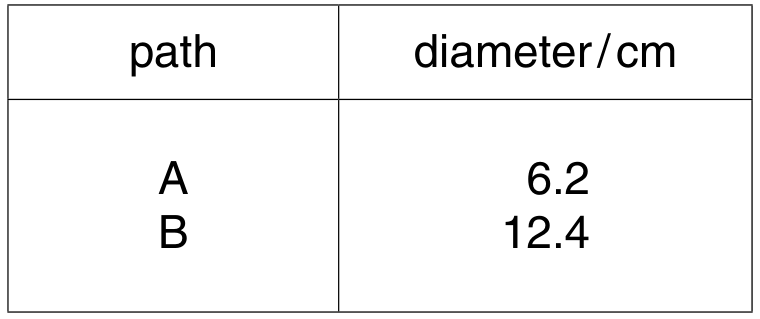
Fig. 6.2
The ions in path B each have charge .
Determine the mass, in u , of the ions in path B .
What could not be used to create an electric current?
alpha-particles
beta-particles
neutrons
protons
State what is meant by quantisation of charge.
The student repeats the experiment and determines the following values for the charge on oil drops.
Use these values to suggest a value for the elementary charge. Explain your working.
elementary charge = ..... C
An atomic nucleus emits a -particle.
What change does this cause to the proton number and the nucleon number of the nucleus?
proton number
nucleon number
-1
+1
0
-1
+1
-1
+1
0
Describe the main principles of the determination of the charge on an oil drop by Millikan's experiment. You may draw a diagram if you wish.
In an experiment to determine the fundamental charge, values of charge on oil drops were found by a student to be as shown below.
State the value, to two significant figures, of the fundamental charge that is suggested by these values of charge on oil drops.
Describe the two main results of the -particle scattering experiment.
result 1 :
result 2:
Relate each of the results in (a) with the conclusions that were made about the nature of atoms.
result 1:
result 2:
One of the isotopes of uranium is uranium-238 .
State what is meant by isotopes.
For a nucleus of uranium-238, state
the number of protons,
number =
the number of neutrons.
number =
A uranium-238 nucleus has a radius of .
Calculate, for a uranium-238 nucleus,
its mass,
mass = kg
The density of a lump of uranium is . Using your answer to (c)(ii), suggest what can be inferred about the structure of the atom.
Nuclei of an isotope of copper ( Cu ) each have 29 protons and 37 neutrons. This isotope is a emitter.
State the nuclide notation in the form for this nucleus of copper.
The energy spectrum of the radiation emitted by a sample of this isotope is shown in Fig. 7.1.
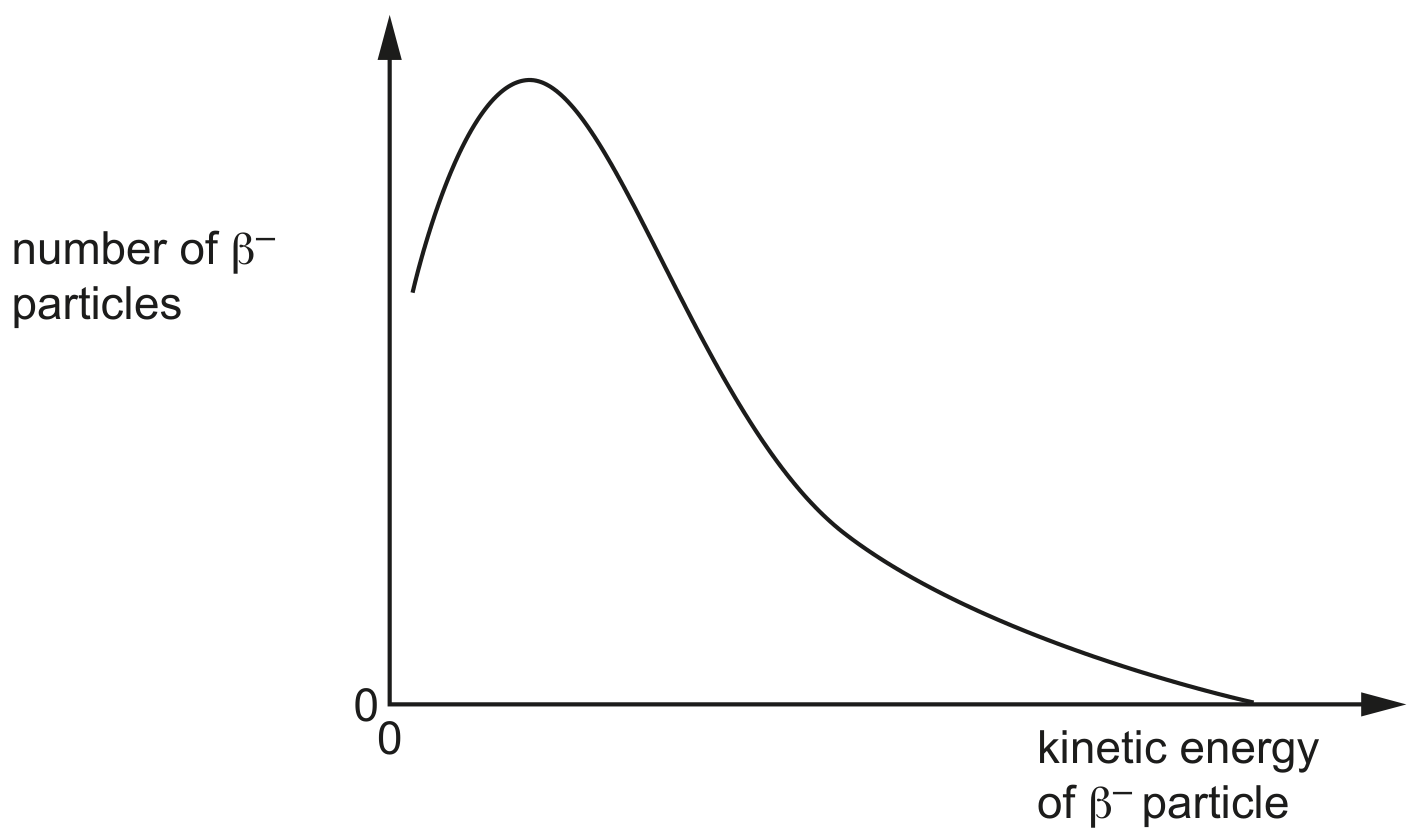
Fig. 7.1
Use Fig. 7.1 to explain why other particles apart from the particles must be emitted during this decay.
State the name of the other particle emitted during the decay of this isotope.
The copper isotope decays to an isotope of zinc (Zn).
Give the radioactive decay equation for this decay. Include the nucleon and proton numbers of all the particles involved.