EduNinja
[Maximum number: 3]

An isolated spherical planet has a diameter of 6.8×10⁶ m6.8 \times 10^{6} \mathrm{~m}. Its mass of 6.4×10²³ kg6.4 \times 10^{23} \mathrm{~kg} may be assumed to be a point mass at the centre of the planet.

(a)

A stone of mass 2.4 kg is raised from the surface of the planet through a vertical height of 1800 m .
Use the value of field strength given in (a) to determine the change in gravitational potential energy of the stone.
Explain your working.

change in energy =

J

[ 3 ]
[Maximum number: 3]

An isolated spherical planet has a diameter of 6.8×10⁶ m6.8 \times 10^{6} \mathrm{~m}. Its mass of 6.4×10²³ kg6.4 \times 10^{23} \mathrm{~kg} may be assumed to be a point mass at the centre of the planet.

(a)

A stone of mass 2.4 kg is raised from the surface of the planet through a vertical height of 1800 m .
Use the value of field strength given in (a) to determine the change in gravitational potential energy of the stone.
Explain your working.

change in energy =

J

[ 3 ]
[Maximum number: 1]

A train of mass 600000 kg moves with a speed of 100 km h1100 \mathrm{~km} \mathrm{~h}^{-1}.
What is the order of magnitude of the kinetic energy of the train?

A

106 J10^{6} \mathrm{~J}

B

108 J10^{8} \mathrm{~J}

C

1010 J10^{10} \mathrm{~J}

D

1012 J10^{12} \mathrm{~J}

[Maximum number: 1]

An Olympic athlete of mass 80 kg competes in a 100 m race.
What is the best estimate of his mean kinetic energy during the race?

A

4×10² J4 \times 10^{2} \mathrm{~J}

B

4×10³ J4 \times 10^{3} \mathrm{~J}

C

4×10⁴ J4 \times 10^{4} \mathrm{~J}

D

4×10⁵ J4 \times 10^{5} \mathrm{~J}

(a)
(i)

The maximum gravitational potential energy of the ball above the ground is 22 J .

Calculate the mass of the ball.
mass = kg

[ 2 ]
(a)

A force F acts on a mass m along a straight line for a distance s. The acceleration of the mass is a and the speed changes from an initial speed u to a final speed v.

[ 3 ]
(i)

Use your answer in (i) and an equation of motion to show that kinetic energy of a mass can be given by the expression

 kinetic energy =1/2× mass ×( speed )2.\text { kinetic energy }=1 / 2 \times \text { mass } \times(\text { speed })^{2} .
[ 3 ]
[Maximum number: 1]

An Olympic athlete of mass 80 kg competes in a 100 m race.
What is the best estimate of his mean kinetic energy during the race?

A

4×10² J4 \times 10^{2} \mathrm{~J}

B

4×10³ J4 \times 10^{3} \mathrm{~J}

C

4×10⁴ J4 \times 10^{4} \mathrm{~J}

D

4×10⁵ J4 \times 10^{5} \mathrm{~J}

(a)

The ball has a mass of 0.050 kg . It moves from A and reaches B after rebounding.

[ 2 ]
(i)

For this motion, calculate the change in
1. kinetic energy,
change in kinetic energy = J [2]
2. gravitational potential energy.
change in potential energy = J

[ 2 ]
[Maximum number: 3]

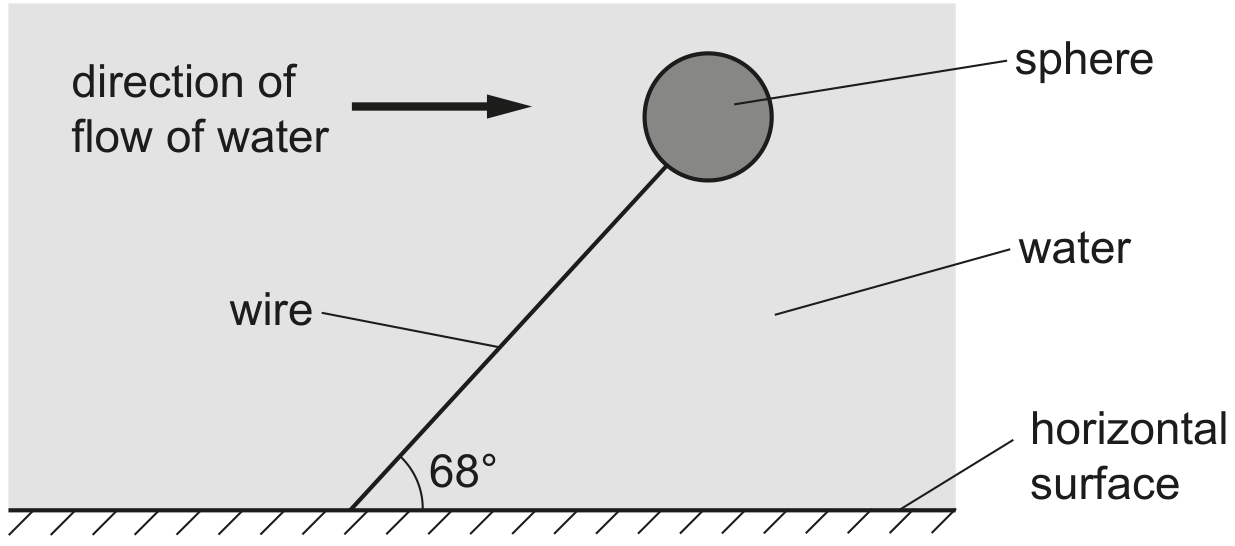
A sphere is attached by a metal wire to the horizontal surface at the bottom of a river, as shown in Fig. 2.1.

Fig. 2.1 (not to scale)

Fig. 2.1 (not to scale)

The sphere is fully submerged and in equilibrium, with the wire at an angle of 6868^{\circ} to the horizontal surface. The weight of the sphere is 32 N . The upthrust acting on the sphere is 280 N . The density of the water is 1.0×10³ kg m31.0 \times 10^{3} \mathrm{~kg} \mathrm{~m}^{-3}.

Assume that the force on the sphere due to the water flow is in a horizontal direction.

(a)

The centre of the sphere is initially at a height of 6.2 m above the horizontal surface. The speed of the water then increases, causing the sphere to move to a different position. This movement of the sphere causes its gravitational potential energy to decrease by 77 J .

Calculate the final height of the centre of the sphere above the horizontal surface.
height = m

[ 3 ]
[Maximum number: 2]

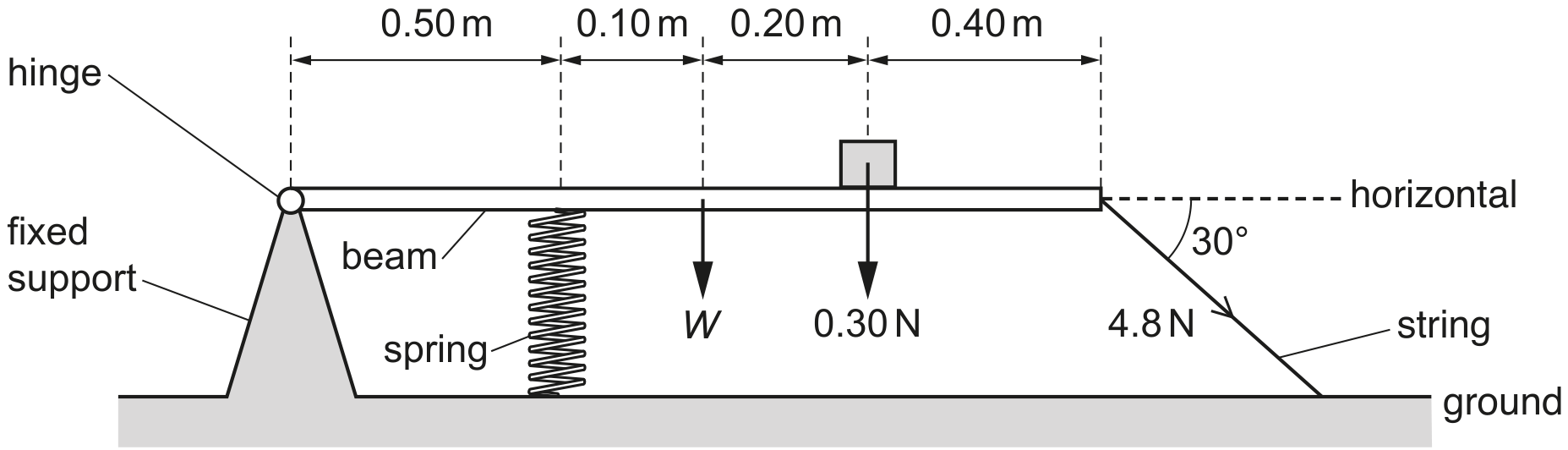
A rigid uniform beam of weight W is connected to a fixed support by a hinge, as shown in Fig. 2.1.

Fig. 2.1 (not to scale)

Fig. 2.1 (not to scale)

A compressed spring exerts a total force of 8.2 N vertically upwards on the horizontal beam. A block of weight 0.30 N rests on the beam. The right-hand end of the beam is connected to the ground by a string at an angle of 3030^{\circ} to the horizontal. The tension in the string is 4.8 N . The distances along the beam are shown in Fig. 2.1.

The beam is in equilibrium. Assume that the hinge is frictionless.

(a)

The string is cut so that the spring extends upwards. This causes the beam to rotate and launch the block into the air. The block reaches its maximum height and then falls back to the ground.

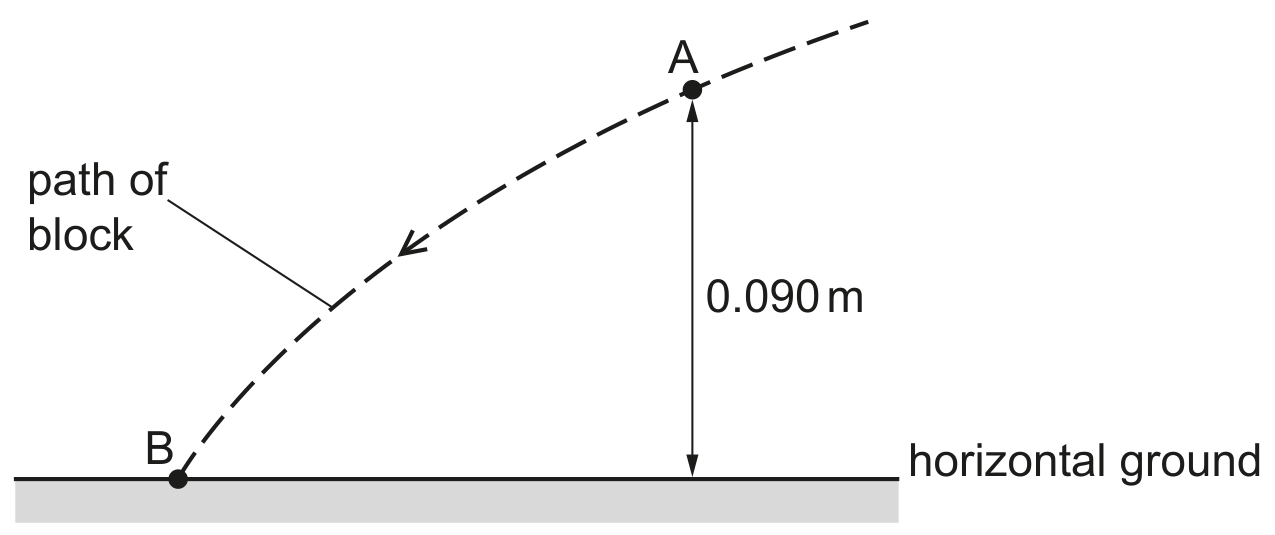
Fig. 2.2 shows part of the path of the block in the air shortly before it hits the horizontal ground.

Fig. 2.2 (not to scale)

Fig. 2.2 (not to scale)

The block is at a height of 0.090 m above the ground when it passes through point A . The block has a kinetic energy of 0.044 J when it hits the ground at point B .
Air resistance is negligible.

[ 2 ]
(i)

Calculate the decrease in the gravitational potential energy of the block for its movement from A to B .
decrease in gravitational potential energy = J

[ 2 ]
0