EduNinja
[Maximum number: 8]

A sphere of radius 2.1 mm falls with terminal (constant) velocity through a liquid, as shown in Fig. 1.1.
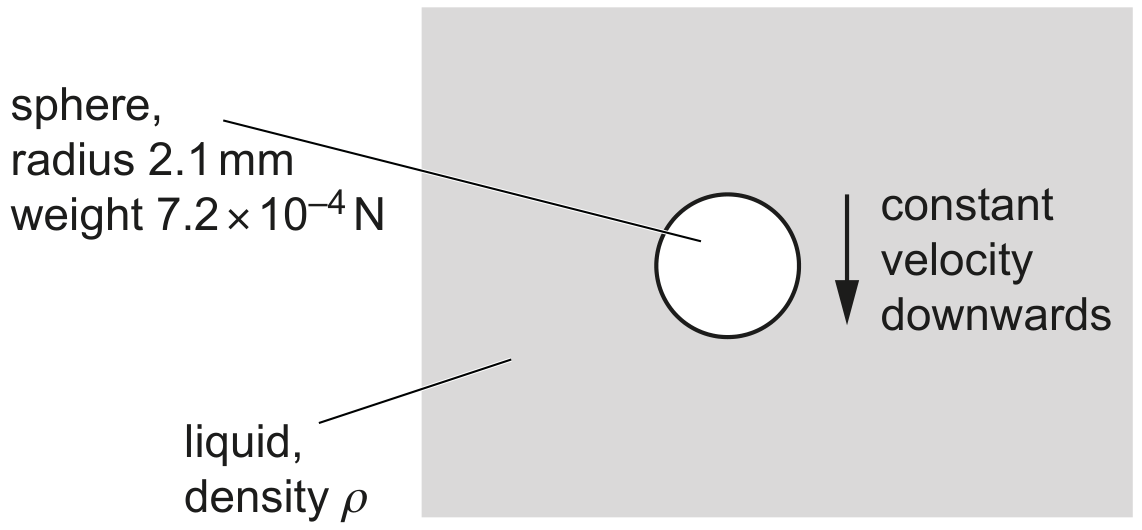
Fig. 1.1

Fig. 1.1

Three forces act on the moving sphere. The weight of the sphere is 7.2×10⁴ N7.2 \times 10^{-4} \mathrm{~N} and the upthrust acting on it is 4.8×10⁴ N4.8 \times 10^{-4} \mathrm{~N}. The viscous force FVF_{\mathrm{V}} acting on the sphere is given by

FV=krvF_{\mathrm{V}}=k r v

where r is the radius of the sphere, v is its velocity and k is a constant. The value of k in SI units is 17 .

(a)
(i)

Determine the magnitude of the terminal (constant) velocity of the sphere.

[ 8 ]
(a)

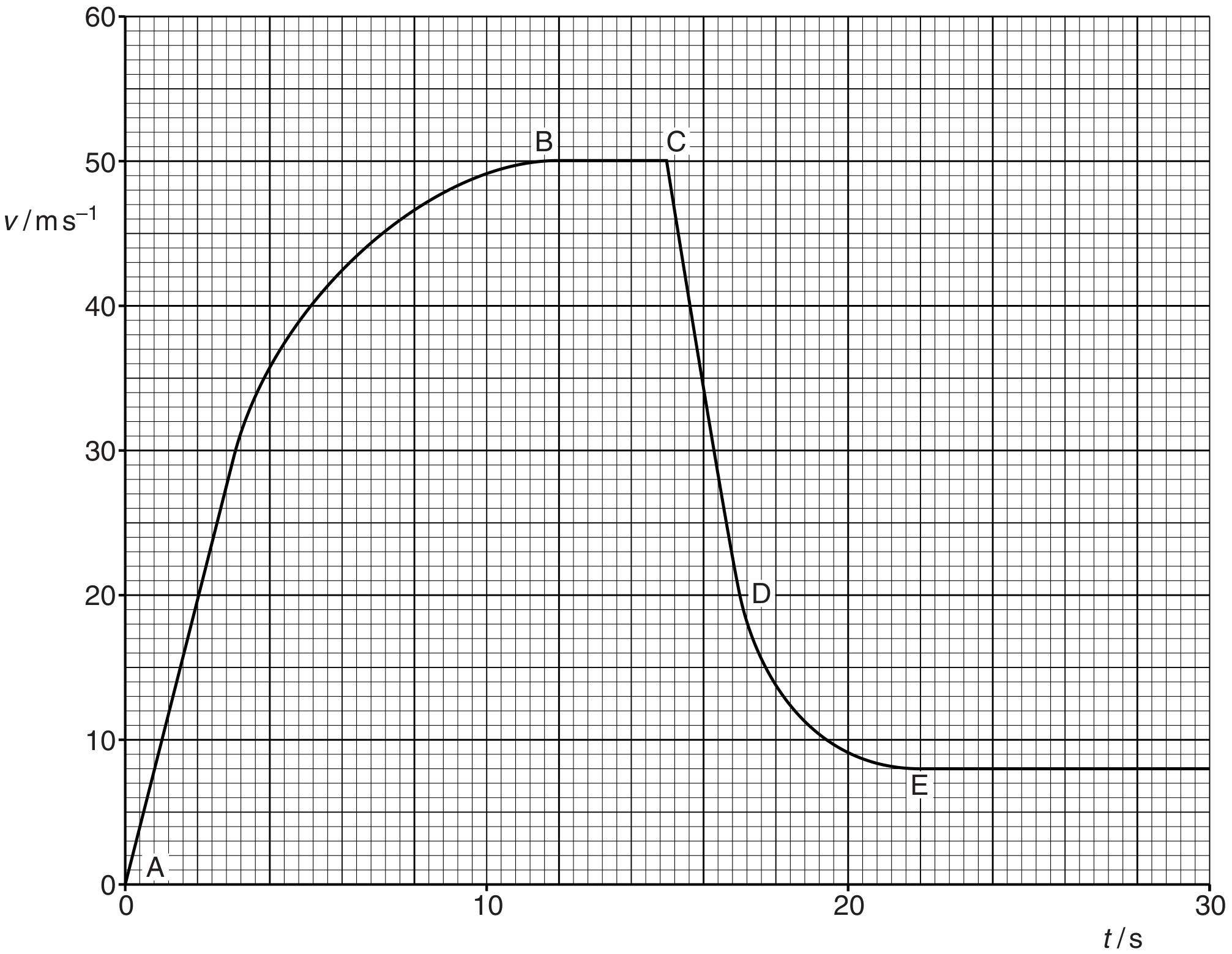
The variation with time t of vertical speed v of a parachutist falling from an aircraft is shown in Fig. 1.1.

Fig. 1.1

Fig. 1.1

[ 4 ]
(i)

Explain the variation of the resultant force acting on the parachutist from t=0 (point A) to t=15 st=15 \mathrm{~s} (point C).

[ 3 ]
(ii)

Describe the changes to the frictional force on the parachutist
1. at t=15 st=15 \mathrm{~s} (point C ),
2. between t=15 st=15 \mathrm{~s} (point C ) and t=22 st=22 \mathrm{~s} (point E).

[ 1 ]
(a)

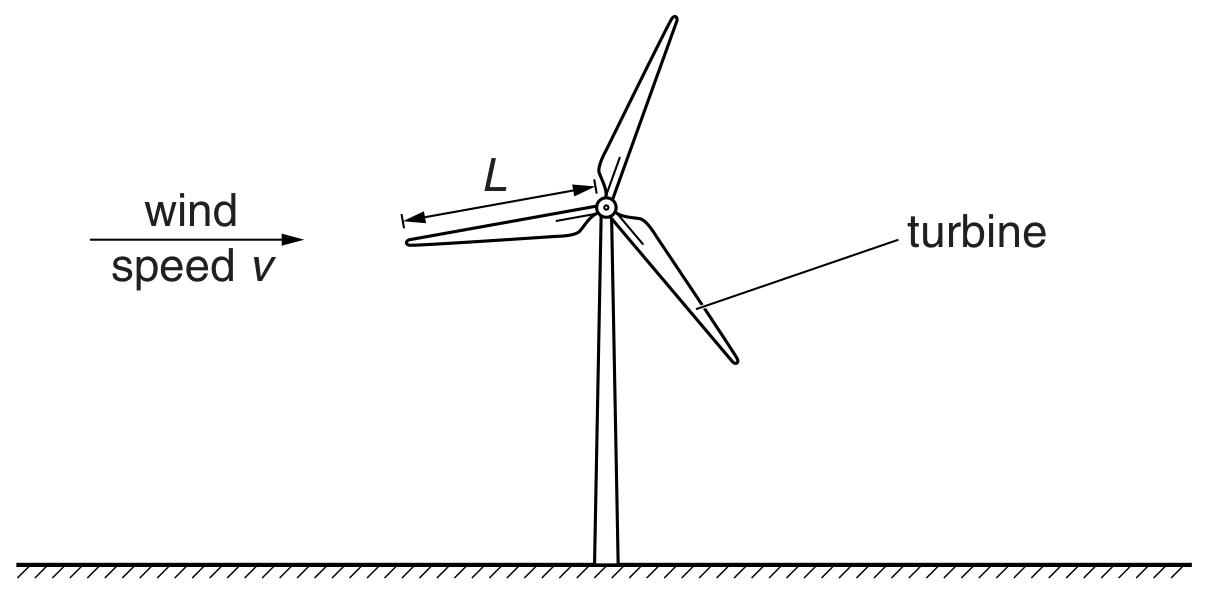
Fig. 1.1 shows a turbine that is used to generate electrical power from the wind.

Fig. 1.1

Fig. 1.1

The power P available from the wind is given by

P=CL2ρv3P=C L^{2} \rho v^{3}

where L is the length of each blade of the turbine, ρ\rho is the density of air, v is the wind speed, C is a constant.

[ 2 ]
(i)

Suggest two reasons why the electrical power output of the turbine is less than the power available from the wind.

1

[ 2 ]
(a)

In practice, the planet in (b) does have an atmosphere that causes a viscous force to act on the moving rock.

State and explain the variation, if any, in the resultant force acting on the rock as it moves vertically upwards.

[ 2 ]
[Maximum number: 1]

A football is kicked so that it moves vertically upwards through the air.
What is the variation in the air resistance and the resultant force acting on the ball as it moves vertically upwards?

air resistance

resultant force

decreases

decreases

decreases

increases

increases

decreases

increases

increases

[Maximum number: 3]

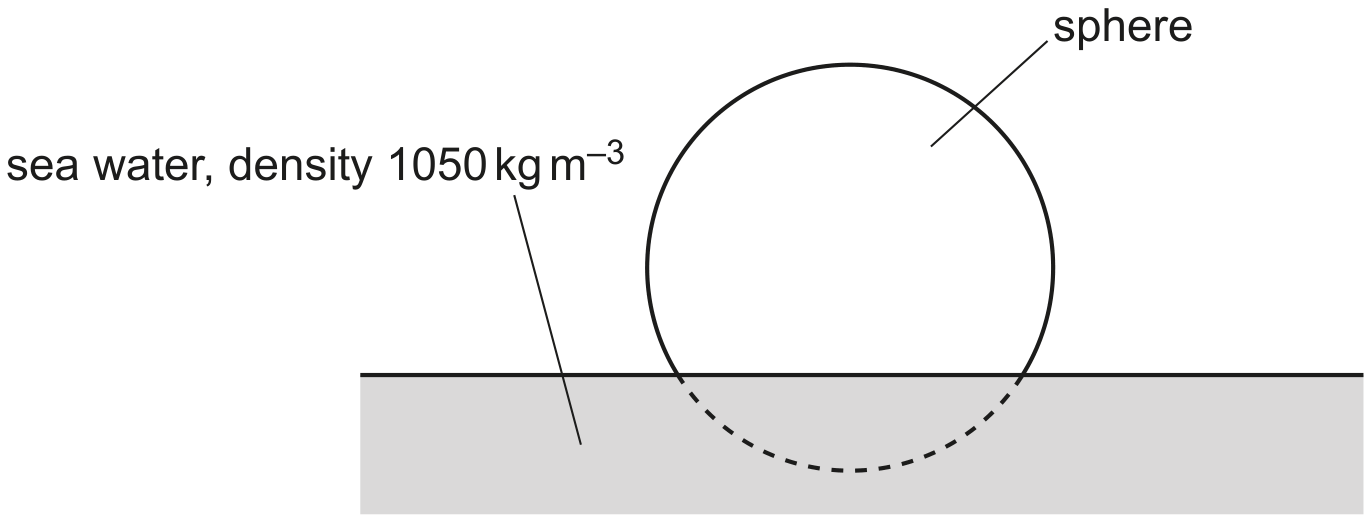
A sphere floats in equilibrium on the surface of sea water of density 1050 kg m31050 \mathrm{~kg} \mathrm{~m}^{-3}, as shown in Fig. 2.1.

Fig. 2.1

Fig. 2.1

(a)

The sphere is now held so that its entire volume is below the surface of the water. The sphere is then released.

[ 3 ]
(i)

The sphere accelerates upwards but remains entirely below the surface of the water. State and explain what happens to the acceleration of the sphere as its velocity begins to increase.

[ 3 ]
(a)

The diver in (b) enters the water and decelerates.

[ 2 ]
(i)

Describe and explain the variation of the viscous drag force acting on the diver in the water as he moves downwards.

[ 2 ]
[Maximum number: 2]

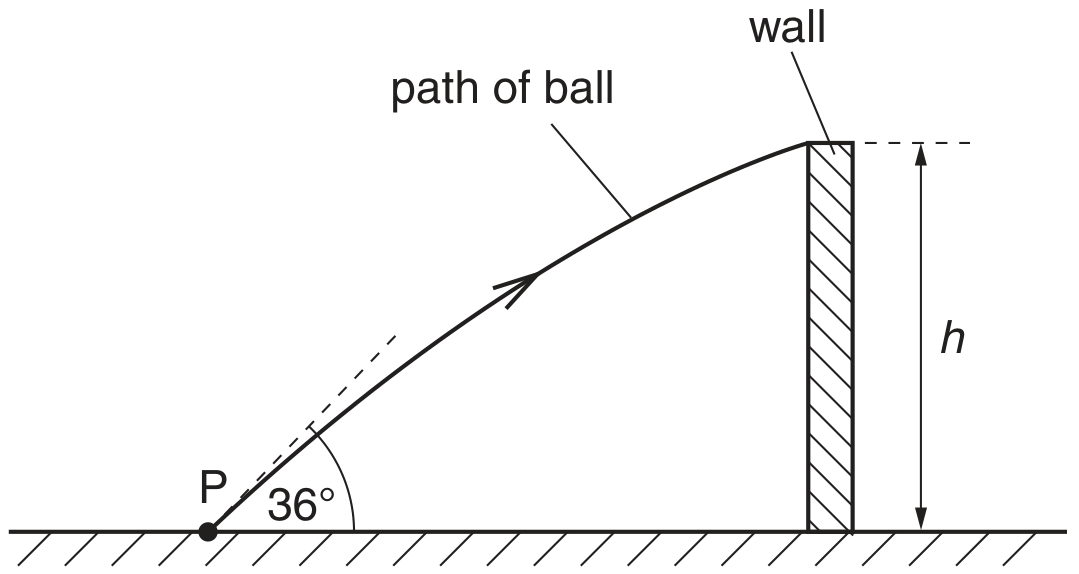
A ball is thrown from a point P , which is at ground level, as illustrated in Fig. 2.1.

Fig. 2.1

Fig. 2.1

The initial velocity of the ball is 12.4 m s112.4 \mathrm{~m} \mathrm{~s}^{-1} at an angle of 3636^{\circ} to the horizontal.
The ball just passes over a wall of height h. The ball reaches the wall 0.17 s after it has been thrown.

(a)

A second ball is thrown from point P with the same velocity as the ball in (a). For this ball, air resistance is not negligible.
This ball hits the wall and rebounds.
On Fig. 2.1, sketch the path of this ball between point P and the point where it first hits the ground.

[ 2 ]
(a)

The student in (b) takes a second photograph starting at the same position on the scale. The ball has the same radius but is less dense, so that air resistance is not negligible.

State and explain the changes that will occur in the photograph.

[ 2 ]
[Maximum number: 2]

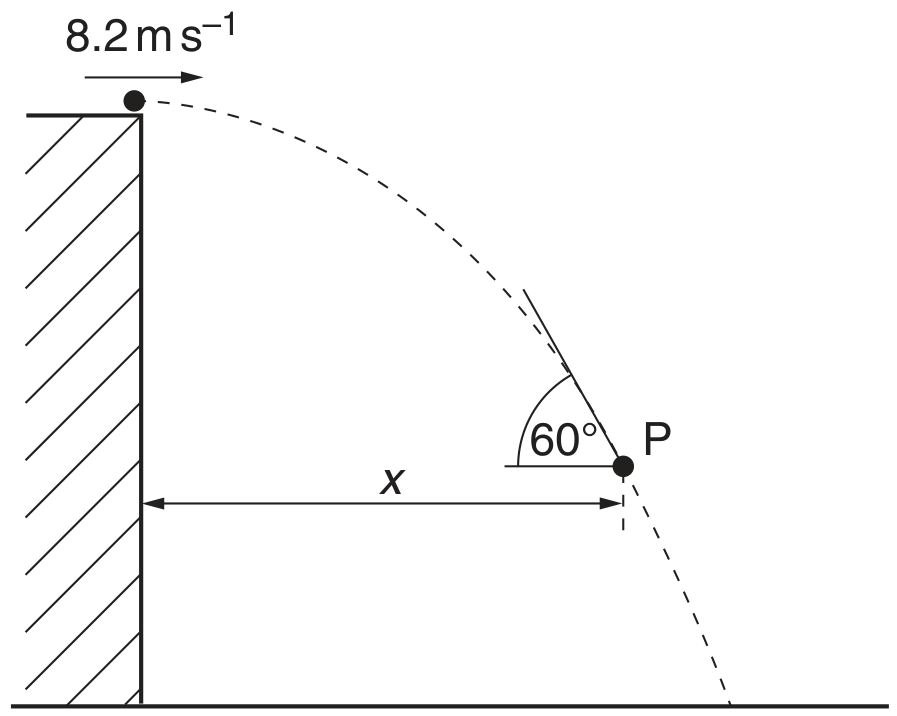
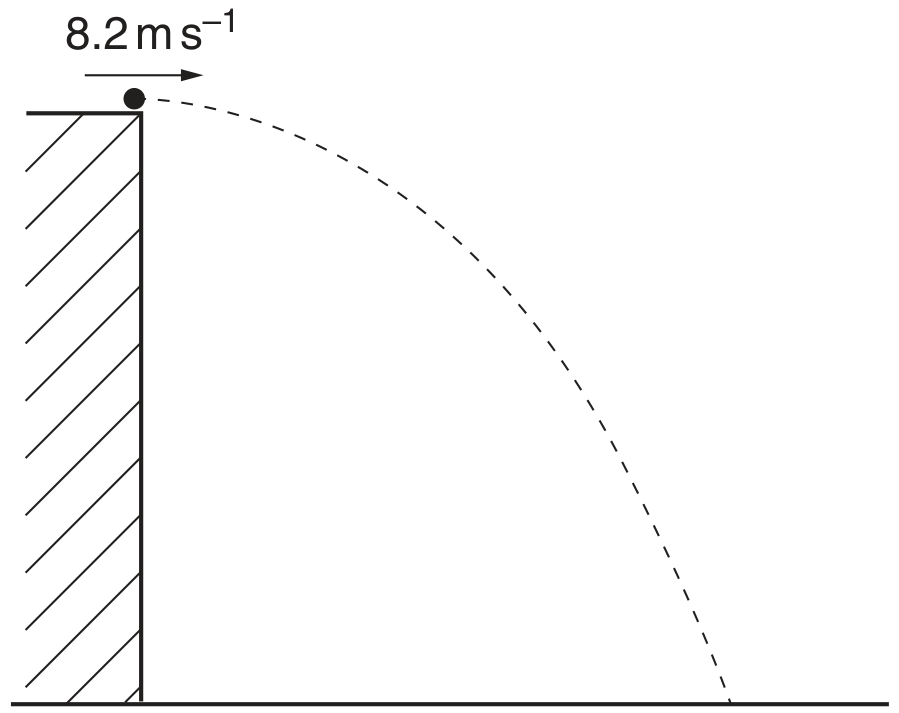
A ball is thrown horizontally from the top of a building, as shown in Fig. 2.1.

Fig. 2.1

Fig. 2.1

The ball is thrown with a horizontal speed of 8.2 ms18.2 \mathrm{~ms}^{-1}. The side of the building is vertical. At point P on the path of the ball, the ball is distance x from the building and is moving at an angle of 6060^{\circ} to the horizontal. Air resistance is negligible.

(a)

The path of the ball in (a), with an initial horizontal speed of 8.2 m s18.2 \mathrm{~m} \mathrm{~s}^{-1}, is shown again in Fig. 2.2.

Fig. 2.2

Fig. 2.2

On Fig. 2.2, sketch the new path of the ball for the ball having an initial horizontal speed

[ 2 ]
(i)

equal to 8.2 m s18.2 \mathrm{~m} \mathrm{~s}^{-1} but with air resistance (label this path A ).

[ 2 ]
0