A light meter is used to measure the intensity of light in a classroom. Daylight is incident normally on the sensor of the meter. The sensor has an area of . The reading on the meter is .
Calculate the power of the daylight incident on the sensor.
State what is meant by work done.
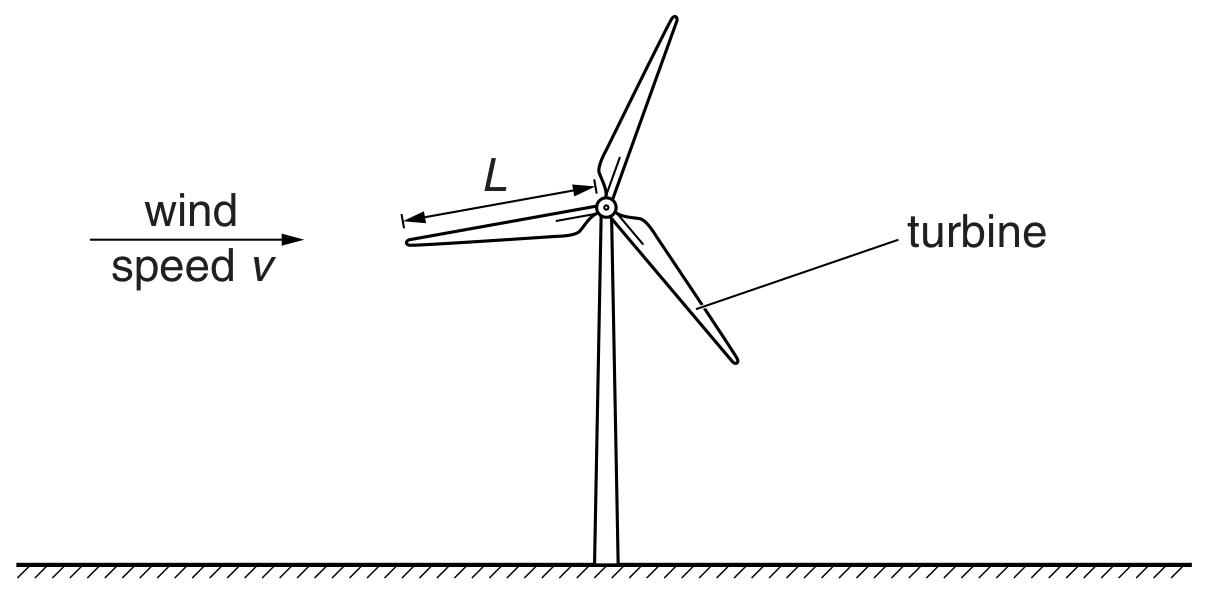
Fig. 1.1 shows a turbine that is used to generate electrical power from the wind.

Fig. 1.1
The power P available from the wind is given by
where L is the length of each blade of the turbine, ρ is the density of air, v is the wind speed, C is a constant.
The length L of each blade of the turbine is 25.0 m and the density ρ of air is 1.30 in SI units. The constant C is 0.931 .
The efficiency of the turbine is 55 % and the electric power output P is 3.50×10⁵ W.
Calculate the wind speed.
wind speed = ms−1
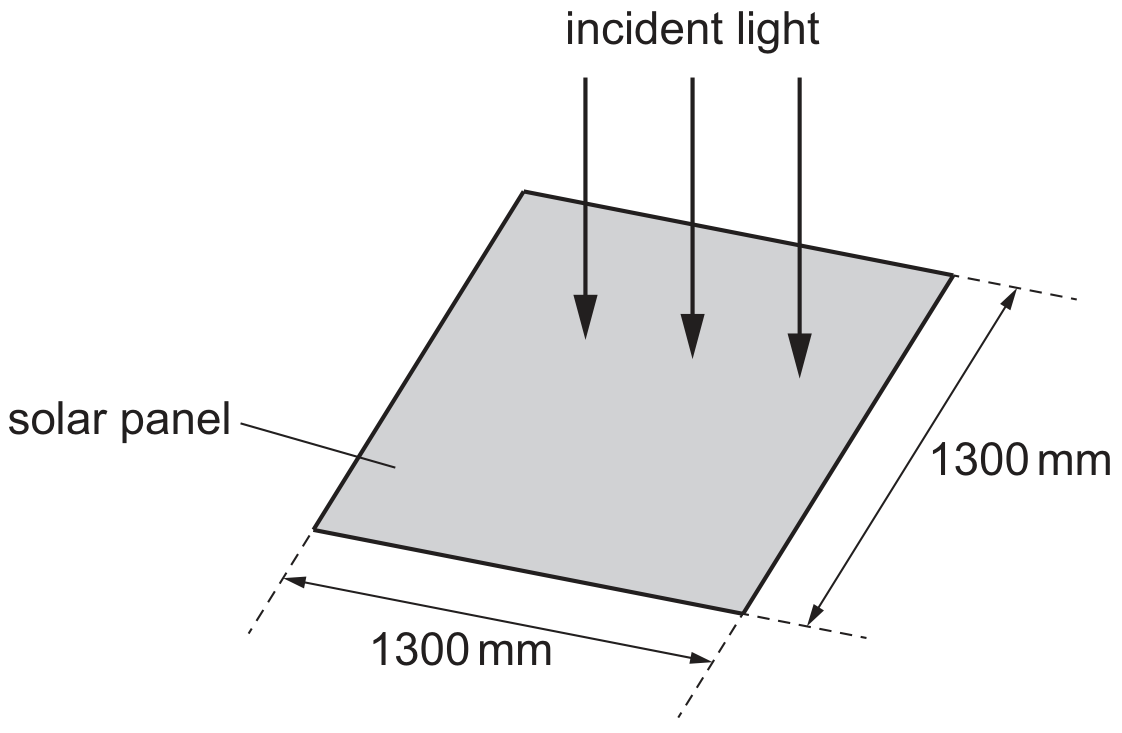
A square solar panel with sides of length 1300 mm is shown in Fig. 1.1.

Fig. 1.1 (not to scale)
Light is incident normally on the solar panel.
The useful power output of the solar panel is 160 W .
Calculate the percentage efficiency of the solar panel.
Another square solar panel is placed so that light of the same intensity is incident normally on it. The new panel has shorter sides than the original panel. The new panel has the same power output as the original panel.
State and explain whether the efficiency of the new panel is greater than, less than or the same as the efficiency of the original panel.
Define power.
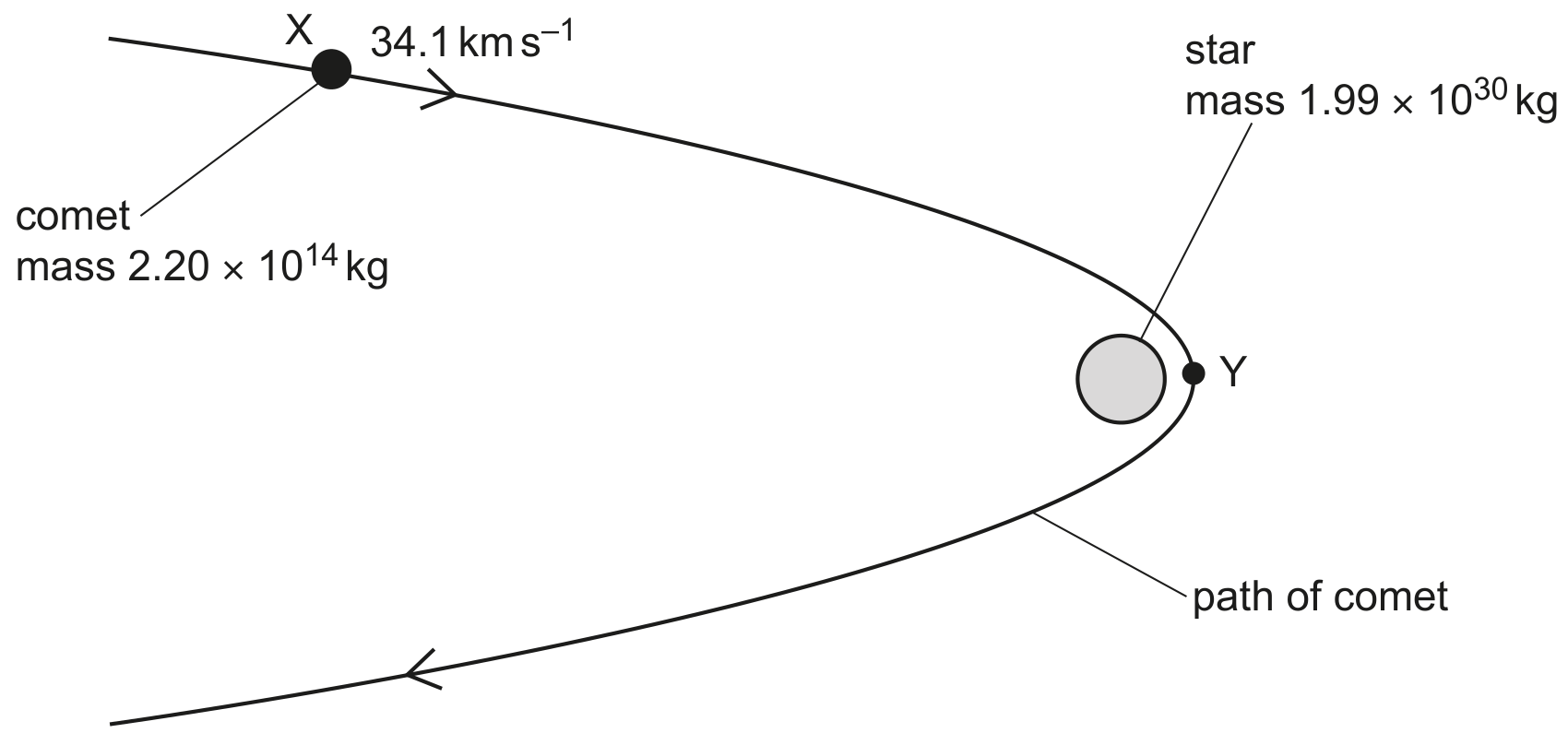
Fig. 1.1 shows the path of a comet of mass 2.20×10¹⁴ kg as it passes around a star of mass 1.99×1030 kg.

Fig. 1.1 (not to scale)
At point X , the comet is 8.44×10¹¹ m from the centre of the star and is moving at a speed of 34.1 km s−1.
At point Y , the comet passes its point of closest approach to the star. At this point, the comet is a distance of 6.38×10¹⁰ m from the centre of the star.
Both the comet and the star can be considered as point masses at their centres.
Use your answer in (b)(i) to determine the speed, in kms−1, of the comet at point Y .
speed = kms−1
A 1.5 V cell supplies 0.20 A to a lamp for seven hours before the lamp goes out. What is a sensible estimate for the initial chemical energy content of the cell?
1×10² J
1×10⁴ J
1×10⁶ J
1×10⁸ J
An ion is accelerated by a series of electrodes in a vacuum. A graph of the power supplied to the ion is plotted against time.
What is represented by the area under the graph between two times?
the change in kinetic energy of the ion
the average force on the ion
the change in momentum of the ion
the change in velocity of the ion
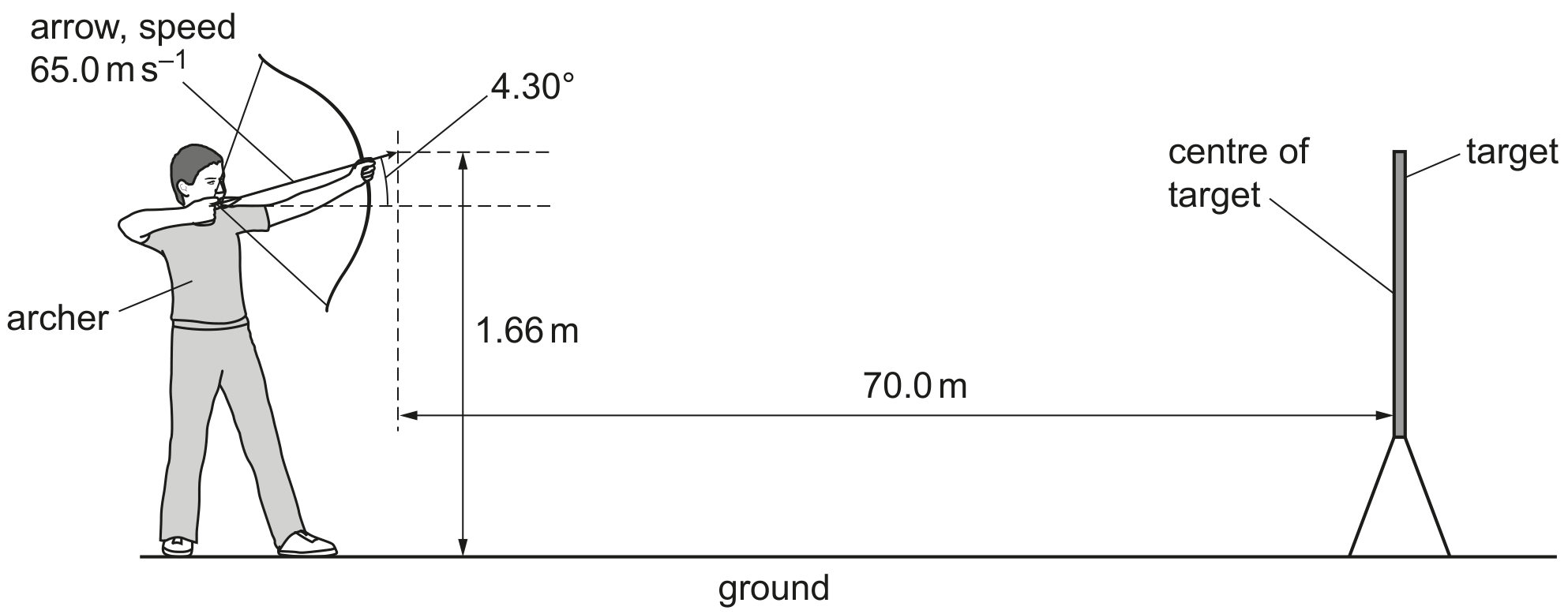
An archer releases an arrow towards a target at a velocity of 65.0 ms−1 at an angle of 4.30∘ above the horizontal, as shown in Fig. 2.1.

Fig. 2.1 (not to scale)
When released, the tip of the arrow is a horizontal distance of 70.0 m from the target and 1.66 m above the horizontal ground.
The arrow hits the centre of the target.
Assume that air resistance is negligible and that all the mass of the arrow is at its tip.
By considering energy changes, state and explain how the final kinetic energy of the arrow as it hits the target compares with its initial kinetic energy immediately after release. A numerical calculation is not required.
Define
work done.
A force F acts on a mass m along a straight line for a distance s. The acceleration of the mass is a and the speed changes from an initial speed u to a final speed v.
State the work W done by F.
A resultant force of 3800 N causes a car of mass of 1500 kg to accelerate from an initial speed of 15 ms−1 to a final speed of 30 ms−1.
The same force is used to change the speed of the car from 30 ms−1 to 45 ms−1. Explain why the distance moved is not the same as that calculated in (i).