EduNinja
[Maximum number: 5]

A battery of electromotive force 12 V and negligible internal resistance is connected to two resistors and a light-dependent resistor (LDR), as shown in Fig. 4.1.
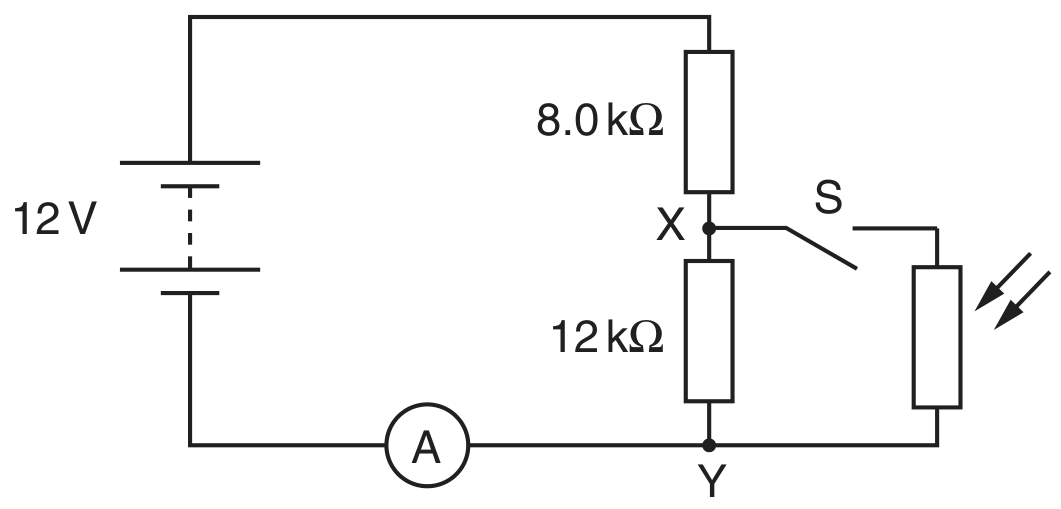
Fig. 4.1

Fig. 4.1

An ammeter is connected in series with the battery. The LDR and switch S are connected across the points XY .

(a)

The switch S is closed. The resistance of the LDR is 4.0kΩ4.0 \mathrm{k} \Omega. Calculate the current in the ammeter.
current =
A

[ 3 ]
(b)

The switch S remains closed. The intensity of the light on the LDR is increased. State and explain the change to

[ 2 ]
(i)

the ammeter reading,

[ 2 ]
[Maximum number: 1]

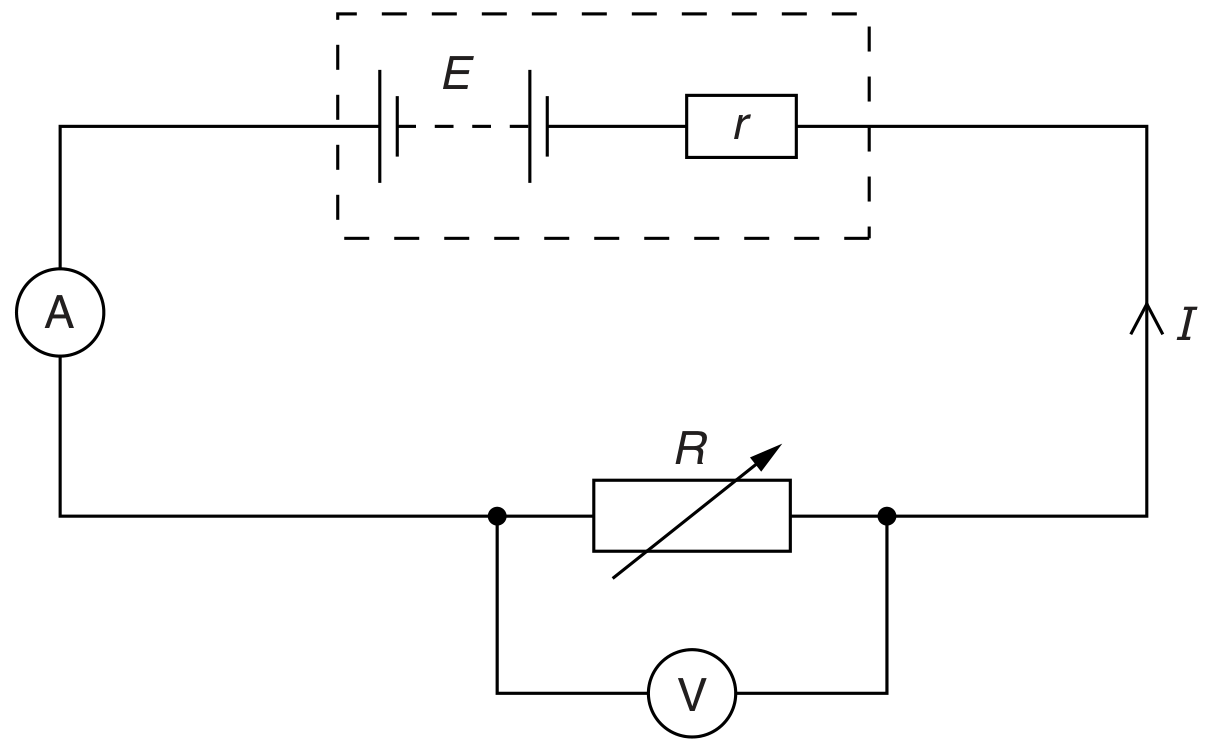
A circuit used to measure the power transfer from a battery is shown in Fig. 4.1. The power is transferred to a variable resistor of resistance R.

Fig. 4.1

Fig. 4.1

The battery has an electromotive force (e.m.f.) E and an internal resistance r. There is a potential difference (p.d.) V across R. The current in the circuit is I.

(a)

Using Kirchhoff's second law, determine an expression for the current I in the circuit.

[ 1 ]
(a)

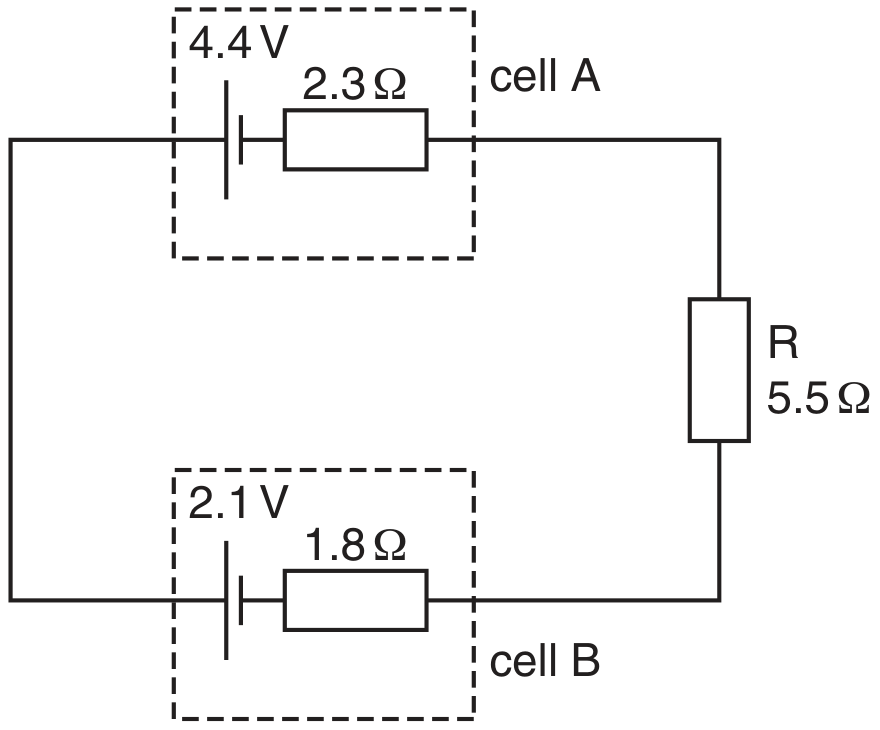
Two cells A and B are connected in series with a resistor R of resistance 5.5Ω5.5 \Omega, as shown in Fig. 4.1.

Fig. 4.1

Fig. 4.1

Cell A has e.m.f. 4.4 V and internal resistance 2.3Ω2.3 \Omega. Cell B has e.m.f. 2.1 V and internal resistance 1.8Ω1.8 \Omega.

[ 3 ]
(i)

State Kirchhoff's second law.

[ 1 ]
(ii)

Calculate the current in the circuit.
current = A

[ 2 ]
(a)

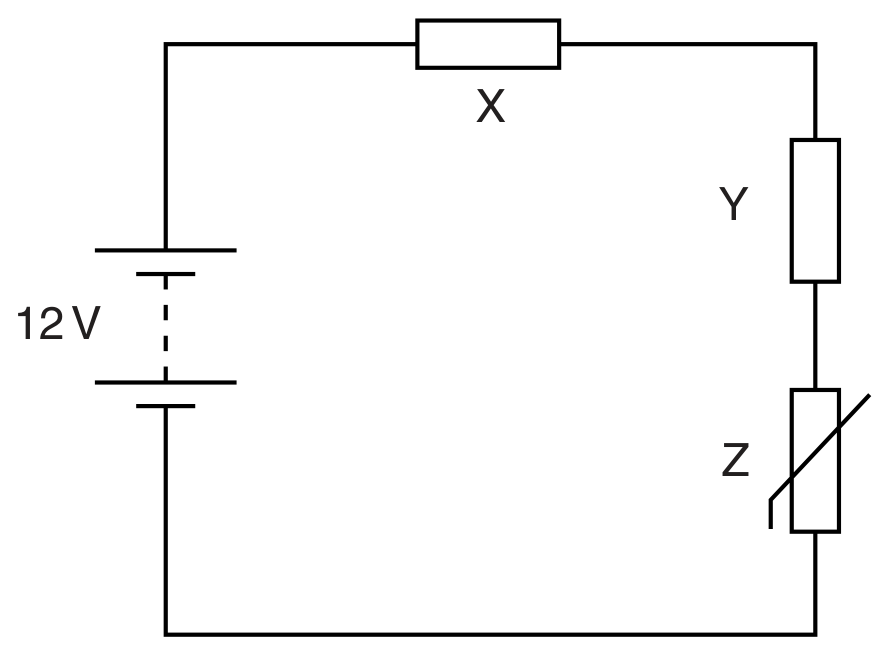
A potential divider circuit is shown in Fig. 5.2.

Fig. 5.2

Fig. 5.2

The battery of electromotive force (e.m.f.) 12 V and negligible internal resistance is connected in series with resistors X and Y and thermistor Z. The resistance of Y is 15kΩ15 \mathrm{k} \Omega and the resistance of Z at a particular temperature is 3.0kΩ3.0 \mathrm{k} \Omega. The potential difference (p.d.) across Y is 8.0 V .

[ 2 ]
(i)

Calculate the current in the circuit.

[ 2 ]
(a)
(i)

State Kirchhoff's first law.

(ii)

Kirchhoff's first law is linked to the conservation of a certain quantity. State this quantity.

[ 1 ]
(b)

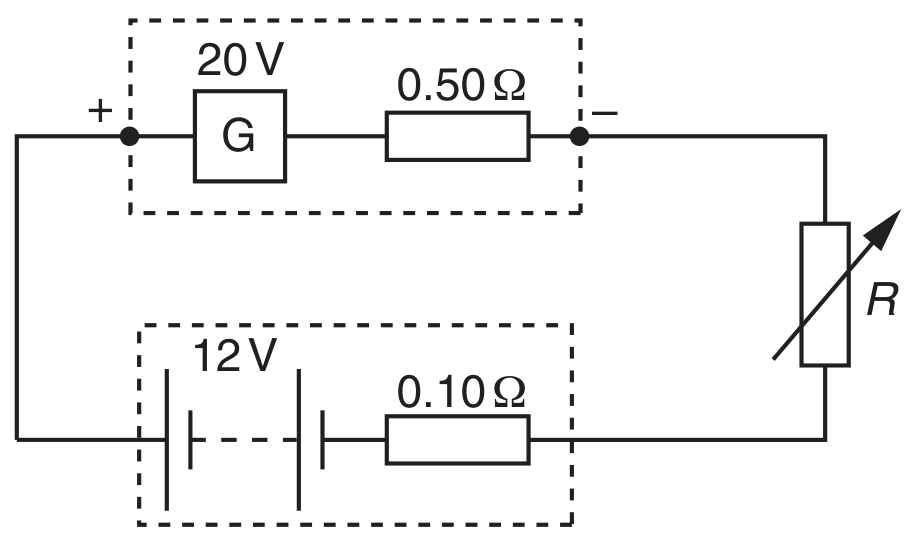
A variable resistor of resistance R is used to control the current in a circuit, as shown in Fig. 5.1.

Fig. 5.1

Fig. 5.1

The generator G has e.m.f. 20 V and internal resistance 0.50Ω0.50 \Omega. The battery has e.m.f. 12 V and internal resistance 0.10Ω0.10 \Omega. The current in the circuit is 2.0 A .

[ 2 ]
(i)

Apply Kirchhoff's second law to the circuit to determine the resistance R.
R= Ω[2]\Omega[2]

[ 2 ]
[Maximum number: 5]

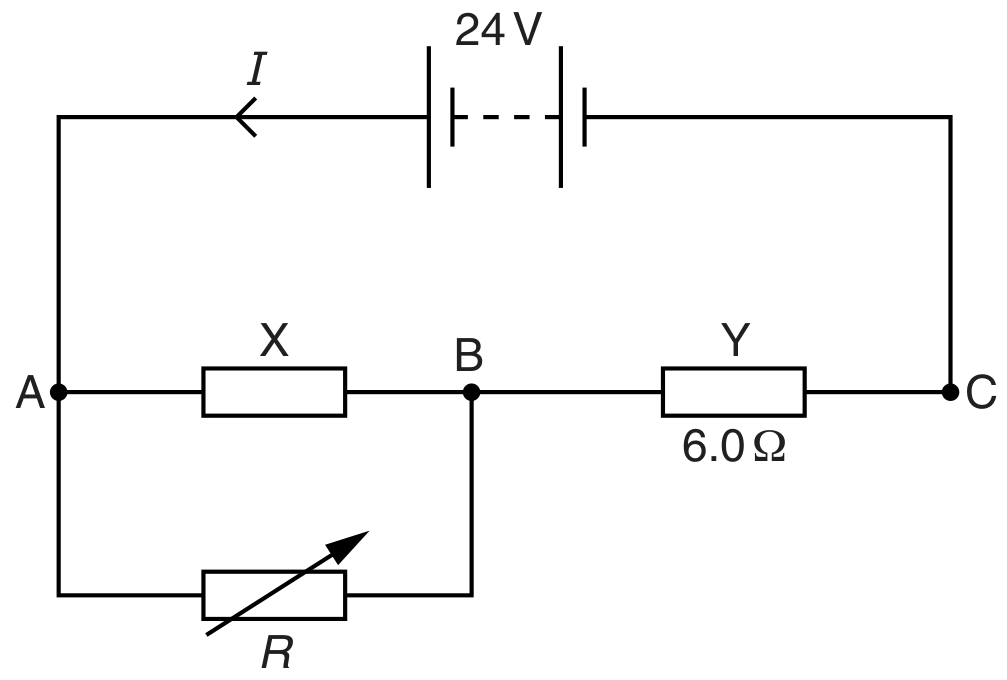
A battery is connected in series with resistors X and Y, as shown in Fig. 6.1.

Fig. 6.1

Fig. 6.1

The resistance of X is constant. The resistance of Y is 6.0Ω6.0 \Omega. The battery has electromotive force (e.m.f.) 24 V and zero internal resistance. A variable resistor of resistance R is connected in parallel with X.

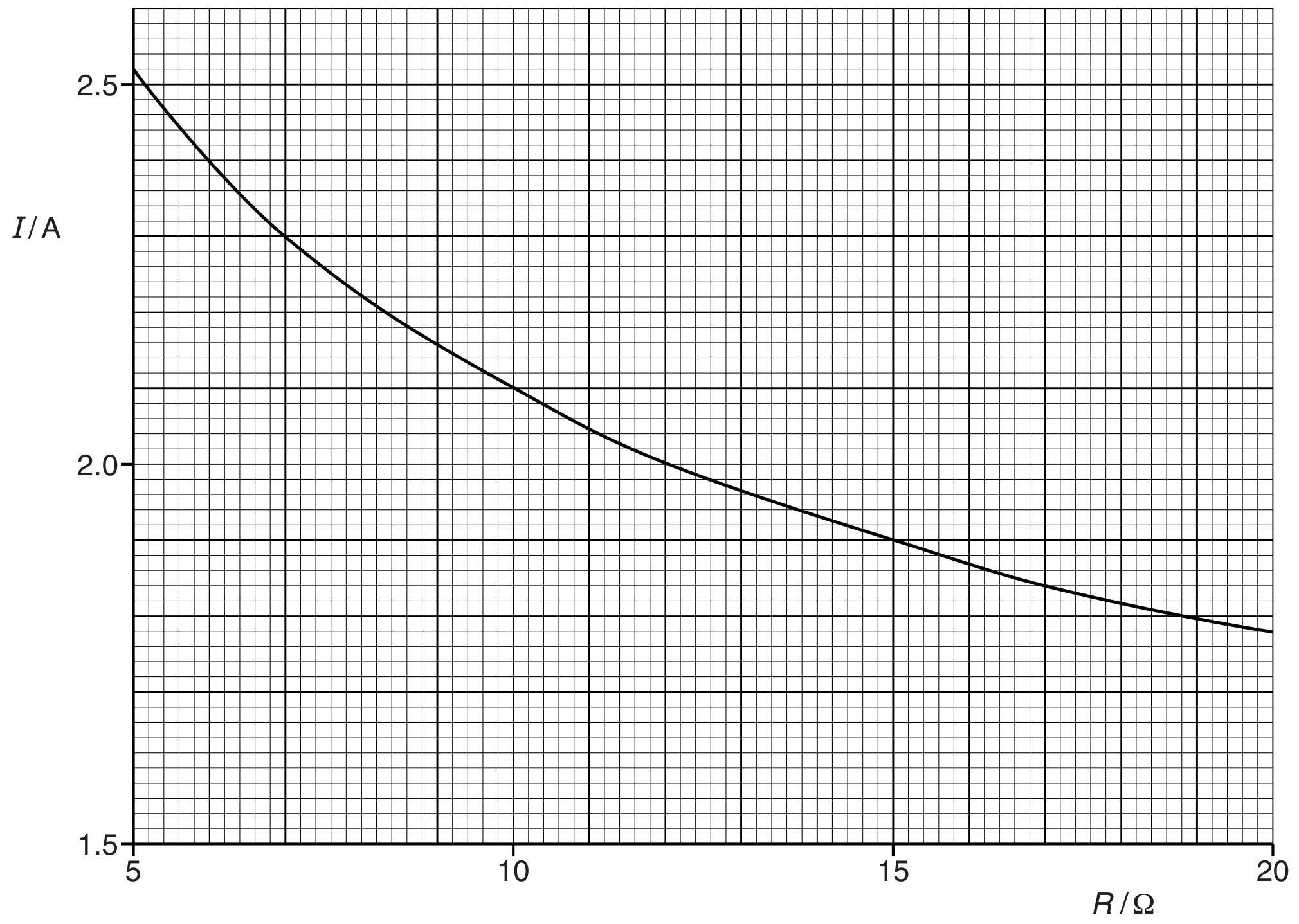
The current I from the battery is changed by varying R from 5.0Ω5.0 \Omega to 20Ω20 \Omega. The variation with R of I is shown in Fig. 6.2.

Fig. 6.2

Fig. 6.2

(a)

For R=6.0ΩR=6.0 \Omega,

[ 5 ]
(i)

show that the p.d. between points A and B is 9.6 V ,

[ 2 ]
(ii)

calculate the resistance of X ,

\text { resistance = \Omega \text { [3] }
[ 3 ]
[Maximum number: 1]

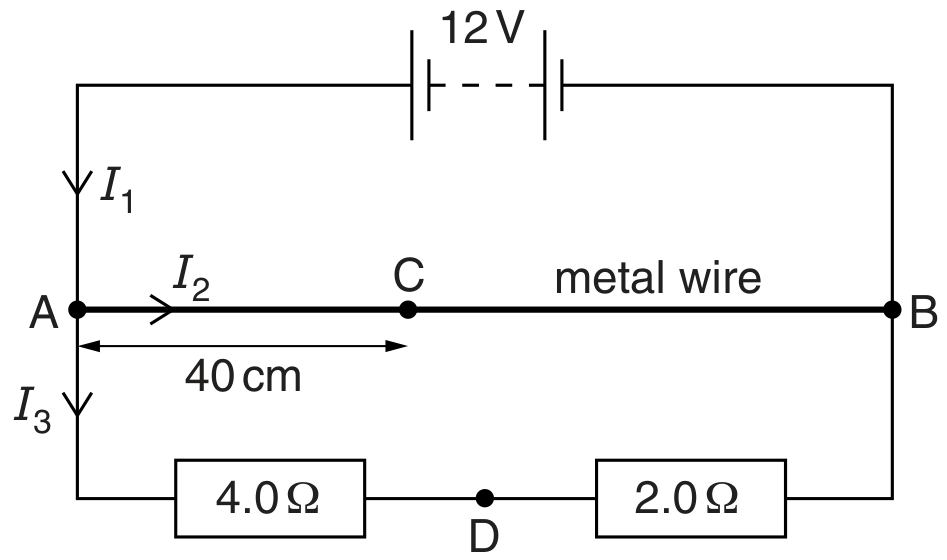
Fig. 5.1 shows a 12 V power supply with negligible internal resistance connected to a uniform metal wire AB . The wire has length 1.00 m and resistance 10Ω10 \Omega. Two resistors of resistance 4.0Ω4.0 \Omega and 2.0Ω2.0 \Omega are connected in series across the wire.

Fig. 5.1

Fig. 5.1

Currents I1,I2I_{1}, I_{2} and I3I_{3} in the circuit are as shown in Fig. 5.1.

(a)
(i)

Use Kirchhoff's first law to state a relationship between I1,I2I_{1}, I_{2} and I3I_{3}.

[ 1 ]
(ii)

Calculate I1I_{1}.

I1=I_{1}=
(iii)

Calculate the ratio x, where

x= power in metal wire  power in series resistors x=\frac{\text { power in metal wire }}{\text { power in series resistors }}
x=

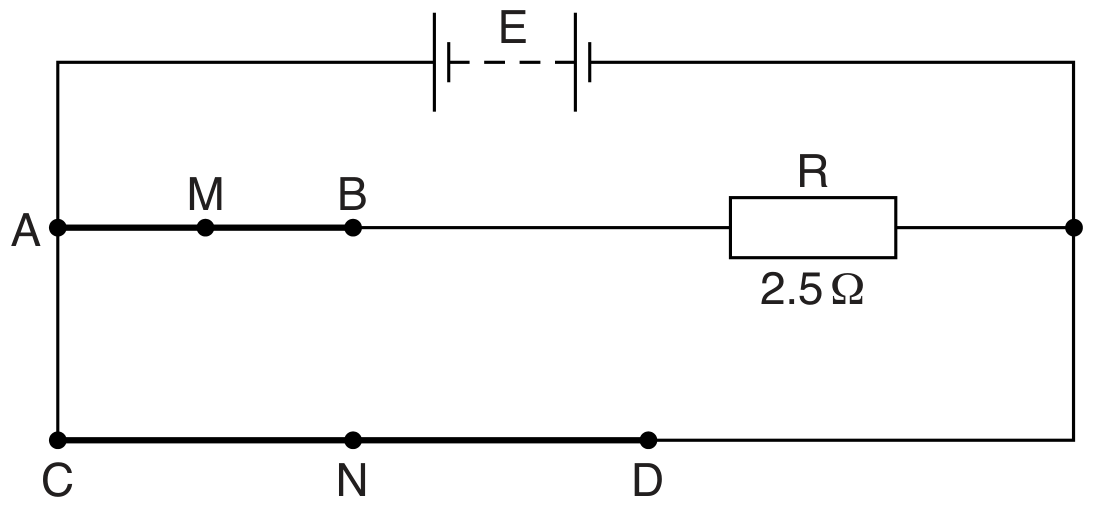
A uniform resistance wire A B has length 50 cm and diameter 0.36 mm . The resistivity of the metal of the wire is 5.1×10⁷Ω m5.1 \times 10^{-7} \Omega \mathrm{~m}.

(a)

The wire A B is connected in series with a power supply E and a resistor R as shown in Fig. 5.1.

Fig. 5.1

Fig. 5.1

The electromotive force (e.m.f.) of E is 6.0 V and its internal resistance is negligible. The resistance of R is 2.5Ω2.5 \Omega. A second uniform wire C D is connected across the terminals of E. The wire C D has length 100 cm , diameter 0.18 mm and is made of the same metal as wire A B.

Calculate

(i)

the current supplied by E,

(a)

State Kirchhoff's first law.

[ 1 ]
(b)

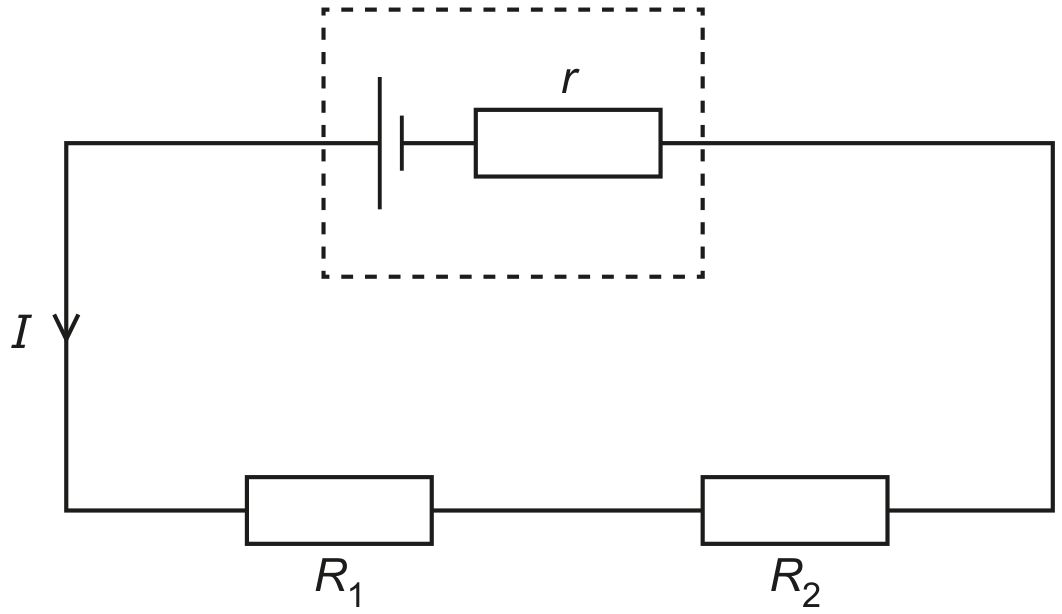
A cell with internal resistance r is connected to two resistors of resistances R1R_{1} and R2R_{2} as shown in Fig. 6.1.

Fig. 6.1

Fig. 6.1

The potential differences (p.d.s) across R1R_{1} and R2R_{2} are V1V_{1} and V2V_{2} respectively.
The terminal p.d. across the cell is V.
The current in the circuit is I.

Use Kirchhoff's laws to show that the total resistance RTR_{\mathrm{T}} of the external circuit is given by

RT=R1+R2.R_{\mathrm{T}}=R_{1}+R_{2} .
[ 2 ]
(a)

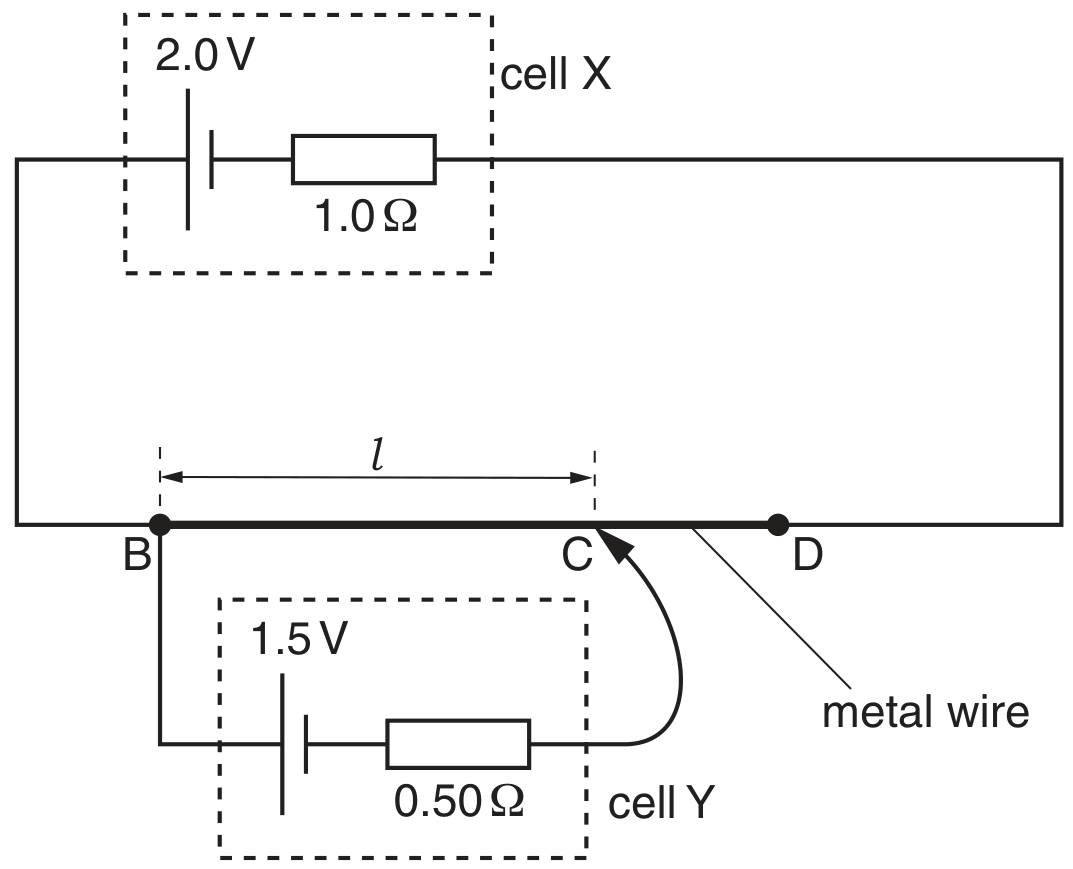
The ends B and D of the wire in (a) are connected to a cell X, as shown in Fig. 6.1.

Fig. 6.1

Fig. 6.1

The cell X has electromotive force (e.m.f.) 2.0 V and internal resistance 1.0Ω1.0 \Omega.
A cell Y of e.m.f. 1.5 V and internal resistance 0.50Ω0.50 \Omega is connected to the wire at points B and C , as shown in Fig. 6.1.

The point C is distance l from point B . The current in cell Y is zero.
Calculate

[ 3 ]
(i)

the current in cell X ,
current = A

[ 2 ]
(ii)

the potential difference (p.d.) across the wire BD,

p.d. =
[ 1 ]
0