EduNinja
(a)

The maximum useful output power P of a car travelling on a horizontal road is given by

P=v3bP=v^{3} b

where v is the maximum speed of the car and b is a constant.
For the car,

P=84 kW±5%P=84 \mathrm{~kW} \pm 5 \%

and b=0.56±7%b=0.56 \pm 7 \% in SI units.

[ 2 ]
(i)

Determine the absolute uncertainty in the value of v.
absolute uncertainty = ms1\mathrm{ms}^{-1}

[ 2 ]
(a)

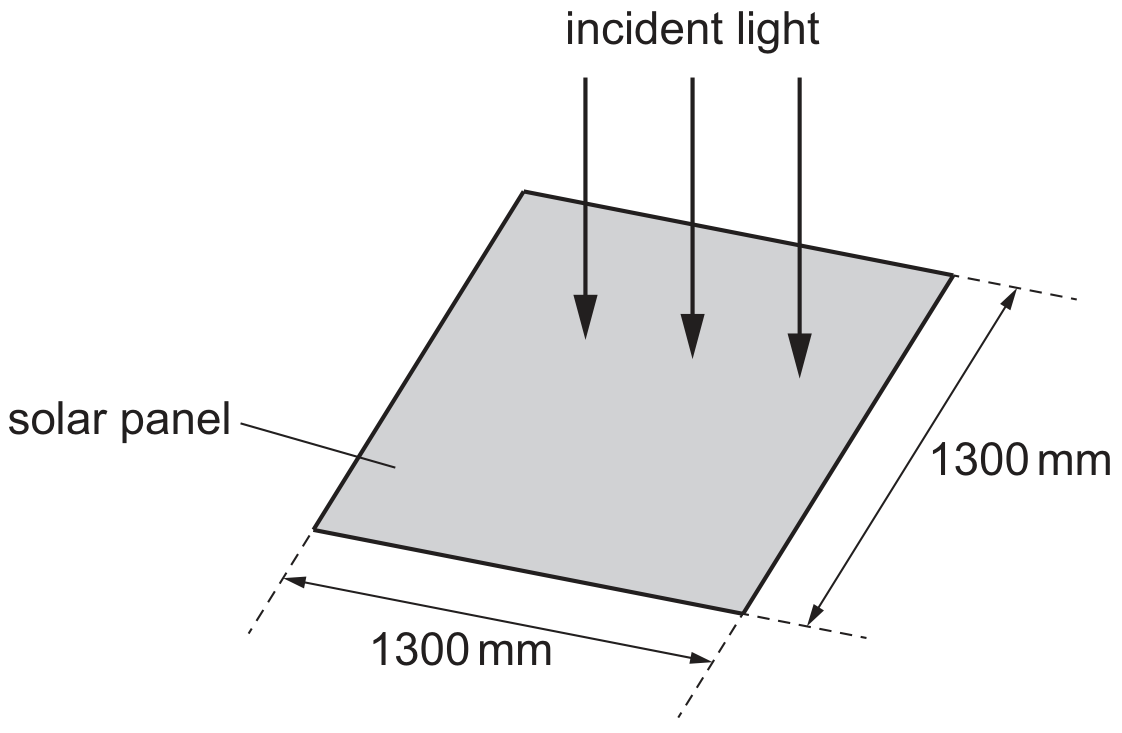
A square solar panel with sides of length 1300 mm is shown in Fig. 1.1.

Fig. 1.1 (not to scale)

Fig. 1.1 (not to scale)

Light is incident normally on the solar panel.

[ 2 ]
(i)

The percentage uncertainty in the incident power is ±3%\pm 3 \%.

The uncertainty in the length of each side is ±5 mm\pm 5 \mathrm{~mm}.
Calculate the percentage uncertainty in the intensity of the light.

Question image
Question image
[ 2 ]
[Maximum number: 4]

A metal wire has a cross-section of diameter approximately 0.8 mm .

(a)

State what instrument should be used to measure the diameter of the wire.

[ 1 ]
(b)

State how the instrument in (a) is

[ 3 ]
(i)

checked so as to avoid a systematic error in the measurements,

[ 1 ]
(ii)

used so as to reduce random errors.

[ 2 ]
[Maximum number: 4]

A digital voltmeter with a three-digit display is used to measure the potential difference across a resistor. The manufacturers of the meter state that its accuracy is ±1%\pm 1 \% and ±1\pm 1 digit. The reading on the voltmeter is 2.05 V .

(a)

For this reading, calculate, to the nearest digit,

[ 2 ]
(i)

a change of 1 % in the voltmeter reading,
change = V

[ 1 ]
(ii)

the maximum possible value of the potential difference across the resistor.
maximum value = V

[ 1 ]
(b)

The reading on the voltmeter has high precision. State and explain why the reading may not be accurate.

[ 2 ]
(a)

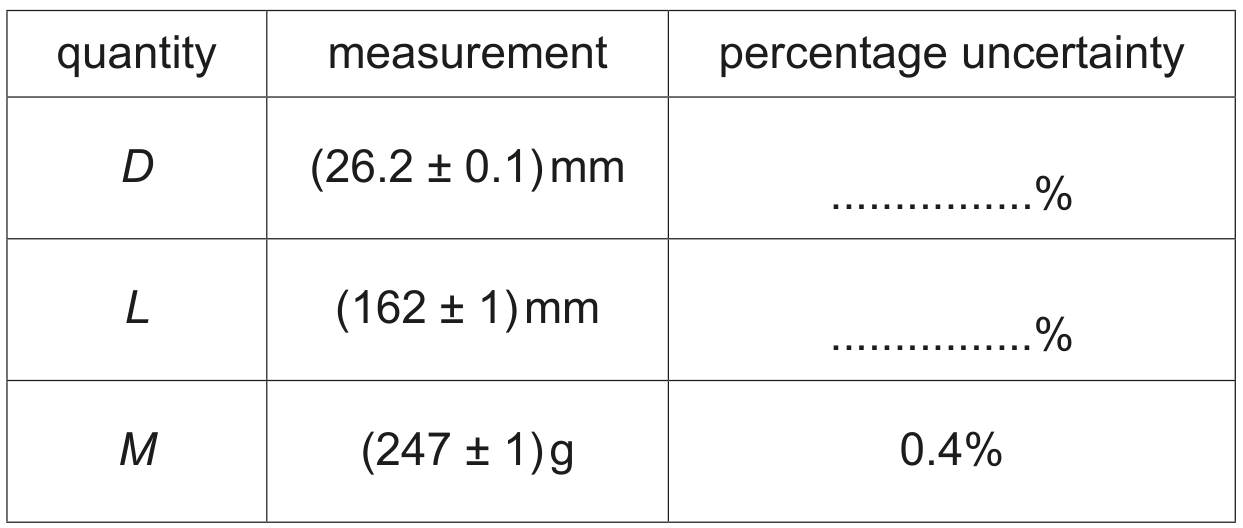
A uniform cylinder has diameter D, length L and mass M.

The density ρ\rho of the cylinder is given by

ρ=4MπD2L.\rho=\frac{4 M}{\pi D^{2} L} .

Table 1.2 shows the data obtained from an experiment to determine the density of the cylinder.

Table 1.2

Table 1.2

[ 3 ]
(i)

Calculate the percentage uncertainties in D and L. Write your answers in Table 1.2.

[ 1 ]
(ii)

Calculate the percentage uncertainty in the density.
percentage uncertainty = \%

[ 2 ]
(a)

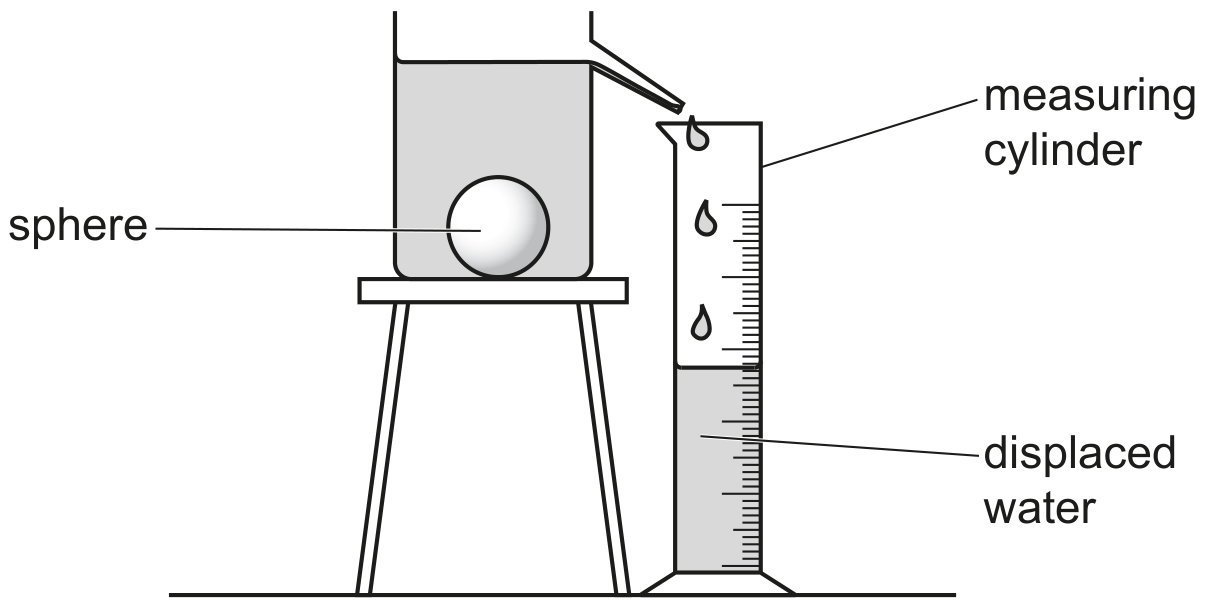
The radius of a small sphere is determined from a measurement of the volume of the sphere. The sphere is submerged in water, displacing some of the water into a measuring cylinder as shown in Fig. 1.1.

Fig. 1.1 (not to scale)

Fig. 1.1 (not to scale)

The measured volume of displaced water is (28.0±0.5)cm3(28.0 \pm 0.5) \mathrm{cm}^{3}.
Calculate:

[ 2 ]
(i)

the percentage uncertainty in the radius of the sphere.

percentage uncertainty =% [2]
[ 2 ]
[Maximum number: 5]

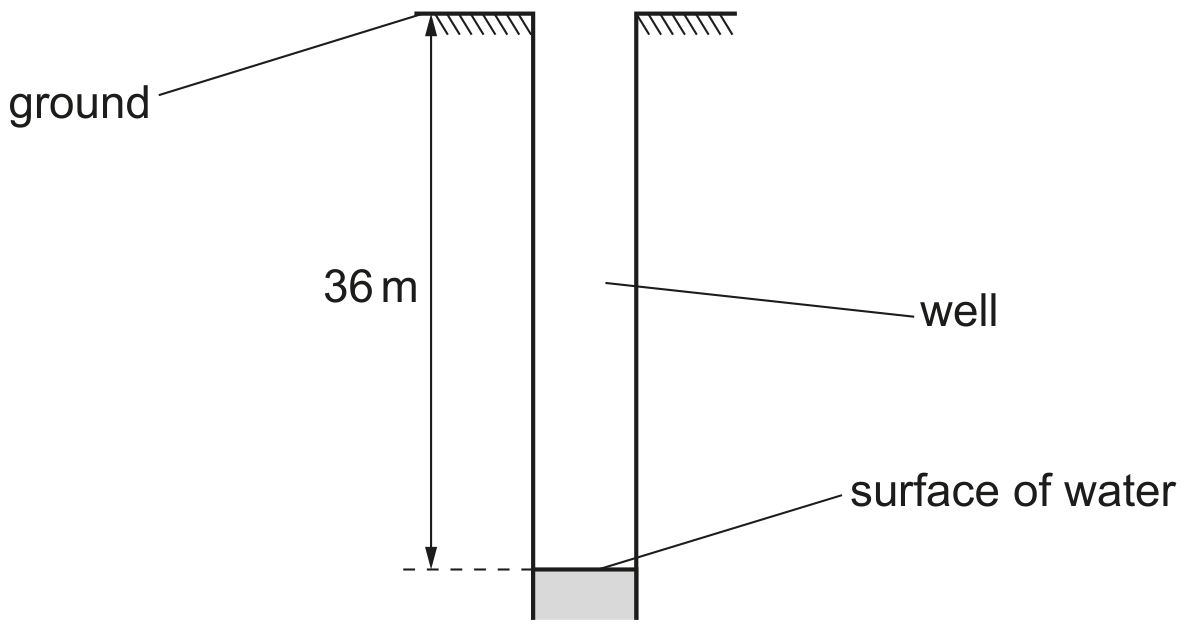
A well has a depth of 36 m from ground level to the surface of the water in the well, as shown in Fig. 1.1.

Fig. 1.1 (not to scale)

Fig. 1.1 (not to scale)

A student wishes to find the depth of the well. The student plans to drop a stone down the well and record the time taken from releasing the stone to hearing the splash made by the stone as it enters the water.

(a)

The time recorded by the student using a stop-watch is not equal to the time in (a).

Suggest three possible reasons, other than the effect of air resistance, for this difference.
1
2
3

[ 3 ]
(b)

The student repeats the experiment three times and uses the results to calculate the depth of the well. The values are shown in Table 1.1.

Table 1.1

Table 1.1

The true depth of the well is 36.0 m . Explain why these results may be described as precise but not accurate.

[ 2 ]
(a)

An experiment is performed to determine the value of k by measuring the values of the other quantities in the equation in (b).

The values of L and R each have a percentage uncertainty of 2\%.
State and explain, quantitatively, which of these two quantities contributes more to the percentage uncertainty in the calculated value of k.

[ 1 ]
(a)

An experiment is performed to determine the acceleration of the car in (b). The following measurements are obtained:

s=3.89 m±0.5%v=2.75 ms1±0.8%\begin{aligned} & s=3.89 \mathrm{~m} \pm 0.5 \% \\ & v=2.75 \mathrm{~ms}^{-1} \pm 0.8 \% \end{aligned}
[ 1 ]
(i)

Determine the percentage uncertainty, to two significant figures, in a.
percentage uncertainty =

(ii)

Use your answers in (c)(i) and (c)(ii) to determine the absolute uncertainty in the calculated value of a.
absolute uncertainty =
ms2\mathrm{ms}^{-2}

[ 1 ]
[Maximum number: 4]

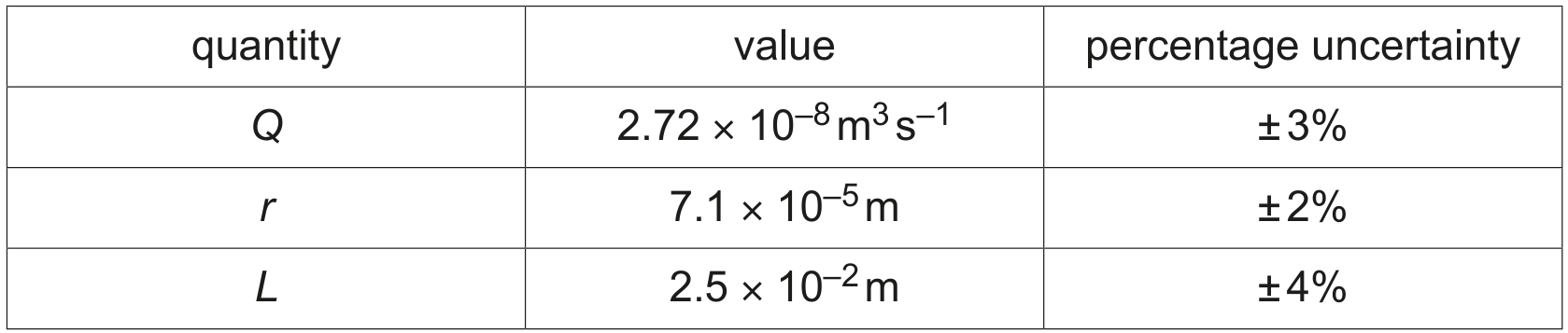
The rate of flow Q of a liquid along a narrow pipe of length L and radius r is given by

Q=αr4LQ=\frac{\alpha r^{4}}{L}

where α\alpha is a constant.

An experiment is carried out to determine the value of α\alpha. The data from the experiment are shown in Table 1.1.

Table 1.1

Table 1.1

(a)

Show that the percentage uncertainty in α\alpha is 15 %.

[ 1 ]
(b)

Calculate α\alpha with its absolute uncertainty. Give your answer to an appropriate number of significant figures.

α=(..±..)×107 s1\alpha=(\ldots \ldots \ldots \ldots \ldots \ldots \ldots \ldots \ldots \ldots \ldots \ldots \ldots . . \pm \ldots \ldots \ldots \ldots \ldots \ldots . .) \times 10^{7} \mathrm{~s}^{-1}
[ 3 ]
0