(a)
The Young modulus of the metal of a wire is . The wire is extended and the strain produced is .
Calculate the stress in GPa.
stress = GPa
[ 2 ]
 EduNinja
The Young modulus of the metal of a wire is . The wire is extended and the strain produced is .
Calculate the stress in GPa.
stress = GPa
A hot-air balloon floats just above the ground. The balloon is stationary and is held in place by a vertical rope, as shown in Fig. 2.1.
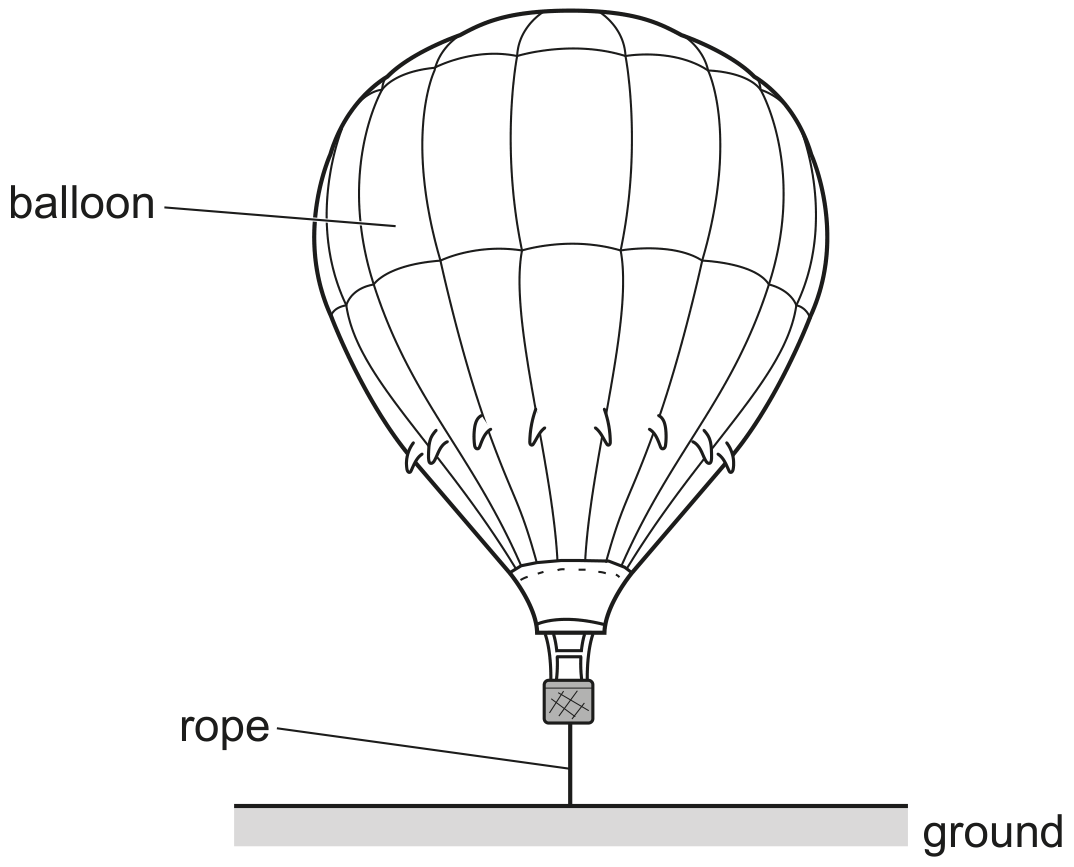
Fig. 2.1
The balloon has a weight W of . The tension T in the rope is .
Upthrust U acts on the balloon.
The density of the surrounding air is .
Before the balloon is released, the rope holding the balloon has a strain of . The rope has an unstretched length of 2.5 m . The rope obeys Hooke's law.
Show that the extension of the rope is .
The rope holding the balloon is replaced with a new one of the same original length and cross-sectional area. The tension is unchanged and the new rope also obeys Hooke's law.
The new rope is made from a material of a lower Young modulus.
State and explain the effect of the lower Young modulus on the elastic potential energy of the rope.
A sphere is attached by a metal wire to the horizontal surface at the bottom of a river, as shown in Fig. 2.1.
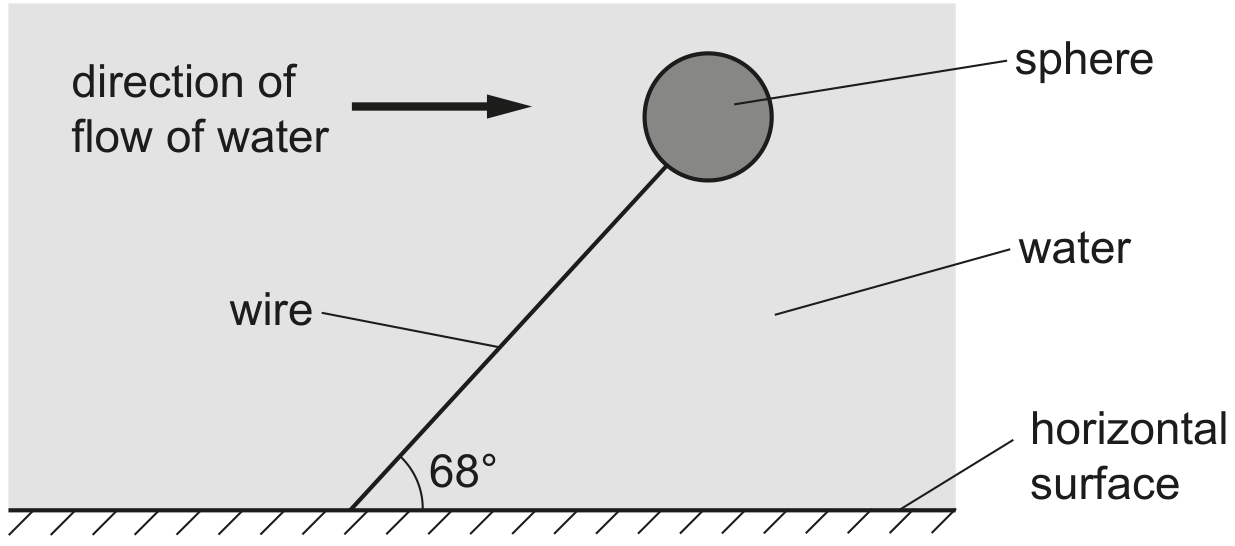
Fig. 2.1 (not to scale)
The sphere is fully submerged and in equilibrium, with the wire at an angle of to the horizontal surface. The weight of the sphere is 32 N . The upthrust acting on the sphere is 280 N . The density of the water is .
Assume that the force on the sphere due to the water flow is in a horizontal direction.
The extension of the wire increases when the sphere changes position as described in (c). The wire obeys Hooke's law.
State a symbol equation that gives the relationship between the tension T in the wire and its extension x. Identify any other symbol that you use.
A rigid uniform beam of weight W is connected to a fixed support by a hinge, as shown in Fig. 2.1.
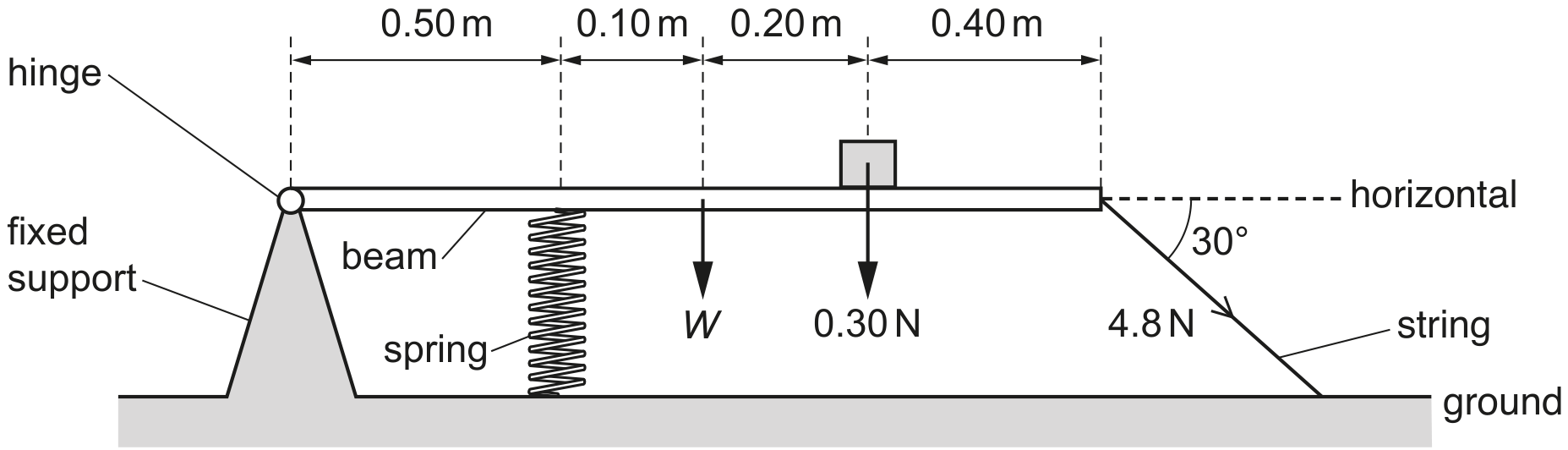
Fig. 2.1 (not to scale)
A compressed spring exerts a total force of 8.2 N vertically upwards on the horizontal beam. A block of weight 0.30 N rests on the beam. The right-hand end of the beam is connected to the ground by a string at an angle of to the horizontal. The tension in the string is 4.8 N . The distances along the beam are shown in Fig. 2.1.
The beam is in equilibrium. Assume that the hinge is frictionless.
The spring obeys Hooke's law and has an elastic potential energy of 0.32 J .
Calculate the compression of the spring.
compression = m
The variation with extension x of the tension F in a spring is shown in Fig. 3.1.
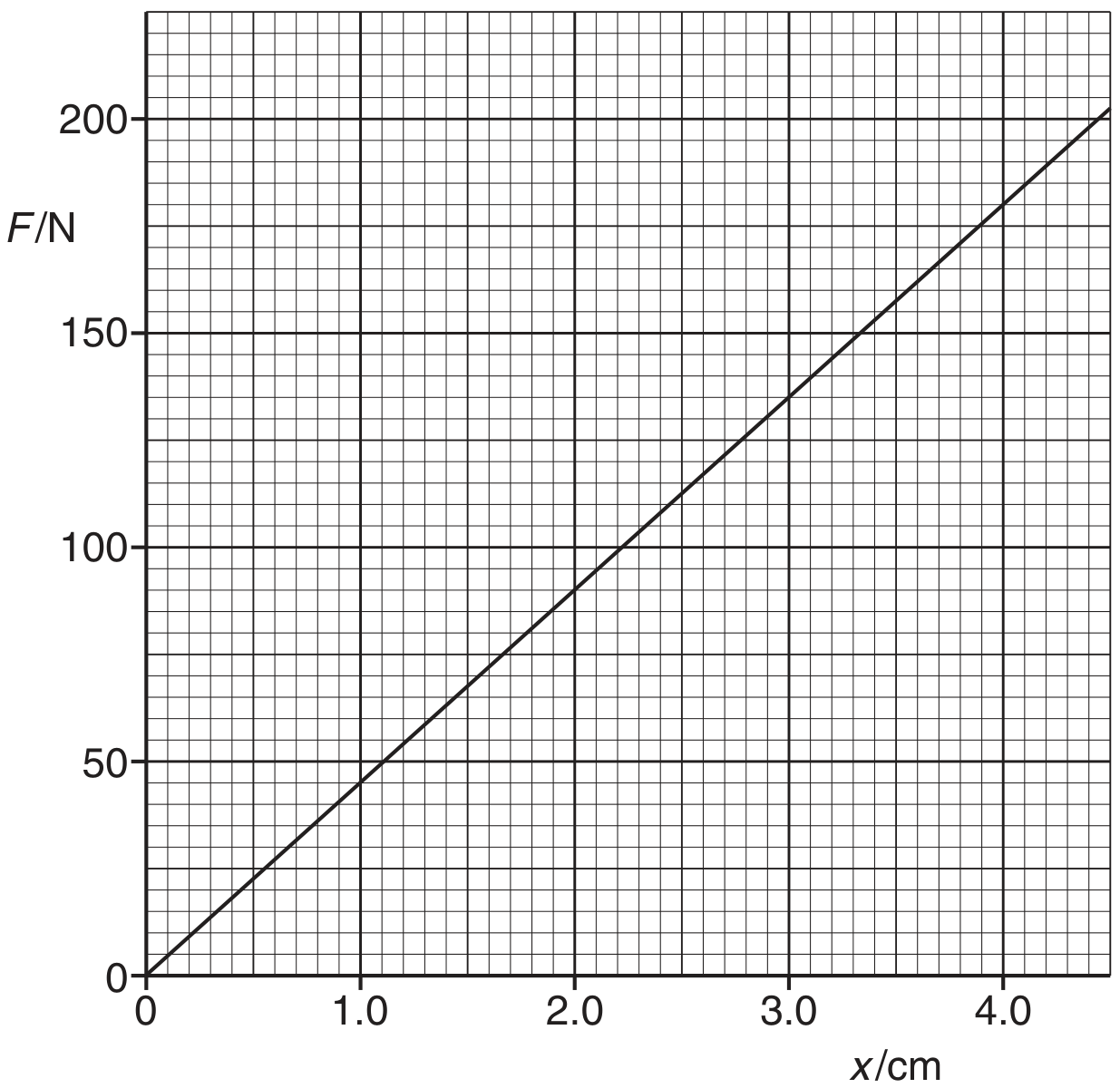
Fig. 3.1
Use Fig. 3.1 to calculate the energy stored in the spring for an extension of 4.0 cm . Explain your working.

A steel ball is projected horizontally from the top of a table, as shown in Fig. 2.1.
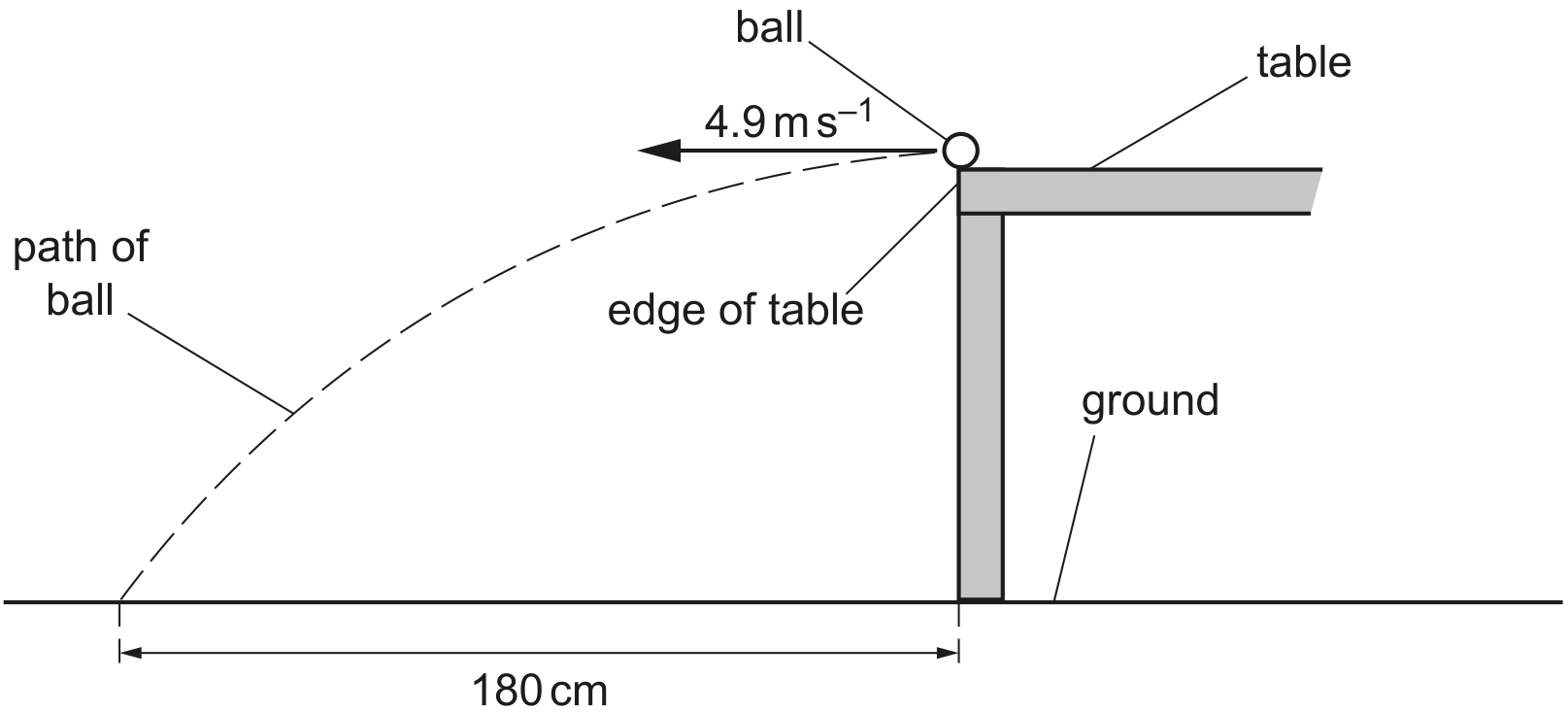
Fig. 2.1 (not to scale)
The ball is projected horizontally at a speed of . The ball lands on the ground a horizontal distance of 180 cm from the edge of the table.
Assume that air resistance is negligible.
The ball is projected by means of a compressed spring which is attached to a fixed block as shown in Fig. 2.2.
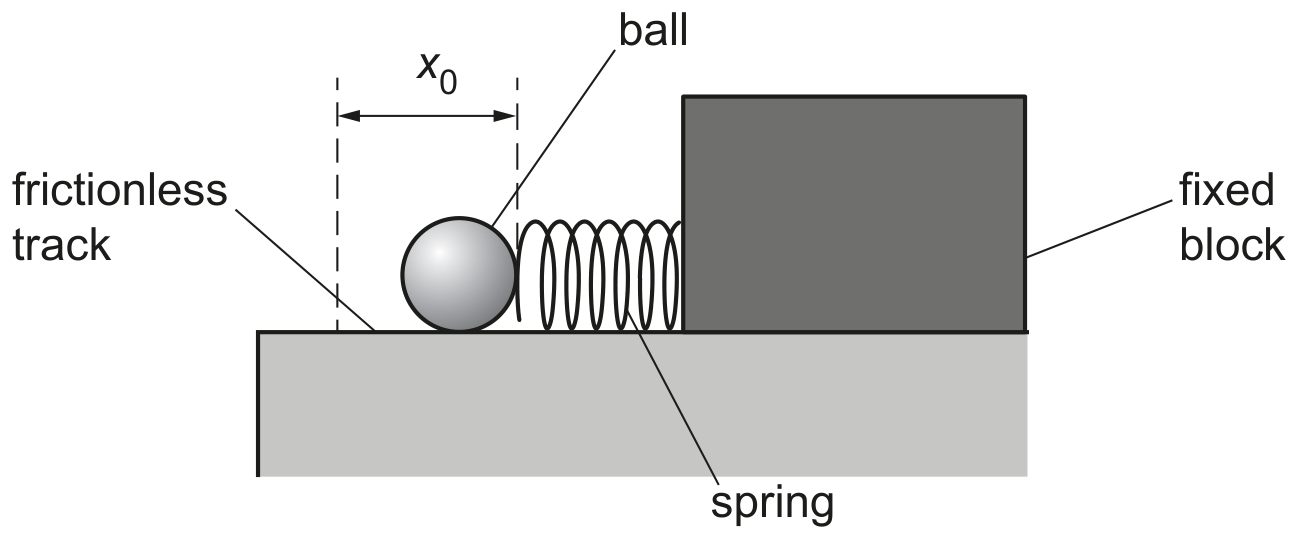
Fig. 2.2
The ball is placed on a frictionless track in front of the spring. The ball is then pulled back so that the spring has compression .
When the spring is released, the ball is projected horizontally as shown in Fig. 2.3.
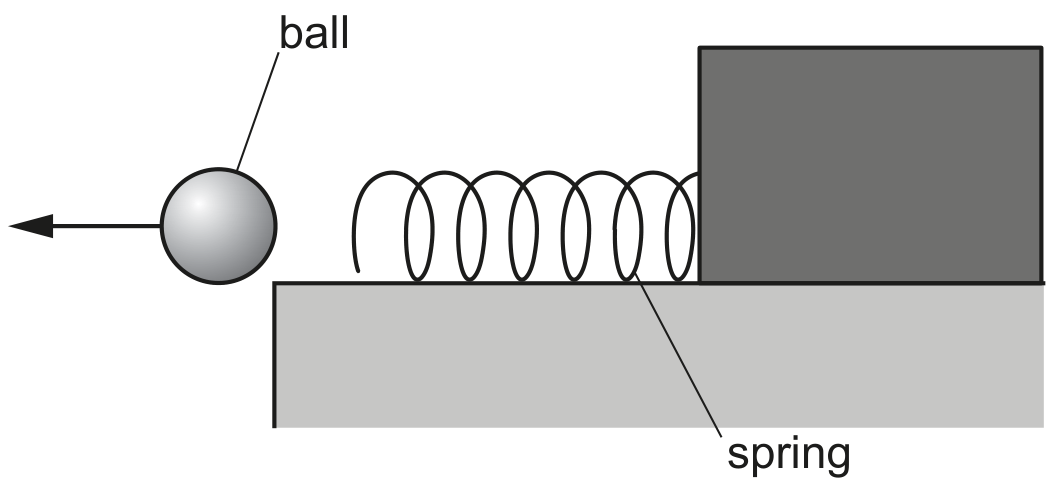
Fig. 2.3
The variation with compression x of the applied force F for the spring is shown in Fig. 2.4.
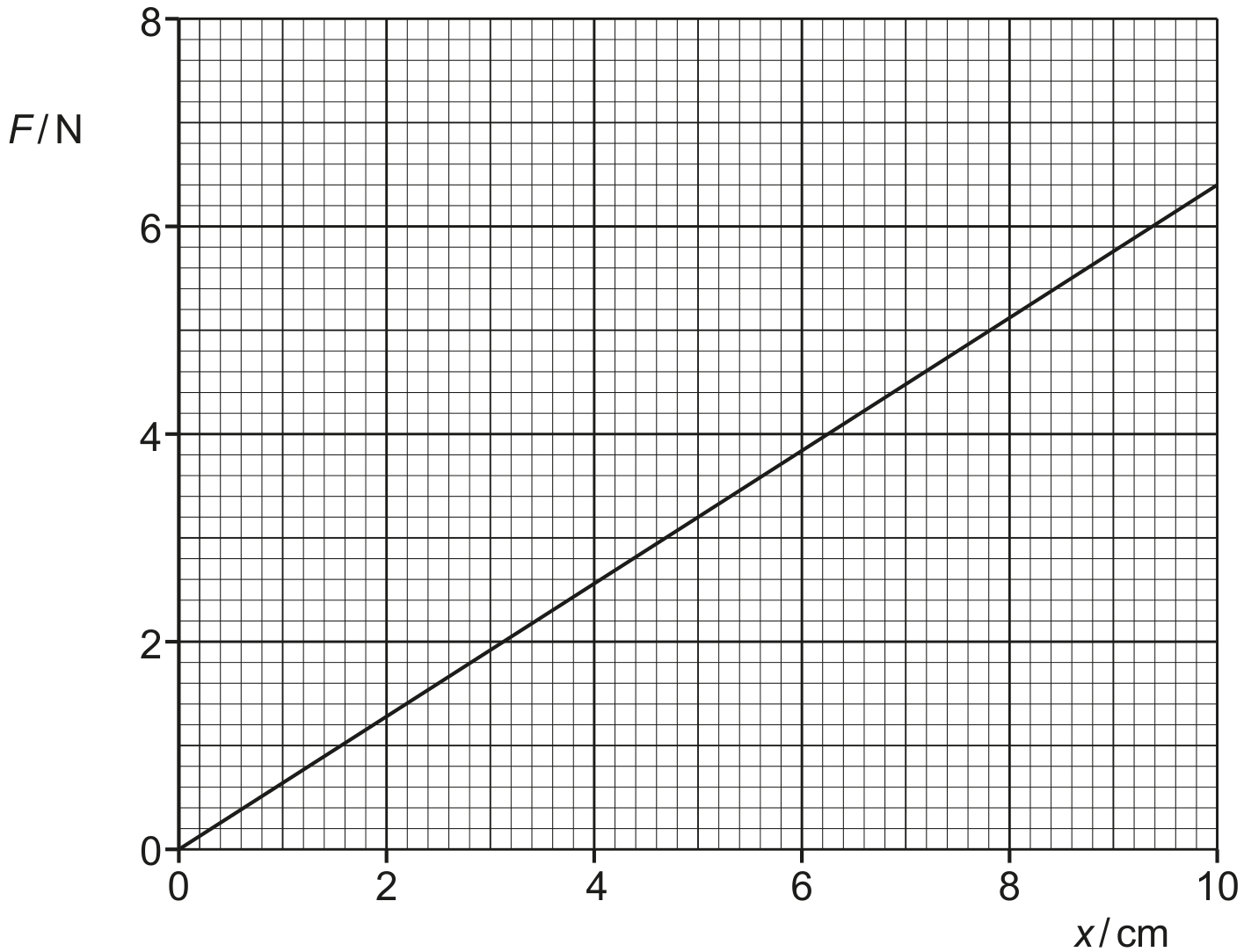
Fig. 2.4
The ball is a uniform sphere of steel of diameter 0.016 m and mass 0.017 kg .
Use Fig. 2.4 to determine the spring constant k of the spring.
Use your answer in (b)(iii) and the value of energy given in (b)(ii) to determine the compression of the spring.
m
A steel sphere of mass 0.29 kg is suspended in equilibrium from a vertical spring. The centre of the sphere is 8.5 cm from the top of the spring, as shown in Fig. 2.1.
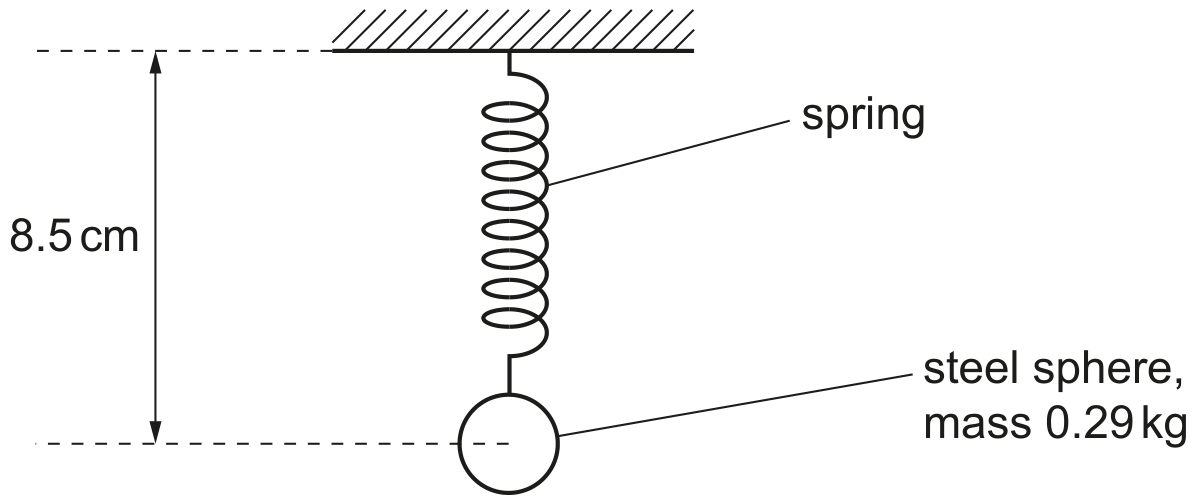
Fig. 2.1
The sphere is now set in motion so that it is moving in a horizontal circle at constant speed, as shown in Fig. 2.2.
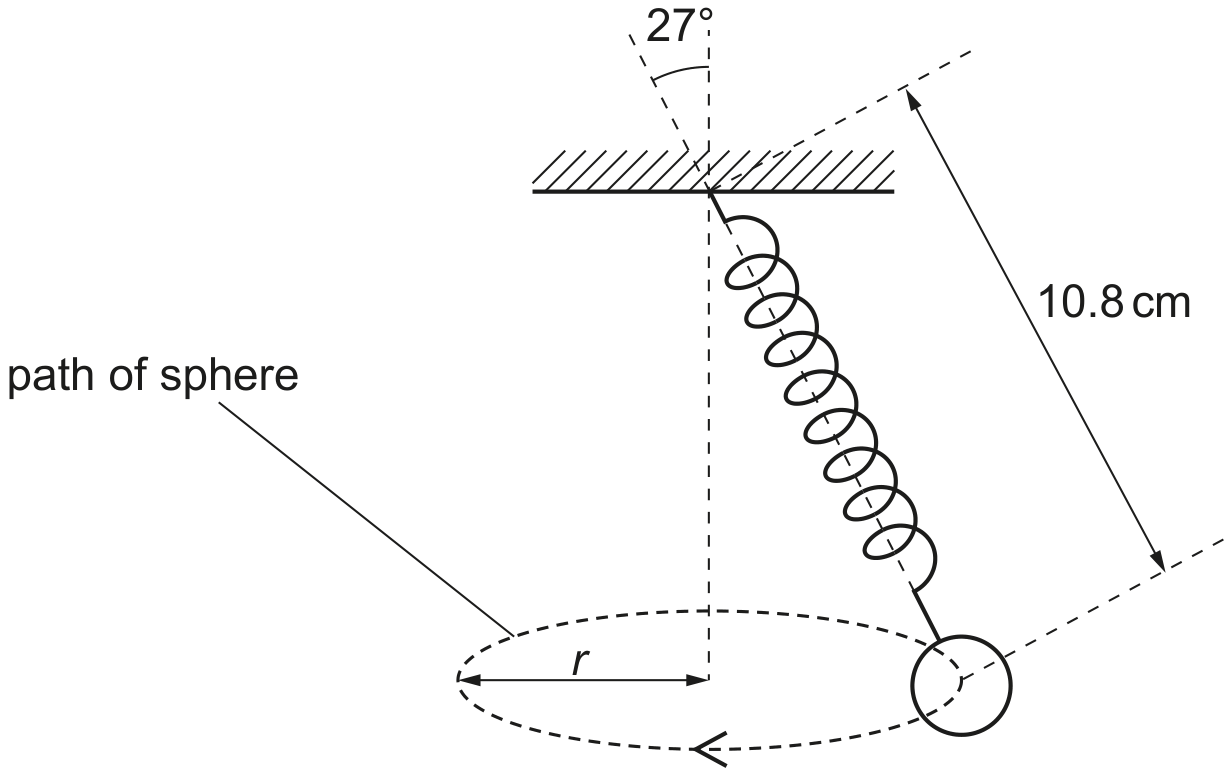
Fig. 2.2
The distance from the centre of the sphere to the top of the spring is now 10.8 cm .
The angle between the linear axis of the spring and the vertical is .
The spring obeys Hooke's law.
Calculate the spring constant, in , of the spring.
A steel sphere of mass 0.29 kg is suspended in equilibrium from a vertical spring. The centre of the sphere is 8.5 cm from the top of the spring, as shown in Fig. 2.1.
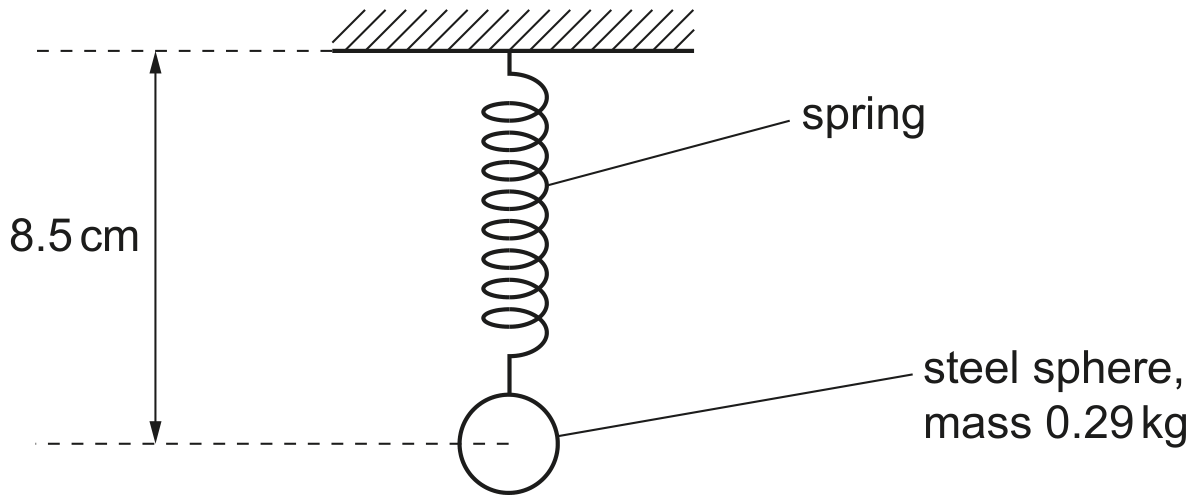
Fig. 2.1
The sphere is now set in motion so that it is moving in a horizontal circle at constant speed, as shown in Fig. 2.2.
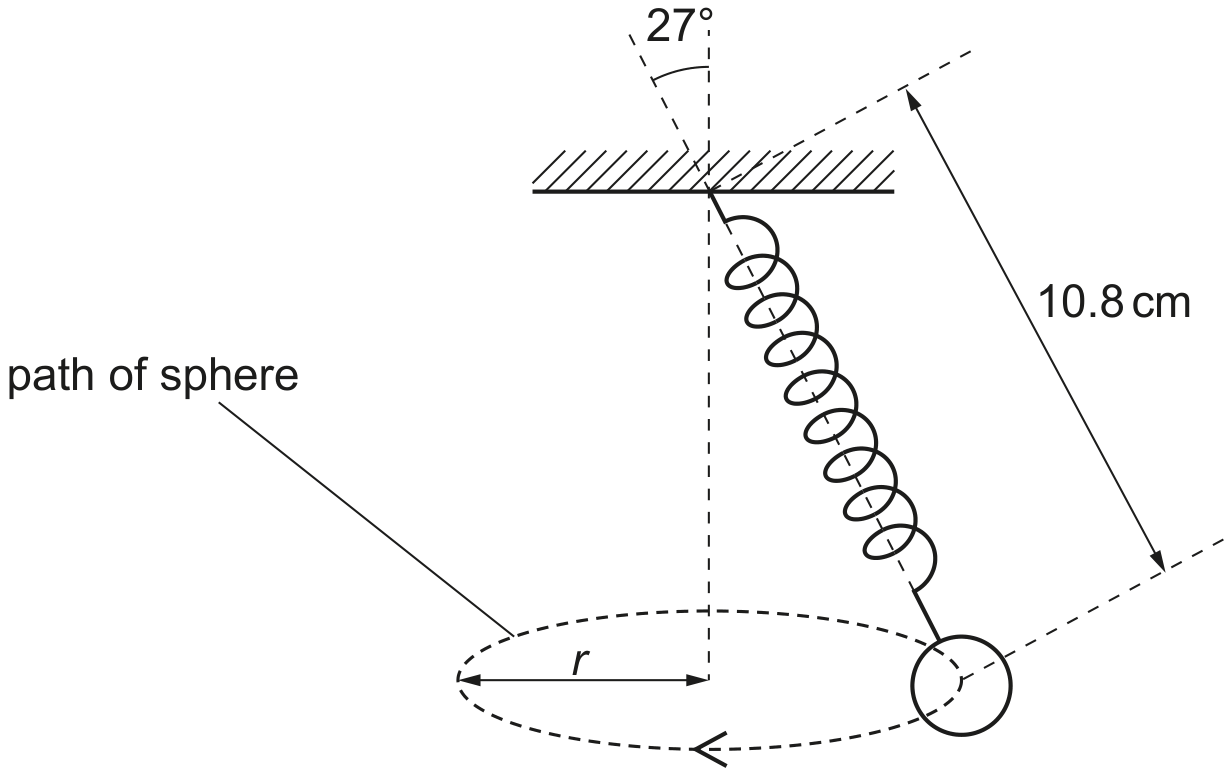
Fig. 2.2
The distance from the centre of the sphere to the top of the spring is now 10.8 cm .
The angle between the linear axis of the spring and the vertical is .
The spring obeys Hooke's law.
Calculate the spring constant, in , of the spring.
A thin metal wire X , of diameter , is used to suspend a model planet, as shown in Fig. 3.1.
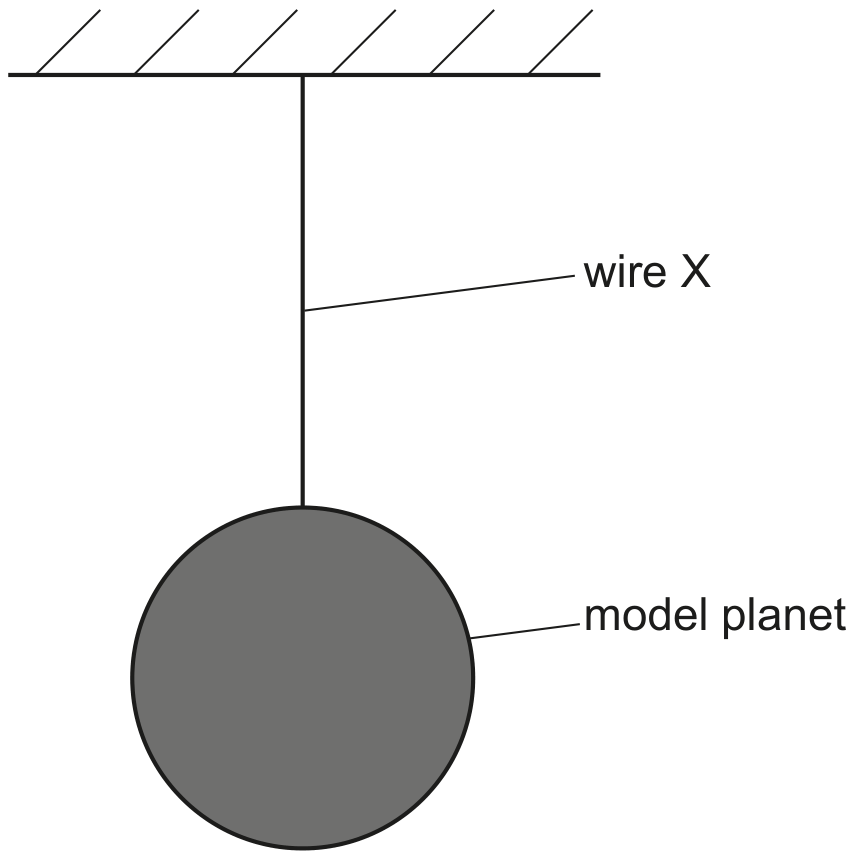
Fig. 3.1 (not to scale)
The variation with strain of the stress for wire X is shown in Fig. 3.2.
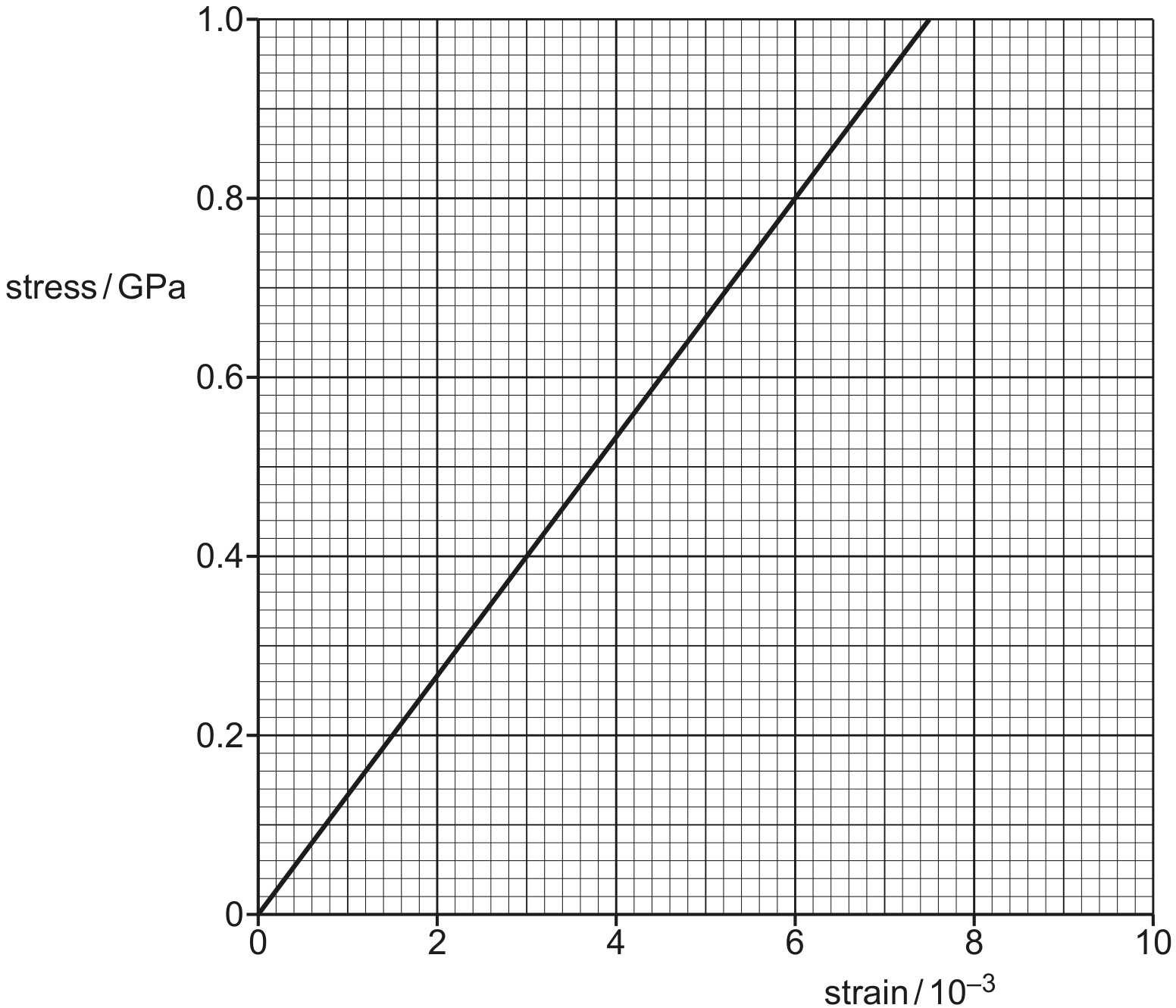
Fig. 3.2
The strain in X is .
Use Fig. 3.2 to calculate the force exerted on the wire by the model planet.
force = N
Wire X is replaced by a new wire, Y , with the same original length and diameter but double the Young modulus of X . Wire Y also obeys Hooke's law.
On Fig. 3.2, draw a line representing the variation with strain of the stress for Y.
The system shown in Fig. 3.1 is part of a mechanism that controls the amount of water in a tank.
Water enters the tank and causes the sphere to rise. This results in the bar becoming horizontal. Fig. 3.2 shows the system in its new position.
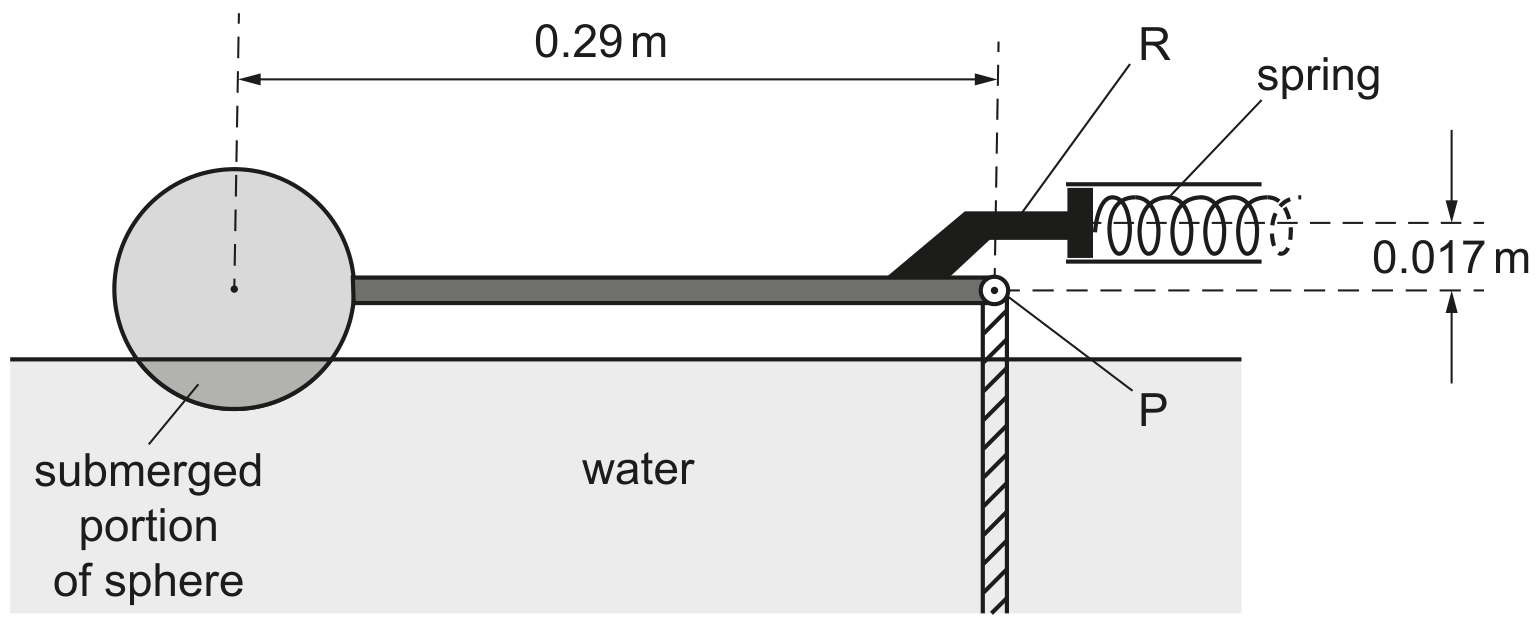
Fig. 3.2 (not to scale)
In this position the rod R exerts a force to compress a horizontal spring that controls the water supply to the tank. R is positioned at a perpendicular distance of 0.017 m above P.
The variation of the force F applied to the spring with compression x of the spring is shown in Fig. 3.3.
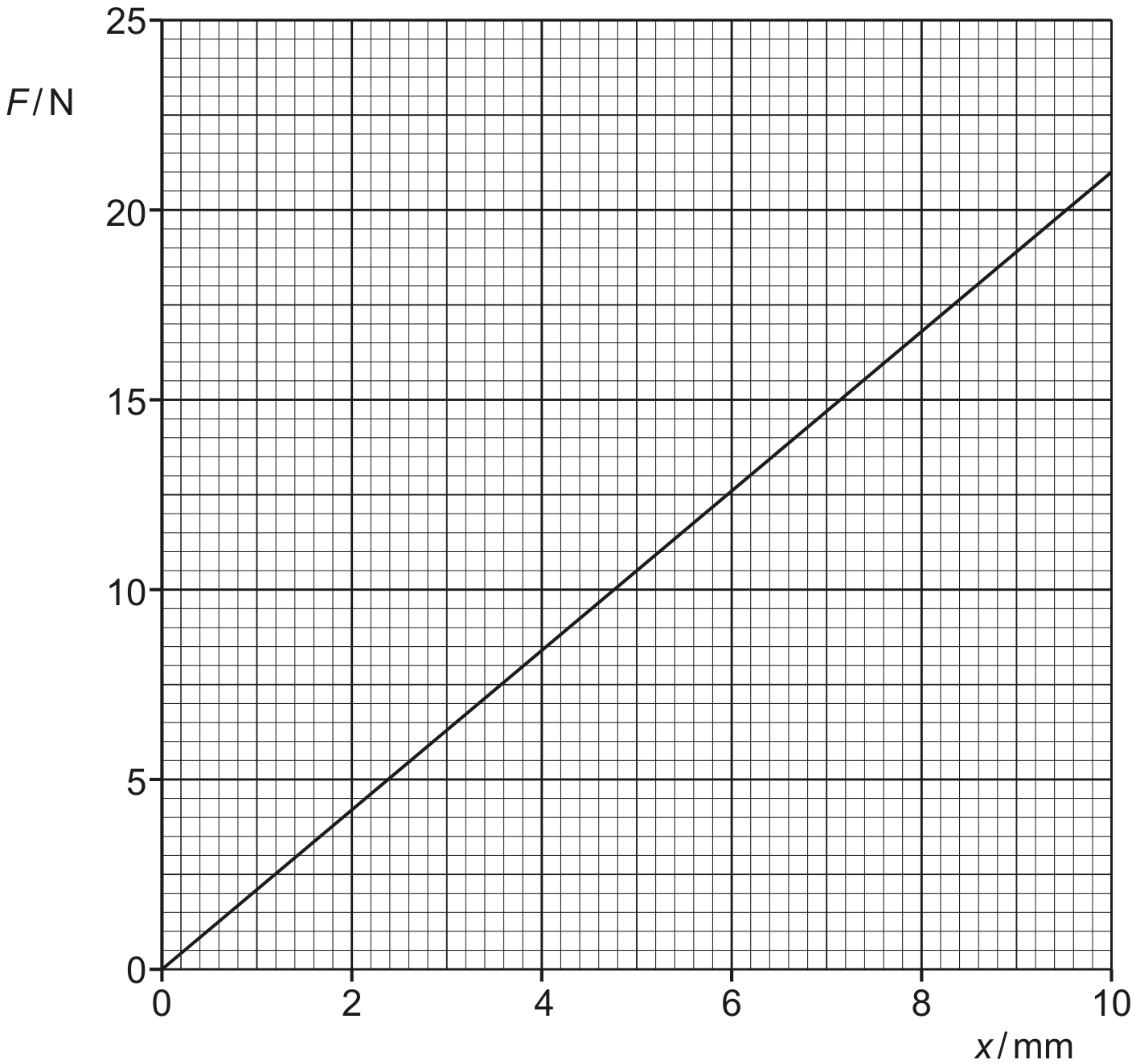
Fig. 3.3
Use Fig. 3.3 to calculate the spring constant k of the spring.