EduNinja
(a)

Under certain conditions, the distance s moved in a straight line by an object in time t is given by

s=12at2s=\frac{1}{2} a t^{2}

where a is the acceleration of the object.
State two conditions under which the above expression applies to the motion of the object.
1
2

[ 2 ]
(b)

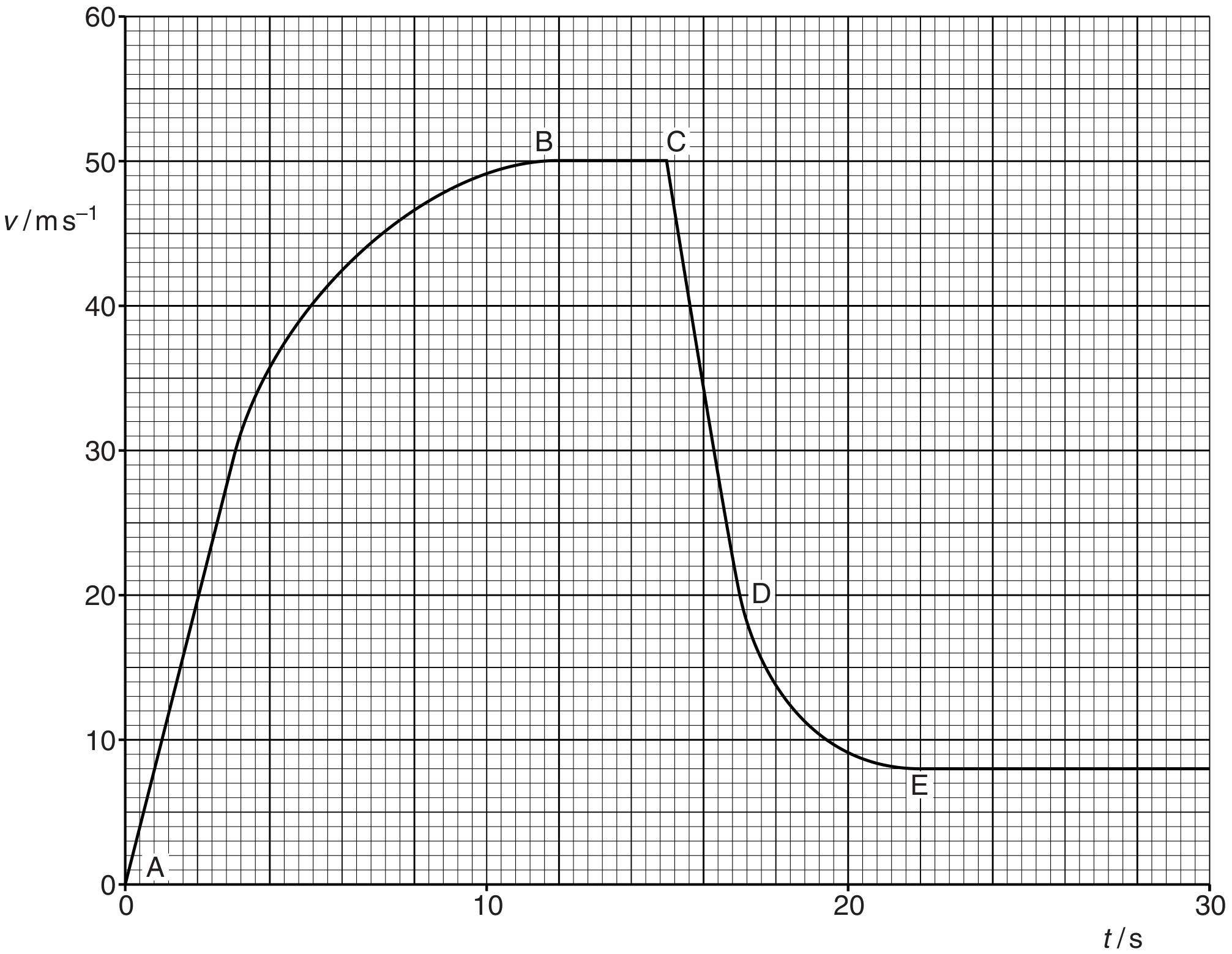
The variation with time t of the velocity v of a car that is moving in a straight line is shown in Fig. 1.1.
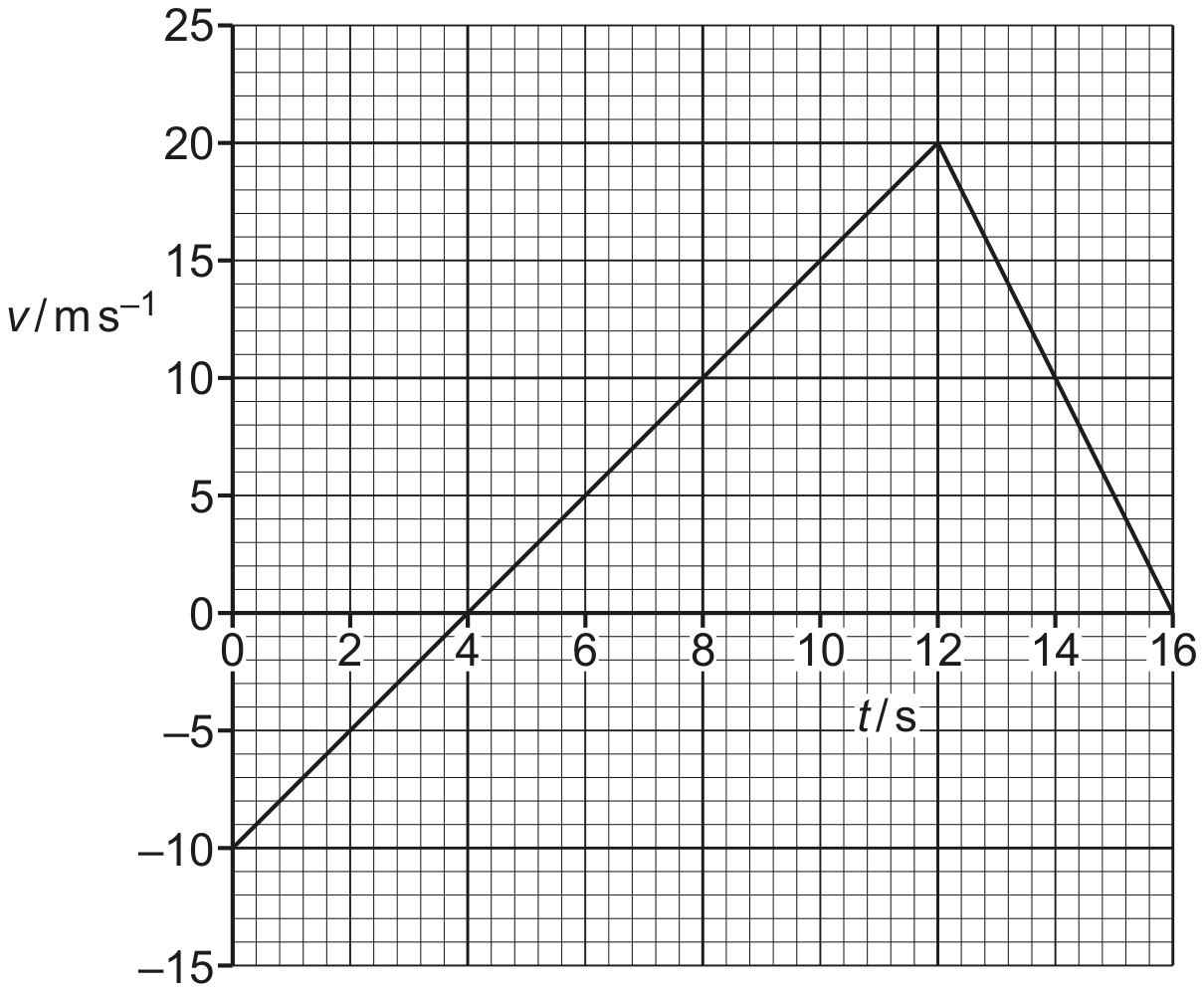
Fig. 1.1

Fig. 1.1

[ 6 ]
(i)

Compare, qualitatively, the acceleration of the car at time t=8.0 st=8.0 \mathrm{~s} and at time t=14.0 st=14.0 \mathrm{~s} in terms of:
- magnitude
- direction.

[ 2 ]
(ii)

Determine the magnitude of the acceleration of the car at time t=4.0 st=4.0 \mathrm{~s}.
acceleration = ms2\mathrm{ms}^{-2}

[ 2 ]
(iii)

The car is at point X at time t=0.

Determine the magnitude of the displacement of the car from X at time t=12.0 st=12.0 \mathrm{~s}.
displacement = m

[ 2 ]
[Maximum number: 2]

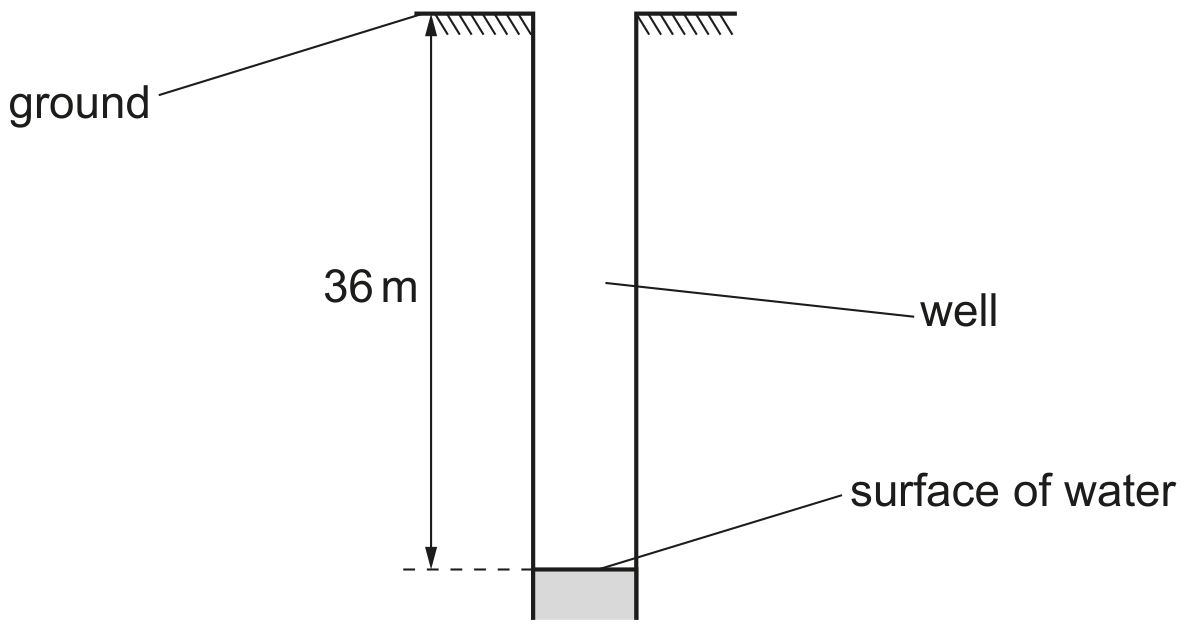
A well has a depth of 36 m from ground level to the surface of the water in the well, as shown in Fig. 1.1.

Fig. 1.1 (not to scale)

Fig. 1.1 (not to scale)

A student wishes to find the depth of the well. The student plans to drop a stone down the well and record the time taken from releasing the stone to hearing the splash made by the stone as it enters the water.

(a)

Assume that air resistance is negligible and that the stone is released from rest.

Calculate the time taken for the stone to fall from ground level to the surface of the water.
time = s

[ 2 ]
(a)

A toy car moves in a horizontal straight line. The displacement s of the car is given by the equation

s=v22as=\frac{v^{2}}{2 a}

where a is the acceleration of the car and v is its final velocity.
State two conditions that apply to the motion of the car in order for the above equation to be valid.

1
2

[ 2 ]
(b)

An experiment is performed to determine the acceleration of the car in (b). The following measurements are obtained:

s=3.89 m±0.5%v=2.75 ms1±0.8%\begin{aligned} & s=3.89 \mathrm{~m} \pm 0.5 \% \\ & v=2.75 \mathrm{~ms}^{-1} \pm 0.8 \% \end{aligned}
[ 1 ]
(i)

Calculate the acceleration a of the car.

\text { a = \mathrm{m} \mathrm{~s}^{-2}
[ 1 ]
(a)

The maximum useful output power P of a car travelling on a horizontal road is given by

P=v3bP=v^{3} b

where v is the maximum speed of the car and b is a constant.
For the car,

P=84 kW±5%P=84 \mathrm{~kW} \pm 5 \%

and b=0.56±7%b=0.56 \pm 7 \% in SI units.

[ 2 ]
(i)

Calculate the value of v.

v=ms1\begin{aligned} & v= \\ & \mathrm{ms}^{-1} \end{aligned}
[ 2 ]
(a)

Define velocity.

[ 1 ]
(b)

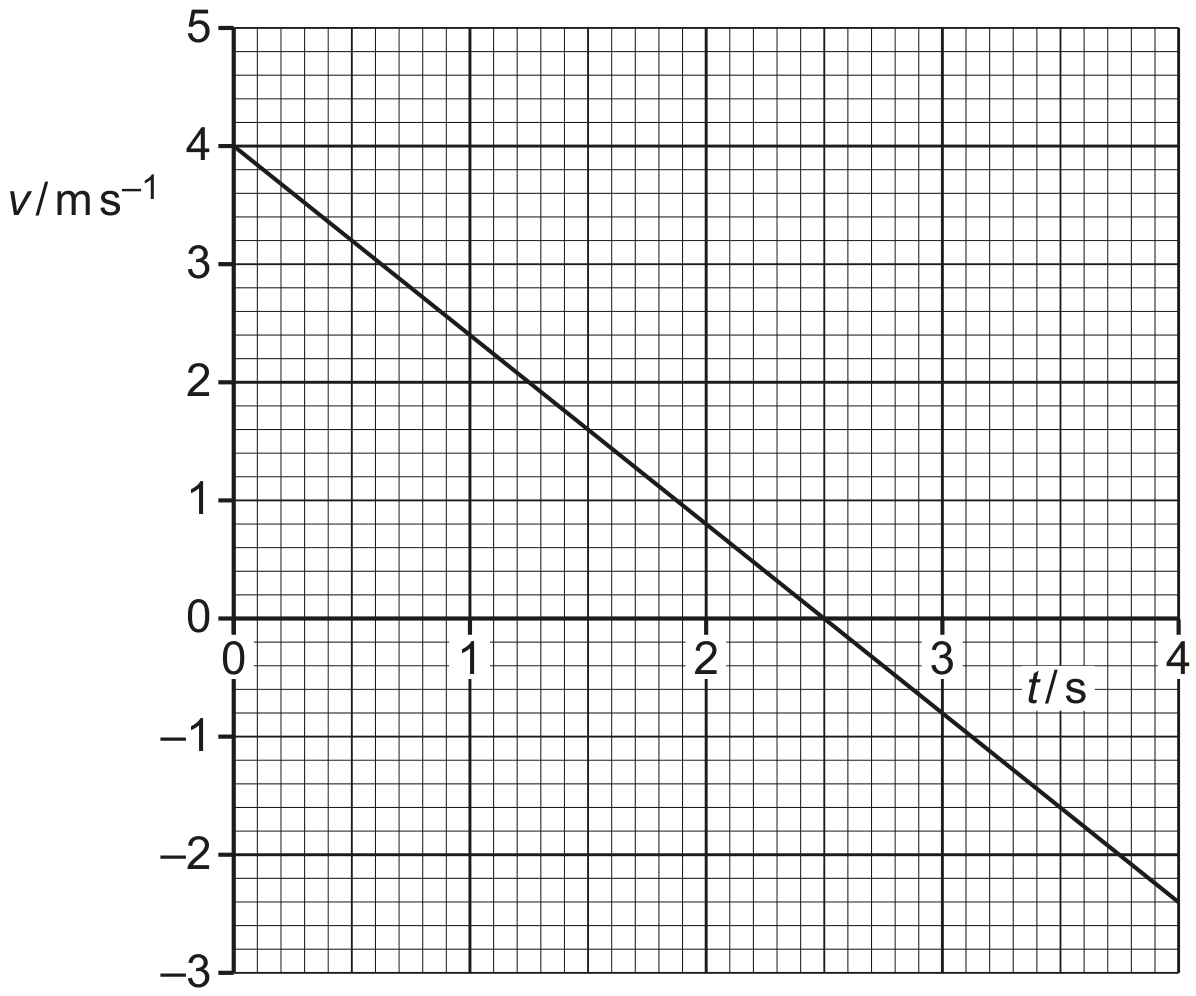
A rock of mass 7.5 kg is projected vertically upwards from the surface of a planet. The rock leaves the surface of the planet with a speed of 4.0 ms14.0 \mathrm{~ms}^{-1} at time t=0. The variation with time t of the velocity v of the rock is shown in Fig. 1.1.

Fig. 1.1

Fig. 1.1

Assume that the planet does not have an atmosphere and that the viscous force acting on the rock is always zero.

[ 3 ]
(i)

Determine the height of the rock above the surface of the planet at time t=4.0 st=4.0 \mathrm{~s}.
height = m

[ 3 ]
(a)
(i)

Define velocity.

[ 1 ]
(b)

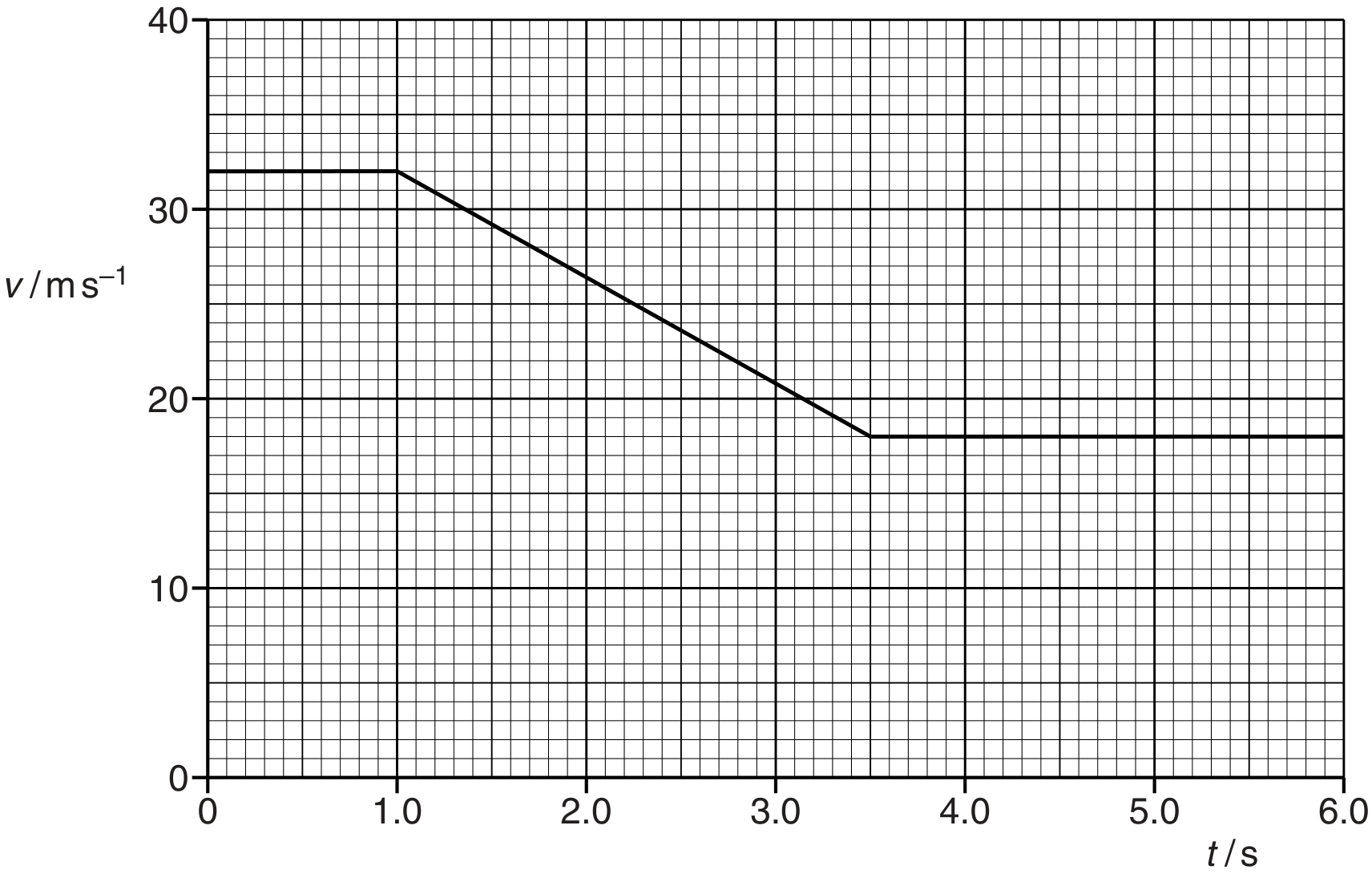
A car of mass 1500 kg moves along a straight, horizontal road. The variation with time t of the velocity v for the car is shown in Fig. 1.1.

Fig. 1.1

Fig. 1.1

The brakes of the car are applied from t=1.0 st=1.0 \mathrm{~s} to t=3.5 st=3.5 \mathrm{~s}.
For the time when the brakes are applied,

(i)

calculate the distance moved by the car, m

[Maximum number: 3]

Show that the terminal velocity of the raindrop is about 7 ms17 \mathrm{~ms}^{-1}.

(a)

A raindrop falls vertically from rest. Assume that air resistance is negligible.

[ 3 ]
(i)

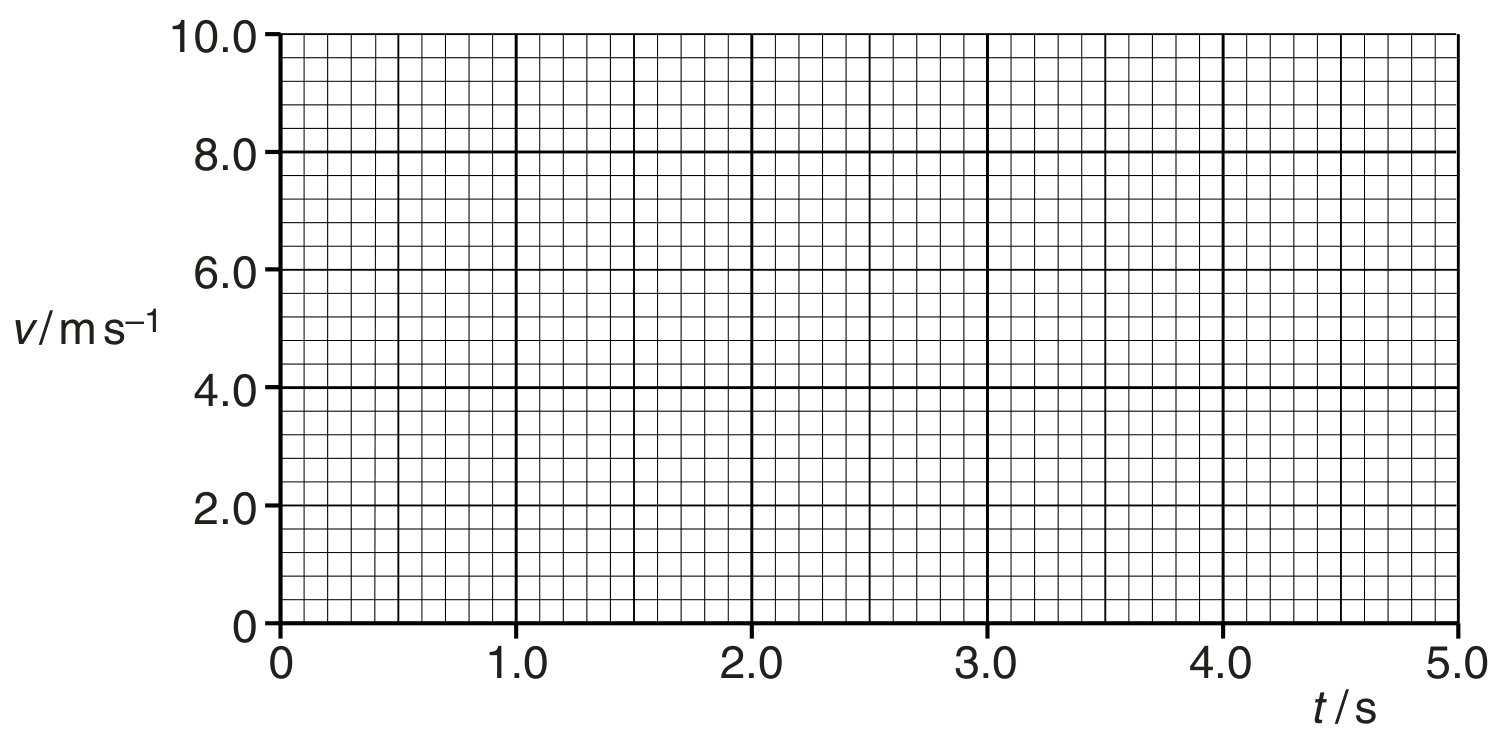
On Fig. 1.1, sketch a graph to show the variation with time t of the velocity v of the raindrop for the first 1.0 s of the motion.

Fig. 1.1

Fig. 1.1

[ 1 ]
(ii)

Calculate the velocity of the raindrop after falling 1000 m .
velocity = ms1\mathrm{ms}^{-1}

[ 2 ]
(a)
(i)

Define acceleration.

[ 1 ]
(b)

The variation with time t of vertical speed v of a parachutist falling from an aircraft is shown in Fig. 1.1.

Fig. 1.1

Fig. 1.1

[ 2 ]
(i)

Calculate the distance travelled by the parachutist in the first 3.0 s of the motion.
distance = m

[ 2 ]
[Maximum number: 6]

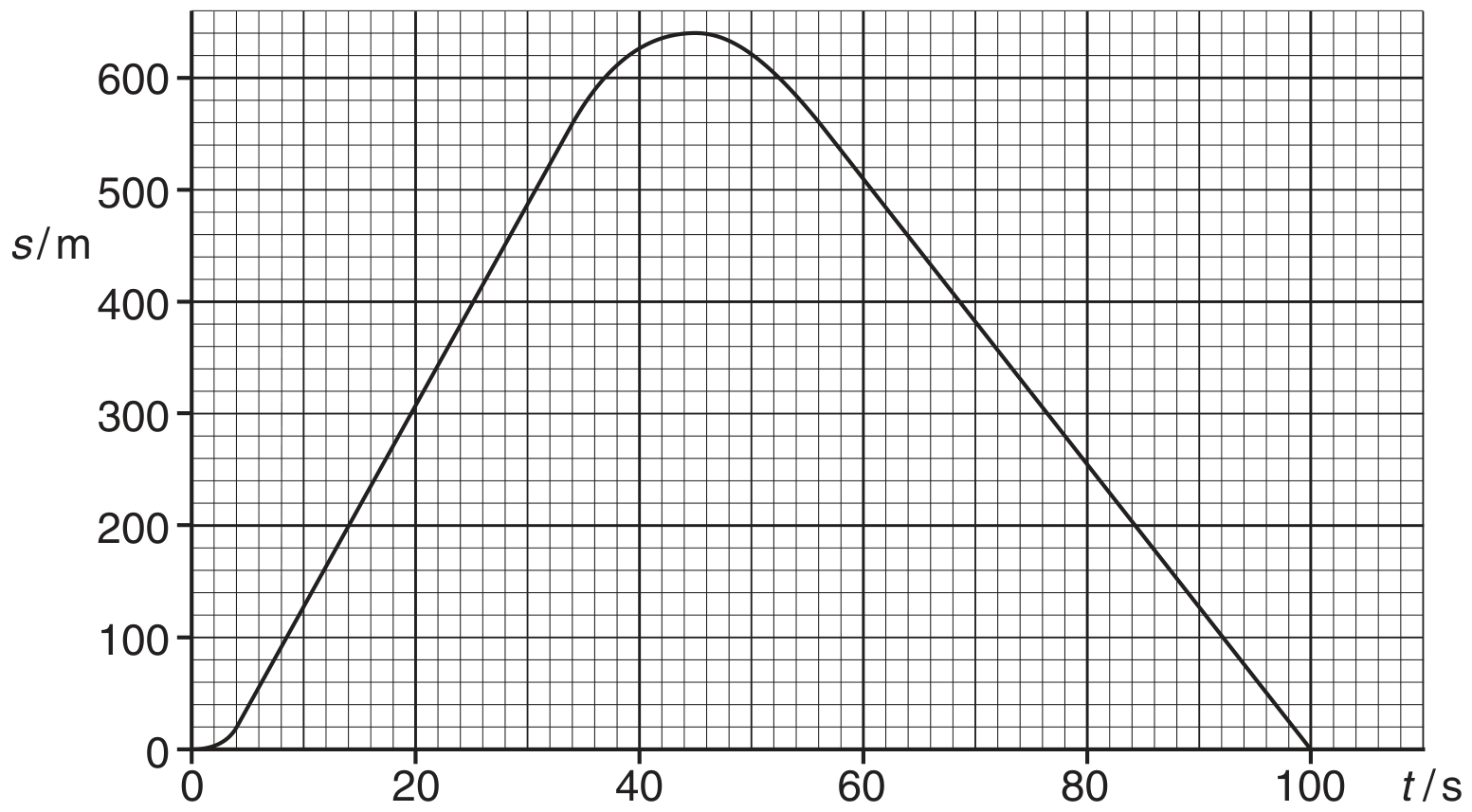
The variation with time t of the displacement s for a car is shown in Fig. 1.1.

Fig. 1.1

Fig. 1.1

(a)

Determine the magnitude of the average velocity between the times 5.0 s and 35.0 s .
average velocity = ms1\mathrm{ms}^{-1}

[ 2 ]
(b)

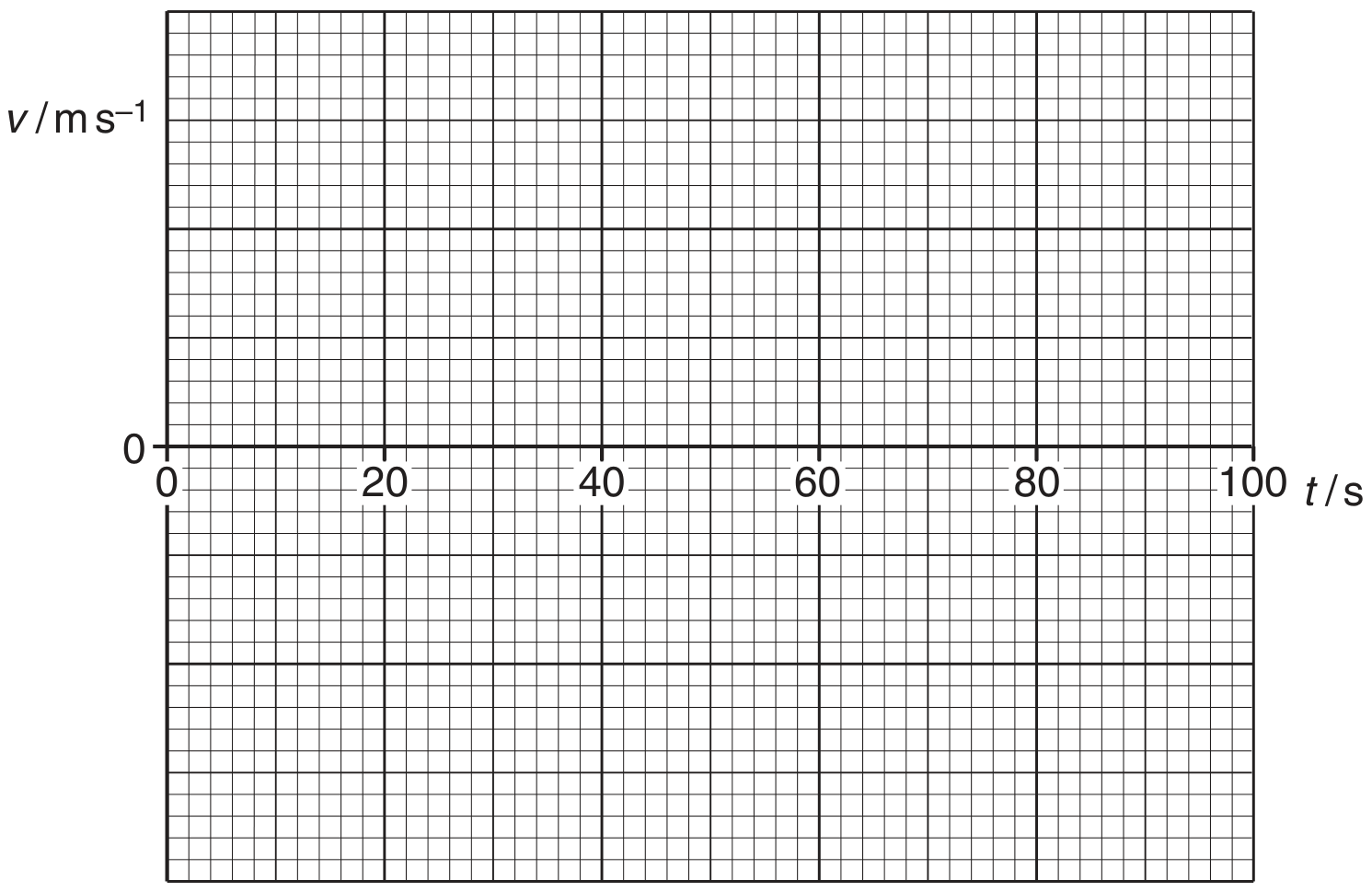
On Fig. 1.2, sketch the variation with time t of the velocity v for the car.

Fig. 1.2

Fig. 1.2

[ 4 ]
[Maximum number: 7]

the magnitude of the frictional force F,

F=
(a)

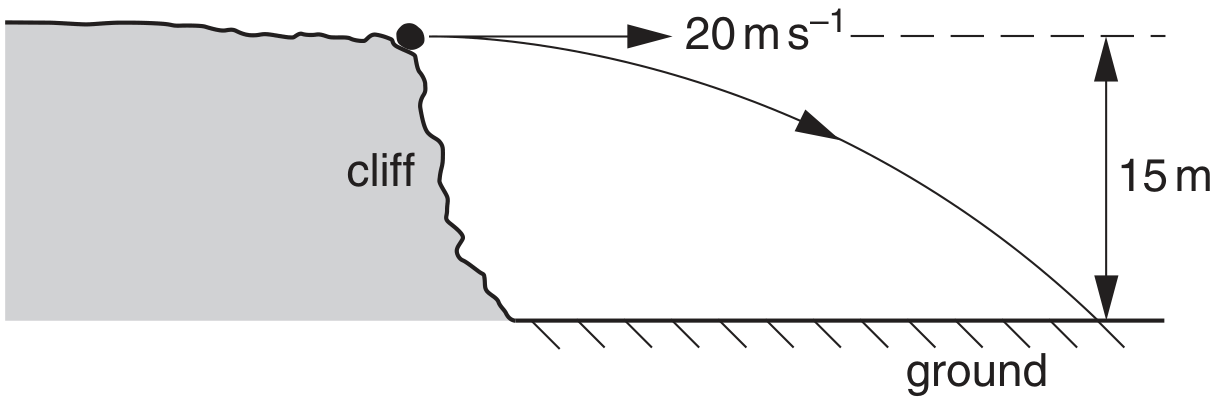
A stone is thrown with a horizontal velocity of 20 ms120 \mathrm{~ms}^{-1} from the top of a cliff 15 m high. The path of the stone is shown in Fig. 1.1.

Fig. 1.1

Fig. 1.1

Air resistance is negligible.
For this stone,

[ 7 ]
(i)

calculate the time to fall 15 m ,
time = s

[ 2 ]
(ii)

calculate the magnitude of the resultant velocity after falling 15 m , ms1[3]\mathrm{ms}^{-1}[3]

[ 3 ]
(iii)

describe the difference between the displacement of the stone and the distance that it travels.

[ 2 ]
0