EduNinja
(a)

State three conditions required for maxima to be formed in an interference pattern produced by two sources of microwaves.
1.
2.
3.

[ 3 ]
(b)

Two slits S1\mathrm{S}_{1} and S2\mathrm{S}_{2} are placed in front of the microwave source M described in (b), as shown in Fig 5.1.
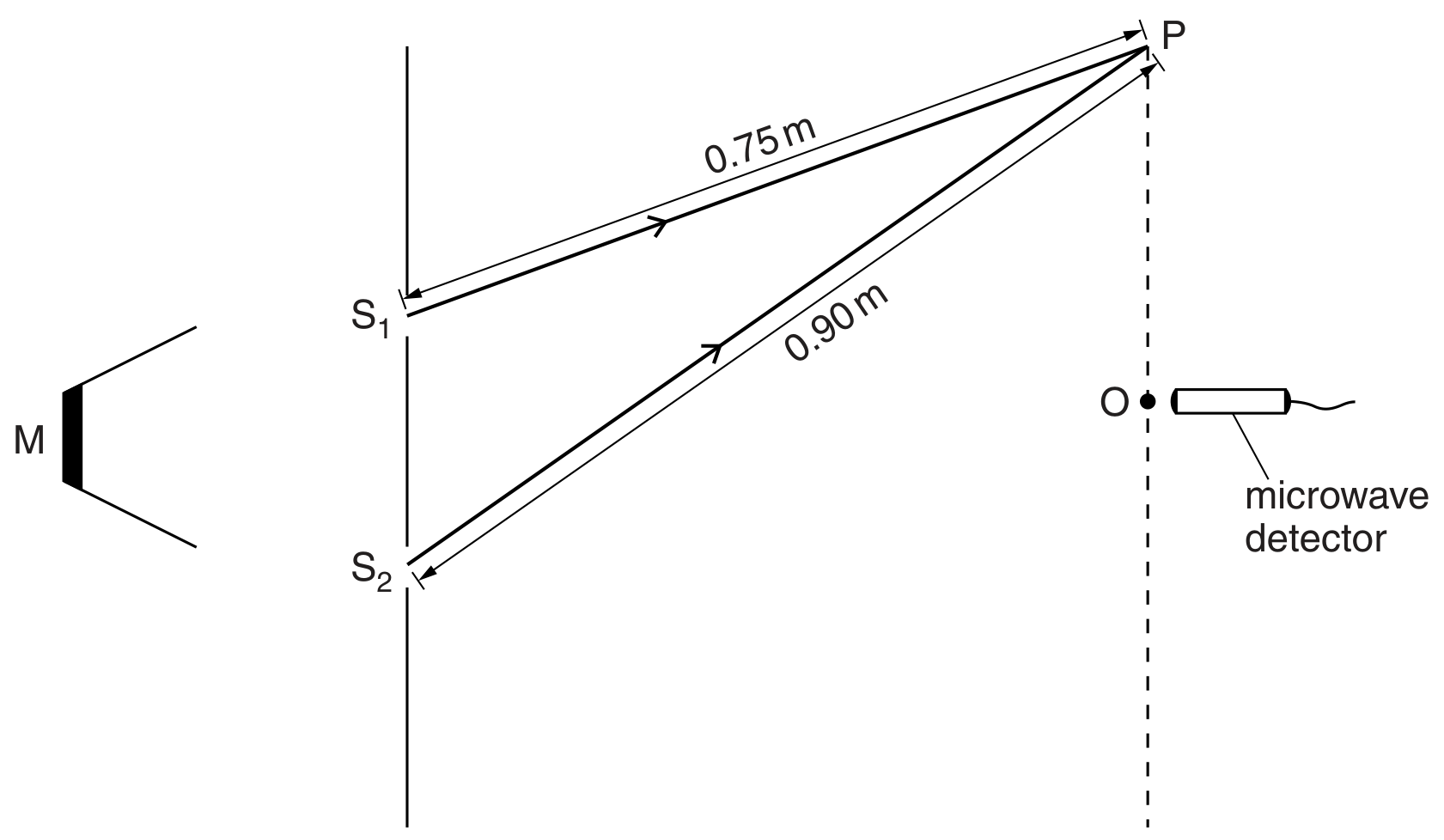
Fig. 5.1 (not to scale)

Fig. 5.1 (not to scale)

The distances S1O\mathrm{S}_{1} \mathrm{O} and S2O\mathrm{S}_{2} \mathrm{O} are equal. A microwave detector is moved from O to P . The distance S1PS_{1} P is 0.75 m and the distance S2PS_{2} P is 0.90 m.

The microwave detector gives a maximum reading at O .

State the variation in the readings on the microwave detector as it is moved slowly along the line from O to P .

[ 3 ]
(c)

The microwave source M is replaced by a source of coherent light.

State two changes that must be made to the slits in Fig. 5.1 in order to observe an interference pattern.
1.
2.

[ 2 ]
(a)

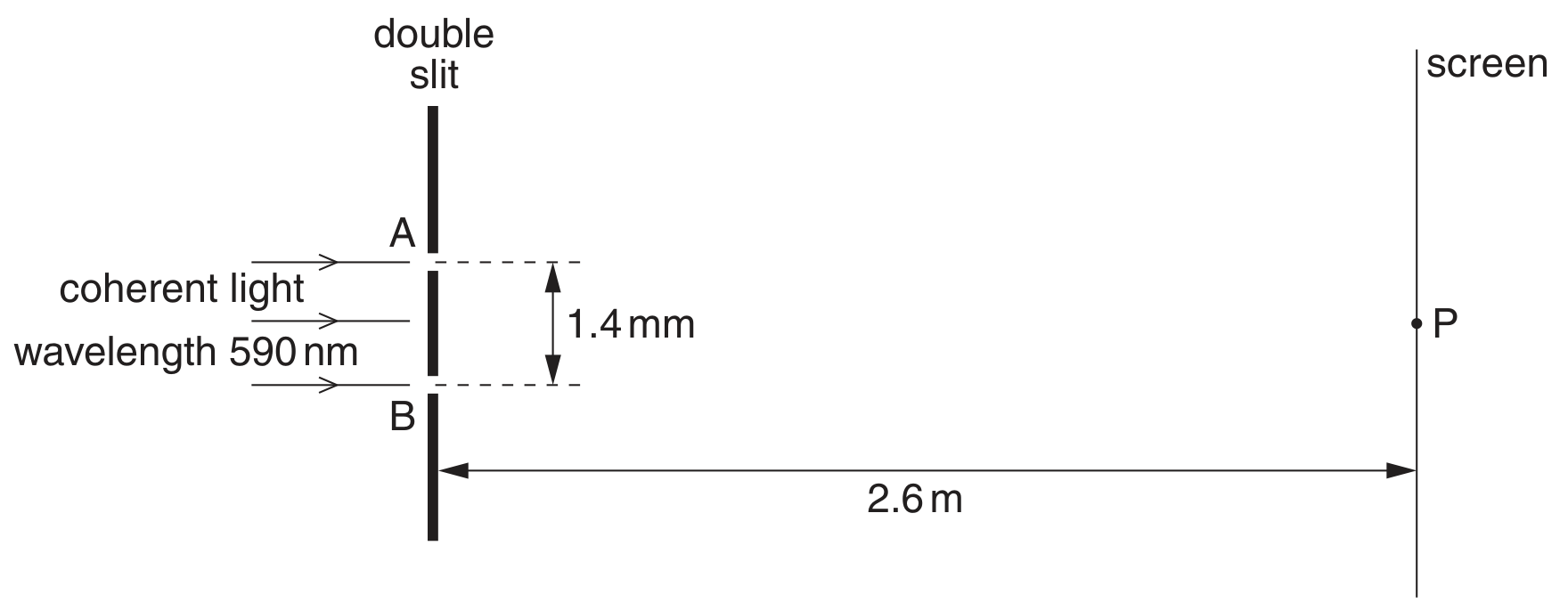
Coherent light of wavelength 590 nm is incident normally on a double slit, as shown in Fig. 6.1.

Fig. 6.1 (not to scale)

Fig. 6.1 (not to scale)

The separation of the slits A and B is 1.4 mm .
Interference fringes are observed on a screen placed parallel to the plane of the double slit. The distance between the screen and the double slit is 2.6 m .

At point P on the screen, the path difference is zero for light arriving at P from the slits A and B.

[ 3 ]
(i)

Determine the separation of bright fringes on the screen near to point P .
separation = mm

[ 3 ]
(ii)

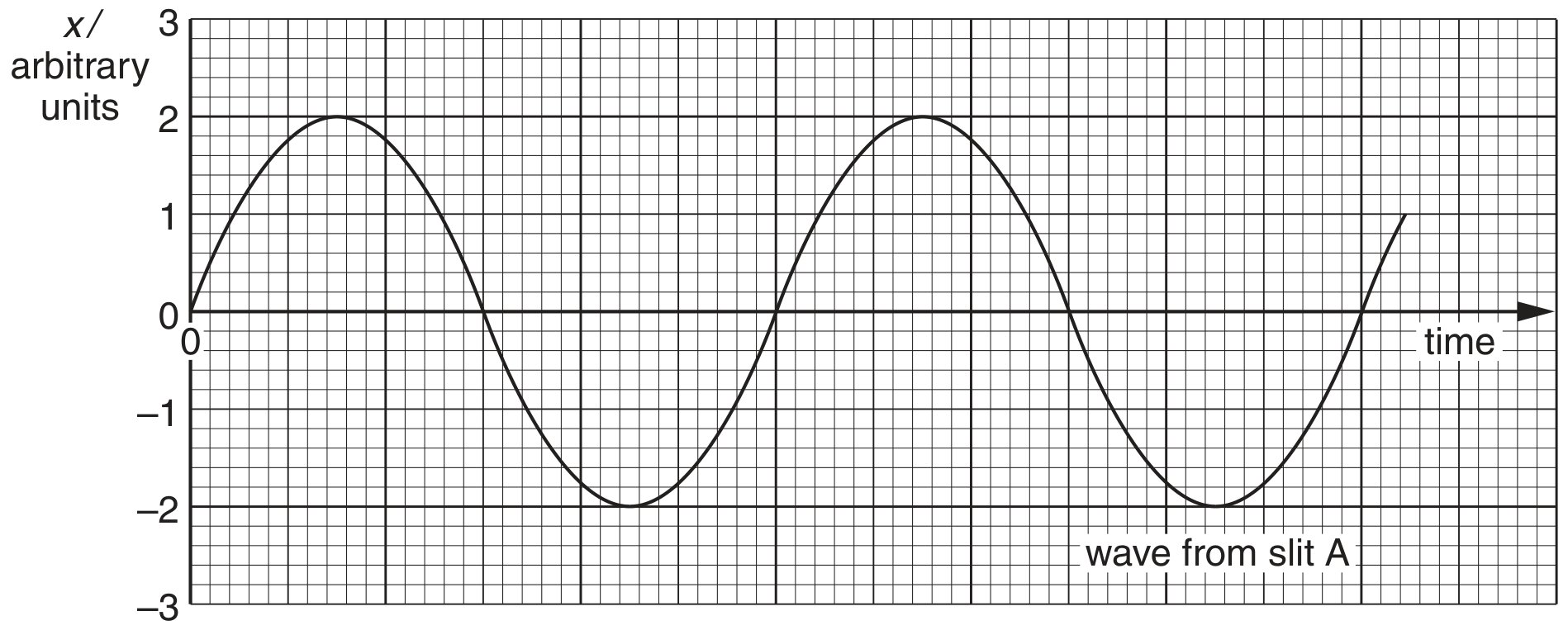
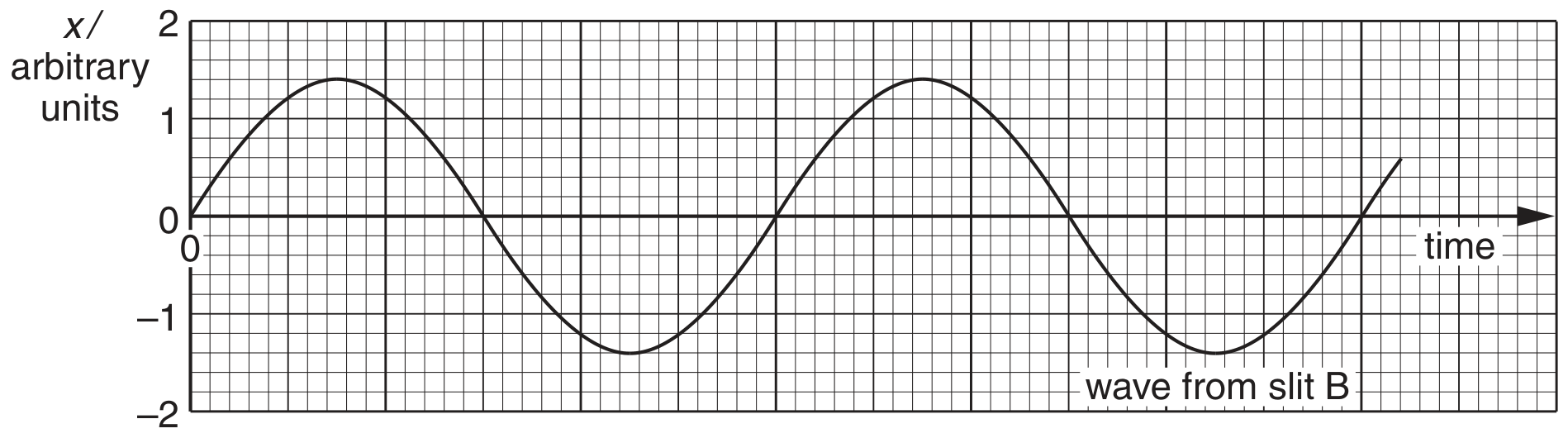
The variation with time of the displacement x of the light wave arriving at point P on the screen from slit A and from slit B is shown in Fig. 6.2a and Fig. 6.2b respectively.

Fig. 6.2a

Fig. 6.2a

Fig. 6.2b

Fig. 6.2b

1. State the phase difference between waves forming the dark fringe on the screen that is next to point P.

2. Determine the ratio
intensity of light at a bright fringe intensity of light at a dark fringe

ratio =
[Maximum number: 1]

Using monochromatic light, interference fringes are produced on a screen placed a distance D from a pair of slits of separation a. The separation of the fringes is x.
Both a and D are now doubled.
What is the new fringe separation?

A

x2\frac{x}{2}

B

x

C

2 x

D

4 x

(a)

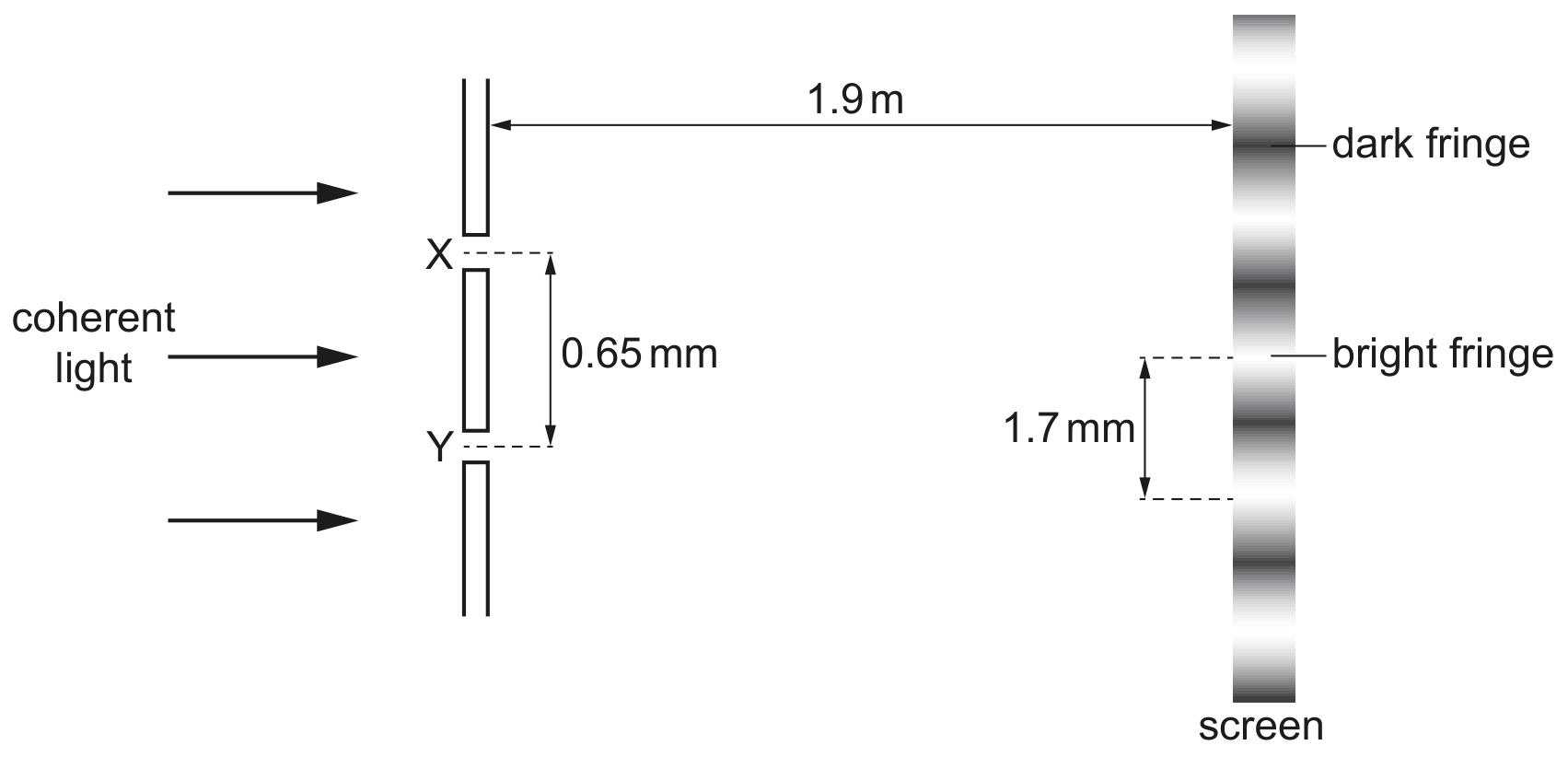
Coherent light is incident normally on two identical slits X and Y . The diffracted light emerging from the slits superposes to produce an interference pattern on a screen positioned at a distance of 1.9 m from the slits.

Fig. 4.1 shows the arrangement and the central part of the interference pattern of bright and dark fringes formed on the screen.

Fig. 4.1 (not to scale)

Fig. 4.1 (not to scale)

The separation of the slits is 0.65 mm . The distance between the centres of adjacent bright fringes is 1.7 mm .

Calculate the wavelength λ\lambda of the light.
λ=\lambda= m

[ 3 ]
[Maximum number: 1]

Two coherent progressive waves from different sources meet at a point.
Which condition must be satisfied for there to be zero resultant amplitude at the point where the waves meet?

A

The two waves must be emitted from their sources with the same intensity.

B

The two waves must be in phase with each other at the point.

C

The two waves must be travelling in opposite directions.

D

The two waves must have the same amplitude at the point.

[Maximum number: 1]

Using monochromatic light, interference fringes are produced on a screen placed a distance D from a pair of slits of separation a. The separation of the fringes is x.

Both a and D are now doubled.
What is the new fringe separation?

A

x2\frac{x}{2}

B

x

C

2 x

D

4 x

[Maximum number: 1]

Two progressive waves meet at a point.
Which condition must be met for superposition of the waves to occur?

A

The waves must be coherent.

B

The waves must be of the same type.

C

The waves must be travelling in opposite directions.

D

The waves must meet in phase.

[Maximum number: 1]

Which electromagnetic wave phenomenon is needed to explain the spectrum produced when white light falls on a diffraction grating?

A

coherence

B

interference

C

polarisation

D

refraction

(a)

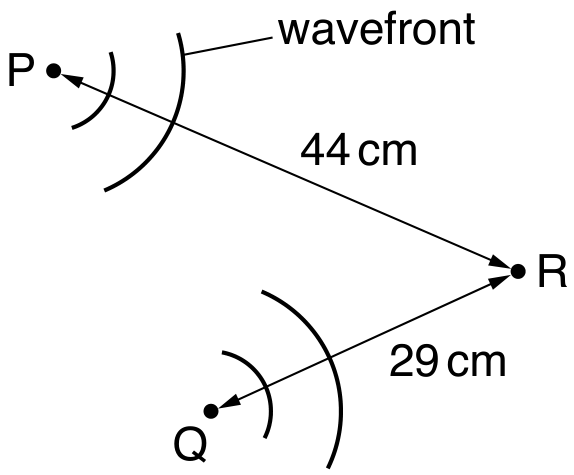
Circular water waves are produced by vibrating dippers at points P and Q , as illustrated in Fig. 4.1.

Fig. 4.1 (not to scale)

Fig. 4.1 (not to scale)

The waves from P alone have the same amplitude at point R as the waves from Q alone. Distance PR is 44 cm and distance QR is 29 cm .

The dippers vibrate in phase with a period of 1.5 s to produce waves of speed 4.0 cm s14.0 \mathrm{~cm} \mathrm{~s}^{-1}.

[ 2 ]
(i)

Calculate the path difference at point R of the waves from P and Q. Give your answer in terms of the wavelength λ\lambda of the waves.
path difference =

[ 2 ]
(a)

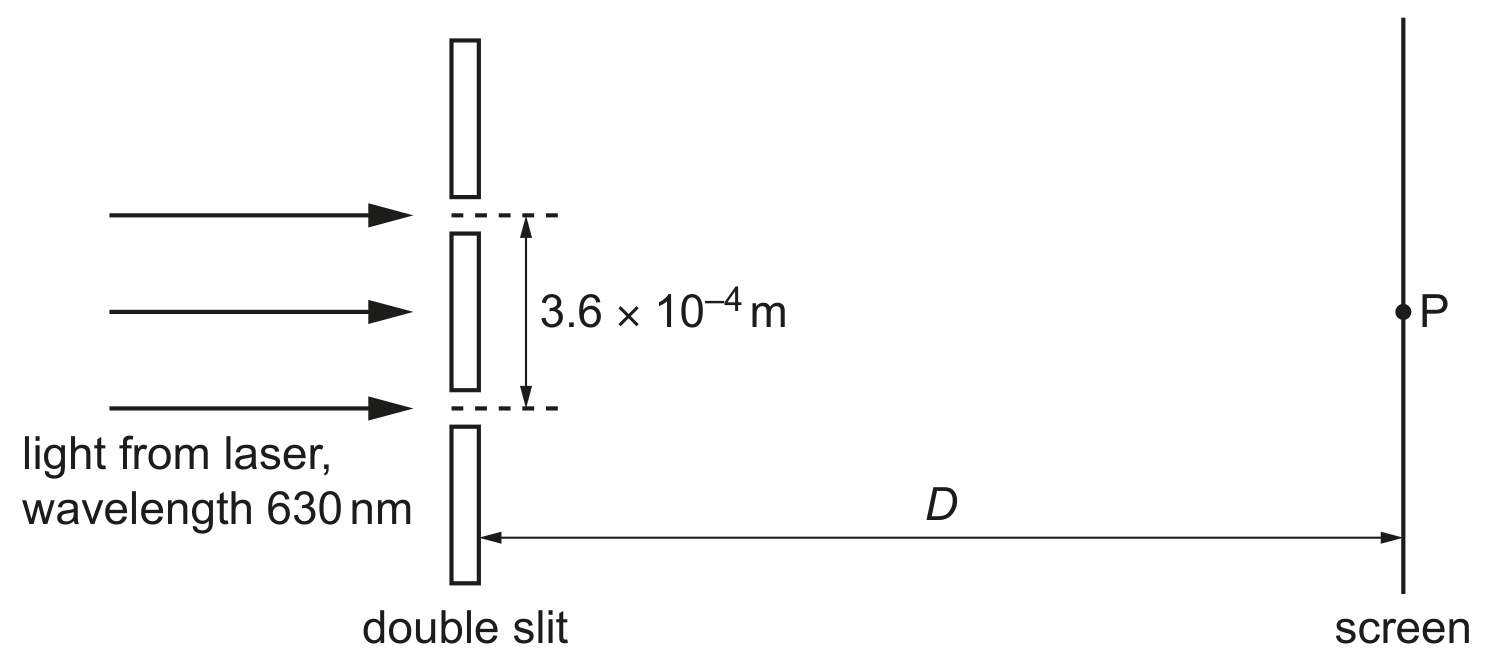
An arrangement for demonstrating interference using light is shown in Fig. 5.2.

Fig. 5.2 (not to scale)

Fig. 5.2 (not to scale)

The wavelength of the light from the laser is 630 nm . The light is incident normally on the double slit. The separation of the two slits is 3.6×10⁴ m3.6 \times 10^{-4} \mathrm{~m}. The perpendicular distance between the double slit and the screen is D.

Coherent light waves from the slits form an interference pattern of bright and dark fringes on the screen. The distance between the centres of two adjacent bright fringes is 4.0×10³ m4.0 \times 10^{-3} \mathrm{~m}. The central bright fringe is formed at point P.

[ 1 ]
(i)

Explain why a bright fringe is produced by the waves meeting at point P .

[ 1 ]
(ii)

Calculate distance D.

D =m
(b)

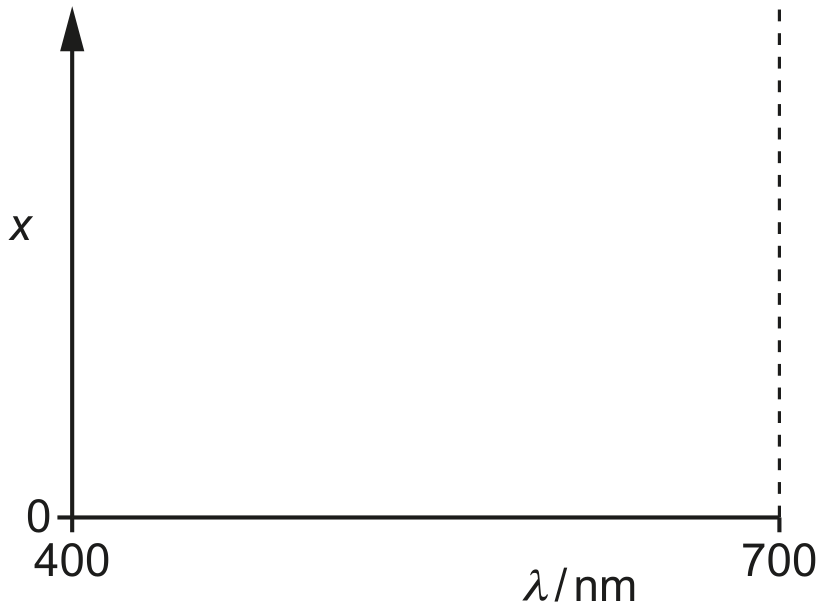
The wavelength λ\lambda of the light in (b) is now varied. This causes a variation in the distance x between the centres of two adjacent bright fringes on the screen. The distance D and the separation of the two slits are unchanged.

On Fig. 5.3, sketch a graph to show the variation of x with λ\lambda from λ=400 nm\lambda=400 \mathrm{~nm} to λ=700 nm\lambda=700 \mathrm{~nm}. Numerical values of x are not required.

Fig. 5.3

Fig. 5.3

[ 1 ]
0