[Maximum number: 1]
The angular deflection of the needle of an ammeter varies with the current passing through the ammeter as shown in the graph.
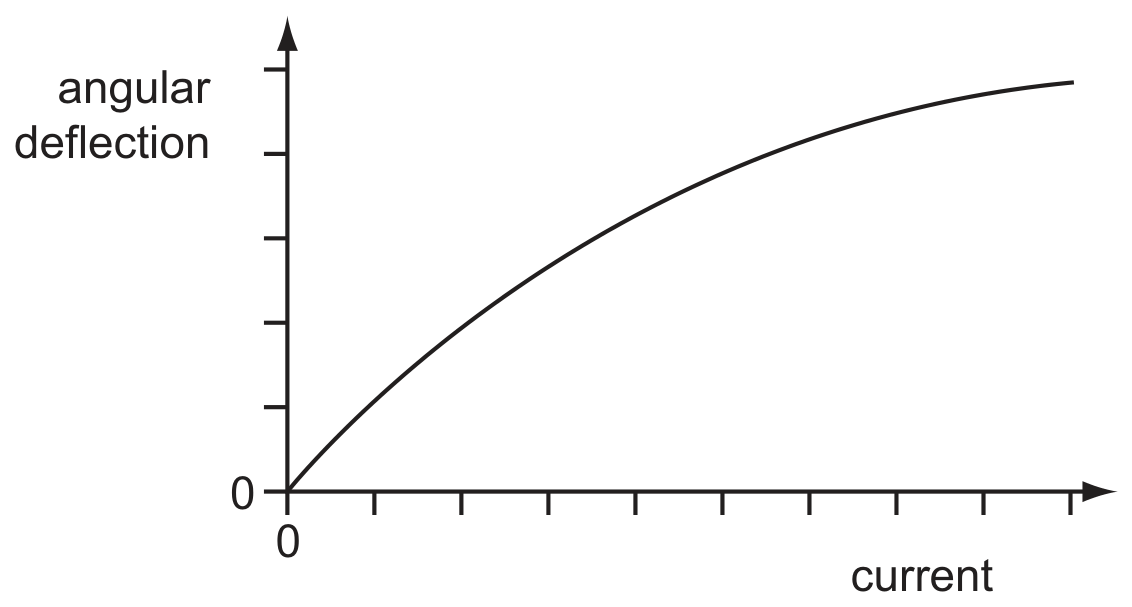
Which diagram could represent the appearance of the scale on this meter?
 EduNinja
The angular deflection of the needle of an ammeter varies with the current passing through the ammeter as shown in the graph.
Which diagram could represent the appearance of the scale on this meter?
Lightning occurs when charge builds up in the atmosphere, creating a potential difference between the ground and the atmosphere.
During a lightning strike there is an average current of for a time of .
Calculate the charge transferred during the lightning strike.
charge = C
An electron in a metal rod moves randomly about a mean position. When an alternating voltage is applied to the ends of the rod, the mean position can be considered to oscillate with simple harmonic motion along the axis of the rod. Fig. 4.1 shows the variation with time t of the displacement x of the mean position from a fixed point on the axis of the rod.
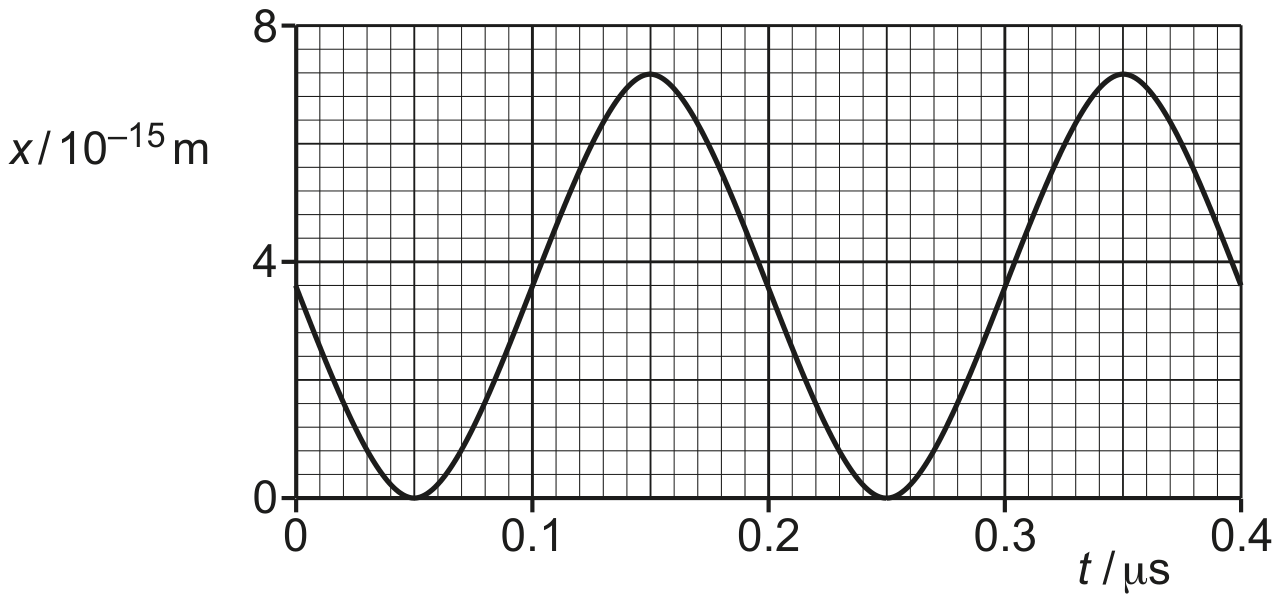
Fig. 4.1
The rod has a cross-sectional area of and contains a number density of conduction electrons (charge carriers) of .
All of the conduction electrons in the rod may be assumed to be oscillating in phase with, and with the same amplitude as, the oscillation shown in Fig. 4.1.
Use the information in (a)(iii) to calculate the magnitude of the maximum current in the rod.
An electric heater is to be made from nichrome wire. Nichrome has a resistivity of at the operating temperature of the heater.
The heater is to have a power dissipation of 60 W when the potential difference across its terminals is 12 V .
For the heater operating at its designed power,
calculate the current,
current = A
A student sets up a circuit with a battery, an ammeter, a heater and a light-dependent resistor (LDR) all in series.
The battery has negligible internal resistance.
A voltmeter is connected across (in parallel with) the heater.
The heater is a wire made of metal of resistivity . The wire has length 2.0 m and cross-sectional area .
The reading on the voltmeter is 4.8 V .
Calculate:
the reading on the ammeter.
reading on ammeter =
A
For a current-carrying wire, the current can be calculated using the equation shown.
What is the meaning of n ?
the number of charge carriers in the wire
the number of charge carriers multiplied by the volume of the wire
the number of charge carriers per unit length of the wire
the number of charge carriers per unit volume of the wire
The diagram shows the symbol for a wire carrying a current I.

What does this current represent?
the charge flowing past a point in the wire per unit time
the number of electrons flowing past a point in the wire per unit time
the number of positive nuclei flowing past a point in the wire per unit time
the number of protons flowing past a point in the wire per unit time
The number of free electrons passing a point in a wire in 24 hours is . What is the average current in the wire?
6.3 pA
67 A
4.0 kA
An electric current I is given by the formula I=A n v q.
What do each of the symbols represent for an electric current in a metal wire?
A
n
v
q
area of
cross-section
number of free
electrons
voltage
charge of each
nucleus
area of
cross-section
number of free
electrons per unit
volume
average drift
speed of free
electrons
charge of each
electron
current
number of free
electrons
average drift
speed of free
electrons
charge of each
nucleus
current
number of free
electrons per unit
volume
voltage
charge of each
electron
There is an electric current in a copper wire.
Which statement describing the average drift speed of the charge carriers in the wire is correct?
It is nearly .
It is proportional to the cross-sectional area of the wire.
It is proportional to the length of the wire.
It is proportional to the magnitude of the current.