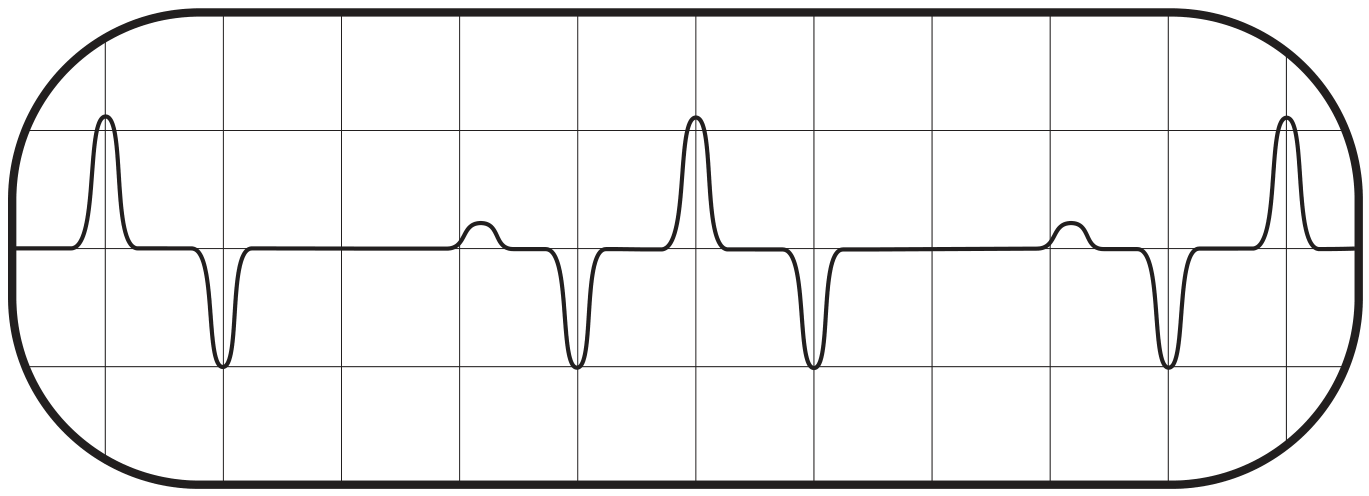
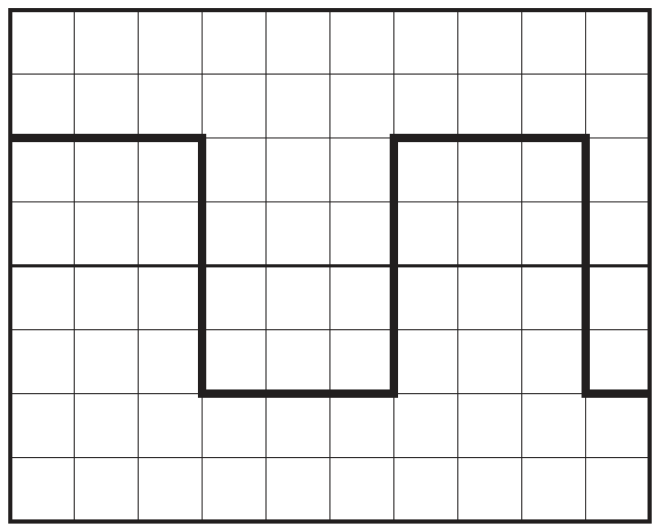
EduNinja
[Maximum number: 2]

The speed v of a transverse wave on a uniform string is given by the expression

v=Tlmv=\sqrt{\frac{T l}{m}}

where T is the tension in the string, l is its length and m is its mass.

An experiment is performed to determine the speed v of the wave. The measurements are shown in Table 1.1.
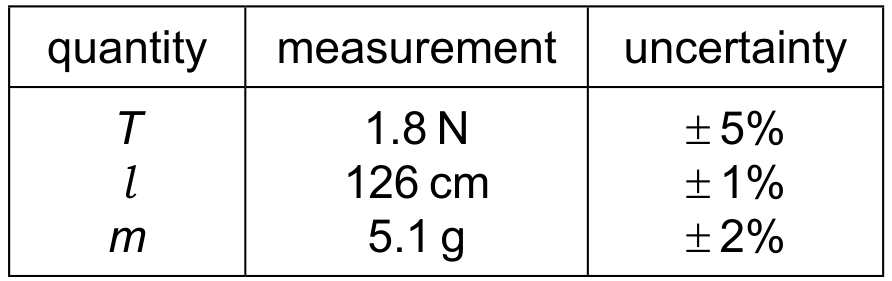
Table 1.1

Table 1.1

(a)

Use the data in Table 1.1 to calculate the speed v.

v=.....................................  m s1 [2] v=\ldots \ldots \ldots \ldots . . . . . . . . . . . . . . . . . . . . . . . . . . . . . . . . . . . . . ~ \mathrm{~m} \mathrm{~s}^{-1} \text { [2] }
[ 2 ]
(a)

An electromagnetic wave has frequency 12 THz .

[ 2 ]
(i)

Calculate the wavelength in μm\mu \mathrm{m}.
wavelength = μm\mu \mathrm{m}

[ 2 ]
[Maximum number: 1]

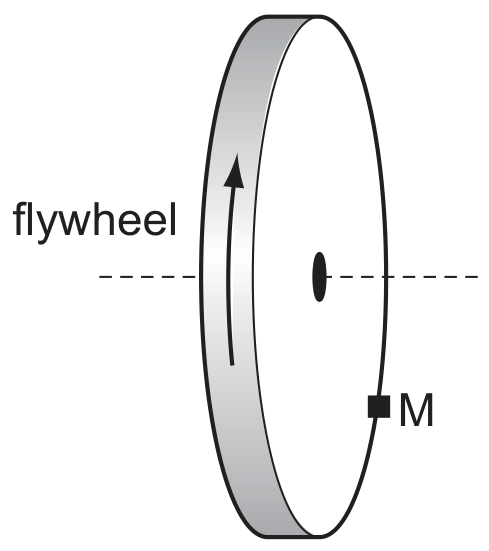
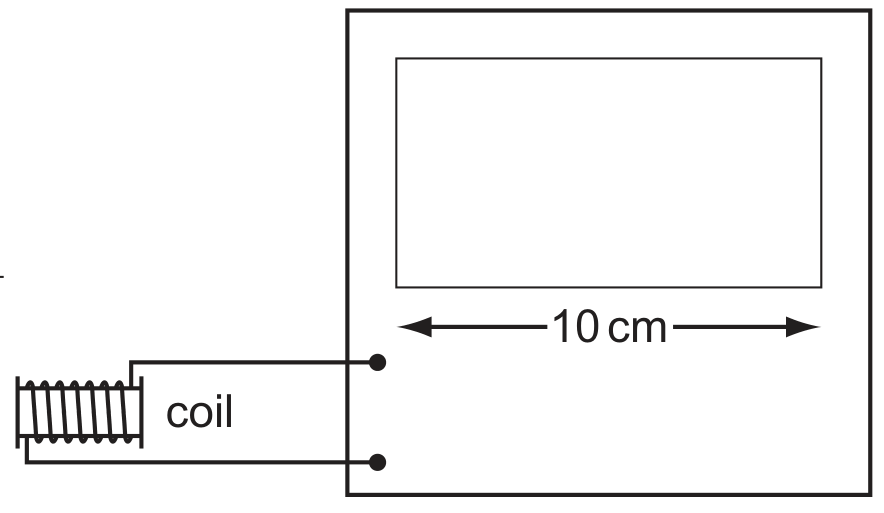
The diagram shows a cathode-ray oscilloscope (c.r.o.) being used to measure the rate of rotation of a flywheel.

Question image
Question image

The flywheel has a small magnet M mounted on it. Each time the magnet passes the coil, a voltage pulse is generated, which is passed to the c.r.o. The display of the c.r.o. is 10 cm wide. The flywheel is rotating at a rate of about 3000 revolutions per minute.
Which time-base setting will display clearly separate pulses on the screen?

A

1scm11 \mathrm{scm}^{-1}

B

10 ms cm110 \mathrm{~ms} \mathrm{~cm}^{-1}

C

100μ s cm1100 \mu \mathrm{~s} \mathrm{~cm}^{-1}

D

1μscm11 \mu \mathrm{scm}^{-1}

[Maximum number: 1]

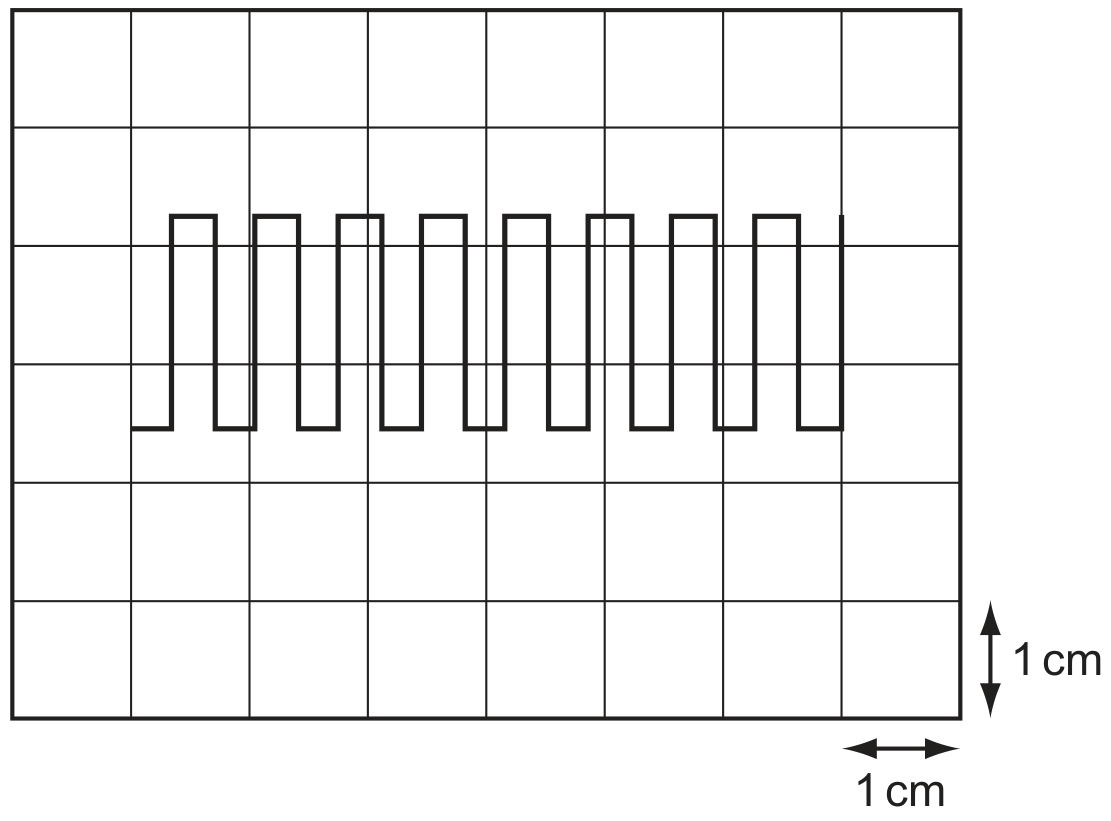
The diagram shows a square-wave trace on the screen of a cathode-ray oscilloscope. A grid of 1 cm squares covers the screen. The time-base setting is 10 ms cm110 \mathrm{~ms} \mathrm{~cm}^{-1}.

Question image

What is the approximate frequency of the square wave?

A

70 Hz

B

140 Hz

C

280 Hz

D

1400 Hz

[Maximum number: 1]

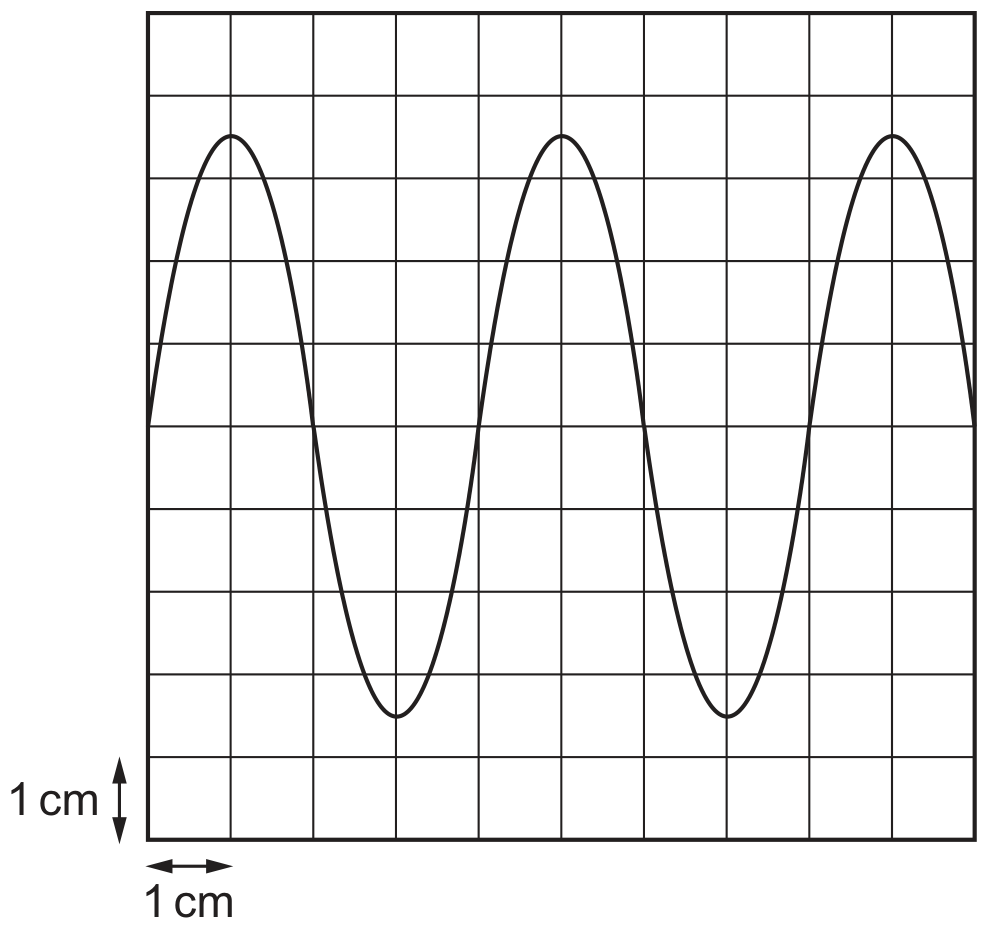
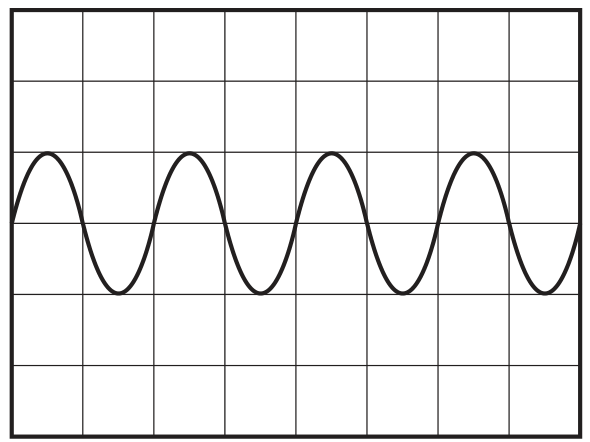
A cathode-ray oscilloscope (c.r.o.) is connected to an alternating voltage. The following trace is produced on the screen.

Question image

The oscilloscope time-base setting is 0.5 ms cm10.5 \mathrm{~ms} \mathrm{~cm}^{-1} and the Y-plate sensitivity is 2 V cm12 \mathrm{~V} \mathrm{~cm}^{-1}.
Which statement about the alternating voltage is correct?

A

The amplitude is 3.5 cm .

B

The frequency is 0.5 kHz .

C

The period is 1 ms .

D

The wavelength is 4 cm .

[Maximum number: 1]

A whale produces sound waves of frequency 5 Hz . The waves are detected by a microphone and displayed on an oscilloscope.

Question image

What is the time-base setting on the oscilloscope?

A

0.1msdiv10.1 \mathrm{msdiv}^{-1}

B

1msdiv11 \mathrm{msdiv}^{-1}

C

10msdiv110 \mathrm{msdiv}^{-1}

D

100msdiv1100 \mathrm{msdiv}^{-1}

[Maximum number: 1]

A signal that repeats periodically is displayed on the screen of a cathode-ray oscilloscope.

Question image

The screen has 1 cm squares and the time base is set at 2.00 ms cm12.00 \mathrm{~ms} \mathrm{~cm}^{-1}.
What is the frequency of this periodic signal?

A

50 Hz

B

100 Hz

C

125 Hz

D

200 Hz

[Maximum number: 1]

A wave has a frequency of 5 GHz .
What is the period of the wave?

A

20000μ s20000 \mu \mathrm{~s}

B

20 ns

C

2 ns

D

200 ps

[Maximum number: 1]

A signal has a frequency of 2.0 MHz .
What is the period of the signal?

A

2μ s2 \mu \mathrm{~s}

B

5μ s5 \mu \mathrm{~s}

C

200 ns

D

500 ns

[Maximum number: 1]

A cathode-ray oscilloscope displays a square wave, as shown in the diagram.

Question image

The time-base setting is 0.20 ms per division.
What is the frequency of the square wave?

A

8.3 Hz

B

830 Hz

C

1300 Hz

D

1700 Hz

0